Fiaker Vienna: Horse-Drawn Carriage Rides, Real Prices & the Ethics Debate
Official 2026 Fiaker rates in full, the per-carriage pricing fact that changes the whole calculation, where the stands are, what each route shows you, and an honest account of the animal-welfare argument.

Photo by Kai Seeliger
- Fiaker Prices in Vienna: The Official Rates
- What You Actually Get for €60 and for €105
- How the Price Compares to Everything Else
- Where the Stands Are
- How Not to Be Overcharged
- The Animal Welfare Debate
- Is It Worth It? The Honest Verdict
- What You See on the Ride
- The Horses and the Drivers
- Alternatives, If You Decide Against It
- A Short History
- Practical Details
- Frequently Asked Questions
- Related Vienna Guides
- Photo Credits
This article contains advertising. Our booking links are routed through a partner that adds commission tracking automatically, so if you book through one we earn a commission from the provider, at no extra cost to you. It never affects what we recommend. Affiliate disclosure
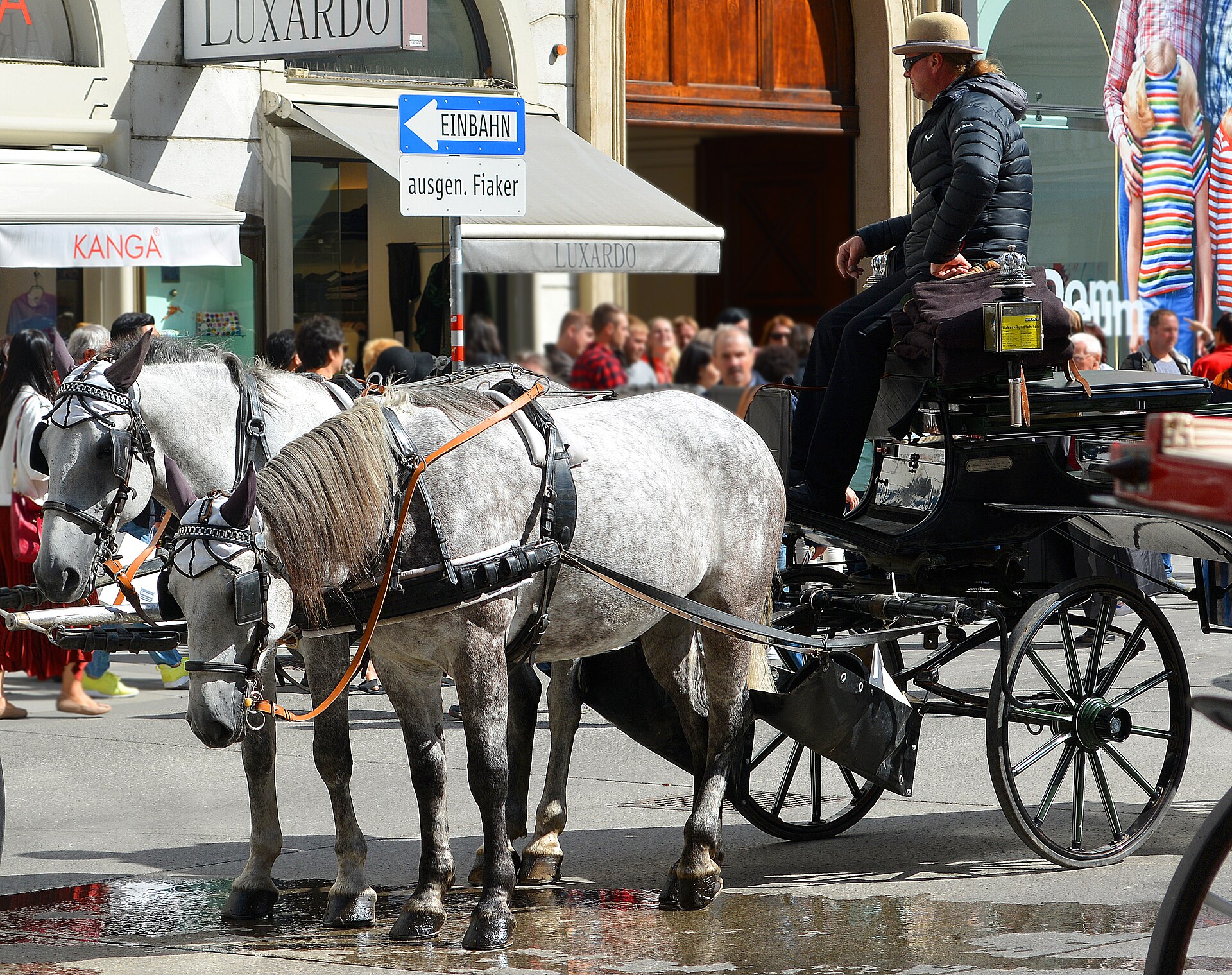
There is a road sign on Stephansplatz that says EINBAHN — one way — with a small plate underneath reading ausgen. Fiaker: except carriages. Vienna’s horse-drawn cabs have their own exemptions in the city’s traffic law, their own stands, their own licensing, and a place in the municipal self-image that no other tourist product here comes close to. They also cost a great deal more than most people expect, which is why almost every visitor asks the same two questions in the same order, and the first is always the Fiaker Vienna price.
This guide gives the official 2026 rates in full, explains the one pricing fact that changes the whole calculation, says where the stands are and what each route actually shows you, sets out the animal-welfare debate honestly from both sides, and gives a straight verdict on whether it is worth the money. Prices are the official published rates, checked in September 2026; confirm at the stand before you get in.
Fiaker Prices in Vienna: The Official Rates
The single most important fact on this page: Fiaker fares are charged per carriage, not per person. A carriage takes four adults comfortably and five at a squeeze. A ride that looks outrageous for one person is entirely reasonable split four ways — and a great many visitors pay the solo price without realising they could have shared.
| Route | Duration | Price per carriage | Per person, four sharing |
|---|---|---|---|
| City centre, short tour | About 20 minutes | €60 | €15 |
| City centre, long tour | About 40 minutes | €105 | €26.25 |
| Zentralfriedhof, short | 30 minutes | €65 | €16.25 |
| Zentralfriedhof, long | 60 minutes | €110 | €27.50 |
| Schönbrunn palace park | About 30 minutes | €95 | €23.75 |
| Wheelchair-accessible carriage | Per hour | €160 | — |
The Zentralfriedhof rides run from mid-March to 1 November, and the Schönbrunn park rides from late March to late October. The wheelchair-accessible carriage is operated by Fiaker Susi and is booked in advance on +43 699 10602935.
What You Actually Get for €60 and for €105
The two city-centre options are genuinely different products, and the cheaper one is not simply a shorter version of the more expensive one.
The €60, twenty-minute tour is a loop of the immediate inner city: a circuit around the Stephansdom, through the narrow lanes behind it, down past the Hofburg and back. It is enough to experience the thing — the sound of hooves on cobbles between five-storey Baroque facades is genuinely unlike anything else — and not really enough to see anything you would not see better on foot.
The €105, forty-minute tour goes further out: onto the Ringstrasse, past the opera, the museums, the Rathaus and the Burgtheater, and through parts of the first district the short tour skips. This is the one that functions as an actual sightseeing tour rather than a novelty, and if you are going to do it at all, it is the better purchase.
Neither includes commentary as a guaranteed part of the price. Some drivers talk continuously and well; some say almost nothing; some will narrate if you ask. This is worth establishing before you get in, because it is the difference between a tour and a taxi ride.
How the Price Compares to Everything Else
€105 sounds like a lot until you put it next to what else Vienna sells to visitors, which is the only comparison that actually helps.
| Experience | Cost | Per person, four sharing |
|---|---|---|
| Fiaker, 40-minute city tour | €105 per carriage | €26.25 |
| Tourist Mozart concert, Category A | €109 per person | €109 |
| Hop-on hop-off bus, 24 hours | About €37 per person | €37 |
| Food tour | €70–140 per person | €70–140 |
| Licensed private guide, half day | €180–350 per group | €45–88 |
| Danube sightseeing cruise | From €33 per person | €33 |
| State Opera standing room | €13–18 per person | €13–18 |
| Tip-based walking tour | €10–20 per person | €10–20 |
Read that column on the right and the Fiaker stops looking like the outlier. A carriage for four costs less per head than a hop-on hop-off ticket and a quarter of what a costumed Mozart concert charges — and it is the only item on the list that is genuinely unique to this city. Read the middle column instead, as a solo traveller, and it is the most expensive thing on the page.
That is the whole verdict compressed into one table: the Fiaker is not overpriced, it is priced for a group, and the mistake most people make is buying it alone. Our full comparison of Vienna tours and experiences sets every category side by side.
Where the Stands Are
Fiaker have designated stands, and you take the one at the front of the rank exactly as with taxis. In central Vienna:
- Stephansplatz — the biggest rank, beside the cathedral. Busiest, and the most likely to have a queue in summer.
- Michaelerplatz — in front of the Hofburg’s domed gate. The most photogenic starting point.
- Albertinaplatz — by the Albertina and the opera.
- Petersplatz — small, quieter, just off the Graben.
- Burgtheater / Volksgarten — on the Ring.
- Zentralfriedhof, Gate 2 — for the cemetery tours, in season.
- Schönbrunn — for the palace park rides, in season.
You do not need to book. Walk to a rank, agree the route and the price with the driver, and get in.
How Not to Be Overcharged
The published rates above are the official ones and the overwhelming majority of drivers charge them. The problems that do occur are avoidable:
- Agree the route and the total before you get in. Say which of the standard tours you want — “the twenty-minute city tour” or “the forty-minute tour” — and confirm the figure out loud.
- Confirm it is per carriage. It is. But say it, so there is no confusion at the end.
- Ask whether cards are accepted before you set off. Many drivers take them; some do not. Vienna is more cash-attached than most of western Europe — see our money and payment guide.
- Do not accept a “special” route at an unquoted price. The standard tours are standard for a reason.
- Ignore anyone who approaches you away from a rank. The same rule applies here as to concert tickets: never buy from someone who came to you on the street.
Tipping is normal but modest — rounding up, or five euros on a long tour. Our Vienna tipping guide covers the wider convention.
The Animal Welfare Debate
You cannot write honestly about the Fiaker without this section, and you cannot write it honestly by picking a side and stopping. Here is where the argument actually stands.
What the rules are
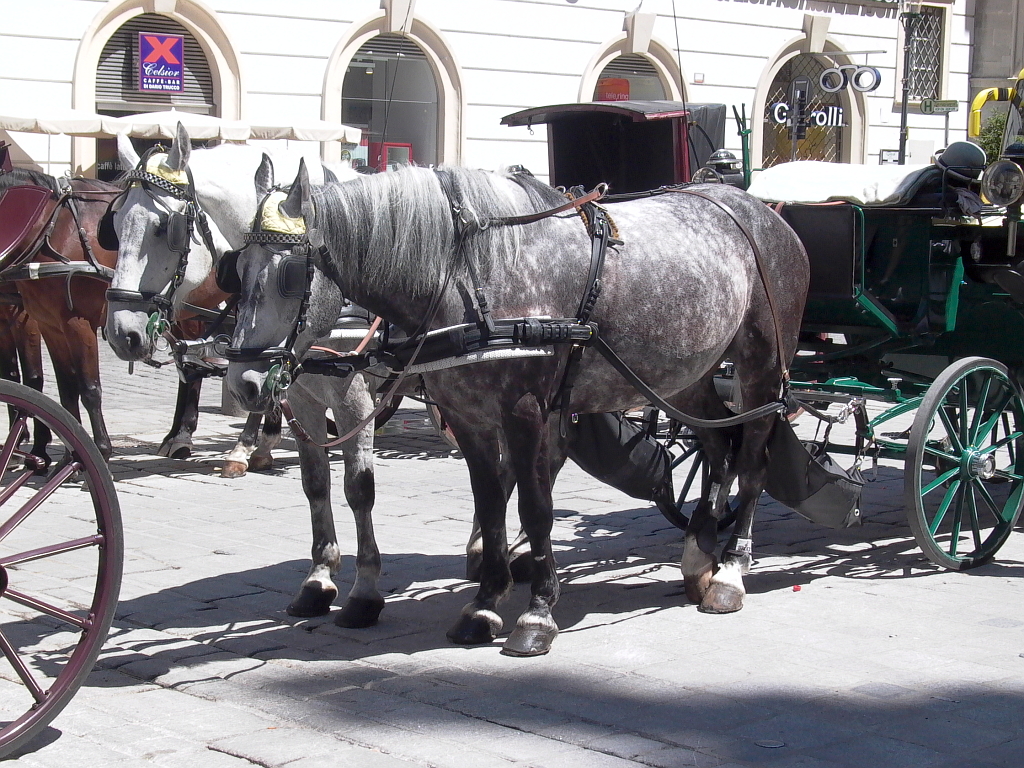
Vienna regulates the trade specifically. The most significant provision is the Hitzefrei rule: when the temperature at the Innere Stadt measuring station reaches 35°C, all carriages must stop work and return to their stables. There are also rules on working hours, rest periods, stabling and veterinary checks. Horses wear dung catchers, which is why Vienna’s centre does not smell like a nineteenth-century city.
The case against
Animal-welfare organisations argue that the 35°C threshold is too high and should come down to 30°C. Their broader case is that asphalt and stone radiate heat well above the air temperature a measuring station records, that standing harnessed at a rank in direct sun for hours is itself a burden distinct from pulling, and that a city centre full of traffic, noise and crowds is not a reasonable working environment for a horse regardless of the thermometer. Several European cities have restricted or banned the practice.
The case for
The trade and some veterinary opinion argue the opposite. A study by the University of Vienna’s veterinary school, involving nearly 400 measurements on working Fiaker horses, found no cases of heat stress, and the vet most publicly associated with that work has said there is no evidential basis for a 30°C limit. Drivers argue that the horses are draught breeds that need work and exercise, that the animals are valuable and well cared for because they are the business, and that a lower threshold would end a licensed trade that has existed here since the seventeenth century.
There has also been litigation. In May 2023 a Fiaker operator sued an animal-welfare association over a public claim that Fiaker horses “collapse time and again due to the heat”; the collapses in question were found not to be heat-related, and the court ordered the claim retracted as untrue.
Where that leaves you
Vienna has not banned horse-drawn carriages and no ban is in force. The debate is live, genuinely contested, and not settled by either side’s press releases.
Our position is this: we are not going to tell you it is cruel, because the evidence does not support saying that flatly, and we are not going to tell you it is fine, because reasonable people looking at the same streets in August disagree. What we will say is that if you do take one, take it in the morning or the evening rather than at two in the afternoon in July, look at the horses at the rank before you choose a carriage, and walk away from any driver or animal that does not look right. That is a decision you are entitled to make with your money, and it is the one lever a visitor actually has.
Is It Worth It? The Honest Verdict
As transport: no. It is slower than walking, it goes where the driver goes, and it costs sixty euros. Nobody should use a Fiaker to get anywhere.
As sightseeing: no. Twenty minutes at walking pace covers less ground than twenty minutes on foot, and you cannot stop to look at anything. A tip-based walking tour at €15 a head tells you more about the city in two hours than any carriage ride will in forty minutes.
As an experience, for four people sharing: yes, actually. At €26 a head for the long tour, it is in the same range as a decent lunch and a good deal cheaper than a tourist concert. The specific thing you are buying — the height of the seat, the pace, the sound of hooves in a stone street, a driver in a bowler hat who has probably been doing this for twenty years — is genuinely particular to Vienna and does not translate to anything else. It is not a rip-off. It is a luxury, priced like one, and it is honest about that.
For one or two people: probably not. Sixty euros for twenty minutes, or a hundred and five for forty, is a lot of money for two, and you will feel it. If it is a special occasion — and it is a very good special occasion, which is why it appears in our romantic Vienna guide — then fine. Otherwise the arithmetic is against you.
What You See on the Ride
The standard city routes cover the ground you would walk anyway, which is part of the point: you are seeing familiar streets from an unfamiliar height and speed.
Expect the Stephansdom from several angles, the lanes of the old town behind it, Michaelerplatz and the Hofburg, and on the longer tour a stretch of the Ringstrasse taking in the opera, the museums and the Rathaus. Our guide to the Innere Stadt covers the same ground on foot.
The Zentralfriedhof route is the interesting outlier and almost no visitor knows about it. Vienna’s central cemetery is enormous, half-wild, full of monumental graves and roaming deer, and a carriage is a genuinely sensible way to cover it — it is far too big to walk end to end. Beethoven, Brahms, Schubert, Strauss and Falco are all there. At €65 for thirty minutes or €110 for an hour, it is the best-value Fiaker ride in the city and by some distance the most atmospheric.
The Schönbrunn park route at €95 covers the palace gardens, which are free to walk and are one of the great pleasures of the city on foot — see our Schönbrunn guide. Take it if walking is difficult; otherwise walk.

The Horses and the Drivers
A little context makes the ride considerably more interesting, and most drivers will tell you all of this if you ask.
The horses are mostly heavy draught and warmblood types — you will see a lot of greys, which is partly tradition and partly that pale coats absorb less heat. They work in pairs, harnessed to a two-axle carriage, and they are shod for cobbles and asphalt rather than for fields. Each carriage carries a dung catcher slung behind the horses, which is the reason a city with several dozen working horses in its centre does not smell like one.
The drivers are licensed. Becoming a Fiaker driver in Vienna requires an examination covering the city’s history and topography as well as horsemanship — the trade takes the guiding half of the job seriously, even if not every driver on every day does. The bowler hat is not a costume put on for tourists; it is what the trade has worn for well over a century, and you will notice the drivers are not in period dress in the way the ticket sellers on Kärntner Straße are. That distinction matters: the Fiaker is a licensed survival, not a re-enactment.
Ask questions. A driver who has worked the same six streets for two decades knows a great deal, and the difference between a silent ride and a good one is frequently just whether anyone in the carriage spoke first. Ask about the horses by name; it is the reliable way in.

Alternatives, If You Decide Against It
If the price or the ethics puts you off, there are several things that scratch some of the same itch.
- Trams 1 and 2 around the Ringstrasse, for €2.40. Not a carriage, but a slow circuit of the same grand buildings at a pace that lets you look. See our tram guide.
- The Zentralfriedhof on foot or by bicycle, if it is the cemetery that appeals. Tram 71 goes there.
- The Schönbrunn park, which is free and enormous and better walked than driven — see the Schönbrunn guide.
- A Danube boat, from €33, if what you want is to sit still and be shown the city. See the Danube in Vienna.
- The Riesenrad in the Prater, for the other great slow Viennese cliché, which involves no animals at all.
A Short History
The name comes from the Rue Saint-Fiacre in Paris, where the first horse-drawn cabs for hire were stationed in the seventeenth century; the word travelled to Vienna and stuck. Licensed Fiaker have operated here since 1693, and at the trade’s nineteenth-century peak there were something like a thousand carriages working the city.
They were ordinary transport, not a tourist product, and they were woven into Viennese life to a degree that is hard to convey now — there are Fiaker songs, Fiaker plays, and a distinctive Viennese coffee, the Fiaker, served with rum and a cherry, named after the drivers who drank it. The drivers had a reputation for a particular kind of blunt Viennese wit that survives in the trade’s self-presentation today.
What remains is a much smaller licensed fleet doing a job that no longer exists, kept alive by visitors. That is either charming or slightly melancholy depending on your mood, and both readings are correct.
Practical Details
Booking
Not needed. Go to a rank. Booking through an online platform generally means paying a markup for something you can arrange in thirty seconds on Stephansplatz.
Capacity and children
Four adults comfortably, five at a squeeze, and small children can sit on laps. Children generally love it, and the twenty-minute version is about the right attention span. See Vienna with kids.
Weather
Carriages run year round. Many are half-closed or have a folding hood, and blankets are provided in winter — a Fiaker through the Christmas markets in December is a genuinely lovely thing, and one of the better arguments for the whole exercise. In summer, go early or late; see our guide to Vienna in December for the winter version.
Accessibility
Standard carriages involve a step up. The wheelchair-accessible carriage at €160 an hour must be booked in advance.
Photography
Michaelerplatz is the best backdrop, Stephansplatz the most recognisable. Our Vienna photography spots guide covers where the light works.
Frequently Asked Questions
How much does a Fiaker cost in Vienna?
€60 for the twenty-minute city-centre tour and €105 for the forty-minute one, charged per carriage rather than per person. A carriage takes four adults, which makes the long tour about €26 each. Zentralfriedhof rides are €65 for thirty minutes and €110 for an hour; Schönbrunn park is €95.
Is the Fiaker price per person or per carriage?
Per carriage. This is the single most useful thing to know, and it transforms the arithmetic for a group of four.
Do I need to book a Fiaker in Vienna?
No. Go to a rank at Stephansplatz, Michaelerplatz, Albertinaplatz, Petersplatz or the Burgtheater and take the carriage at the front. Booking through a platform usually means paying a markup for nothing.
Is the Fiaker worth it in Vienna?
For four people sharing, yes — about €26 a head for something genuinely particular to this city. For one or two, the arithmetic is hard to justify unless it is a special occasion. As sightseeing or transport it is poor value either way; take it for the experience, not the itinerary.
Is riding in a Fiaker cruel to the horses?
It is genuinely contested. Vienna regulates working hours, rest and stabling, and requires all carriages off the streets at 35°C. Welfare organisations want that threshold lowered to 30°C and object to standing at ranks in direct sun; the trade and some veterinary opinion, including a University of Vienna study of working Fiaker horses that found no heat stress, disagree. No ban is in force. If you go, go early or late rather than mid-afternoon in summer, and look at the horses before you choose a carriage.
Are Fiaker banned when it is too hot in Vienna?
Yes. At 35°C measured at the Innere Stadt station, all carriages must leave the city centre and return to their stables.
How long does a Fiaker ride last?
Twenty or forty minutes for the standard city tours, thirty or sixty at the Zentralfriedhof, and about thirty in the Schönbrunn park.
Where do Fiaker leave from in Vienna?
Stephansplatz, Michaelerplatz, Albertinaplatz, Petersplatz and the Burgtheater/Volksgarten in the centre, plus Gate 2 at the Zentralfriedhof and Schönbrunn in season.
Can I take a Fiaker in winter?
Yes, year round. Many carriages are half-closed and blankets are provided. Advent, with the markets and the lights, is arguably the best time of year to take one.
What is a Fiaker coffee?
A Viennese coffee-house drink — black coffee with rum or brandy and a cherry — named after the carriage drivers. Our coffee house guide covers the full menu of names.
Related Vienna Guides
- Vienna Tours & Experiences Compared
- Free Walking Tours in Vienna
- Vienna Hop-On Hop-Off Buses Compared
- Romantic Vienna
- The Innere Stadt
- Unique Experiences in Vienna
- What a Vienna Trip Costs
- Vienna with Kids
- First Time in Vienna: 15 Essential Tips
Photo Credits
Fiaker on Stephansplatz: Fiaker am Stephansplatz by Arquus, CC BY-SA 4.0, via Wikimedia Commons.
Fiaker horses waiting at a rank: Fiaker horses in row by Onsemeliot, CC BY-SA 3.0, via Wikimedia Commons.