Prater Vienna: Ferris Wheel, Rides & Complete Park Guide (2026)
Visit Vienna's iconic Prater park. Complete guide to the 1897 Riesenrad ferris wheel (€13.50 adult), the Wurstelprater amusement park (free entry, pay-per-ride), the Liliputbahn miniature railway (€3.90), the Schweizerhaus beer garden's famous Stelze, the 4.4-km Hauptallee, and the Grüner Prater forest where actual Viennese spend their weekends. Plus the Third Man cinematic history and family-friendly visit plans.

Photo by Daniel Żabiński
- The Prater at a Glance
- The Wiener Riesenrad — Vienna’s Iconic Ferris Wheel
- The Wurstelprater Amusement Park
- The Grüner Prater — The Forest Section
- The Liliputbahn — Vienna’s Miniature Railway
- Schweizerhaus — The Prater Beer Garden
- Other Prater Restaurants and Cafés
- How to Visit the Prater
- Vienna Prater for Families
- The Prater by Season
- The Prater Christmas Market
- The Prater’s History
- Photography at the Prater
- Combining the Prater with Other Vienna Sites
- Prater Practical Tips
- FAQ
- Final Tip: The Prater Has Two Faces
- Related Vienna Guides
This article contains advertising. Our booking links are routed through a partner that adds commission tracking automatically, so if you book through one we earn a commission from the provider, at no extra cost to you. It never affects what we recommend. Affiliate disclosure
The Prater is one of Vienna’s most iconic public spaces — a 6-million-square-meter park combining the famous Wurstelprater amusement park (with the 1897 Riesenrad ferris wheel) and the vast Grüner Prater forest stretching east from the city. The Prater has been a public space since Emperor Joseph II opened it to commoners in 1766, and the amusement park section has been a continuous Vienna attraction since the late 19th century. The Riesenrad — Vienna’s giant ferris wheel built in 1897 — is one of the most famous landmarks in the city and famously features in Carol Reed’s 1949 film noir The Third Man.
For visitors, the Prater works on multiple registers: a quick 30-minute Riesenrad ride for the iconic view; a 2-3 hour walk through the Wurstelprater amusement park; a half-day green-space walk through the Grüner Prater forest; or a full day combining beer-garden lunch at Schweizerhaus with the kid-friendly Liliputbahn miniature train ride. The Wurstelprater is free to enter; you pay per individual ride.
This is the complete Vienna Prater guide: the Riesenrad explained, the major amusement park rides, the Grüner Prater forest highlights, the Schweizerhaus beer garden, the Liliputbahn miniature railway, and how to combine the Prater with broader Vienna sightseeing. Pair with our Vienna attractions and things to do in Vienna.
The Prater at a Glance
| Aspect | Detail |
|---|---|
| Location | 2nd district (Leopoldstadt), east of the Inner City |
| Total size | ~6 million m² (the largest urban park in central Vienna) |
| Wurstelprater (amusement park) | ~250 individual rides and stalls; free entry, pay-per-ride |
| Grüner Prater (forest section) | Open meadows, forest, cycling paths, the 4.4-km Hauptallee |
| Riesenrad height | 64.75 meters; visible from across central Vienna |
| Riesenrad year built | 1897 (one of the world’s oldest operating ferris wheels) |
| Wurstelprater hours | March-October, ~10 am-11 pm; reduced winter hours |
| Grüner Prater hours | Open year-round, 24 hours |
| U-Bahn | U1 or U2 to Praterstern |
The Wiener Riesenrad — Vienna’s Iconic Ferris Wheel
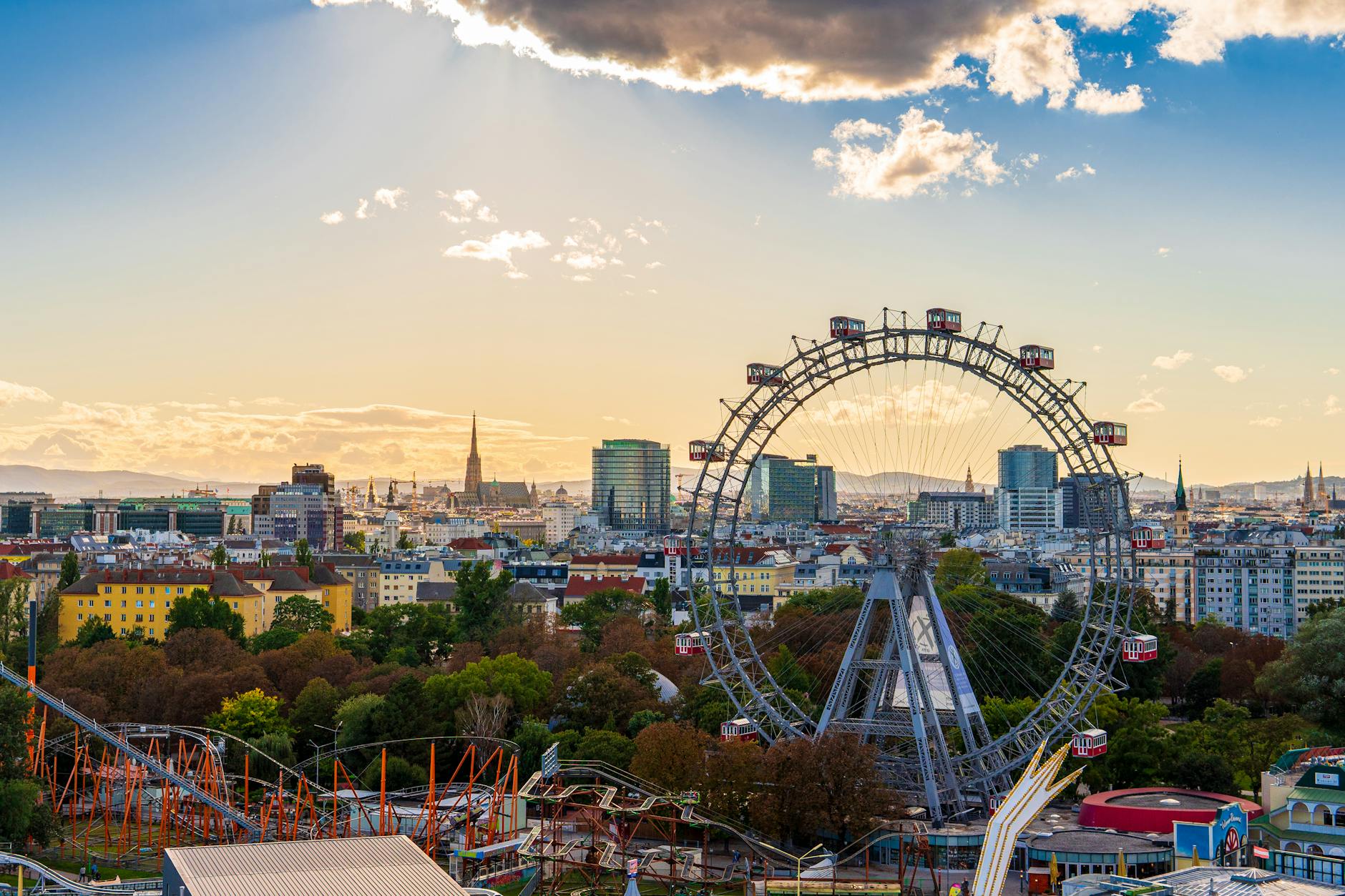
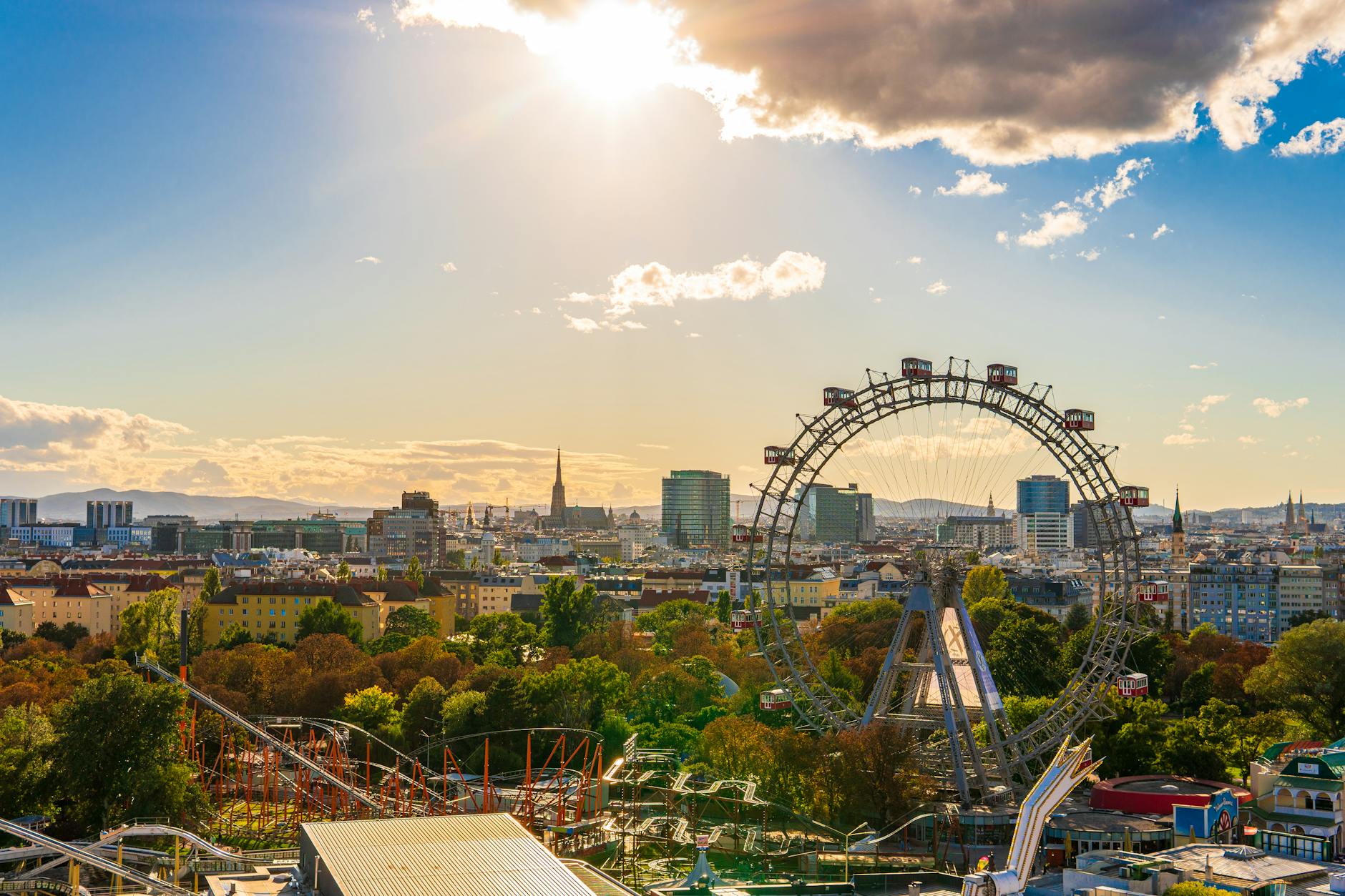
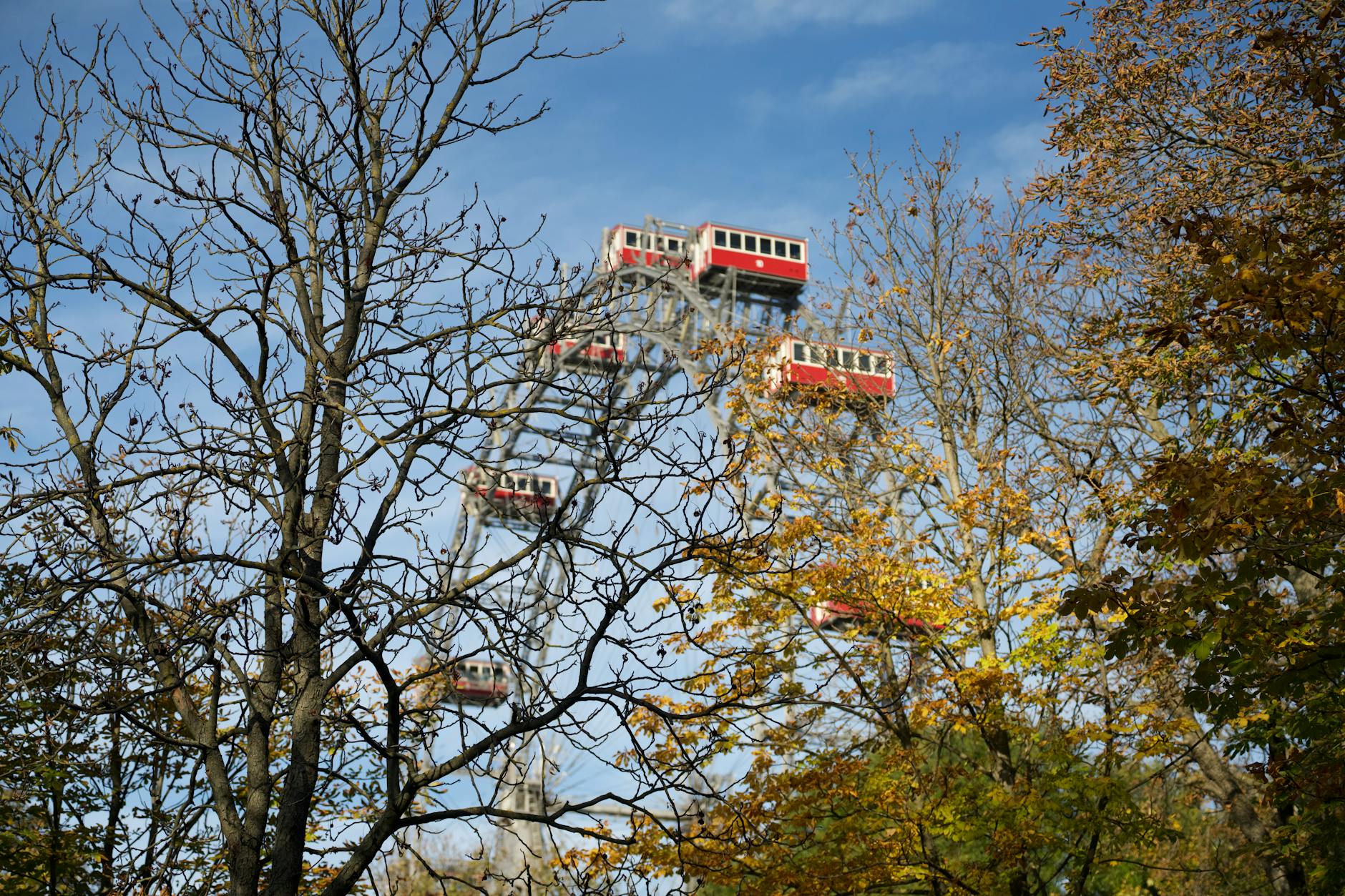
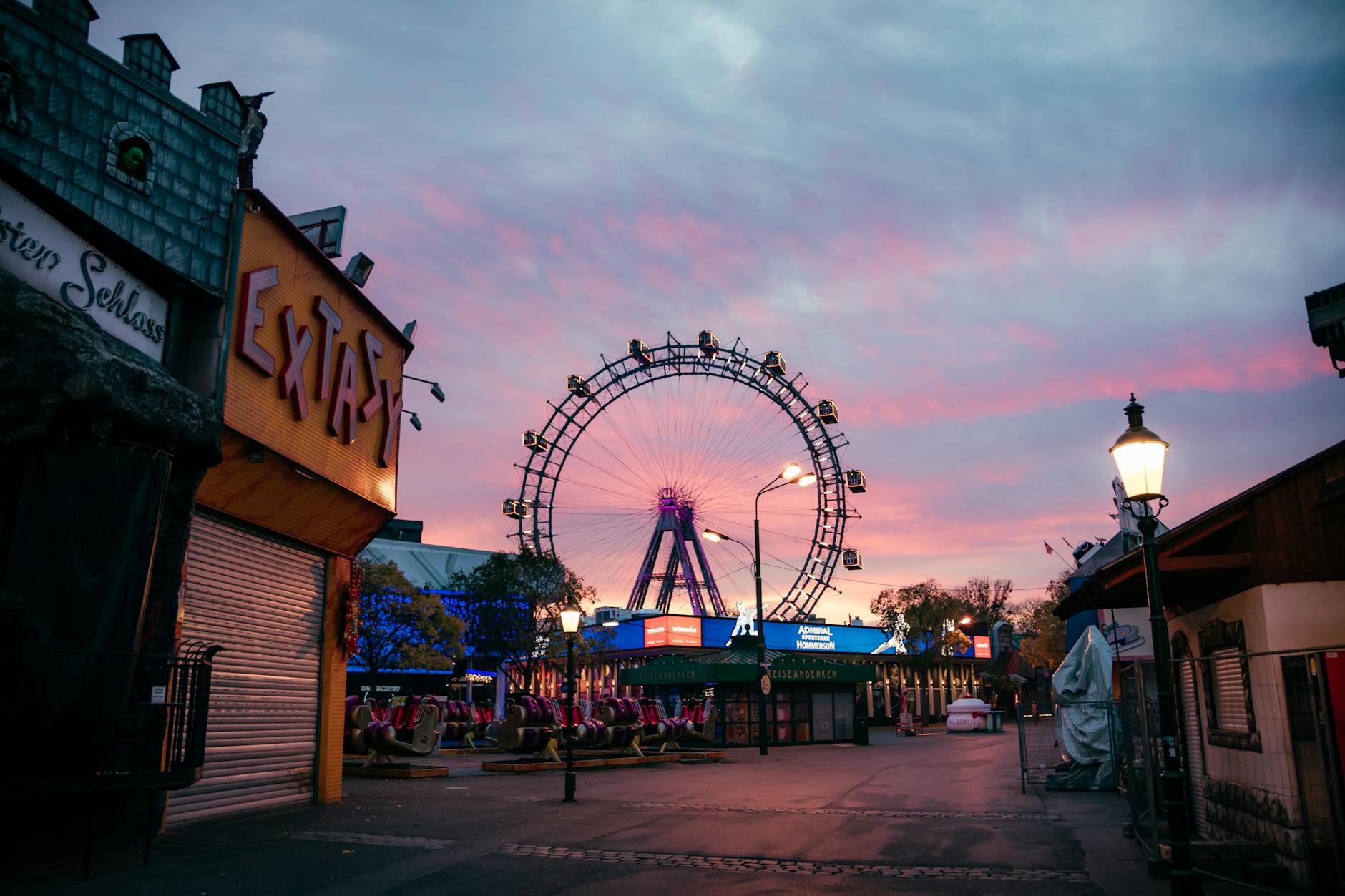
The Riesenrad is the defining symbol of the Prater and one of the most photographed landmarks in Vienna. Built in 1897 by British engineer Walter Bassett Bassett to celebrate the 50th anniversary of Emperor Franz Joseph’s reign, the wheel was one of the largest engineering achievements of its era. The original 30 wooden cabins were destroyed in the 1944-1945 fire that swept through the Prater; the wheel was reconstructed with 15 cabins after the war.
Riding the Riesenrad
- Cost: €13.50 adult, €6 child (under 6 free with adult)
- Ride duration: 15-20 minutes; the wheel makes one slow rotation
- Hours: 9 am-10 pm in peak season; reduced winter hours
- What you see: Vienna’s skyline including Stephansdom spire (3.5 km west); the Danube; the Donauinsel; the Wienerwald hills; the entire Prater forest beneath you
- Best timing: Sunset for the golden light over the city; early morning for empty cabins; weekday afternoons for shortest queues
The Riesenrad Restaurant
One of Vienna’s most distinctive dining options. The Riesenrad operates private 4-person dining cabins for breakfast, lunch, and dinner — you book the cabin, it cycles slowly around the wheel during your meal, and you eat with the panoramic view. Prices: €100-€200 per person depending on meal and time. Book 4-8 weeks ahead in peak season; one of Vienna’s most-requested romantic dining experiences.
The Third Man Connection
Carol Reed’s 1949 film noir The Third Man filmed its most famous scene aboard the Riesenrad — Orson Welles delivers the “cuckoo clock speech” while riding alone in a wooden cabin. The scene cemented the Riesenrad as a cinematic icon. Film fans visiting Vienna often combine the Riesenrad with a stop at the Vienna Third Man Museum and the famous Vienna Sewer Tour, both Third Man-themed.
The Wurstelprater Amusement Park
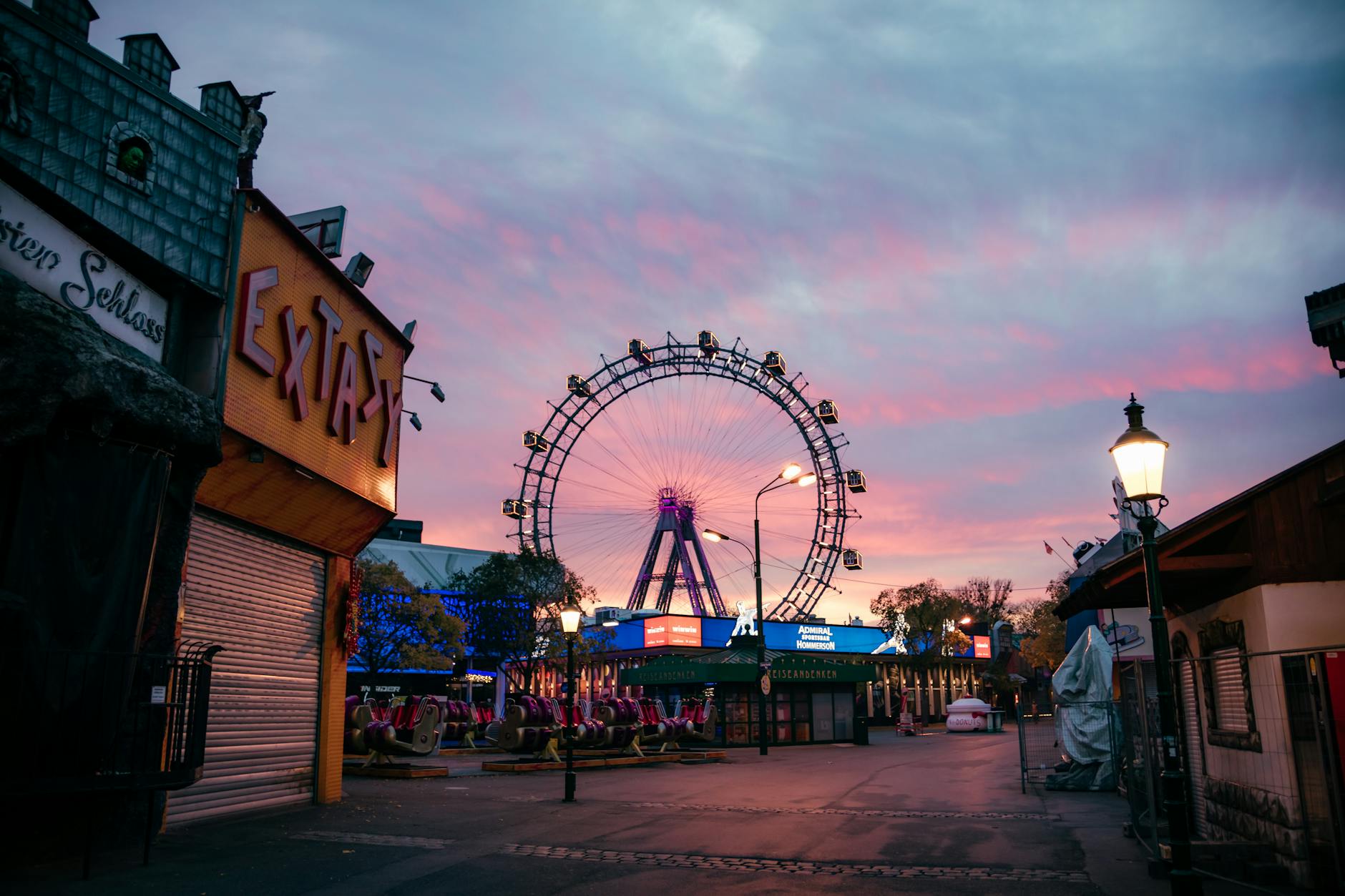
The Wurstelprater is Vienna’s free-entry amusement park stretching about 1 km from Praterstern through the entrance gates to the various ride sections. The park is open March-October roughly; some attractions stay open year-round. Major sections:
The Classic Section (Near Riesenrad)
- The Riesenrad — the iconic ferris wheel
- The Praterturm — modern observation tower (117m), built 2010 — €4 adult
- Madame Tussauds — the wax museum, separate paid entry
- The Olympic-themed Riesenrad-Plus rides — various small carousels and family rides
- Madame Tussauds Vienna — wax museum, separate ticket
The Vintage Rides
- Carousel rides from the 1920s-1950s, still operating
- Ghost trains in classic vintage style
- The Toboggan — wooden slide ride
- Test-your-strength bell hammers from the early 1900s
The Modern Rides
- Roller coasters — multiple modern thrill rides
- Bumper cars
- Various spinning rides and stomach-droppers
- The Tagada and similar modern carnival rides
Pricing
The Wurstelprater operates on a pay-per-ride model rather than an entry fee. Most rides cost €2-€8 individually. A typical visit with a few rides costs €15-€40 per person. The combined “Hop on Hop Off” carnival passes don’t really exist at the Prater — it’s old-school pay-as-you-go.
The Grüner Prater — The Forest Section
Behind the amusement park, the Grüner Prater (Green Prater) is the much larger and significantly quieter park section. The 6-million-square-meter area is essentially an urban forest with meadows, ponds, biking paths, and beer gardens scattered throughout.
The Hauptallee
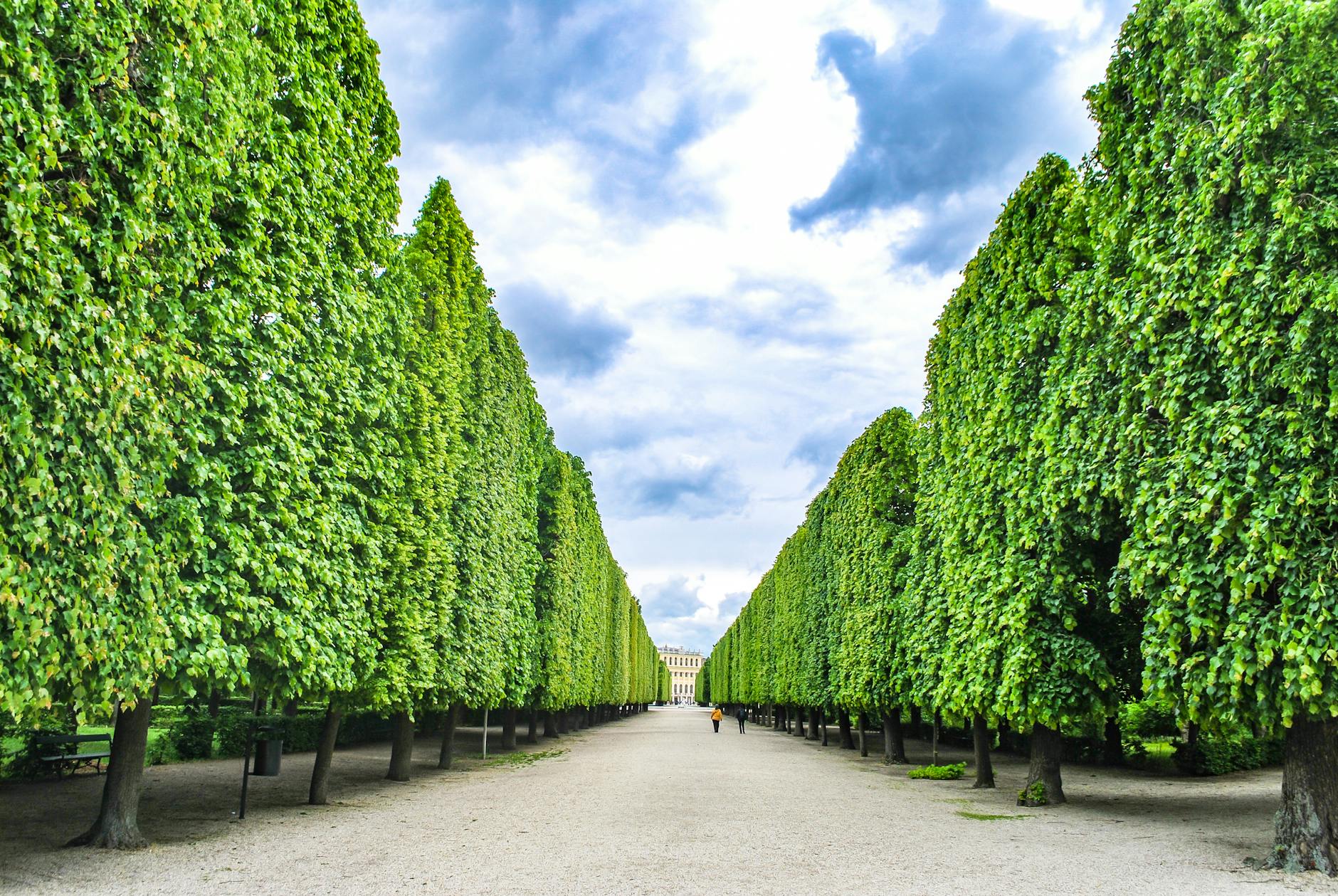
The Hauptallee is the 4.4-km tree-lined boulevard cutting through the Grüner Prater from Praterstern toward the Lusthaus pavilion at the far end. Planted in 1538, the avenue is Vienna’s most-used outdoor exercise route — joggers, cyclists, roller-skaters, and horseback riders use it daily. The Hauptallee is genuinely flat (rare in central Vienna) and fully paved, making it one of the best places to exercise in the city.
The Lusthaus
An 18th-century Baroque pavilion at the far eastern end of the Hauptallee — once an emperor’s hunting lodge, now a small café with a long history. Lovely cycle destination, about 4.4 km from Praterstern. Best in late afternoon for the lower sun on the avenue.
The Trabrennbahn Krieau
The Vienna horse-racing track at the northern edge of the Grüner Prater. Trotting races run several times monthly; the Krieau district has been developed with student housing and modern restaurants. Worth a visit if you want a quieter Prater experience.
The Wiener Stadion
Vienna’s main football stadium (Ernst-Happel-Stadion) is on the Prater grounds. It hosts Rapid Wien football matches and the occasional Austrian national team game.
The Liliputbahn — Vienna’s Miniature Railway
The Liliputbahn is a 1928 miniature railway running 3.9 km through the Prater. The narrow-gauge train (one-third normal track width) carries passengers in 16-passenger open carriages around the park. €3.90 per ride; runs March-October.
The Liliputbahn is one of Vienna’s most family-friendly attractions and a hit with kids of all ages. The route loops around the Wurstelprater and through parts of the Grüner Prater, providing a relaxed way to see the park without walking the full distance.
Schweizerhaus — The Prater Beer Garden
Schweizerhaus is Vienna’s most beloved Prater dining institution — a beer garden serving house-brewed Budweiser beer and famous “Stelze” (pork knuckle) since 1920. The terrace seats 2,000+ in summer; the indoor section runs year-round (mostly). The atmosphere is essentially a Vienna outdoor festival on any sunny day from April to October.
Menu Highlights
- Stelze (Pork Knuckle) — Schweizerhaus’s signature dish; ~€18-€22 for the full portion
- Wiener Schnitzel — oversized portions; ~€18-€24
- Krainerwurst with mustard — Vienna sausage; ~€10-€15
- Schweizerhaus house-brewed beer — Krügerl (0.5L) €4-€5
- Spritzer or Almdudler — Austrian summer drinks
Schweizerhaus operates seasonally — open mid-March through October. Reservations recommended for groups; walk-in works most weekdays. Sundays in summer can have 30-minute waits.
Other Prater Restaurants and Cafés
- Bratwurst-Pichler — Würstelstand with various Prater sausages
- Café Lehmann — historic Prater café
- Schweizerhaus annex for quicker takeaway
- Riesenrad Restaurant (private cabin dining) — covered above
- Lusthaus café — at the far end of the Hauptallee
- Various carnival food stalls in the Wurstelprater (Langos, candy floss, pretzels)
How to Visit the Prater
Quick Visit (1.5 hours)
- U1 or U2 to Praterstern
- Walk into the Wurstelprater (5 min)
- Ride the Riesenrad (30 min including queue)
- Walk through the carnival area (30 min)
- Stop at a Würstelstand for a snack
- Return via Praterstern U-Bahn
Half-Day (3-4 hours)
- Riesenrad + Wurstelprater wander
- Liliputbahn ride (45 min loop)
- Schweizerhaus lunch (90 min)
- Walk the Hauptallee toward the Lusthaus (60 min)
- Return via U-Bahn
Full Day Plan
- Morning at Wurstelprater (rides, Riesenrad)
- Schweizerhaus lunch
- Liliputbahn ride
- Walk the full Hauptallee to Lusthaus (90 min one-way)
- Return cycle via Citybike Vienna or Donkey Republic
- Late afternoon at the Trabrennbahn Krieau (if racing day)
- Dinner in nearby Leopoldstadt at Schweizerhaus or Skopik & Lohn (Karmelitermarkt area)
Vienna Prater for Families
The Prater is one of Vienna’s most family-friendly attractions. Tips:
- Most rides have height minimums — typically 100-120 cm for thrill rides; family rides often allow kids 80+ cm with adult
- The Liliputbahn welcomes all ages — kids genuinely love the miniature train
- The Wurstelprater entrance is free — you can walk in without paying anything if you don’t want rides
- Strollers work on the Wurstelprater paths and Hauptallee
- The Grüner Prater meadows are excellent for kids’ run-around time
- Bring cash — many small ride operators are cash-only or have card minimums
- Restrooms are at the Riesenrad area and Schweizerhaus — bring coins (€0.50)
- Sunscreen and hats for summer days
The Prater by Season
| Season | What’s Open |
|---|---|
| Spring (March-May) | Wurstelprater fully open; Schweizerhaus open; meadows in flower; gradual opening of all rides |
| Summer (June-August) | Peak season; all rides open; Schweizerhaus busy; Riesenrad sunset rides at peak; Hauptallee jogging culture |
| Autumn (September-October) | Wurstelprater closing season; Schweizerhaus closing late October; foliage on Hauptallee |
| Winter (November-March) | Most rides closed; Riesenrad continues operating; Grüner Prater forest year-round; Christmas market in Prater area |
The Prater Christmas Market
From mid-November through December 23, the area around the Riesenrad hosts a Christmas market — less famous than Rathausplatz or Schönbrunn but with a unique fairground atmosphere. The Christmas market combines traditional market stalls with carnival rides; particularly atmospheric in the early-evening hours when the Riesenrad is lit and the Christmas market lights are on.
The Prater’s History
The Prater has been a public space since 1766, when Emperor Joseph II decreed: “All people, regardless of class, are permitted to enter and stay in the Prater.” This was a radical Enlightenment-era act — previously the Prater had been imperial hunting grounds reserved for the nobility. Joseph II’s decree opened the entire complex to commoners and effectively created what may be Europe’s first major public urban park.
The amusement park grew gradually through the 19th century. The 1873 Vienna World Exhibition placed the Riesenrad’s predecessor — temporary structures — in the Prater. The current Riesenrad was built in 1897. The 1944-1945 fire destroyed most of the wooden Riesenrad cabins (15 of the original 30 were rebuilt after the war).
The Hauptallee was planted in 1538, making it one of the oldest tree-lined avenues in Europe still in original location. Joseph II’s 1766 decree made it the people’s avenue.
Photography at the Prater
- Riesenrad at sunset — golden light, classic landmark shot
- Riesenrad at blue hour — the wheel illuminated against the deep blue sky
- Hauptallee in autumn — golden foliage tunnel
- Vintage Wurstelprater rides — the 1920s-1950s rides with their original signage make for distinctive photographs
- Long exposure of the lit Riesenrad after dark — motion-blur magic
- The Liliputbahn cabin from above — kid-friendly Instagram shots
Combining the Prater with Other Vienna Sites
Same-Day Combinations
- Prater morning + Karmelitermarkt brunch (10-minute walk back toward the Inner City)
- Prater afternoon + Donaukanal evening bars (15-minute walk west)
- Riesenrad ride + Donauinsel beach (summer weekend)
- Prater + Schloss Hof palace day trip (Schloss Hof is 40 km east on the Slovak border)
Multi-Day Plans
The Prater isn’t usually a multi-day destination, but it pairs naturally with broader Leopoldstadt exploration. See our Leopoldstadt article for full neighborhood plans.
Prater Practical Tips
- Cash — many small ride operators and Würstelstands prefer cash over card
- Coins for restrooms — €0.50-€1 at the Riesenrad area
- Sunscreen and hat in summer — minimal shade in the Wurstelprater section
- Comfortable shoes — Hauptallee walking is flat but a full out-and-back is 9 km
- Skip weekends if possible — Saturday/Sunday afternoons see peak crowds
- The Liliputbahn is cash-only at the ticket window — bring small bills
- Bring a picnic for Grüner Prater meadows — much cheaper than the on-site cafés
FAQ
What is the Vienna Prater?
The Prater is Vienna’s massive public park combining the Wurstelprater amusement park (with the 1897 Riesenrad) and the Grüner Prater forest. About 6 million square meters total, free public entry, in the 2nd district.
How much does the Riesenrad cost?
€13.50 adult, €6 child (under 6 free with adult). A single rotation takes 15-20 minutes.
Is the Wurstelprater free to enter?
Yes — completely free entry. You pay for individual rides at each attraction (€2-€8 per ride typically).
What’s the best time to visit the Riesenrad?
Sunset for golden-hour photography; weekday afternoons for shortest queues; early morning for almost-empty cabins.
Should I eat at Schweizerhaus?
Yes — at least once. The beer garden experience is genuinely distinctive and the Stelze (pork knuckle) + house-brewed beer combination is a classic Vienna meal. €40-€60 per person for a full meal with drinks.
Can I cycle through the Prater?
Yes — the Hauptallee is one of Vienna’s best cycling routes. Rent at Citybike Vienna stations near Praterstern. The 4.4-km flat avenue allows easy round-trip rides.
Is the Prater kid-friendly?
Yes — extremely. The Liliputbahn miniature railway, the Wurstelprater rides with various age-appropriate options, the free Grüner Prater forest, and the Schweizerhaus playground make it Vienna’s best family attraction.
How do I get to the Prater?
U1 or U2 to Praterstern station — direct access. About 10 minutes from Stephansplatz. Free to enter; pay for individual rides.
Final Tip: The Prater Has Two Faces
Visitors think “Prater” and imagine the carnival rides. The carnival is fun, but the genuinely Viennese Prater experience is the Grüner Prater — the 4.4-km Hauptallee walk, the Schweizerhaus beer garden, the Lusthaus pavilion at the avenue’s end, and the empty forest paths where actual Viennese spend their weekend afternoons. Spend the carnival hour for the Riesenrad photo, then walk past the rides into the green spaces. That’s the Prater that residents have used for 250 years.
For more, see our Vienna attractions, our Leopoldstadt district article, and our family-friendly Vienna with kids guide.
The Hauptallee is four and a half kilometres of straight, car-free chestnut avenue, and it is the reason so many Vienna cycling tours end up here. You do not need a guide to ride it — but if you want the Prater joined up with the Danube Canal and the Ring in one three-hour loop, our comparison of Vienna bike tours sets out the operators, prices and departure times.
The Riesenrad’s most famous fifteen minutes were filmed in one of these cabins in 1948, and the cuckoo-clock speech delivered in it has followed Vienna around ever since. If that is why you are queuing, our guide to the Third Man tour and film locations maps the rest of them — the doorway, Josefsplatz, the Zentralfriedhof and the sewer you can actually go down.