Vienna Concert Tickets: Booking Mozart, Strauss & Classical Concerts Without Getting Ripped Off
Vienna has two classical music economies operating in the same square kilometre. One sells world-class opera for EUR 13; the other sells costumed Mozart for EUR 109. Here is how to tell them apart.

Photo by cottonbro studio
- What Concert Tickets Actually Cost in Vienna
- The Structure of the Vienna Concert Market
- The Great Venues, and What Each Is Actually For
- How to Actually Buy: A Ranked List
- The Costumed Sellers: Say No
- When a Tourist Mozart Concert Is Actually the Right Choice
- Which Concert Should You Actually Book?
- Standing Room, Step by Step
- Discounts, Standby and Youth Tickets
- Where the Venues Are
- Practical Matters
- Reading a Concert Listing Properly
- A Common Mistake: Confusing the Buildings
- Beyond Classical
- Frequently Asked Questions
- Related Vienna Guides
- Photo Credits
This article contains advertising. Our booking links are routed through a partner that adds commission tracking automatically, so if you book through one we earn a commission from the provider, at no extra cost to you. It never affects what we recommend. Affiliate disclosure
Two people stand fifty metres apart on Kärntner Straße on the same evening. One has just paid €109 to a man in a powdered wig for a Mozart concert in a hotel ballroom. The other is about to pay €13 to stand at the back of the Vienna State Opera and watch a world-class production of Der Rosenkavalier. Both of them believe they have bought a Viennese classical music evening. Getting Vienna concert tickets right is almost entirely a matter of knowing which of those two people you are about to become.
This guide sets out how the market actually works: the real venues and what they charge, the standing-room tickets that make Vienna the cheapest great music city in Europe, how the resale layer marks things up, what the costumed street sellers are really selling, and when a tourist Mozart concert is genuinely the right choice. Prices were checked in September 2026 and change with the season; treat them as the right order of magnitude rather than a quotation.
What Concert Tickets Actually Cost in Vienna
| What | Price | Who it suits |
|---|---|---|
| State Opera standing room, balcony | €13 | Almost everyone. The city’s best deal |
| State Opera standing room, gallery | €15 | Same, marginally better sightlines |
| State Opera standing room, parterre | €18 | Best of the three, sells first |
| Musikverein Golden Hall, standing | €6–12 | Anyone willing to stand for 90 minutes |
| Musikverein Brahms-Saal recital | €25–75 | Chamber music and song |
| Musikverein, smaller halls | €15–40 | New music, young artists |
| Musikverein seated, Vienna Symphony | €25–180 | The realistic seated option |
| Musikverein seated, Vienna Philharmonic | €40–250 | The famous one, if you can get in |
| Konzerthaus, Vienna Symphony | €25–80 | Excellent value, less famous building |
| Tourist Mozart concert, Cat C | €69 | People who want the costumes |
| Tourist Mozart concert, Cat A | €109 | Same, closer to the front |
| Tourist Mozart concert, Superior | €139 | Same again |
| New Year’s Day Concert | €90–1,200 | Ballot only, over a year ahead |
| Street seller in a wig | €70–120 | Nobody |
The Structure of the Vienna Concert Market
Almost every pricing oddity in this city comes down to one fact: Vienna has two entirely separate classical music economies operating in the same square kilometre.
The first is the real one. It exists for the roughly two million people who live here, it runs on subscriptions and season tickets, it fills the State Opera and the Musikverein and the Konzerthaus about three hundred nights a year, and it is heavily subsidised on the explicit principle that serious music should be affordable. That is why a standing ticket to a world-class opera costs less than a cinema seat.
The second exists for visitors. It sells a costumed Mozart-and-Strauss greatest-hits programme, in rented rooms, to people who are in Vienna for three days and want to tick a box. It is legal, it is not fraudulent, and some of it is competently performed. It costs five to ten times as much as the first economy for a fraction of the artistic standard.
Neither of these is hidden. But the second one advertises aggressively, has better search-engine placement, employs people in wigs to stand on the main shopping street, and is what most visitors encounter first. The first economy does almost no marketing at all, because it does not need to.
The Great Venues, and What Each Is Actually For
The Vienna State Opera (Staatsoper)
Roughly 300 performances a year of some fifty different operas and ballets, with a repertory system that changes the programme almost nightly. Standard of production and singing among the highest anywhere.
Standing room is the headline. 567 standing places, sold on the day of performance only: €13 balcony, €15 gallery, €18 parterre. They go on sale online at 10:00 Vienna time on wiener-staatsoper.at on the day, and are also sold at the box office. The parterre places sell fastest. Long-standing local practice is to tie a scarf to the brass rail in front of your spot to reserve it during the interval.
Seated tickets run the full range, and the top of it is genuinely expensive. But there is a large middle: side-balcony and upper-circle seats with restricted views often go for €20–50 and give you a perfectly good evening in a spectacular building. Our State Opera guide covers the queue, the dress code and how the repertory system works.
The Musikverein
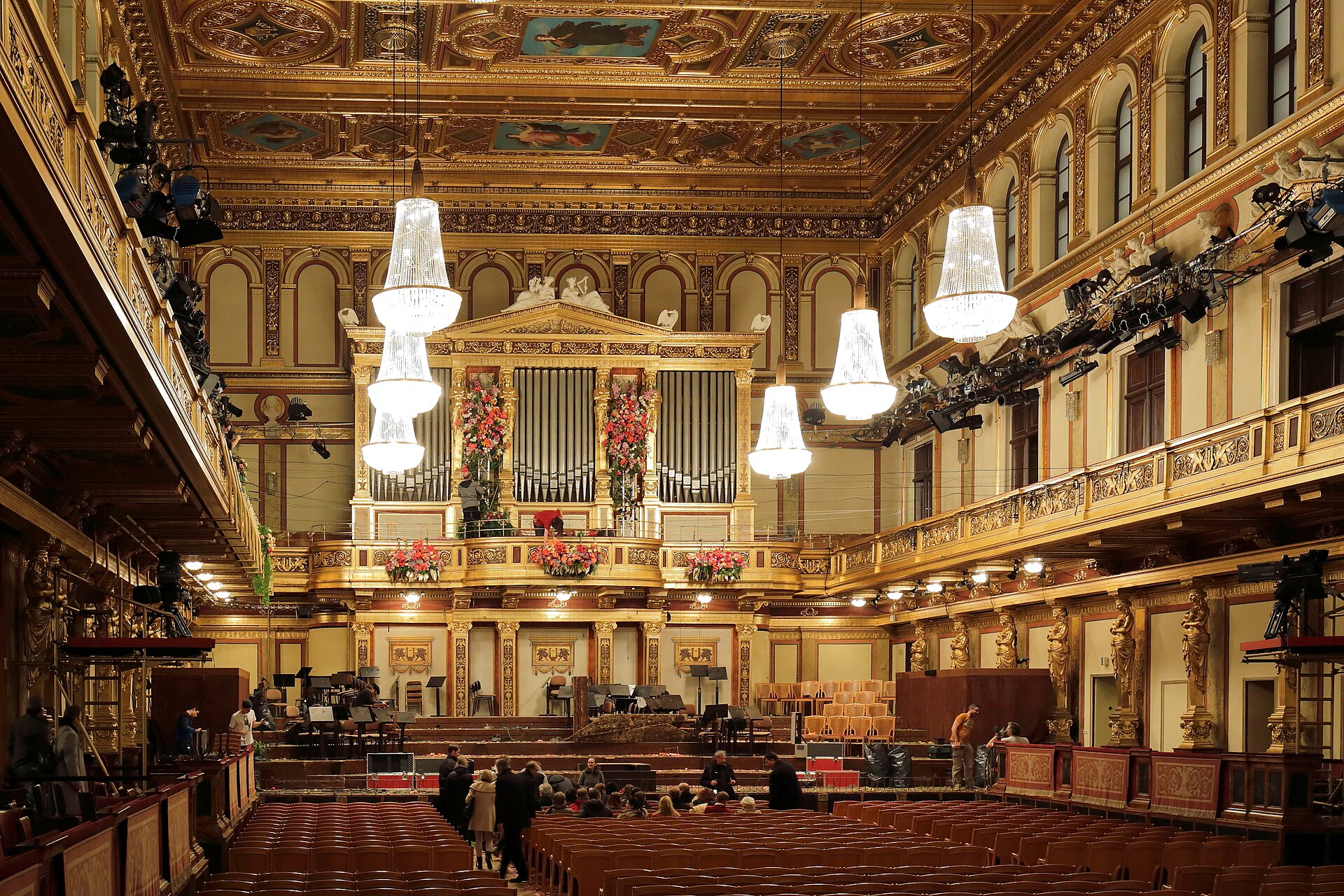
The Golden Hall — the room in every New Year’s Day broadcast — is a shoebox of gilt and caryatids that is widely considered the finest concert acoustic in the world. Home of the Vienna Philharmonic.
Standing places in the Golden Hall run roughly €6–12, which is arguably an even better deal than the opera. The building also contains the Brahms-Saal, a jewel-box recital room with concerts from about €25, and four smaller modern halls in the basement extension where new and experimental music happens from around €15.
Seated tickets: about €25–180 for a Vienna Symphony programme, and €40–250 for the Philharmonic. The Philharmonic’s own subscription concerts are largely locked up by subscribers, some of whom have held their seats for decades — this is the one genuine scarcity in Viennese music, and it is not solvable with money at short notice. Our Musikverein guide has the detail.
The Wiener Konzerthaus
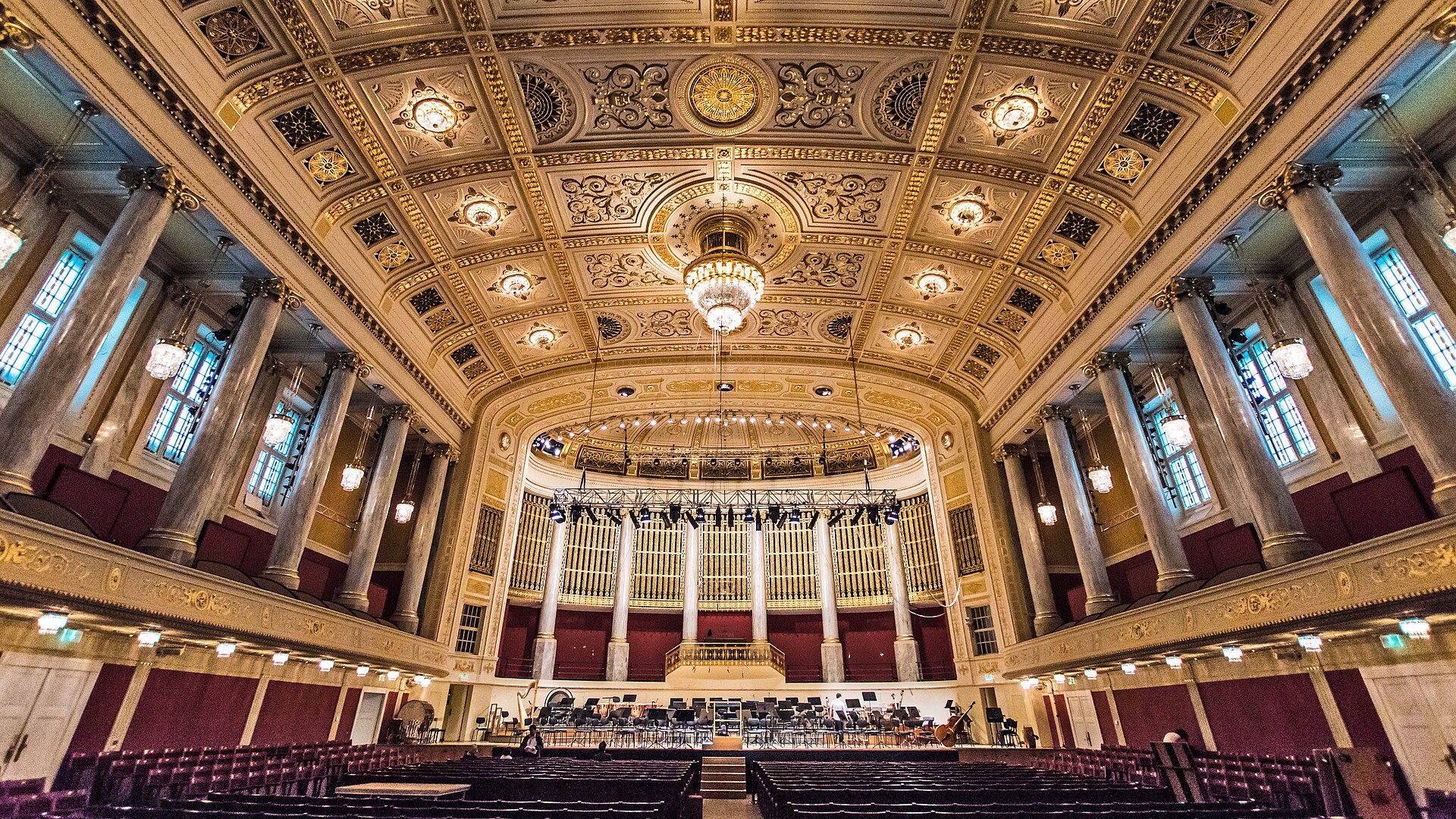
The most underrated ticket in Vienna. A magnificent Secession-era building ten minutes’ walk from the Musikverein, home of the Vienna Symphony, with four halls of its own: the Großer Saal, the Mozart-Saal, the Schubert-Saal and the small Berio-Saal.
The programming is broader than the Musikverein’s — a great deal of contemporary music, jazz, world music and early music alongside the standard repertoire — and typical Vienna Symphony prices of €25–80 buy you a good seat rather than a compromise. If you want one serious concert on a normal budget and you do not specifically need the gold room, this is where to look first.
The Volksoper
Vienna’s second opera house, in the 9th district, specialising in operetta, musicals and lighter opera, often in German. Tickets are substantially cheaper than the Staatsoper, the standard is high, and it has standing room of its own. If you want to see Die Fledermaus done properly by people who do it every year, this is the place, and it is almost entirely free of tourists.
Churches and palace rooms
A large amount of genuinely good music happens in Vienna’s churches, particularly around Advent and Easter, and much of it is free or costs a small donation. The Augustinerkirche, the Michaelerkirche, the Peterskirche and the Stephansdom all host serious sacred music. This is a different category from the commercial “church concerts” advertised to tourists — check whether the performers are named, and whether the venue’s own website lists the event.
How to Actually Buy: A Ranked List
- The venue’s own website. Always first, always cheapest, always the real seat map. wiener-staatsoper.at, musikverein.at, konzerthaus.at, volksoper.at. All have English versions. All take international cards.
- The venue box office in person. Same prices, plus the ability to ask a human which restricted-view seat is actually acceptable. Worth doing for a big purchase.
- Standing room, on the day. No booking, no fee, no risk. Turn up.
- The Bundestheaterkassen, the federal theatres’ central box office, for Staatsoper and Volksoper tickets in one place.
- Resale platforms — only when the above have failed, and only knowing you are paying a markup.
The resale layer, and how to see through it
Very few of the “companies” selling Vienna concerts online actually put on concerts. GetYourGuide, Viator, Tiqets, Classictic and a long tail of white-label ticket sites resell the same handful of producers under different product names, with different photographs and a €10–30 spread between them.
Two listings with different titles and different prices are routinely the same performance in the same room. The test is simple and takes thirty seconds: find the name of the venue and the name of the ensemble, then search for those two things directly. If the ensemble has its own website and its own box office, buy there. If you cannot find out who is actually playing, that is the answer.
The Costumed Sellers: Say No
You will be approached, repeatedly, by people in eighteenth-century costume on Kärntner Straße, on the Graben and directly outside the State Opera. They are selling tickets to Mozart-and-Strauss programmes for €70–120.
This is the single most consistent tourist trap in Vienna, and it works because the pitch is plausible: you are standing outside an opera house, someone in period dress is offering you Mozart tonight, and you have not planned an evening. What you get is a small ensemble playing a greatest-hits programme in a minor venue — not the room you are standing outside, and usually not one you have heard of.
The performances are not illegal and are not always bad. The price is the problem: you are paying State Opera money for something several tiers below it, when a €13 standing ticket to an actual world-class production is sold from the box office thirty metres away.
The rule: never buy a concert ticket from someone who approached you on the street. If you want a costumed Mozart concert — and there are good reasons to — buy it from the operator’s own website, where the same product is cheaper and you can see which venue it is in.
When a Tourist Mozart Concert Is Actually the Right Choice
We are hard on these concerts, so it is worth being fair about when they make sense.
The licensed ones — the Wiener Mozart Konzert series, which plays in the Musikverein’s Golden Hall and Brahms Hall and sometimes the State Opera — are competently performed, run in genuinely spectacular rooms, and cost €69 (Cat C), €89 (Cat B), €109 (Cat A) or €139 (Superior). They are not artistically serious and no Viennese person would go to one. But:
- They are in English and explicitly for visitors, which some people genuinely prefer to a three-hour opera in Italian with German surtitles.
- They are 90 minutes and start at a civilised hour, which matters with children or a 06:00 flight.
- You can book them months ahead, which standing room by definition does not allow.
- The costumes and the room are the point for a lot of people, and there is nothing wrong with that.
If that describes you, book directly with the operator and choose Category C. The programme is identical from every seat and the acoustics in the Golden Hall are famously even. Paying €70 more to sit closer buys you very little.

Which Concert Should You Actually Book?
A short decision guide, because the choice is genuinely confusing from outside.
You have one evening and want the best possible experience for the least money. State Opera standing room. Check what is on, go online at 10:00 that morning, pay €13–18, arrive an hour early, and stand. Nothing else in Europe is close.
You want to sit down, and to spend a moderate amount. A Vienna Symphony concert at the Konzerthaus, €25–80 for a genuinely good seat in a beautiful hall, booked directly. Or a restricted-view seat at the State Opera in the same range.
You specifically want the Golden Hall. Book a standing place at the Musikverein for €6–12, or a Vienna Symphony seat from €25. Both put you in the same room as the New Year’s Day broadcast for a fraction of a tourist-concert price.
You want ninety minutes, in English, bookable three months ahead, with costumes. A licensed Wiener Mozart Konzert, Category C, booked on the operator’s own site. Accept what it is and enjoy it.
You are travelling with children. The Volksoper for operetta, a Sunday morning with the Vienna Boys’ Choir at the Hofburgkapelle, or a short tourist concert. Not a four-hour Wagner. Our Vienna with kids guide has more.
You want something that is not Mozart or Strauss at all. The Konzerthaus’s contemporary and jazz programming, the Musikverein’s basement halls, or the Wien Modern festival in November. See Vienna in November.
Standing Room, Step by Step
The single most common reason people do not use Vienna’s best deal is that nobody explains the mechanics. Here they are, for the State Opera.
- Check what is on at wiener-staatsoper.at. The repertory changes almost every night, so the same trip can offer you five different operas.
- Buy at 10:00 Vienna time on the day of the performance, online. Parterre (€18) goes first, then gallery (€15), then balcony (€13). If the online allocation is gone, the box office also sells standing places — a physical queue forms in the afternoon for popular nights.
- Arrive about an hour before curtain. Standing places are unallocated within their section: first there, best rail.
- Leave your coat and bag in the cloakroom. It is compulsory and it is free or nearly so. You do not want to hold a coat for three hours.
- Claim a rail place and mark it. The Viennese convention is to tie a scarf to the brass rail. It is universally respected, and it means you can leave for the interval without losing your spot.
- Use the seat-back surtitle screens. They are on the rails in standing room too, with a language selector including English.
- Expect to stand for the whole thing. Two hours for a Puccini, four and a half for a Wagner. Look at the running time before you commit.
The Musikverein’s standing places work on a similar logic, and its concerts are shorter — typically ninety minutes to two hours. If you have never done this and are unsure, start there.

Discounts, Standby and Youth Tickets
A handful of legitimate ways to pay less, none of which involve a reseller.
- Under-27 tickets. The federal theatres — State Opera, Volksoper, Burgtheater — sell heavily discounted last-minute seats to anyone under 27 with ID. If you qualify, this is the best-value seated ticket in the city.
- Standby and last-minute. Unsold seats are released at reduced prices shortly before curtain at several venues. Worth a walk to the box office at 18:30 if you are flexible about what you see.
- The Vienna City Card carries small discounts at some venues, though it is primarily a transport product. Our comparison of the Vienna City Card and the Vienna Pass explains which, if either, pays back.
- Restricted-view seats. Genuinely cheap, and at the State Opera “restricted” often means you miss part of one side of the stage in a house where the sound is excellent everywhere. Ask at the box office which specific seats are the good bad ones.
- Free church music. Sunday morning Mass at several inner-city churches includes orchestral and choral settings performed to a professional standard, at no charge beyond a collection.
Where the Venues Are
Everything above is walkable from the centre, which makes an evening easy to plan.
- State Opera — on the Ring at Karlsplatz. U1, U2 and U4 to Karlsplatz; trams 1, 2, D and 71 to Oper.
- Musikverein — two minutes’ walk from the opera, on the far side of Karlsplatz. Same stops.
- Konzerthaus — ten minutes from the Musikverein, U4 to Stadtpark.
- Volksoper — in the 9th district, U6 to Währinger Straße-Volksoper, or tram 40, 41 or 42.
Our getting around Vienna guide covers the network, and the U-Bahn guide the lines. Note that the U-Bahn runs all night at weekends, so a late curtain is never a transport problem.
Practical Matters
What to wear
Less than you think. Vienna dresses up more than London or Berlin but the days of enforced formality are long gone. A jacket, or a dress, or smart trousers and a decent shirt, will be entirely correct anywhere including the State Opera. Nobody in standing room is in black tie. Premieres and gala nights are a different matter, and so are the balls — see our ball season guide.
The season
The main season runs from September to June. July and August are thin: the State Opera and the Musikverein largely close, and what is on offer in high summer skews heavily towards the tourist concerts, which is worth knowing before you plan a musical trip around August. Our guide to the best time to visit Vienna covers the calendar.
Latecomers
Vienna’s serious venues do not seat latecomers until an interval. This is enforced. Arrive twenty minutes early — which is in any case the right amount of time to look at the building.
Standing room in practice
You will be on your feet for two to four hours on a hard floor, leaning on a padded rail. Wear comfortable shoes, leave your coat in the cloakroom, and go early enough to get a rail place rather than a spot behind one. It is genuinely one of the great cultural experiences in Europe and it is how a very large number of Viennese students first heard the operas they love.
Reading a Concert Listing Properly
Most bad purchases in Vienna are made from listings that are technically accurate and deliberately vague. Four things to look for, in order.
Who is playing? A real listing names the orchestra or ensemble and usually the conductor and soloists. A tourist listing says “a Mozart ensemble in historical costume” or invents a grand-sounding name that returns nothing outside ticket-sales sites. If you cannot find the ensemble’s own website, its own recordings, or its own concert calendar, you are looking at a product rather than a performer.
Where exactly? “In the heart of Vienna’s historic centre” is not a venue. “Musikverein, Brahms-Saal” is. Watch particularly for listings that show a photograph of a famous hall and name a different room in small print, or none at all — being in the Musikverein building is not the same as being in the Golden Hall, and both are honest descriptions of very different evenings.
What is the programme? Serious concerts publish the works, in order, with the interval marked. A listing that promises “the greatest melodies of Mozart and Strauss” is telling you it is a compilation, which is fine as long as you know that is what you are buying.
How long, and does that include an interval? Tourist concerts run about ninety minutes with one interval. Operas run from two to four and a half hours. Neither is better; they are simply different evenings, and one of them requires stamina.
A Common Mistake: Confusing the Buildings
Vienna has an unusual number of grand nineteenth-century performance spaces within a few hundred metres of each other, and their names are used loosely by anyone selling tickets.
The Staatsoper on the Ring is the opera house. The Musikverein, two minutes away, is a concert hall — there is no opera staged there. The Konzerthaus is a separate concert hall ten minutes further on. The Burgtheater is a spoken-word theatre and stages no music at all. The Hofburg is a palace complex with rentable rooms, several of which host commercial concerts, and it is not a concert hall in any institutional sense; a ticket “at the Hofburg” tells you the postcode and nothing else.
None of these distinctions matter much until you have paid €109 expecting one and arrived at another. Our guides to the State Opera and the Musikverein describe both buildings properly, and the Hofburg guide explains what that complex actually contains.
Beyond Classical
Vienna is not only a classical city, though it works hard at the branding. The Konzerthaus and the Arena, the Gasometer, the Flex and the WUK all run substantial rock, electronic and world-music programmes; there is a real jazz scene, and a summer festival calendar that fills the Danube island and the Rathausplatz. See our guides to jazz and live music in Vienna, Vienna’s music festivals and Vienna nightlife.
Frequently Asked Questions
How much do concert tickets cost in Vienna?
From €6 for standing in the Musikverein’s Golden Hall and €13 for standing at the State Opera, through €25–80 for a good seat at a Vienna Symphony concert, to €250 and beyond for a prime Philharmonic seat. Tourist Mozart concerts sit at €69–139, which is well above the value line.
Where is the cheapest place to hear classical music in Vienna?
Standing places at the Musikverein, from about €6, and standing room at the State Opera, from €13. Church concerts during Advent and Easter are often free or donation-based. All three are better than anything on offer at €70.
How do I get Vienna State Opera standing room tickets?
They are sold on the day of the performance only — online from 10:00 Vienna time on the opera’s own website, and at the box office. €13 balcony, €15 gallery, €18 parterre. Parterre sells first. There is no advance booking and no reason to pay a reseller for one.
Are the Mozart concerts in Vienna worth it?
The licensed ones in the Musikverein and State Opera are competently played and enjoyable if you want a gilded-room greatest-hits evening in ninety minutes. They are not artistically serious, and at €69–139 they cost several times a State Opera standing ticket. Book direct rather than through a reseller, and take the cheapest category.
Should I buy tickets from the people in costume on the street?
No. They sell the same tourist concerts at €70–120, in venues you have not chosen, when the same product is cheaper from the operator’s own website and a genuinely world-class alternative is on sale for €13 nearby.
Do I need to book Vienna concert tickets in advance?
For a specific Philharmonic subscription concert or a State Opera premiere, months ahead. For everything else, a few days is usually plenty, and standing room needs no advance booking at all. The exception is the New Year’s Day Concert, which is allocated by ballot more than a year ahead.
What is the difference between the Musikverein and the Konzerthaus?
The Musikverein is the older, more famous building with the Golden Hall and the Vienna Philharmonic; the Konzerthaus is a Secession-era hall a short walk away, home of the Vienna Symphony, with broader programming and easier availability. The Konzerthaus is usually the better value; the Musikverein is the room you have seen on television.
Is there a dress code for Vienna concerts?
Smart casual is fine almost everywhere, including the State Opera. Jacket or dress for a good seat; nobody expects formal wear in standing room. Balls and gala premieres are the exceptions.
Are concerts available in Vienna in summer?
Fewer. The State Opera and the Musikverein largely close in July and August, which leaves the tourist concert market dominant. If classical music is the point of your trip, come between September and June.
Can I get Vienna Philharmonic tickets?
For their own subscription concerts, rarely — most seats are held by long-standing subscribers. Standing places sometimes come available, and the orchestra plays in the State Opera pit almost nightly, which is a far easier and much cheaper way to hear the same musicians.
Karlskirche runs a Vivaldi programme under its dome most evenings, and the room is genuinely beautiful to hear strings in — but it is priced as a tourist concert, not as a music one. Our Karlskirche guide sets it against Musikverein standing room and explains when the setting justifies the premium.
Related Vienna Guides
- Vienna State Opera: Tickets & Standing Room
- The Musikverein: Golden Hall Concerts
- Vienna Classical Music Guide
- Opera in Vienna
- Vienna Tours & Experiences Compared
- The Vienna Boys’ Choir
- Vienna’s Composers
- Evenings in Vienna
- First Time in Vienna: 15 Essential Tips
Photo Credits
The Golden Hall of the Musikverein: Wien – Musikverein, großer Saal by C.Stadler/Bwag, CC BY-SA 4.0, via Wikimedia Commons.
The Großer Saal of the Wiener Konzerthaus: Großer Saal, Wiener Konzerthaus by Dozor, CC BY-SA 4.0, via Wikimedia Commons.