Vienna Hop-On Hop-Off Buses Compared: Big Bus vs Vienna Sightseeing
Big Bus and Vienna Sightseeing compared route by route, with real 2026 prices, the EUR 6 tram alternative that covers most of the same ground, and the five situations where a bus ticket genuinely earns its fare.
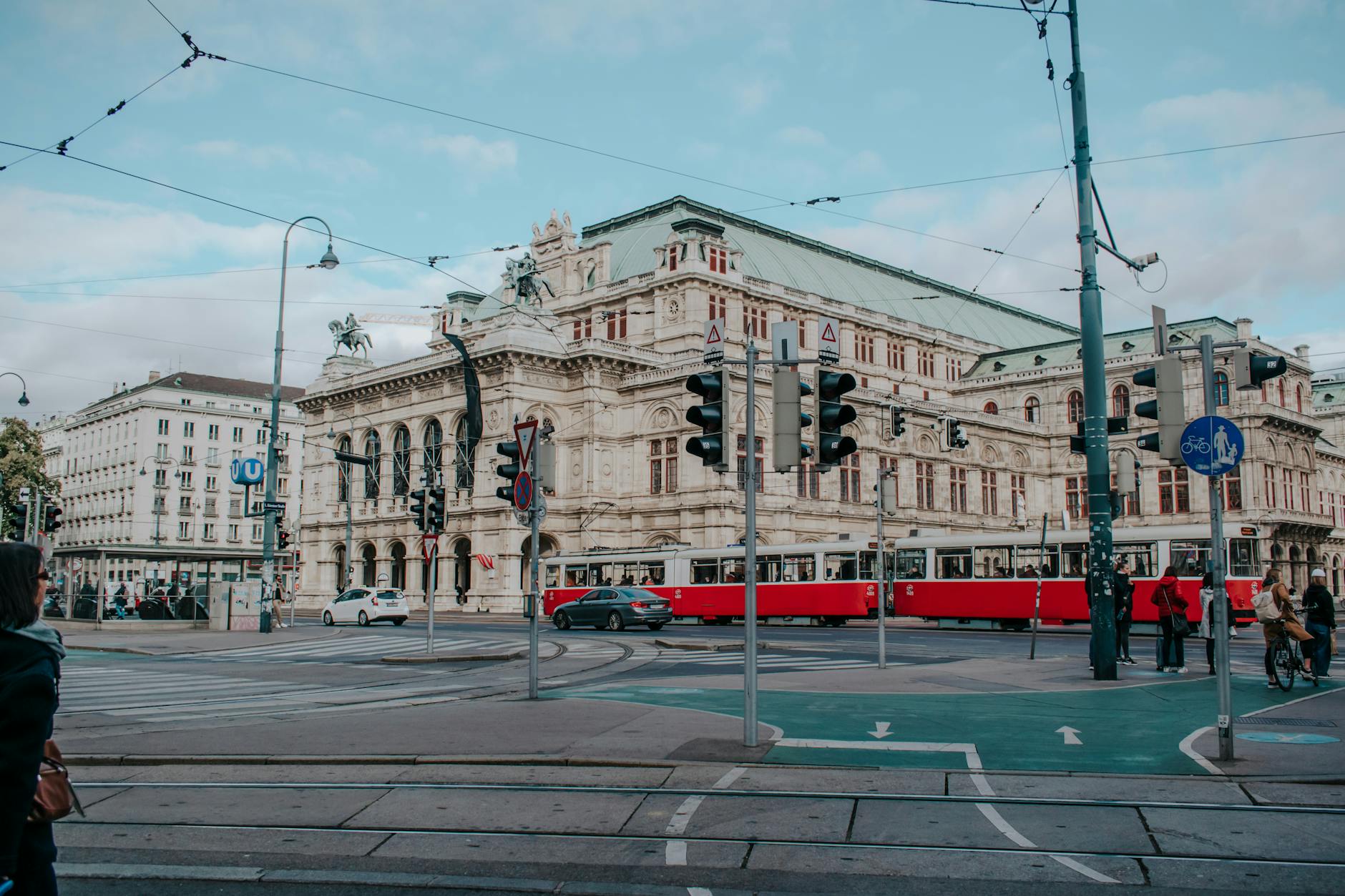
Vienna's iconic trams glide past the State Opera — the Ringstraße is a sightseeing route in itself
- The Two Operators at a Glance
- First, the Honest Question: Does Vienna Need One?
- Big Bus Vienna
- Vienna Sightseeing
- The €6 Alternative: Trams 1 and 2
- What the Bus Routes Actually Show You
- Who a Hop-On Hop-Off Ticket Is Genuinely For
- Who Should Skip It
- The Other Operators You Will See
- Buying Without Overpaying
- Practical Details
- The Arithmetic, Set Out Plainly
- Frequently Asked Questions
- Related Vienna Guides
- Photo Credits
This article contains advertising. Our booking links are routed through a partner that adds commission tracking automatically, so if you book through one we earn a commission from the provider, at no extra cost to you. It never affects what we recommend. Affiliate disclosure
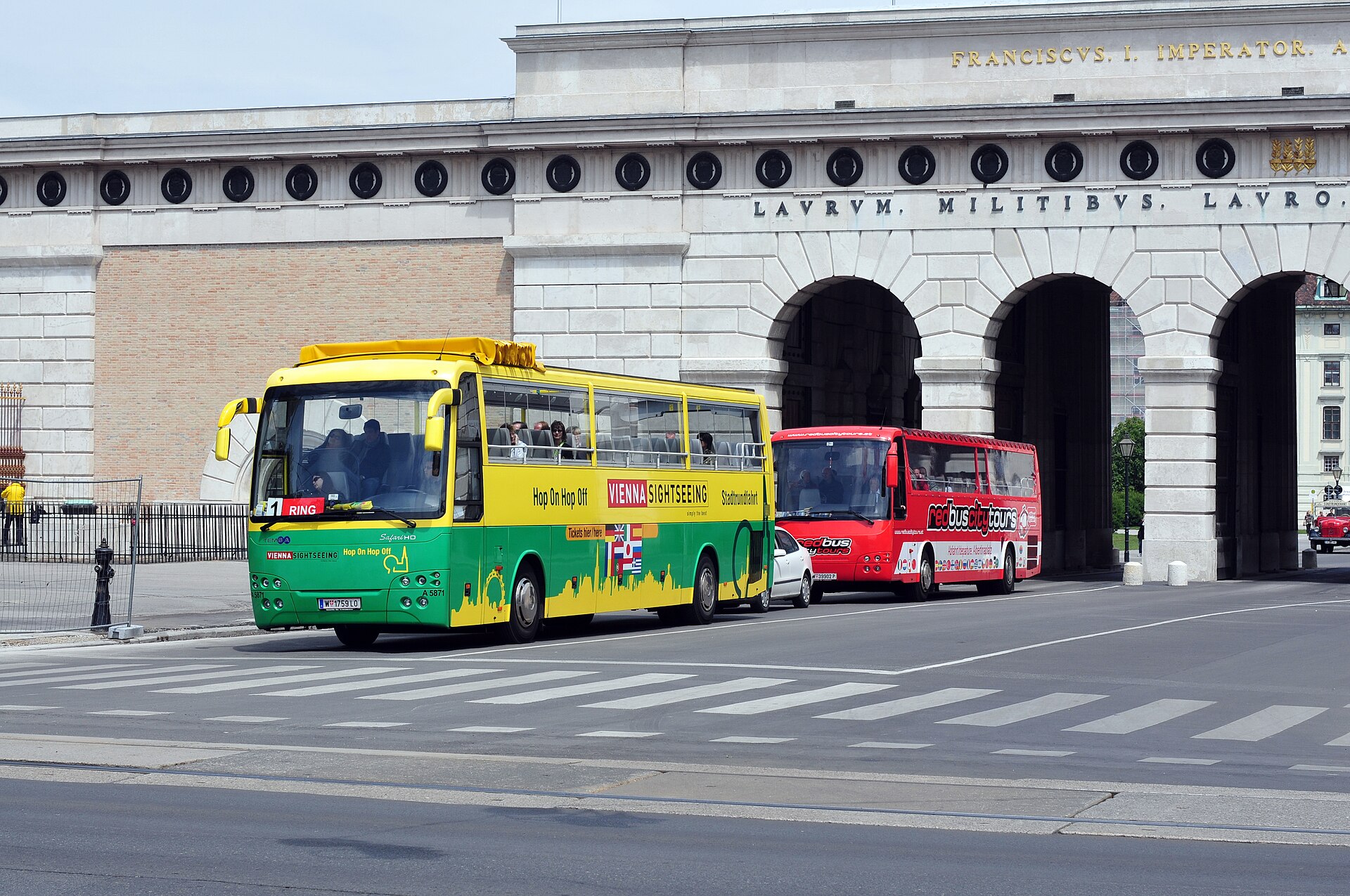
Stand at the Burgtor on Heldenplatz for ten minutes on a summer morning and you will see a yellow-and-green bus, a red double-decker and a second red bus all pull up within sight of each other, each selling essentially the same circuit of the same city. Meanwhile, a tram that costs €2.40 for a single journey runs the full length of the Ringstrasse a hundred metres away. Working out whether hop on hop off Vienna buses are worth the money means being honest about that comparison first, and about the fact that Vienna is one of the few European capitals where the answer is frequently no.
This guide compares the two main operators route by route, sets out what each actually costs, explains the €6 alternative that covers most of the same ground, and identifies the specific situations — and there are real ones — where a hop-on hop-off ticket is genuinely the right purchase. Prices were checked in September 2026 and vary by season; treat them as the right order of magnitude rather than a quotation.
The Two Operators at a Glance
| Big Bus Vienna | Vienna Sightseeing | |
|---|---|---|
| Livery | Red open-top double-deckers | Yellow and green |
| Routes | 2 | 4 |
| Stops | 25 | 50+ |
| Audio languages | 8 | 19 |
| Frequency | Every 20–30 minutes | Every 30–60 minutes |
| Operating hours | Roughly 09:15–17:30 | Roughly 09:15–17:20 |
| 24-hour ticket | From about €37 | Comparable |
| 48-hour ticket | About €45 | About €45 |
| 72-hour ticket | Around €50–55 | Around €50–55 |
| Extras | Free date changes; 48h adds walking tours and a sausage plate | Summer Green Line to Grinzing and the wine hills |
| Included in the Vienna Pass | No | Yes, all four routes |
First, the Honest Question: Does Vienna Need One?
Three facts make Vienna an unusually weak market for sightseeing buses, and no operator is going to volunteer them.
The historic core is about 1.5 kilometres across. Nearly every headline sight inside the Ring — St. Stephen’s Cathedral, the Hofburg, the State Opera, the Kunsthistorisches Museum, the Albertina, the Rathaus — is within twenty minutes’ walk of the others, along flat, handsome, pedestrianised streets. A bus that drives you between them is solving a problem you do not have.
The public transport is world class and costs almost nothing. A single is €2.40, a 24-hour pass €6.00, a 72-hour pass €17.10. The U-Bahn runs every two to five minutes and all night at weekends. That is a third of the price of a 24-hour bus ticket for a network that goes everywhere rather than round a loop. Our guide to Vienna transport tickets and passes has the full fare table.
Trams 1 and 2 already do the Ringstrasse tour. More on that below, because it is the single most useful thing on this page.
What the buses genuinely add is: a roof to sit under with a commentary in your language, a seat you do not have to stand up from, and step-free access to Schönbrunn and Belvedere without changing lines. Those are real benefits for specific people. They are not worth €37 to a fit twenty-eight-year-old with three days and a map.
Big Bus Vienna
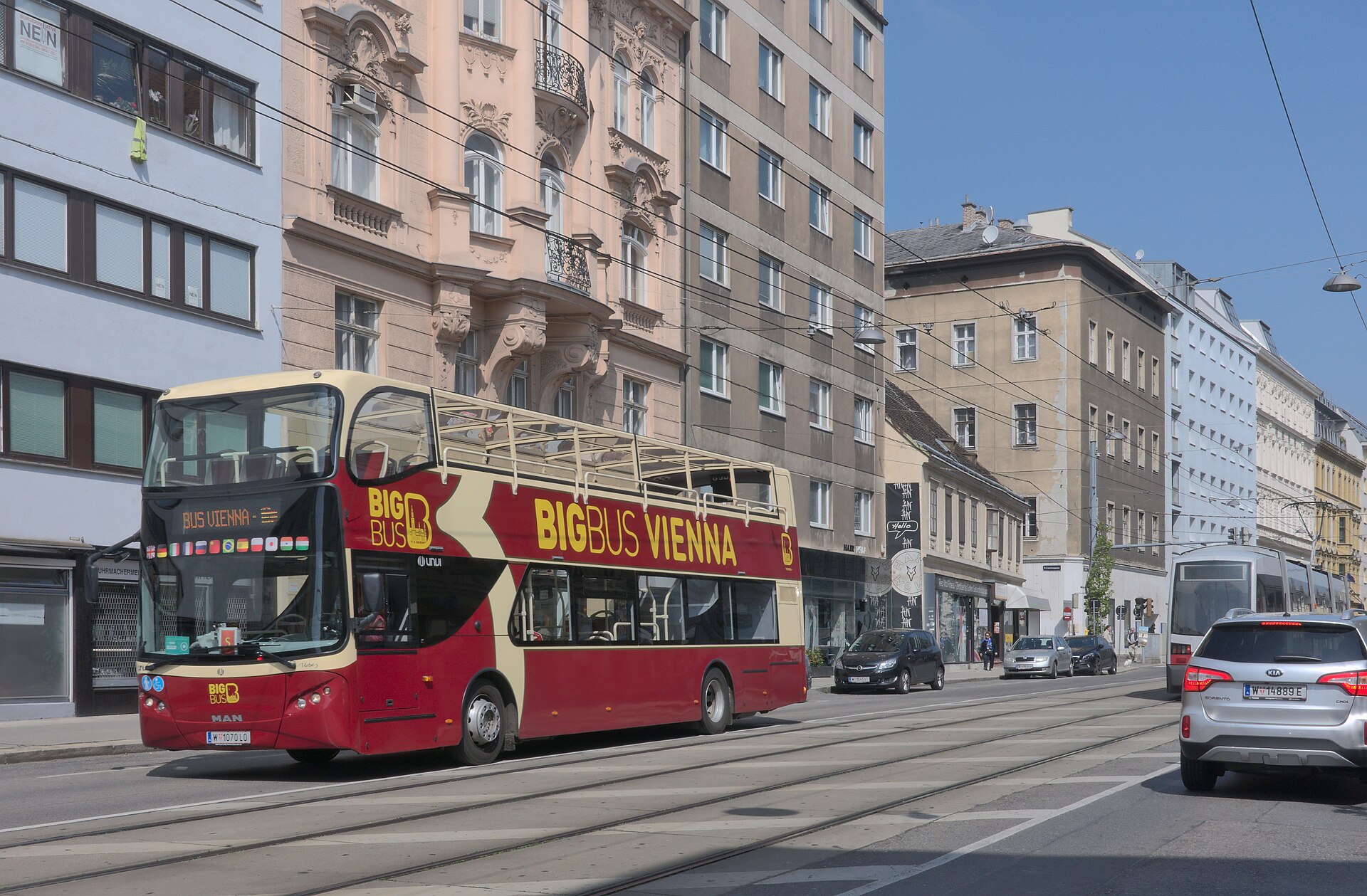
The international brand, running red open-top double-deckers on two routes covering 25 stops, with recorded commentary in eight languages. Buses come every 20–30 minutes, which is the best frequency in the city, roughly from 09:15 to 17:30.
The two-route structure keeps things simple: one loop does the Ring and the inner city, the other runs out to Schönbrunn and the western sights. You are unlikely to get lost or to find yourself waiting an hour.
Prices start around €37 for 24 hours and €45 for 48, with 72-hour tickets in the €50–55 range. Tickets include free date changes if your plans move, which is more useful than it sounds when you are booking a summer trip months ahead. The 48-hour ticket bundles in guided walking tours and a Viennese sausage plate — a genuine extra, though not one worth choosing the operator for.
Verdict: the better bus if you want frequency and simplicity, and the better bus for a short stay. The open top is excellent in June and a mistake in November.
Vienna Sightseeing
The local operator, in yellow and green, running the largest network in the city: four colour-coded routes, more than 50 stops, and audio commentary in 19 languages. Frequency is lower — every 30 to 60 minutes depending on the route and the season — and hours are similar, roughly 09:15 to 17:20.
The four routes cover considerably more ground than Big Bus’s two, including outer districts and, in summer, a Green Line out to Grinzing and the wine-growing hills on the city’s northern edge. That last one is the genuinely distinctive product: it takes you somewhere the other operator does not go, and somewhere that is a real faff on public transport with luggage or small children. Our Heurigen guide explains what is up there.
Prices are broadly comparable, at about €45 for 48 hours. The significant difference is that Vienna Sightseeing’s four routes are included in full with the Vienna Pass, which changes the arithmetic entirely if you were considering that product anyway — see our Vienna Pass review and our analysis of whether the Vienna Pass is worth it.
Verdict: the better bus for a longer stay, for wider coverage, and for anyone holding a Vienna Pass. The lower frequency is a real cost — a missed bus on a 60-minute route can eat an hour of a short trip.
The €6 Alternative: Trams 1 and 2
This is the single most useful piece of advice on this page, and it is why we are lukewarm about the buses in general.
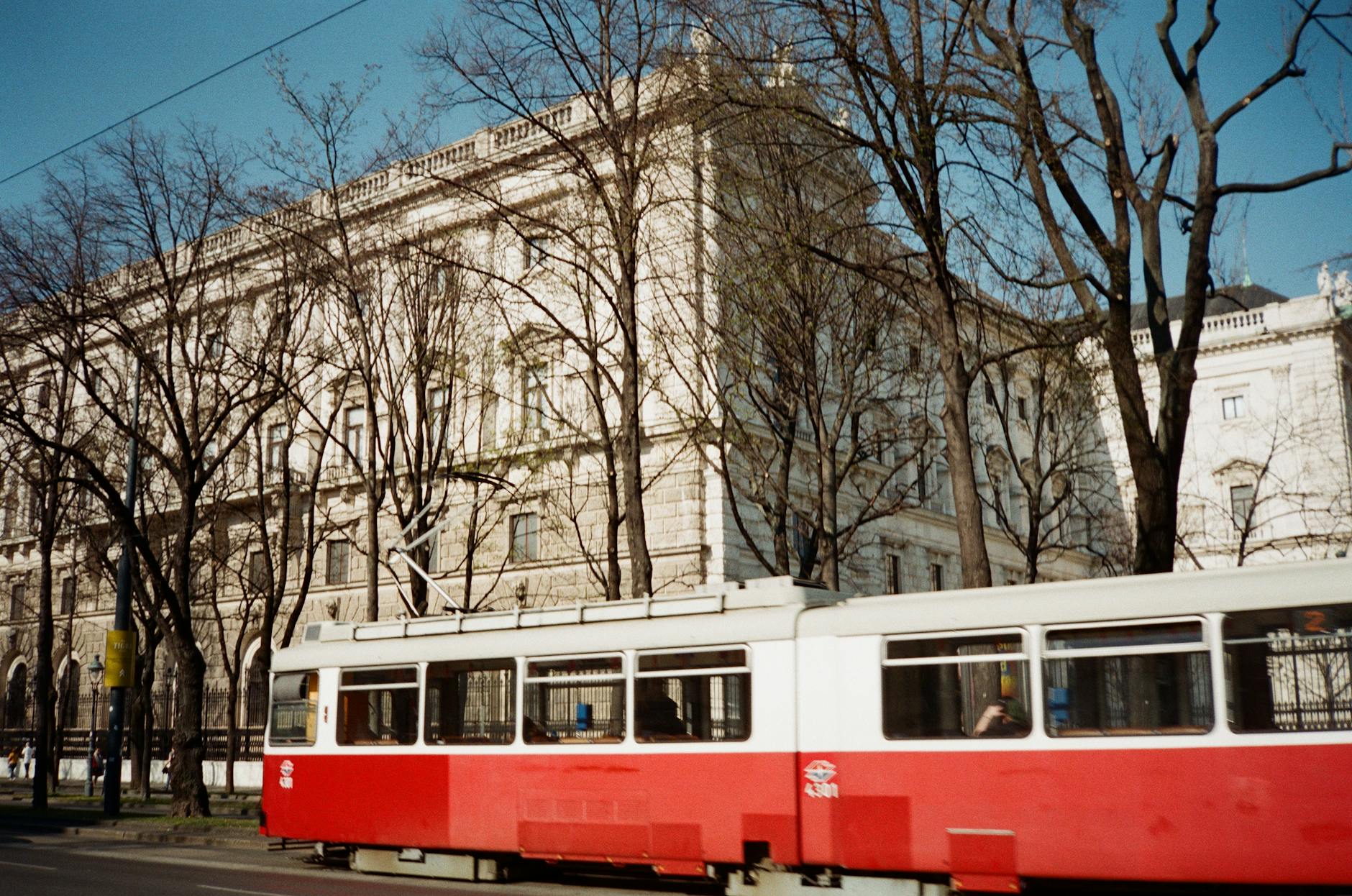
Vienna’s Ringstrasse — the grand boulevard built on the line of the demolished city walls — is served by ordinary public trams. Tram 1 runs one half of the circuit and tram 2 the other; together they take you past the State Opera, the Kunsthistorisches and Naturhistorisches Museums, the Parliament, the Rathaus, the Burgtheater, the University, the Votivkirche, the Stock Exchange and the Urania, which is the great majority of what a hop-on hop-off Ring loop shows you.
The cost is a €2.40 single or nothing extra at all if you already hold a transport pass. The trams run every few minutes, from early morning to late at night, in every season, with heating in winter. You can get off wherever you like and get back on with the same ticket if it is a day pass.
What you do not get is commentary. That is a genuine difference, and it is solvable: a downloaded audio guide, or a decent guidebook, or our own Ringstrasse guide, which walks you building by building. Our Vienna tram guide covers the network more broadly, and includes the historic vintage tram that occasionally runs the same route.
If your interest is the Ringstrasse specifically, take the tram. It is not a compromise; it is a better product at a tenth of the price.
What the Bus Routes Actually Show You
Setting the price question aside for a moment, it is worth knowing what a full loop contains, because the answer explains why the buses feel repetitive after the first hour.
The Ring loop — both operators run a version of it — is the great nineteenth-century boulevard and its buildings: the State Opera, the twin museums on Maria-Theresien-Platz, the Parliament with its Athena fountain, the neo-Gothic Rathaus, the Burgtheater, the University, the Votivkirche. It is genuinely one of the most coherent pieces of urban planning in Europe, built in a single push from 1857 onwards on the line of the demolished fortifications, and it is the reason Vienna looks the way it does. Our Ringstrasse guide takes it building by building.
The southern extension takes in the Belvedere, Karlskirche and the Naschmarkt, and in some versions the Hundertwasserhaus and the Prater.
The western route is the one that earns its keep: out along the Wienzeile to Schönbrunn, which is five kilometres from the centre and the one major sight that genuinely benefits from being driven to.
The summer Green Line (Vienna Sightseeing only) climbs to Grinzing, Kahlenberg and the vineyards, which is the single most awkward part of Vienna to reach without a plan.
What none of the routes really show you is the Vienna most visitors end up liking best: the inner-city lanes behind the Graben, the market streets of Neubau and Mariahilf, the courtyards, the coffee houses. Those are walking, and no bus will take you into them. Our guides to the Innere Stadt and Neubau and Mariahilf cover the ground the loops miss.
Who a Hop-On Hop-Off Ticket Is Genuinely For
We would rather be useful than contrarian. There are five situations where these buses earn their fare.
- Limited mobility. This is the strongest case. The buses are step-free at the stops, drop you at the entrance to Schönbrunn and the Belvedere rather than a few hundred metres away, and remove the cobbles and the U-Bahn stairs from your day entirely.
- Extreme weather. Vienna gets genuinely hot in July and August — regularly into the mid-thirties — and a covered lower deck with air conditioning is a different experience from walking the Ring at two in the afternoon. The same applies in heavy rain.
- Small children. A bus you can get on and off with a pushchair, that requires no line changes, and that gives a tired four-year-old somewhere to sit is worth real money. See Vienna with kids.
- One day, first visit, no plan. If you have a single day, no research done and no appetite for doing any, a 24-hour ticket is a legitimate way to see a lot of the city and decide what to come back to. Our one-day itinerary is the cheaper version of the same idea.
- Schönbrunn and the wine hills in one ticket. Vienna Sightseeing’s outer routes, and particularly the summer Green Line to Grinzing, cover ground that is awkward on public transport. If Grinzing is on your list, the bus is a reasonable way to get there.
Who Should Skip It
- Anyone staying three days or more and comfortable walking. Buy a 72-hour transport pass for €17.10 and use the whole city instead of a loop.
- Anyone whose sightseeing is inside the Ring. You will spend more time waiting for the bus than you would have spent walking.
- Anyone visiting in November, January or February. The top deck is the product, and it is unusable. You are paying open-top prices for an enclosed bus in traffic.
- Anyone who already has a Vienna Pass — you have Vienna Sightseeing included, so do not buy a separate ticket.
- Anyone hoping to use it as transport. It is not. It runs to 17:30, on a fixed loop, at 20–60 minute intervals. The U-Bahn is faster, later and cheaper.
The Other Operators You Will See
Big Bus and Vienna Sightseeing are the two that matter, but they are not the only buses circling the Ring, and the extras are worth recognising so you know what you are looking at.
Redbus City Tours runs red coaches on a similar central circuit, generally at a lower price point and with fewer stops. It is a smaller operation and its buses are usually enclosed coaches rather than open-top double-deckers, which makes it a better bet in bad weather and a worse one in June.
Gray Line and various white-label operators appear on booking platforms selling what is often somebody else’s bus under a different name. The Vienna market has a long history of this, and it is the main reason two apparently different products can have identical route maps.
The Vienna Ring Tram is a different animal again: a dedicated yellow tourist tram that runs the Ring circuit with commentary, operated separately from the ordinary public trams. It is a single loop rather than a hop-on hop-off product, and it costs considerably more than the €2.40 that trams 1 and 2 charge for the same rails. Check whether it is currently running before planning around it — the service has been suspended and reinstated more than once.
The general rule holds across all of them: identify the operator, find its own website, and compare that price against what the platform is asking.
Buying Without Overpaying
Both operators are resold heavily through GetYourGuide, Viator, Tiqets and a long tail of white-label ticket sites, frequently under product names that do not mention the operator at all. Two listings with different titles, different photographs and a €10 price gap are routinely the same bus.
The rules are simple:
- Identify the operator before you buy. If a listing will not tell you whether it is Big Bus or Vienna Sightseeing, that is deliberate.
- Check the operator’s own website. It is almost always the same price or cheaper, and it is where you will find the current route map and any seasonal changes.
- Buy the shortest ticket that covers your plan. The step from 24 to 48 hours is around €8; the step from 48 to 72 is smaller again. That looks like value, but a 72-hour ticket you use for four hours is worse value than a 24-hour ticket you use fully.
- Check what the Vienna Pass would cost you if you are considering Vienna Sightseeing. It bundles the buses with attraction entry, and for a dense sightseeing itinerary it sometimes pays back.
- Do not buy from a street seller. The same rule that applies to concert tickets applies here.
Practical Details
Where to board
The main interchange points for both operators are around the State Opera on the Ring and at the Burgtor on Heldenplatz. Tickets can be bought on board from the driver as well as online, and there is no need to start at stop one — get on wherever you are.
Frequency and the last bus
Both operators finish around half past five, which surprises people planning an evening. Vienna in summer is light until nine; the buses are not. Plan the bus for the middle of the day and the evening for something else — see our guide to evenings in Vienna.
The commentary
Recorded, delivered through earphones handed out on board, and of the standard you would expect: accurate, broad, and not remotely comparable to a licensed guide. Austria regulates the title of Fremdenführer and qualifying takes years; a recorded loop is a different product. If you want a real guide, our comparison of Vienna tours and experiences covers walking tours and private guides, where the tip-based walking tours are the cheapest way to get a human being.
Seasonality
Routes and frequencies contract in winter and some seasonal routes — the Green Line in particular — do not run at all. Check the current map rather than one you found in an article from two summers ago.
Weather on the top deck
The top deck is open. In July it is the best seat in Vienna and you will want sun cream and water. In April it is cold at 40 km/h. In rain it is empty. Factor this in before paying for a product whose whole selling point is a roofless view.

The Arithmetic, Set Out Plainly
Here is the comparison nobody selling you a ticket will make. Assume a couple on a three-day trip.
| Option | Cost for two, three days | What it covers |
|---|---|---|
| 72-hour public transport passes | €34.20 | Every U-Bahn, tram and bus in the city, all day and all night, including the Ring circuit on trams 1 and 2 |
| 72-hour hop-on hop-off tickets | €100–110 | Two to four fixed loops, 09:15–17:30, with commentary |
| Both | €134–144 | The above, plus the ability to get home after the buses stop |
The gap is roughly €70 for a couple, which is a good dinner, two opera tickets and a Fiaker ride, or four museum entries. That is what you are buying the commentary and the open top deck with.
If the answer is still yes — because of mobility, or heat, or children, or simply because you like sightseeing buses and that is a perfectly reasonable thing to like — then buy it without guilt. We would simply rather you made that trade knowingly than discovered the tram afterwards. Our breakdown of what a Vienna trip costs puts the figure in context against everything else you will spend.
Frequently Asked Questions
Is the hop-on hop-off bus worth it in Vienna?
For most visitors, no. The historic centre is small and walkable, a 24-hour public transport pass costs €6.00 against roughly €37 for a bus ticket, and trams 1 and 2 already run the Ringstrasse circuit. It becomes genuinely worthwhile for limited mobility, extreme heat or rain, small children, a single unplanned day, or the outer routes to Schönbrunn and Grinzing.
Which is better, Big Bus or Vienna Sightseeing?
Big Bus for frequency and simplicity on a short stay — two routes, 25 stops, a bus every 20–30 minutes. Vienna Sightseeing for coverage on a longer stay — four routes, 50+ stops, 19 languages, and a summer line to the wine hills — and automatically if you hold a Vienna Pass, which includes it.
How much does a hop-on hop-off bus cost in Vienna?
Roughly €37 for 24 hours, €45 for 48 hours and €50–55 for 72 hours with either operator, though prices move with the season and with which platform you buy from.
What is the cheapest way to see the Ringstrasse?
Trams 1 and 2, which between them cover the whole circuit as ordinary public transport. A single is €2.40; a 24-hour pass covering everything else in the city is €6.00. You lose the commentary and save around €30.
How long does a full hop-on hop-off loop take in Vienna?
Around an hour for the central Ring loop without getting off, and longer for the outer routes to Schönbrunn and the wine hills. With stops, allow a full day to do a whole network properly.
Do hop-on hop-off buses run in winter in Vienna?
Yes, on reduced routes and frequencies, and some seasonal lines do not run at all. The open top deck — the main reason to buy the ticket — is not usable in cold or wet weather, so winter is the weakest case for one.
Is the hop-on hop-off included in the Vienna Pass?
Vienna Sightseeing’s four routes are included in full. Big Bus is not. If you are buying a Vienna Pass, do not also buy a bus ticket.
What time do the buses stop running?
Around 17:20–17:30 for both operators. They are a daytime product, not an evening one.
Can I buy a ticket on the bus?
Yes, from the driver, at the standard price. There is no need to book ahead except in peak summer, and buying on board lets you see the weather first — which, for an open-top bus, is a genuine advantage.
Related Vienna Guides
- Vienna Tours & Experiences Compared
- Vienna Transport Tickets & Passes
- The Vienna Tram Guide
- The Ringstrasse, Building by Building
- Is the Vienna Pass Worth It?
- Vienna City Card vs Vienna Pass
- Getting Around Vienna
- The One-Day Vienna Itinerary
- Vienna Money-Saving Tips
Photo Credits
Vienna Sightseeing and Redbus coaches at the Burgtor: 13-05-24-wien-RalfR-094 by Ralf Roletschek, CC BY 3.0, via Wikimedia Commons.
Big Bus Vienna on Nussdorfer Straße: Wien 09 Alsergrund, Nussdorfer Straße, BigBus by Paul Korecky, CC BY-SA 2.0, via Wikimedia Commons.