Free Walking Tours in Vienna: Which Ones Are Actually Worth Your Time
How tip-based tours actually work, who runs them in Vienna, exactly where and when they meet, what you should really tip, and how to tell a good guide from a bad one in the first ten minutes.
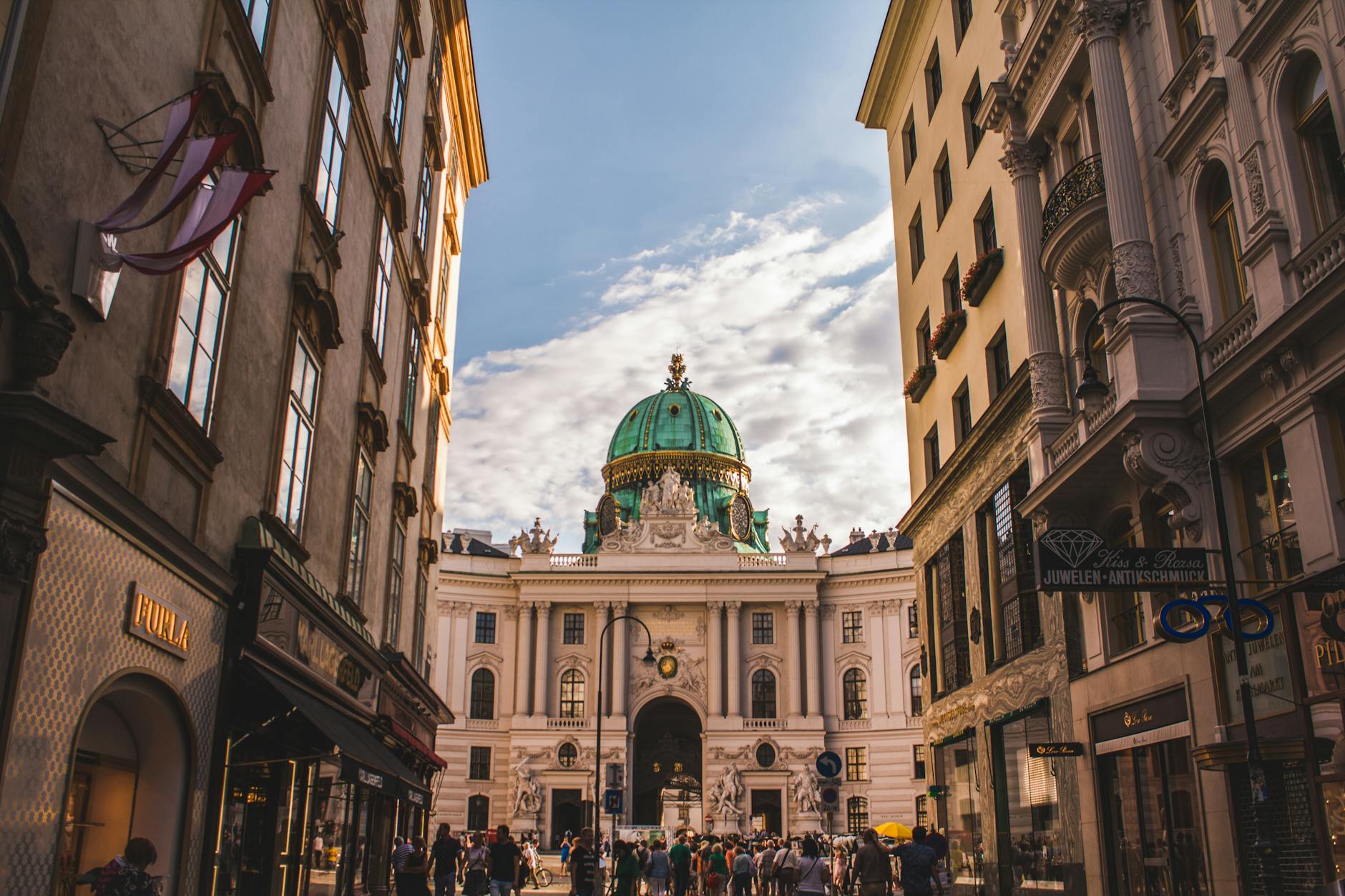
Photo by Prakhar Bansal
- Free Walking Tours in Vienna at a Glance
- How “Free” Actually Works
- Who Runs Them in Vienna
- What You Should Actually Tip
- What the Standard Tour Covers
- Six Things a Good Vienna Guide Will Tell You
- The Licensing Question
- How to Tell a Good Tour From a Bad One
- Free Versus Paid: When to Pay
- Practical Details
- Etiquette, Briefly
- The Honest Downsides
- Frequently Asked Questions
- Related Vienna Guides
- Photo Credits
This article contains advertising. Our booking links are routed through a partner that adds commission tracking automatically, so if you book through one we earn a commission from the provider, at no extra cost to you. It never affects what we recommend. Affiliate disclosure
At ten o’clock on a summer morning there are sometimes four green umbrellas within thirty metres of each other at the foot of the Albertina, each with a guide underneath it and thirty to fifty people gathering round. It looks chaotic and it is a genuinely good system — but the word “free” in free walking tour Vienna is doing a lot of quiet work, and understanding exactly what it means is the difference between a two-hour introduction that reframes the whole city and an awkward shuffle at the back of a crowd you cannot hear.
This guide sets out how tip-based tours actually work economically, who runs them in Vienna, where and when they meet, what you should genuinely tip, what the standard route covers, and — the part nobody writes down — how to tell a good one from a bad one before you have committed two hours to it. Details were checked in September 2026; confirm meeting times on the operator’s own site, because they shift with the season.
Free Walking Tours in Vienna at a Glance
| Actual cost | €10–20 per person, as a tip. Not optional in practice |
|---|---|
| Duration | Two to two and a half hours |
| Typical times | 10:00 and 14:00 daily, year round |
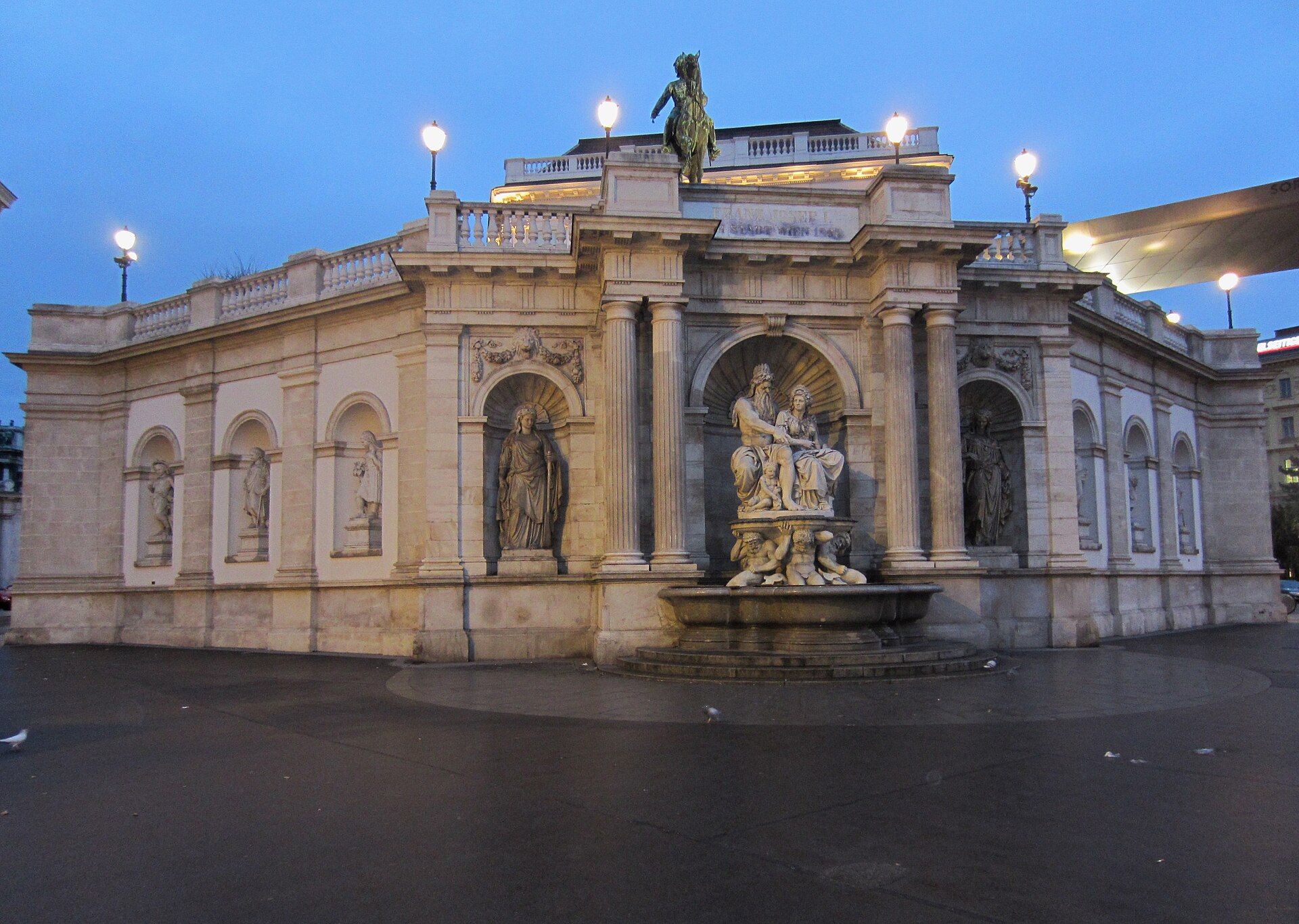
| Main meeting point | Albertinaplatz, at street level by the Albrechtsbrunnen. Look for the green umbrella |
| Arrive | 10–15 minutes early |
| Booking | Free and usually required online; you can often just turn up |
| Group size | 15–20 off season, 40–60 in July and August |
| Language | English daily; German, Spanish and others on some days |
| Covers | Innere Stadt only — Stephansplatz, Graben, Michaelerplatz, Hofburg, Heldenplatz, Ring |
| Does not cover | Museum or palace interiors. Free-tour guides cannot legally guide inside them |
How “Free” Actually Works
This is worth understanding because it changes how you should behave on the tour.
A tip-based walking tour is not a charity and the guide is not a volunteer. In the standard model the guide is self-employed and pays the platform or company a fee for every person who turns up — typically a few euros a head. If nobody tips, the guide has worked two and a half hours and is out of pocket. The tips are the wage, not a bonus on top of one.
This has two consequences. First, tipping is not optional in any meaningful sense, and walking away without paying is not taking advantage of a free offer — it is costing a working person money. Second, it explains the model’s incentives: guides are paid by volume, so they want large groups; they are paid by tip, so they want to be entertaining. Both of those things are visible in the product.
What you get in exchange is real. The guides are typically well-read, often historians or students, frequently foreign residents who chose Vienna and can explain it to outsiders in a way a local sometimes cannot. And the format lets you find out whether you like a guide before paying them, which almost no other tour product allows.
Who Runs Them in Vienna
Good Vienna Tours
The longest-established and the one most people end up on. English free tours run daily at 10:00 and 14:00, meeting in front of the Albertina at street level, beside the Albrechtsbrunnen fountain — not up at the museum’s own entrance, which is a genuinely common mistake and costs people their tour. Look for the green umbrella; arrive ten to fifteen minutes early.
The route covers the historic centre: St. Stephen’s Cathedral, the Hofburg, the old Jewish quarter and the inner city’s highlights. They also run paid themed tours, which is where the business actually makes its money.
Walkative!
A central European network operating in a dozen cities, with a Vienna programme of tip-based tours plus paid specialist walks. Broadly the same product and the same standard; different guides, different personalities.
GuruWalk
Not a tour company but a marketplace: individual guides list their own tours and you book through the platform. Vienna listings typically run at 10:00 and 14:00 from Albertinaplatz, by the Danubius fountain, green umbrella, near the hot-dog stand with the green rabbit on its roof — a landmark that is more useful than it sounds.
Because GuruWalk is a marketplace, quality varies far more than with a single operator, and the reviews attached to an individual guide are correspondingly more informative. This is the platform where reading the reviews genuinely pays.
Others
Several smaller operators and independent guides run tip-based walks in Vienna, some with a specific angle — Red Vienna, the Jewish quarter, the Third Man, Habsburg scandal. Availability shifts season to season. The general rule: if you cannot find the operator’s own website with its own schedule, be careful.
What You Should Actually Tip
The commonly quoted range for Vienna is €10–20 per person. Our recommendation, plainly:
- €10 per person is the floor for a competent two-hour tour. Below that you are not covering the guide’s costs by much.
- €15 per person is the right default for a good tour that you enjoyed.
- €20 or more for a genuinely excellent guide, a small group, or a tour that ran long because people kept asking questions.
- Per person, not per couple. The guide paid a fee for each of you.
Bring cash. Some guides now take cards or a payment app, but many do not, and standing there apologising is worse for everyone than having a €20 note in your pocket. Vienna is more cash-attached than most of western Europe generally — see our money and payment guide and our Vienna tipping guide for the wider convention.
Even at the top of that range, this is the best value guided experience in the city. For comparison, a licensed private guide costs €180–350 for a half day, and a costumed Mozart concert costs €69–139 for ninety minutes — see our concert tickets guide on that particular economy.
What the Standard Tour Covers
Almost every free tour in Vienna walks a version of the same circuit, because the Innere Stadt is small and the highlights are unavoidable. Expect roughly:
- Albertinaplatz and the State Opera — the meeting point, the memorial against war and fascism, and the opera house’s difficult history.
- Kärntner Straße to Stephansplatz — the main shopping spine, and usually a warning about the costumed ticket sellers on it.
- The Stephansdom — exterior, the roof tiles, the two towers, the Turkish siege stories. Interiors are generally not entered.
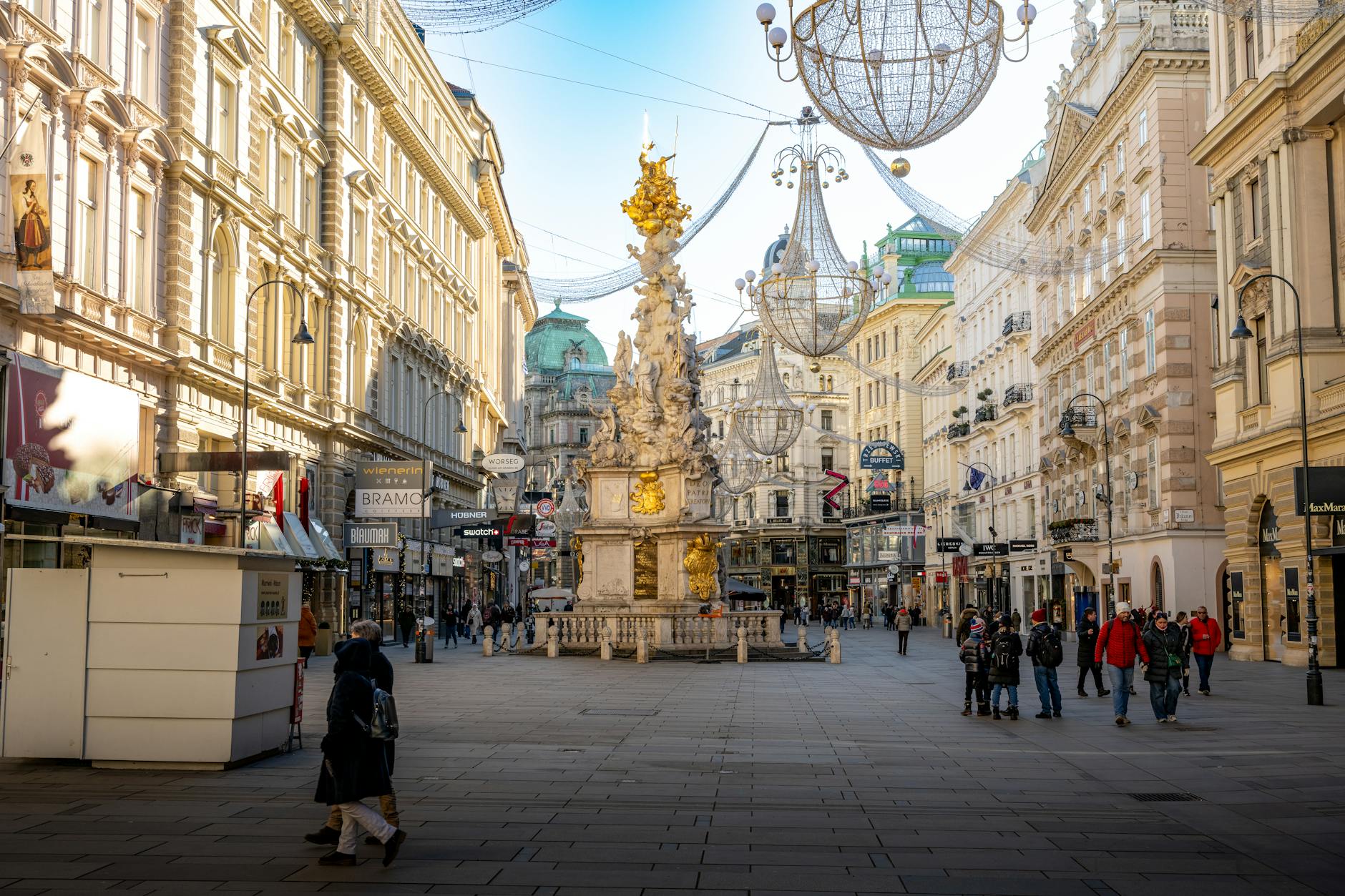
- The Graben — the plague column, the Roman street plan underneath, and the Loos public lavatories, which are genuinely worth the anecdote.
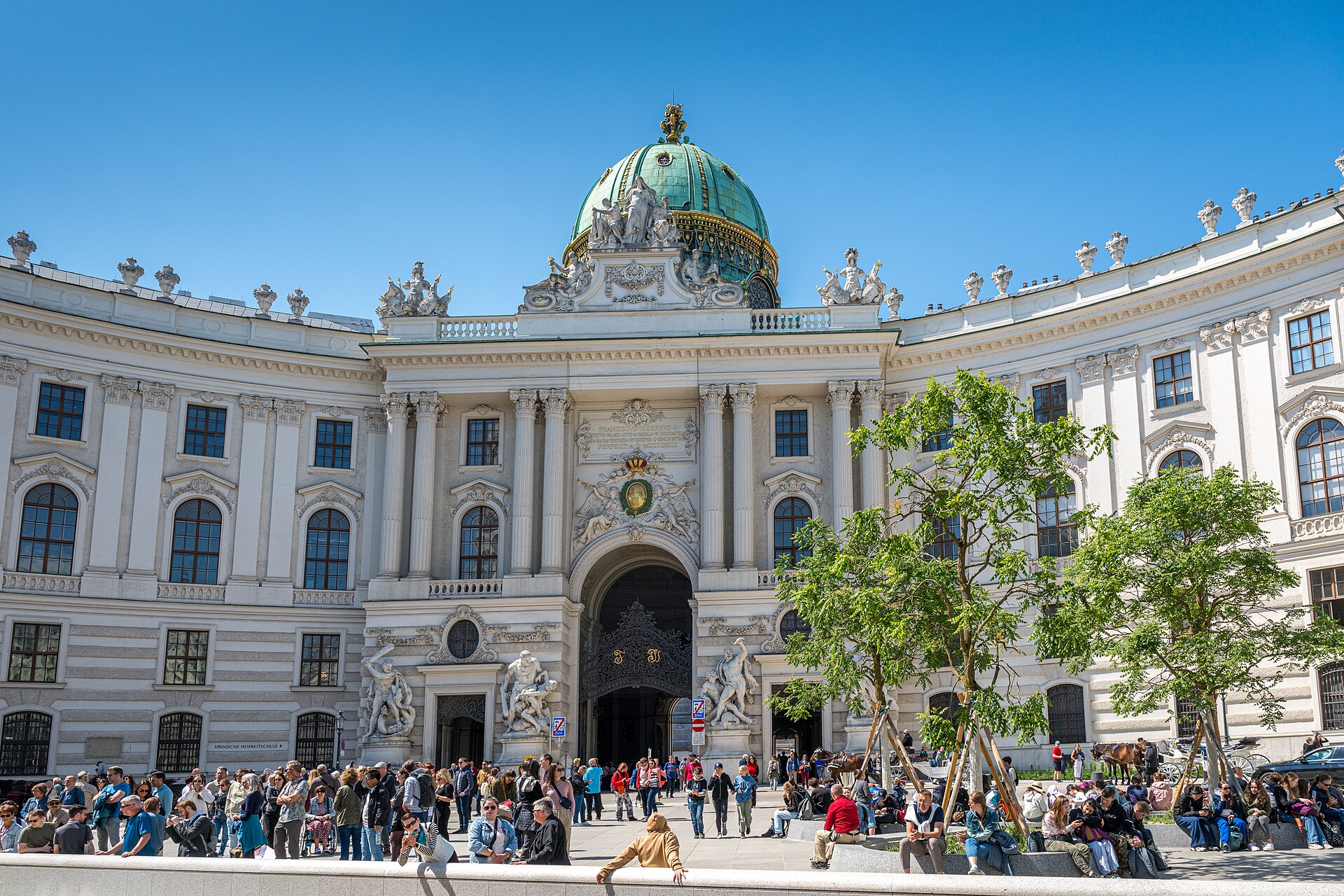
- Michaelerplatz and the Michaelertor — the Roman excavations, the Loos House and the story about Franz Joseph and the “house without eyebrows”.
- The Hofburg and Heldenplatz — the Habsburgs compressed into fifteen minutes, and the balcony from which the Anschluss was announced in 1938.
- The Ringstrasse — usually finishing near the Rathaus, the Burgtheater or back at the opera.
A good guide uses this route as a spine and hangs the actual history off it. A weak one recites dates at each stop. The difference is entirely in the person.
Six Things a Good Vienna Guide Will Tell You
To give a sense of what separates a worthwhile two hours from a recital of dates, here are the kinds of things the better guides in this city actually build a tour around. If you hear none of it, you have drawn a weak guide.
Why the Ringstrasse exists at all. Vienna was a walled city until the 1850s, ringed by fortifications and a cleared field of fire. Franz Joseph ordered the walls demolished in 1857 and had the boulevard and its public buildings raised on the site in a single planned push. The reason the Parliament is Greek, the Rathaus Gothic and the museums Renaissance is that each style was chosen to argue for what the building was for. Our Ringstrasse guide goes building by building.
Why the Stephansdom roof is patterned. The tiles form the double-headed eagle and the arms of the city, and the whole roof is a post-war reconstruction — the cathedral burned in 1945 after the fires spread from nearby shops, and every Austrian province contributed to rebuilding it. See our Stephansdom guide.
What the plague column on the Graben is actually commemorating. Not a victory, an epidemic — and it is one of the strangest and most theatrical pieces of Baroque public sculpture in Europe.
Why the Loos House upset an emperor. Adolf Loos put an unornamented modernist facade directly opposite the Hofburg’s ceremonial gate in 1910. Franz Joseph is said to have had the palace windows on that side kept shut. It is the single best story on Michaelerplatz and it explains a whole argument about Viennese modernism in ninety seconds. See Jugendstil Vienna.
What happened on the Heldenplatz balcony in March 1938, and how Vienna spent fifty years afterwards deciding what to say about it. A serious guide does not skip this, and the memorial against war and fascism at the tour’s own starting point on Albertinaplatz is where a good one starts the conversation.
Where the Romans were. Vindobona’s street grid is still legible in the inner city, and the excavated foundations are visible under glass on Michaelerplatz. Vienna is roughly two thousand years old and the Habsburg version is only the most recent layer. Our history of Vienna covers the full sequence.
The Licensing Question
Austria regulates the profession of Fremdenführer — licensed tourist guide. Qualifying takes a multi-year course and a state examination covering art history, architecture, history and Austrian law, and licensed guides are legally the only people permitted to guide commercially inside many museums and monuments.
Most free-tour guides operate outside that system. This is entirely legal on public streets, and it is not a criticism — plenty of tip-based guides are excellent, and some are licensed. But it explains two things you will notice:
- Free tours stay outside. You will stand in front of the Hofburg, not inside it. If interiors are what you want, you need a different product.
- It explains the price gap. A two-hour street walk costs a tip; three hours with a licensed guide inside the palaces costs €200. You are buying different things.
How to Tell a Good Tour From a Bad One
The variable is the guide, not the company, and you can assess it in the first ten minutes.
Good signs: the guide introduces themselves and asks where people are from; the group is under about twenty-five; they carry a speaker or project properly; they start with a framing idea rather than a list; they say something at the first stop that you had not read on a plaque.
Warning signs: a group of fifty; no amplification; a guide reading from a script; heavy up-selling of the company’s paid tours in the first twenty minutes; long stops in direct sun with no shade offered.
You are allowed to leave. Nobody has paid anything yet. If the group is enormous and you cannot hear, walk away in the first ten minutes and come back at 14:00 with a different operator. This is the great structural advantage of the tip-based model and almost nobody uses it.
Timing that improves your odds
- Take the 10:00, not the 14:00. Smaller groups, cooler, and it leaves the whole afternoon.
- Avoid July and August if you can. Groups double, and a fifty-person walking tour on Kärntner Straße is not a tour, it is a crowd. May, June, September and October are much better — see our guide to the best time to visit Vienna.
- Off-season is a different product entirely. A January free tour might have eight people on it. It is worth wearing the coat for.
- Book online even though you do not have to. It costs nothing and it tells the operator how many guides to send.
Free Versus Paid: When to Pay
Free tours do one job extremely well: they orient you, on day one, on a broad sweep of the historic centre. They are not good at depth, and they are structurally incapable of taking you indoors.
Do the free tour if: it is your first morning, you want the shape of the city, you like the social format, or you want to try a guide before committing to their paid tour.
Pay instead if: you have a specific interest — Klimt and the Secession, Jewish Vienna, Red Vienna’s social housing, the Third Man, Freud, architecture — or you want to go inside somewhere, or you want a group of eight rather than forty. Paid themed walks run €20–45 and are consistently good value; a licensed private guide costs €180–350 for a half day and is worth it split between three or more people.
Our comparison of Vienna tours and experiences covers every category with prices, and our self-guided Vienna walking routes are the genuinely free option if you would rather have a route than a guide.
Themed walks worth paying for
- Jewish Vienna — the Judenplatz excavations, the Leopoldstadt, and a history the standard circuit only touches. See Jewish Vienna.
- Red Vienna — the interwar social housing programme, the Karl-Marx-Hof, and one of the most interesting things this city has ever done. See Red Vienna.
- Secession and Jugendstil — Otto Wagner, Klimt, the Secession building. See Vienna Secession.
- Food tours — a different category, €70–140, and they replace a meal. See Vienna food tours.
- The Third Man and underground Vienna — the sewers, the Ferris wheel, the film. See Vienna’s hidden gems.
Practical Details
Weather
Tours run in rain, in snow and in a heatwave. There is no shelter on the route. In July and August, bring water and a hat — a two-hour standing tour in 34°C is genuinely unpleasant and people do get ill. In winter, dress for standing still rather than for walking; you will be stationary for a good half of the time.
Accessibility
The Innere Stadt is flat, which helps, but it is heavily cobbled and the tours cover about three kilometres with frequent standing stops. Most operators will accommodate a slower pace if you tell them in advance. If mobility is a real constraint, a private guide or the hop-on hop-off bus is the more honest option.
Children
Two and a half hours of standing and listening is a lot for anyone under about ten. Some operators run shorter family walks; otherwise, consider it an adults’ activity. Our Vienna with kids guide has better options.
Language
English tours run daily and are the largest. German, Spanish, Italian and French appear on some days and in some seasons. The English tours are frequently better attended and better resourced. English is spoken everywhere in Vienna in any case — see English in Vienna.
What to bring
Cash for the tip, water, comfortable shoes for cobbles, and a layer. Nothing else. Leave the bag at the hotel; you will be standing in crowds on the busiest streets in the city, which is the one place in Vienna where pickpocketing genuinely happens — see our Vienna safety guide.
Etiquette, Briefly
None of this is complicated, but it makes the two hours better for everyone including you.
- Turn up if you booked. The operator staffs by bookings, and a wave of no-shows means a guide who came in for nothing.
- Stand where you can hear, at the front. The people who hang back at the edge of a forty-person group and then feel short-changed have largely done it to themselves.
- Ask questions. Good guides run on them, and a tour with an engaged group is measurably better than one with a silent one.
- Do not wander off mid-stop to photograph something and then need finding. In a big group it costs the whole tour five minutes.
- Tip in person, at the end, in cash. Look the guide in the eye while you do it; it is a transaction between two people, not a donation box.
- Leave a review if it was good. On GuruWalk in particular, reviews are how individual guides get work, and it costs you two minutes.
The Honest Downsides
- Summer group sizes are the real problem. Forty to sixty people is common in August, and at that size the format stops working.
- The routes are near-identical. Do not do two free tours; do one, then pay for something specific.
- You never go inside anything. Two and a half hours of exteriors is a lot of exteriors.
- The up-sell is real. Most companies use the free tour as a funnel for their paid ones. It is not dishonest, but it takes up airtime.
- Quality is entirely person-dependent, and you cannot know in advance which guide you will get.
- “Free” is not free. Budget €15 a head and treat it as the price.
Even with all that, our verdict is unchanged from the pillar: a tip-based walking tour on your first morning is the single best thing most visitors do in Vienna, and at €15 it remains extraordinary value.
Frequently Asked Questions
Are free walking tours in Vienna really free?
No. The guides are self-employed and generally pay the platform a fee for every person who turns up, so tips are their income rather than a bonus. Budget €10–20 per person and treat it as the price of the tour.
How much should I tip a free walking tour guide in Vienna?
€10 per person is the minimum for a competent tour, €15 is the right default for a good one, and €20 or more for something genuinely excellent. Per person, not per couple, and bring cash.
Where do Vienna’s free walking tours meet?
Almost all of them meet at Albertinaplatz, at street level in front of the Albertina by the Albrechtsbrunnen fountain — not up at the museum entrance. Look for a green umbrella and arrive ten to fifteen minutes early.
What time do free walking tours start in Vienna?
Typically 10:00 and 14:00, daily, year round. Take the 10:00 if you can: smaller groups, cooler weather, and it leaves your afternoon free.
How long is a free walking tour in Vienna?
Two to two and a half hours, covering roughly three kilometres of the Innere Stadt with frequent standing stops.
Do I need to book a free walking tour in Vienna?
Usually you can just turn up, but booking online is free and helps the operator send enough guides. In July and August, book.
Which free walking tour company is best in Vienna?
Good Vienna Tours is the most established and the safest default. Walkative! is comparable. GuruWalk is a marketplace of individual guides, so quality varies more — but the individual reviews are genuinely useful there in a way company-level reviews are not.
Do free walking tours go inside the museums or palaces?
No. Austria licenses guides as Fremdenführer, and only licensed guides may guide commercially inside many museums and monuments. Free tours stay on public streets throughout.
Are free walking tours worth it in Vienna?
Yes, on your first morning — it is the best-value guided experience in the city and it makes everything you see afterwards more legible. Do one, not three; the routes are almost identical, and your second guided experience should be a paid themed walk on something you actually care about.
Can I leave a free walking tour early?
Yes, and you should if the group is unmanageable or the guide is poor. Nothing has been paid at that point. This is the model’s great advantage and hardly anyone uses it.
The Albrechtsbrunnen meeting point sits at the foot of the Albertina, and the museum above it is a sensible place to spend the rest of the morning once the tour ends: the Habsburg state rooms and the Monet-to-Picasso collection take about ninety minutes, and under-19s enter free. See our Albertina museum guide for tickets and opening hours.
Related Vienna Guides
- Vienna Tours & Experiences Compared
- Self-Guided Vienna Walking Routes
- Walking in Vienna
- The Vienna Tipping Guide
- The Innere Stadt
- First Time in Vienna: 15 Essential Tips
- Free Things to Do in Vienna
- Vienna Food Tours Compared
- Vienna on a Budget
Photo Credits
The Albrechtsbrunnen at the Albertina: Der Danubiusbrunnen bei der Albertina by Martin Furtschegger, CC BY 3.0, via Wikimedia Commons.
Michaelerplatz and the Hofburg: Hofburg, Michaelerplatz Wien by Sandor Somkuti, CC BY-SA 2.0, via Wikimedia Commons.