Stephansdom Vienna: Complete Guide to St. Stephen’s Cathedral
Visit Vienna's iconic Stephansdom cathedral. Complete guide to St. Stephen's Cathedral — the 343-step South Tower stair climb, the North Tower elevator with Pummerin bell viewing, the catacombs holding 11,000 plague victims and Habsburg royal organs, the Pilgram pulpit, Anton Pilgram's window-gazer self-portrait, dress code reality, and the 1945 fire and reconstruction story.
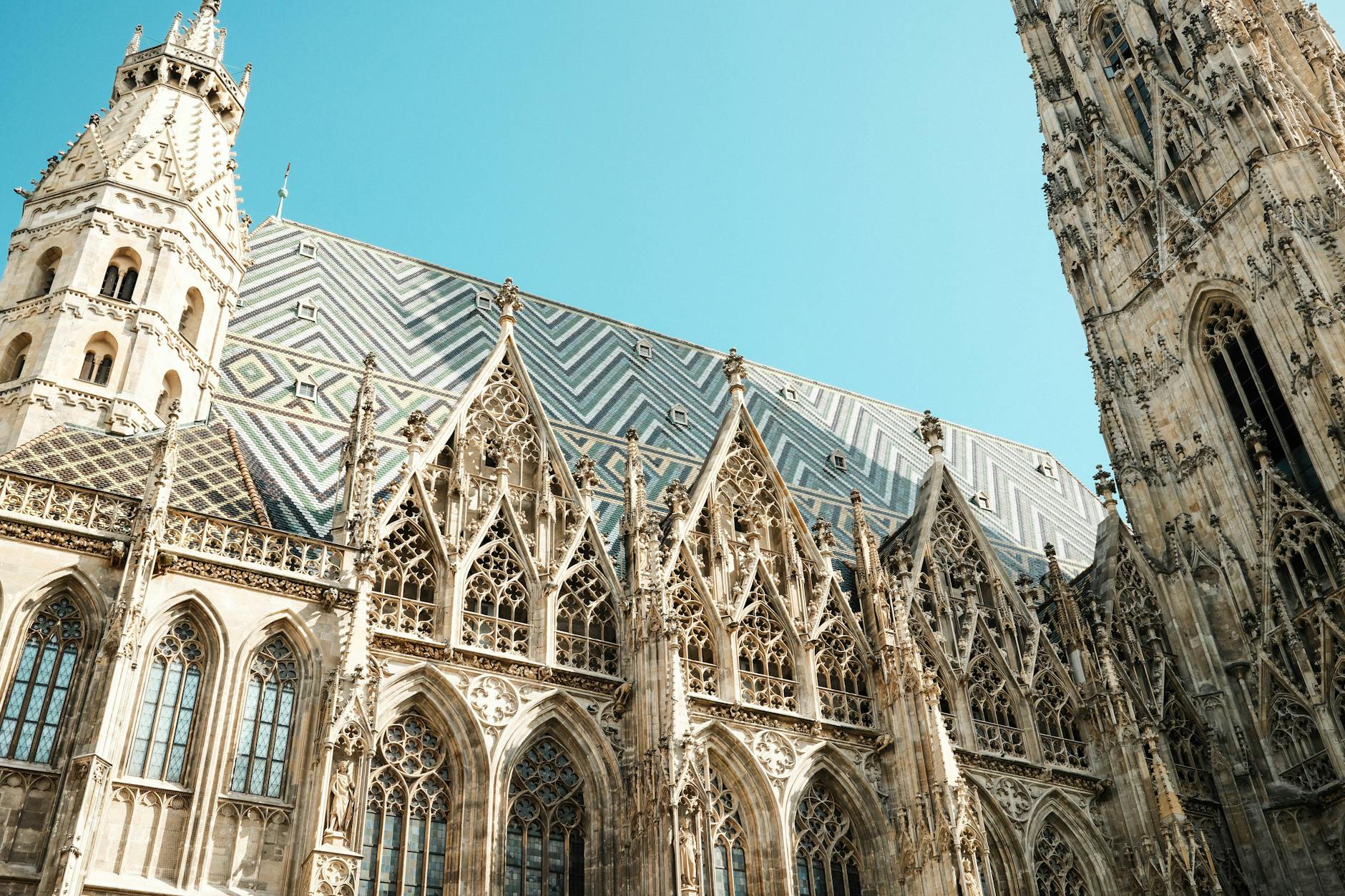
Photo by Airam Dato-on
- Stephansdom at a Glance
- Stephansdom Tickets and Pricing
- The Cathedral Interior
- The Stephansdom Towers — South vs North
- The Stephansdom Catacombs
- The Cathedral Treasury (Dom und Diözesanmuseum)
- Stephansdom Dress Code Reality
- Mass and Sunday Services
- The Cathedral’s Architectural History
- How to Visit Stephansdom — The Canonical Half-Day
- Stephansplatz: The Square Around the Cathedral
- Cathedral History Quick Reference
- Famous Stephansdom Events
- Stephansdom with Kids
- Common Stephansdom Mistakes
- FAQ
- Final Tip: Visit Twice
- Related Vienna Guides
This article contains advertising. Our booking links are routed through a partner that adds commission tracking automatically, so if you book through one we earn a commission from the provider, at no extra cost to you. It never affects what we recommend. Affiliate disclosure
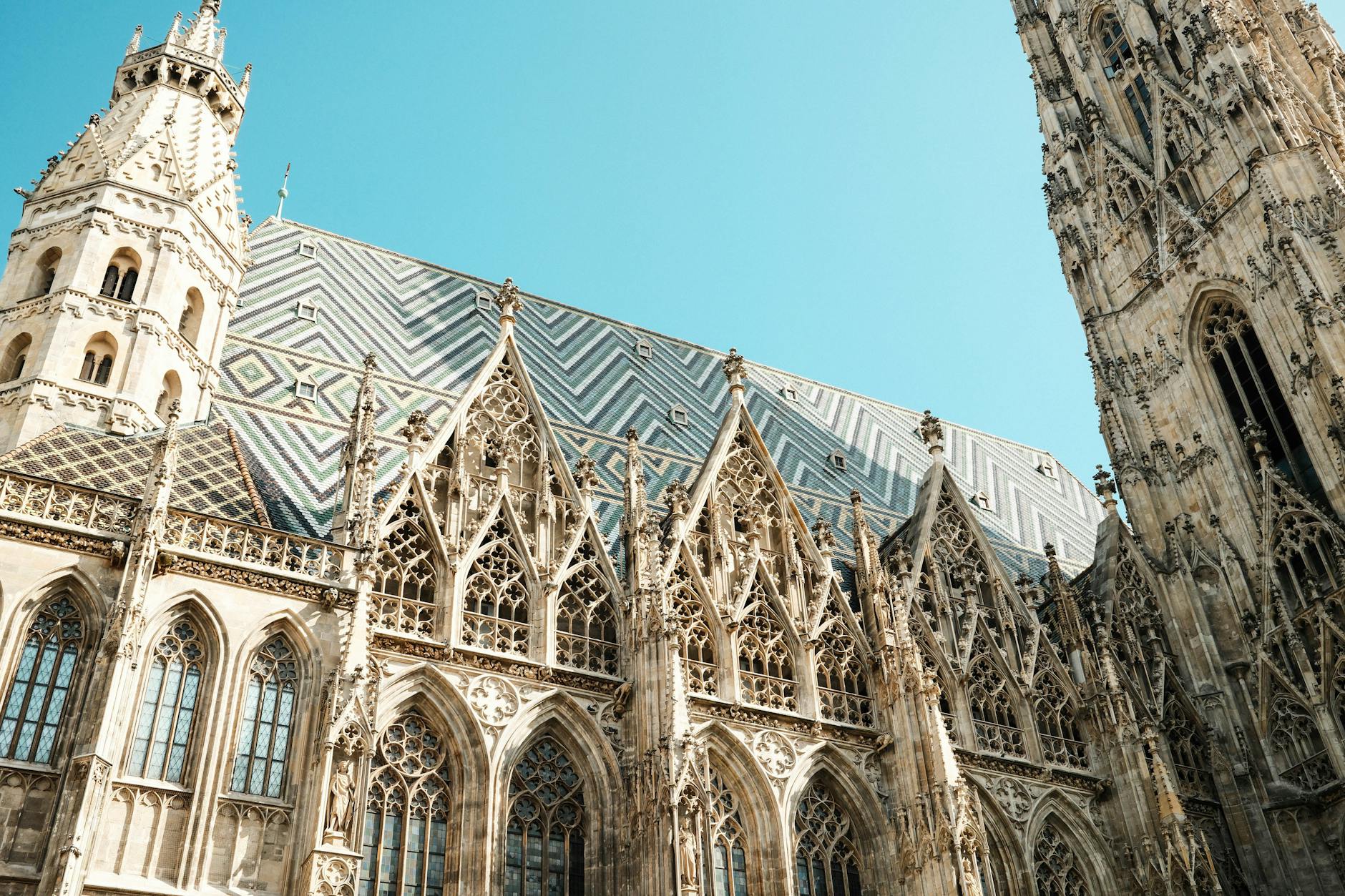
Stephansdom — St. Stephen’s Cathedral — is the symbolic heart of Vienna. The Gothic cathedral has anchored the city for over 700 years, with construction beginning in 1137 and the iconic South Tower (Steffl) completed in 1433. The cathedral survived the 1683 Ottoman siege, the 1809 Napoleonic occupation, and the 1945 fire in the final days of WWII that destroyed most of the interior. Today it remains a working Catholic cathedral (Vienna’s archdiocese seat), a UNESCO World Heritage component, and the most-visited attraction in the Inner City — an estimated 5+ million annual visitors.
Sightseeing visits inside the cathedral cost €8 for adults; the audio guide, tower climbs, catacombs tour, and treasury require separate tickets. The 343-step South Tower stair climb is one of Vienna’s iconic experiences and the North Tower elevator delivers a different but equally good rooftop view. The 11,000 plague-era skeletons in the catacombs and the Habsburg royal organs in the lower crypt give the underground tour an unforgettable atmosphere.
This is the complete Stephansdom Vienna guide: every ticket option, the towers compared, the catacombs experience, the cathedral’s architecture and history, dress code reality, and how to plan your visit. Pair with our Vienna attractions and Vienna history and architecture.
Stephansdom at a Glance
| Aspect | Detail |
|---|---|
| Location | Stephansplatz, 1st district (Innere Stadt) |
| Interior hours | Mon-Sat 6 am-10 pm; Sunday 7 am-10 pm |
| Audio tour hours | Mon-Sat 9 am-5 pm; Sun 1 pm-5 pm |
| South Tower (stairs) | 9 am-5:30 pm summer; 9 am-4:30 pm winter |
| North Tower (elevator) | 9 am-5:30 pm |
| Catacombs tours | Every 30 min, 10 am-5:30 pm |
| Built | Construction began 1137; main building 1300s-1500s |
| Length | 107 meters |
| South Tower height | 136 meters (Vienna’s third-tallest structure) |
| Roof tiles | 230,000 in the famous Zickzack pattern |
| Pummerin bell weight | 21 tons (one of Europe’s largest swinging bells) |
Stephansdom Tickets and Pricing
A sightseeing visit inside the cathedral costs €8 for adults, and the towers, catacombs and treasury are ticketed individually. Pricing for 2026:
| Attraction | Adult | Child (6-14) |
|---|---|---|
| Interior (sightseeing visit) | €8 | Check stephansdom.or.at/info.php |
| Audio tour of full interior | €6 | €2.50 |
| South Tower (stairs, 343 steps) | €8 | €2 |
| North Tower (elevator) | €8 | €3 |
| Catacombs tour (guided, 30 min) | €8 | €2.50 |
| Cathedral Treasury | €6 | €2 |
| All-Inclusive combo | €29 | Check stephansdom.or.at/info.php |
The All-Inclusive combo ticket covers the cathedral with a digital audio guide, both towers, the catacombs tour and the cathedral museum, and stays valid for a year, so it is the better choice if you’ll do everything.
The Cathedral Interior
The Stephansdom interior is 107 meters long, 28 meters high, and can accommodate 12,000 standing worshippers. A sightseeing visit costs €8 for adults; the audio tour (€6) provides commentary on the major features and access to the inner choir area beyond the rope barrier.
Interior Highlights
Pilgram’s Pulpit (c. 1515)
Anton Pilgram’s late-Gothic stone pulpit is one of Europe’s great sculptural works. The pulpit features carved portraits of the four Latin Doctors of the Church (Ambrose, Jerome, Augustine, Gregory) on its sides, lizards and toads on the staircase (symbolizing evil), and a famous self-portrait of Pilgram himself “looking out” from under the staircase at his own work. The “Fenstergucker” (window-gazer) is one of the most photographed details in any European cathedral.
The Mary Pöcs Icon
A 17th-century icon of the Virgin Mary that “wept tears” in 1696 — a Marian apparition that became a major Counter-Reformation symbol. The icon is still displayed in a side chapel and remains a place of pilgrimage.
The Wiener Neustädter Altar (1447)
A massive Gothic winged altarpiece originally from the Cistercian monastery in Wiener Neustadt, moved to Stephansdom in 1884. The altar has 24 painted panels showing scenes from the life of Mary and the Saints. Best viewed on Sundays when the altar is fully opened.
The Tomb of Friedrich III (1467-1513)
Vienna’s largest Late Medieval tomb — a 9-ton red marble sarcophagus by Niklas Gerhaert van Leyden, considered one of the most important German Renaissance sculptural works. Holy Roman Emperor Friedrich III rests here under a hyper-detailed allegorical canopy.
The Albertine Choir
The cathedral’s interior choir area, accessible with the audio tour ticket. Contains the high altar by Pock (1647) showing the stoning of St. Stephen, the patron saint.
The Stephansdom Towers — South vs North
South Tower (Stair Climb)
The South Tower — known affectionately as “Der Steffl” — is Vienna’s most iconic visit. 343 spiral steps in a narrow medieval staircase that’s single-file, can’t be exited mid-climb (once you’re going up, you commit), and rewards the effort with the best 360-degree view of Vienna from any structure in the Inner City.
Practical reality:
- The staircase is genuinely narrow — tight enough that two-way traffic causes pauses on the way down
- The climb takes about 10-15 minutes upward at average pace
- No handrail in much of the staircase; bracing against the wall is normal
- The descent is harder than the ascent on the knees
- The viewing platform at the top is small but has railings on all sides
- The Pummerin bell isn’t here (it’s in the North Tower)
- People with claustrophobia or mobility limitations should choose the North Tower elevator instead
€8, allow 30-45 minutes total. Open mostly Mon-Sat 9 am-5:30 pm in summer, less in winter.
North Tower (Elevator)
The North Tower is the unfinished one — construction was stopped in 1511 when funding ran out, leaving it stubby at 68 meters compared to the South Tower’s 136 meters. The smaller dome was added in 1556. Today the North Tower houses the Pummerin bell (one of Europe’s largest swinging bells, 21 tons) and offers an elevator ride to the viewing platform.
The view is technically less dramatic than the South Tower (lower platform), but the elevator is essential for mobility-limited visitors and the Pummerin bell viewing is a unique experience the South Tower doesn’t offer.
€8, allow 20-30 minutes total.
The Roof Tiles
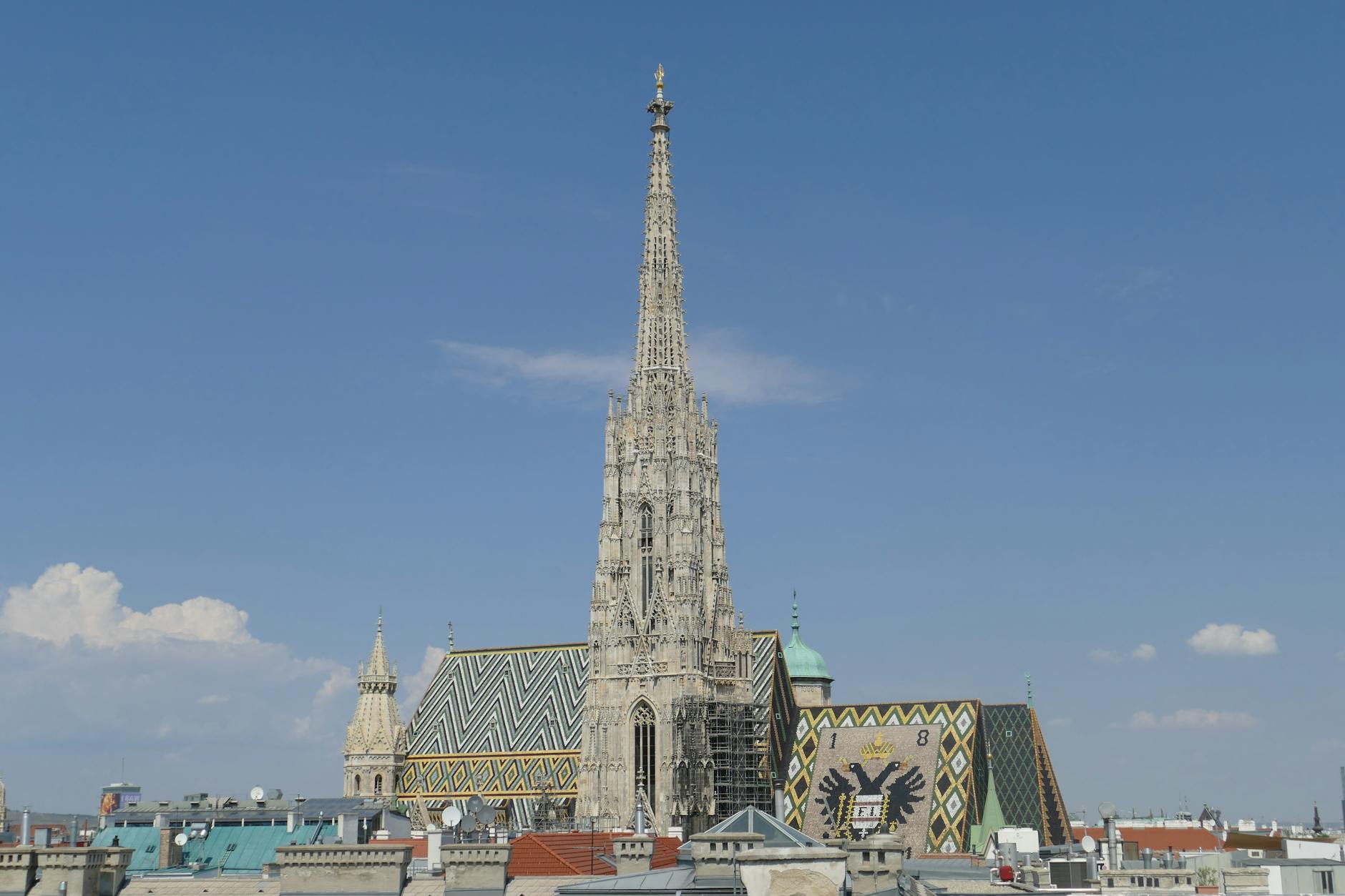
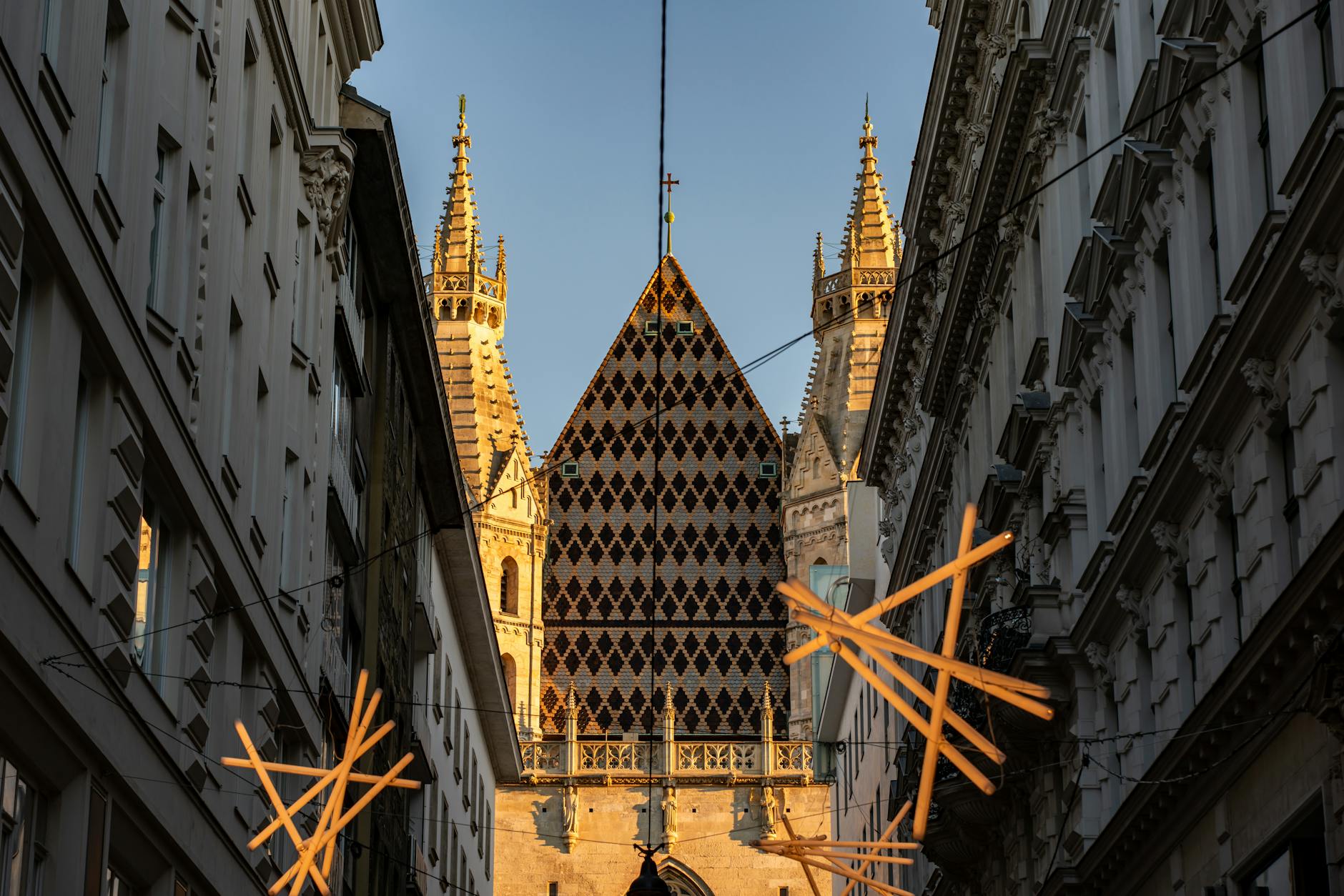
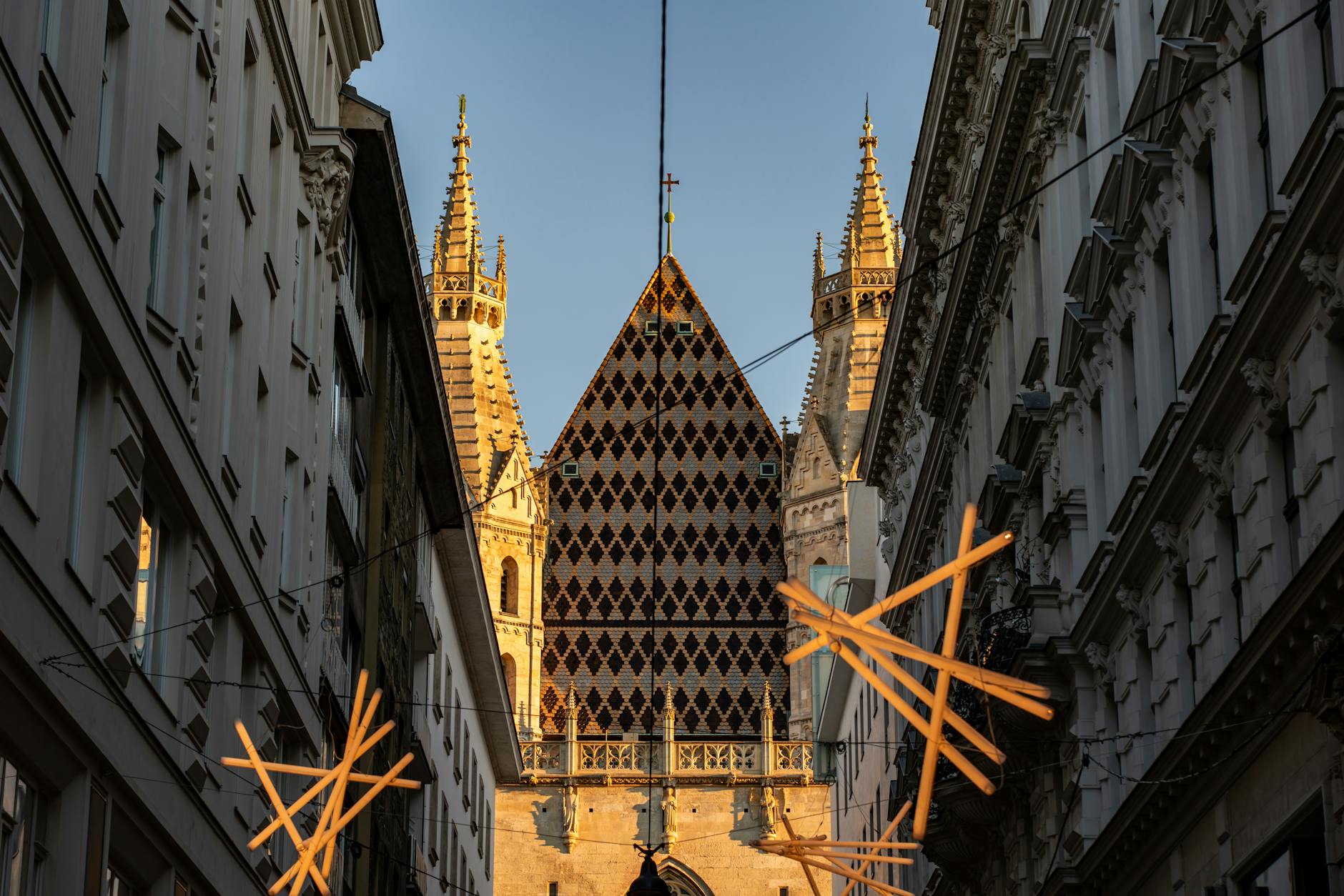
Stephansdom’s roof is one of the most distinctive in Europe — covered in 230,000 colored ceramic tiles arranged in the Habsburg double-headed eagle pattern on the south side and the coats of arms of Vienna and Austria on the north side. The roof was rebuilt after the 1945 fire that destroyed most of the original tiles. Photograph from the South Tower for the iconic angle.
The Stephansdom Catacombs
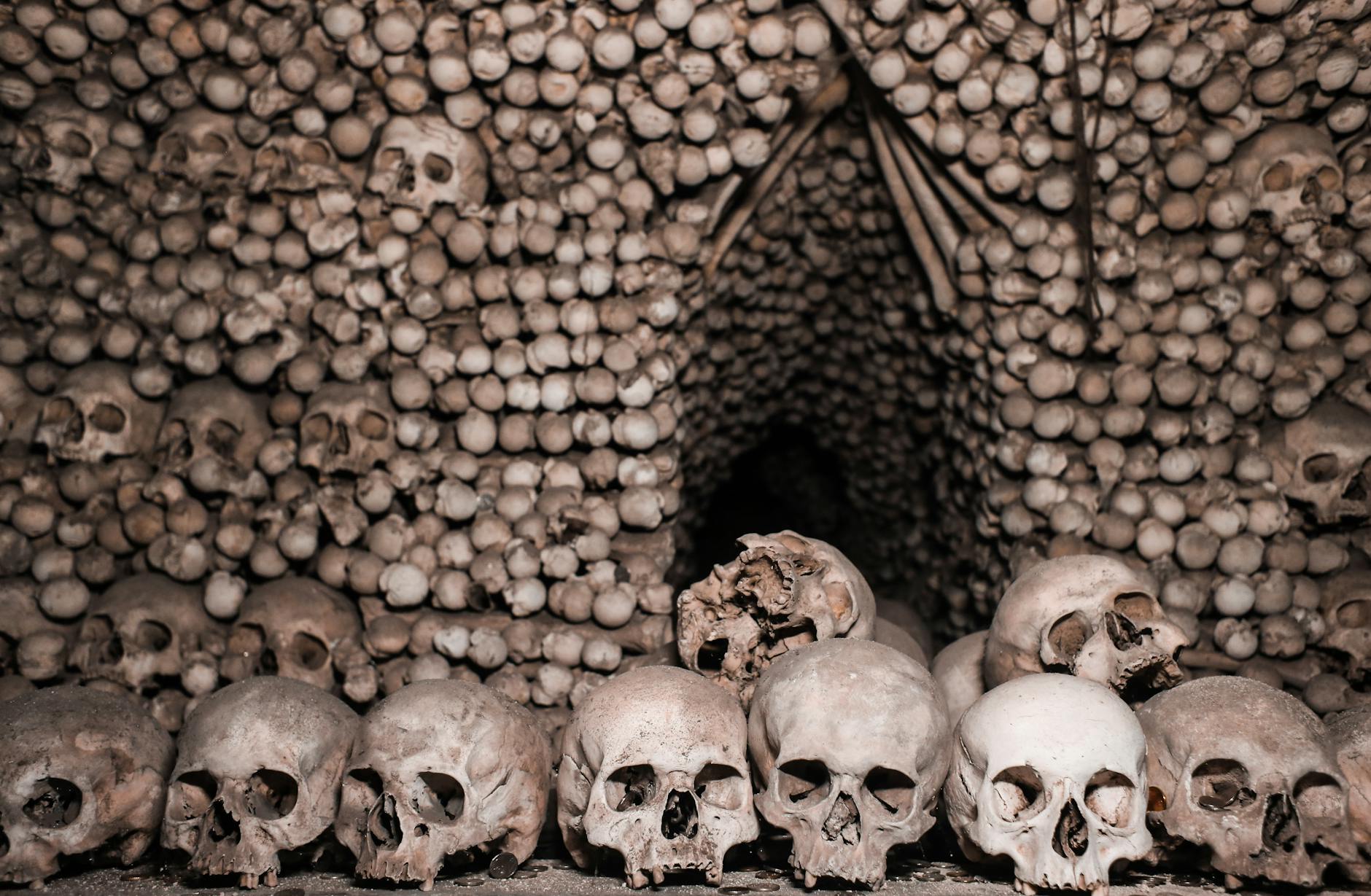
The cathedral catacombs are Vienna’s most extraordinary visit hidden in plain sight. The guided 30-minute tour descends into the medieval and 18th-century burial chambers beneath the cathedral. Two distinct sections:
The Plague Burials
From 1735 onwards, Vienna’s plague victims (an estimated 11,000 bodies) were interred in mass graves directly beneath Stephansdom. The bones are stacked in chambered rooms, organized by chronology and victim type. The atmosphere is genuinely affecting — particularly the chambers where adult and child remains are separated.
The Habsburg Crypt
Vienna’s most unusual Habsburg burial tradition lies beneath Stephansdom: the Habsburgs separated their bodies into three parts after death. The hearts went to the Augustinerkirche; the abdominal organs went to Stephansdom; the rest of the body went to the Imperial Crypt (Kaisergruft) under the Kapuzinerkirche. The Stephansdom crypt holds the abdominal organs of 73 Habsburgs in copper urns.
This three-burial Habsburg tradition is one of the most peculiar funerary practices in European royal history. The catacombs tour guide explains the political and religious reasoning — the practice was supposed to allow the Habsburgs to be physically present at three churches simultaneously.
Catacombs tours run every 30 minutes; €8 adult; 30-minute duration; English tours available certain hours.
The Cathedral Treasury (Dom und Diözesanmuseum)
The Cathedral Treasury houses Stephansdom’s most precious religious objects — reliquaries, chalices, vestments, and ceremonial regalia from the cathedral’s 900-year history. The treasury also contains paintings, manuscripts, and ceremonial objects from across the Vienna archdiocese. €6 adult; allow 60-90 minutes. Less famous than the Hofburg Imperial Treasury but worthwhile for serious religious-art visitors.
Stephansdom Dress Code Reality
Stephansdom is a working cathedral and the staff occasionally remind visitors about appropriate dress. The rules:
- Shoulders should be covered — no tank tops or strapless tops
- Knees should be covered — short shorts may be denied entry
- No hats inside for men (women’s headscarves are fine)
- No loud talking — particularly during Mass
- Quiet, respectful behavior at all times
The dress code is enforced more strictly during Mass (Sunday mornings + holy days) than during regular tourist hours. In summer, carrying a light shawl or scarf is the standard workaround for sleeveless visitors.
Mass and Sunday Services
Stephansdom holds regular Catholic Mass throughout the week. The schedule varies seasonally — verify on the cathedral website. Key services:
- Sunday High Mass at 10:15 am — most ceremonial; expect crowds
- Sunday Evening Mass at 6 pm — quieter, more local
- Daily morning Masses at 7 am, 8 am, 12:15 pm
- Vesper services (selected evenings)
- Christmas Eve midnight Mass — book ahead; very crowded
- Holy Week services — major liturgical events
Tourists are welcome to attend Mass; standard church etiquette applies (no photography during Mass, stand/sit/kneel with the congregation, leave quietly if needed).
The Cathedral’s Architectural History
The 1137 Romanesque Beginning
The first church on the Stephansdom site was a Romanesque parish church consecrated in 1147 — built mostly between 1137 and that year. Fragments of the original Romanesque structure survive in the cathedral’s western towers (the “Heidenturm” or Pagan Towers, named for the older masonry style).
The 1300s Gothic Transformation
Beginning in 1304, the cathedral was systematically rebuilt in Gothic style. The main building, the choir, and the nave date from this 1300s campaign. The South Tower (Steffl) was begun in 1359 and topped out in 1433.
The Habsburg Era (1500s-1800s)
The Habsburgs expanded the cathedral repeatedly, adding chapels, altars, and the famous roof tiles. The Pummerin bell was cast in 1683 from captured Turkish cannons after the Ottoman siege.
The 1945 Fire
On April 11, 1945, during the final days of WWII, Soviet artillery and fires from the surrounding city damaged the cathedral severely. The roof, much of the choir, and the original Pummerin bell were destroyed. Reconstruction began immediately after the war and continued through the 1950s. The replacement Pummerin bell was cast in 1951 from the original metal. The cathedral was fully restored by 1957.
The Modern Era
Stephansdom remains a working cathedral with active liturgy, ongoing restoration work (the South Tower spire is constantly being maintained), and an estimated 5+ million annual visitors. The cathedral’s image is on Austrian currency, postcards, tourist guides, and the city’s emergency-services badge.
How to Visit Stephansdom — The Canonical Half-Day
Morning (9 am-11 am)
- Enter the cathedral interior (€8 for adults) for 30 minutes
- Take the audio tour (€6) for 45 minutes to access the inner choir and major features
- South Tower climb OR North Tower elevator (choose one based on fitness)
Lunch Nearby
Plachutta Wollzeile, Figlmüller Bäckerstraße, or Trzesniewski — all within 5 minutes’ walk.
Afternoon
- Catacombs tour (€8, 30 min) — the underground experience
- Optional: Cathedral Treasury
- Walk Graben and Kohlmarkt to the Hofburg complex (12-15 minutes)
Stephansplatz: The Square Around the Cathedral
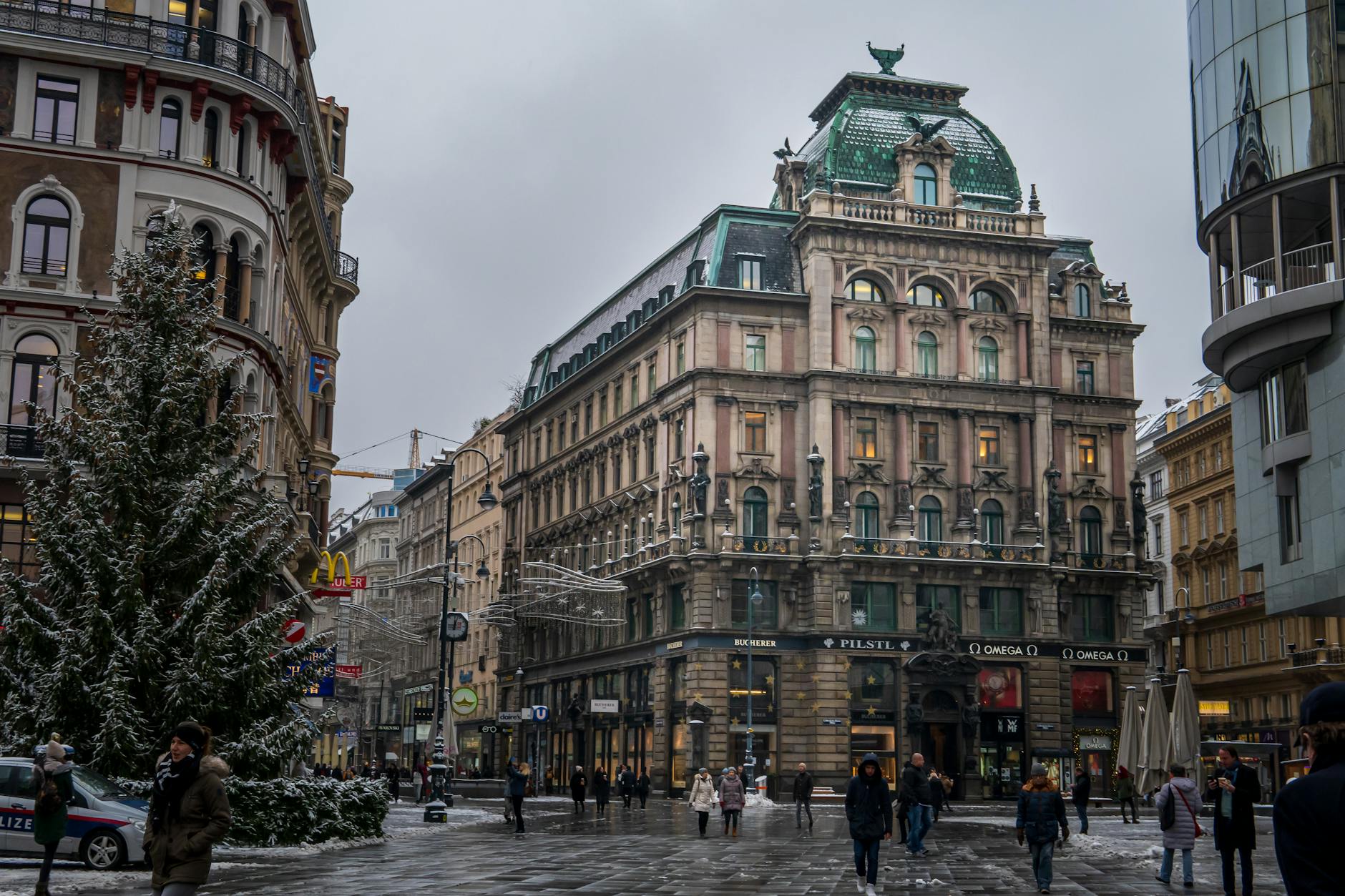
Stephansplatz is the symbolic center of Vienna. The square hosts the cathedral, the famous Hospital of the Holy Spirit ruin in the underground passage, several historic Inner City restaurants, and the convergence of three U-Bahn lines (U1, U2, U3) plus four tram lines. The square is largely pedestrianized; only delivery vehicles allowed in the immediate cathedral area.
The square is a different kind of tourist attraction at different hours:
- Sunrise — empty, photogenic, with the cathedral lit by morning light
- Morning — locals heading to work, light tourist crowd
- Mid-day — peak tourist crowd, street performers, sometimes uncomfortable density
- Sunset — golden hour photography
- Evening — illuminated cathedral, more atmospheric, fewer crowds
- Late night — empty, with a quieter version of the medieval square
Cathedral History Quick Reference
- 1147 — Original Romanesque church consecrated
- 1304 — Gothic reconstruction begins
- 1359 — South Tower construction begins
- 1433 — South Tower (Steffl) completed at 136 meters
- 1469 — Vienna elevated to bishopric (Stephansdom becomes the cathedral)
- 1683 — Pummerin bell cast from captured Turkish cannons
- 1735 — Plague burial vaults beneath cathedral
- 1782 — Mozart marries Constanze Weber at Stephansdom
- 1791 — Mozart’s funeral at Stephansdom
- 1809 — Napoleon’s troops occupy Vienna; cathedral spared
- 1945 — Major fire damage during final WWII days
- 1948 — Pummerin bell rang for the first time at the cathedral’s reopening
- 1957 — Cathedral fully restored to pre-war state
- 2001 — Inner City UNESCO World Heritage designation includes Stephansdom
Famous Stephansdom Events
- Mozart’s wedding (1782) — married Constanze Weber at Stephansdom
- Mozart’s funeral (1791) — held at Stephansdom; he was buried in St. Marx Cemetery
- Beethoven’s funeral procession (1827) — passed through Stephansplatz
- Habsburg coronations — multiple emperors crowned here
- Pope John Paul II’s 1983 visit — celebrated Mass at the cathedral
- State funerals — Habsburg dynasty members, Austrian presidents, prominent Vienna figures
Stephansdom with Kids
The cathedral is family-friendly with caveats. Tips:
- Spacious interior — kids can run a bit (politely) in the back of the nave
- Audio tour available in kid-friendly German
- South Tower stair climb — older kids (10+) can handle the 343 steps; younger kids should take the elevator
- Catacombs — kids 8+ usually find this fascinating, not scary
- Pummerin bell viewing in North Tower — younger kids may need help
- Dress code applies — pack a light cover-up if kids are wearing tank tops/shorts
Common Stephansdom Mistakes
- Trying to climb both towers — fitness-wise, one tower is plenty per visit
- Visiting during Mass without realizing — Sunday 10:15 am is High Mass; tourist access is restricted
- Skipping the catacombs — one of Vienna’s most distinctive underground experiences
- Buying separate tickets when the €29 combo covers everything you plan to do
- Wearing too-revealing clothing in summer — dress code is enforced
- Taking photos during Mass — strictly prohibited
- Not looking up at the roof tiles — the Habsburg eagle pattern is iconic
FAQ
Is Stephansdom free to enter?
No — a sightseeing visit costs €8 for adults. The audio tour (€6), tower climbs, catacombs, and treasury are individually ticketed.
What’s the best Stephansdom ticket?
The All-Inclusive combo (€29 adult) — includes audio tour, both towers, catacombs, and treasury.
Should I climb the South Tower stairs or take the North Tower elevator?
South Tower stairs for the iconic 343-step experience and the better view. North Tower elevator for mobility-limited visitors and the Pummerin bell viewing.
Are the catacombs scary?
Atmospheric, not horror-style. The plague burial chambers are sobering but not disturbing. The Habsburg royal organs in copper urns are unique. Kids 8+ usually find this fascinating.
What’s the dress code for Stephansdom?
Cover shoulders and knees. No tank tops, no short shorts. Hats off inside for men. Quiet, respectful behavior. Dress code enforced more strictly during Mass.
How long does a Stephansdom visit take?
30 minutes for interior only; 90 minutes with audio tour and one tower; 3-4 hours for the full experience including catacombs, both towers, and treasury.
Can I attend Mass at Stephansdom as a tourist?
Yes — Mass is open to all. Standard church etiquette: no photography, follow stand/sit/kneel, leave quietly if needed. Sunday High Mass at 10:15 am is the most ceremonial.
Is the South Tower climb hard?
Moderately. 343 narrow spiral steps, single-file, no exit mid-climb. Most fit adults manage it; mobility-limited visitors should choose the elevator. Allow 15-20 minutes upward.
What’s the Pummerin?
Vienna’s largest bell — 21 tons, cast originally in 1683 from captured Turkish cannons, recast in 1951 after WWII damage. It rings to mark New Year’s Eve at midnight. Located in the North Tower; visible during the elevator visit.
Final Tip: Visit Twice
Most travelers tick Stephansdom off in 30 minutes. The cathedral rewards more time: visit once during the day for the architectural and historical highlights, return at night for the lit-up cathedral and the empty square. Both are genuinely memorable Vienna experiences — and the second visit costs nothing, since the exterior and the square are free to see. The evening visit is one of the city’s best free memories.
For more, see our Vienna attractions, our Vienna history and architecture, and our first time visiting Vienna tips.
The cathedral is also the single best two hours available to anyone passing through Vienna on a connection: it is minutes from where every airport transfer drops you, needs no advance booking, and the south tower gives you the whole city in twenty minutes of climbing. Our guide to the Vienna airport layover explains how much time you actually have to spend here.
Four minutes behind the cathedral, in one of the last medieval-scale lanes in the first district, is the only apartment Mozart lived in that still stands. Our Mozarthaus and Haus der Musik guide covers what is actually inside it — including the honest fact that almost none of his possessions survive.
If you want distance rather than detail — the Danube, the island, the Vienna Woods and the Alps on a good day — the cathedral towers are the wrong height and the Donauturm is the right one. Our Donauturm guide sets the two views side by side and says plainly which to pick on a short trip.
The copper urns of Habsburg viscera in the Ducal Crypt beneath the cathedral are one third of a three-part burial: the hearts went to the Augustinerkirche and the bodies to the Kapuzinergruft on Neuer Markt. Our Imperial Crypt guide covers the third site and the practice that connects them.