Vienna Private Guides & Custom Tours: What They Cost and How to Choose
What a licensed Vienna guide charges in 2026, why fees are per group rather than per person, what the price excludes, and the party size at which a private guide becomes the cheaper option.
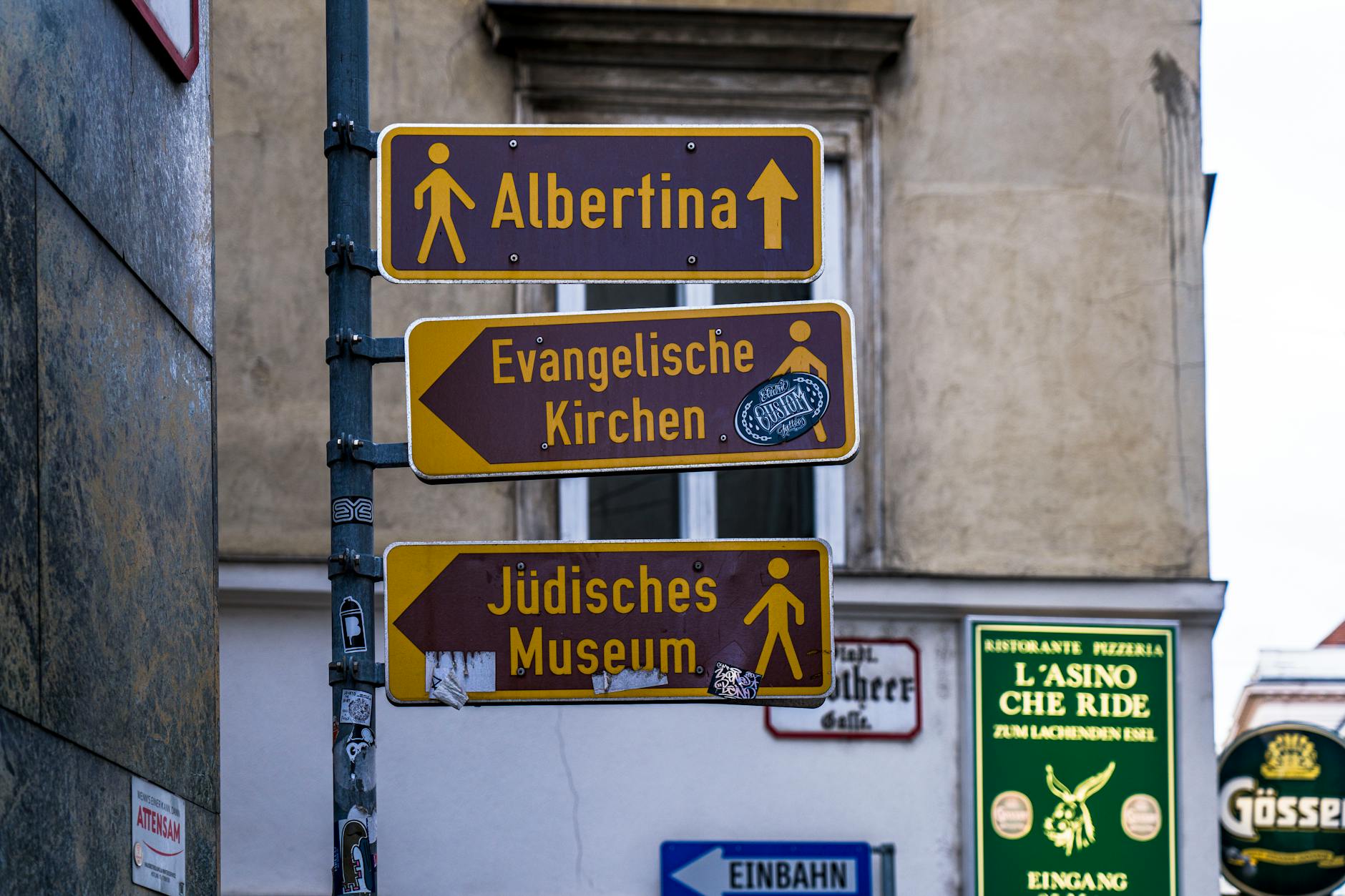
Photo by Jing Zhan
- What a Private Guide Costs in Vienna
- The Fremdenführer Licence, and Why It Matters
- When a Private Guide Is Actually Cheaper
- When It Is Worth It Regardless of the Maths
- Custom Itineraries Worth Commissioning
- How to Book and What to Ask
- What a Private Guide Will Not Fix
- The Honest Verdict
- Frequently Asked Questions
- Related Vienna Guides
- Photo Credits
This article contains advertising. Our booking links are routed through a partner that adds commission tracking automatically, so if you book through one we earn a commission from the provider, at no extra cost to you. It never affects what we recommend. Affiliate disclosure
Somewhere around the third palace, most visitors to Vienna hit the same wall: the rooms are magnificent, the audio guide is competent, and none of it is joining up. Hiring a guide is the standard fix, and typing private tour guide Vienna into a search box turns up a surprisingly orderly market: Austria licenses its guides by state examination, the trade body publishes an annual tariff, and the prices are directly comparable between suppliers. That transparency is rare enough in this city’s tourism economy to be worth a page of its own.
This guide covers what a licensed Viennese guide actually costs in 2026, how the half-day and full-day tariffs are structured, what those fees do and do not include, when a private guide beats a scheduled tour on pure arithmetic, and how to brief one so you get something you could not have got from a book. Figures were checked in September 2026 against the guides’ trade association tariff and a second operator’s public rate card; both change annually, so ask for the current rate when you enquire.
What a Private Guide Costs in Vienna
The critical thing to understand before comparing any prices: guide fees are charged per group, not per person. A guide costs the same whether you are two people or twelve, up to the group-size band. This single fact is what makes private guiding cheap for families and expensive for couples, and it is the calculation almost everybody gets wrong on first look.
| What | 2026 rate | Notes |
|---|---|---|
| Association hourly rate, 1–20 people | €96 incl. 20% VAT (€80 net) | Per hour commenced |
| Association hourly rate, 21–30 people | €110 incl. VAT (€91.67 net) | Per hour commenced |
| Half day, within Vienna | Set by tariff; up to 3 hours | Up to 4 hours outside Vienna |
| Full day | Double the half-day fee | — |
| Operator rate card, Vienna half day (4 hrs) | €450 net | Business rate, second source |
| Operator rate card, Vienna full day (8 hrs) | €825 net | Business rate, second source |
| Extension hour, operator rate | €95–100 net | — |
The two sources are measuring slightly different things — the association publishes a member tariff including VAT, the operator publishes net business rates for tour organisers — but they land in the same territory. As an order of magnitude for a private visitor in 2026: roughly €280–300 for three hours, roughly €450–500 for a half day of four, and somewhere in the region of €800–900 for a full day of eight. If a quote is wildly under that, ask what licence the guide holds.
How half days and full days are defined
The association’s tariff defines a half day as up to three hours within Vienna, or up to four hours outside the city including a maximum of two hours’ walking. A full day is double the half-day fee. Overtime is charged per hour commenced — there is no half-hour rate, so running twenty minutes over costs a full hour.
That walking cap on out-of-town tours is worth noticing. It exists because a guide leading a group on foot for six hours is doing something quite different from a guide sitting in a coach, and the tariff reflects it. If your plan involves a long walk somewhere outside Vienna, say so at the enquiry stage rather than discovering the limit on the day.
What the fee does not include
This catches people out constantly. The guide fee covers the guide’s time and nothing else. Not included, and payable by you:
- All entrance tickets — yours and, in most arrangements, the guide’s own admission where a museum charges for it.
- Transport of any kind. Taxis, public transport tickets, a coach if you want one. A guide who meets you at Schönbrunn is not obliged to get you there.
- Meals, though on a full day it is customary to cover the guide’s lunch if you are stopping to eat.
- Audio equipment, recommended for groups of about twelve and up at roughly €3.75 per person — a real cost in a noisy museum with fifteen people.
Budget the tickets separately and honestly. A family of four doing Schönbrunn and the Kunsthistorisches Museum with a guide is paying for the guide and five sets of admissions, and the tickets are not trivial.
The Fremdenführer Licence, and Why It Matters
Austria regulates guiding as a trade. A Fremdenführer completes a multi-year course — art history, architecture, Austrian history, at least two foreign languages, practical guiding — and then passes a state examination. It is a professional qualification, not a certificate bought online, and holders take it seriously.
The practical consequence for you is access. Only licensed guides may guide commercially inside many Viennese museums and monuments. An unlicensed person can walk you around the Innere Stadt and talk on a public street, which is perfectly legal; they cannot lead a paying group through the Kunsthistorisches Museum or the state rooms of the Hofburg. This is why so many tour listings offer a “guided walk” outside and an audio guide inside, and it is the first question to ask of anyone selling you a private tour: are you licensed, and can you guide inside the places on my list?
It also explains the price floor. A licensed guide has spent years and real money getting there, and the association tariff is what the trade considers the work to be worth. Vienna’s tip-based free walking tours mostly operate outside this system, which is legal on public streets and is a genuinely good product — but it is a different product.
When a Private Guide Is Actually Cheaper
Run the numbers before dismissing the figures above, because per-group pricing changes everything at four people and upwards.
| Party size | 3-hour private guide | Per person | Scheduled small-group tour |
|---|---|---|---|
| 2 people | ~€290 | ~€145 | ~€45–70 each |
| 4 people | ~€290 | ~€73 | ~€45–70 each |
| 6 people | ~€290 | ~€48 | ~€45–70 each |
| 8 people | ~€290 | ~€36 | ~€45–70 each |
At two people a private guide is a genuine luxury and costs three times the alternative. At six it costs about the same as a scheduled tour and you get a person whose entire attention is on your questions. At eight or more it is simply cheaper, and the decision stops being about money at all.
Multi-generational family trips, small groups of friends travelling together and anyone organising a work visit should all be pricing a private guide rather than assuming it is out of reach. It usually is not.
When It Is Worth It Regardless of the Maths
A specific, narrow interest
This is the strongest case. Vienna’s scheduled tours cover the greatest hits, and the city’s depth is elsewhere. If you want Klimt and the Secession properly, or Jewish Vienna, or the interwar housing programme, or Freud’s Vienna, or the medical history of the Allgemeines Krankenhaus, a guide who has specialised in it will give you a day nobody sells off the shelf. Ask the association or the guide directly what their specialism is; most have one and are visibly happier talking about it.
Very limited time
One full day in Vienna and a strong desire not to waste it is a textbook case. A guide removes every queue decision, every routing mistake and every twenty minutes lost working out which entrance is the right one. Our one-day itinerary shows what is achievable unguided; a guide reliably compresses it further.
Mobility, accessibility and small children
A scheduled tour moves at the group’s pace and stops where the itinerary says. A private guide can sit down when you need to, cut a museum in half, route around stairs and cobbles, and adjust when a four-year-old has reached the end of their capacity for gilt. Say what you need at the booking stage — guides are used to it and will tell you honestly what is and is not possible.
Business, incentive and family occasions
If you are hosting people, the guide is doing more than commentary: they are handling logistics, timings and the awkward middle bit of an afternoon. This is a large part of the guiding trade’s actual work in Vienna, and it is why the rate card exists in a net, business-facing form as well as a consumer one.

Custom Itineraries Worth Commissioning
The point of a private day is that it does not have to look like anybody else’s. A few shapes that guides in Vienna are regularly asked for and that work particularly well:
- One building, done properly. Three hours inside the Kunsthistorisches Museum with someone who knows the Bruegel room is worth a week of wandering. The same applies to the Belvedere’s collection and the Hofburg’s Imperial Apartments.
- One neighbourhood, on foot. Leopoldstadt, Ottakring or the sixth and seventh districts, walked slowly, with the social and architectural history attached. Guides who live in these districts do this exceptionally well and it is almost never sold as a scheduled product.
- A single century. 1900 Vienna — Klimt, Wagner, Loos, Freud, Schoenberg, Mahler — is the request guides get most often and the one where a specialist adds the most, because the sites are scattered and the connections are the whole point.
- The city you cannot see. Wartime Vienna, the occupation years, Red Vienna, the Jewish city before 1938. These are the tours that need somebody who knows what used to stand where, and there is no audio guide for an absence.
- A half day out of town. The Wachau, the Vienna Woods or Baden with a guide who comes on the train with you and knows the timetable. Cheaper than a private vehicle and far better than a coach.
The common thread is that all five are things the scheduled market does badly or not at all. If your request is “Schönbrunn and Stephansdom in one morning”, you do not need a private guide; you need a ticket and our Schönbrunn guide.
Languages
The licence requires foreign languages, and Vienna’s guiding pool is unusually deep in them. English, German, Italian, French, Spanish and Russian are all widely covered; Japanese, Mandarin, Arabic, Hungarian, Czech and the Balkan languages are available but thinner, and are the case for booking further ahead. The association’s directory is searchable by language, which is the fastest route to a guide who works in yours rather than one who says they do.
How far ahead to book
Good individual guides are booked out weeks ahead in May, June, September and around the Christmas markets, and the very good ones are effectively fully committed in high season. Three to four weeks is a comfortable lead time; a fortnight is workable outside the peaks; three days in June means taking whoever is left. Out of season you can often book a week ahead and get your first choice.
How to Book and What to Ask
Where to find a guide
Three routes, in descending order of reliability. The Association of Licensed Guides of Vienna runs a directory of licensed members searchable by language and specialism, and is the sensible first stop — everybody listed is qualified by definition. Individual guides’ own websites are the second, and many of Vienna’s best guides have a plain site, a phone number and a full diary. Marketplaces are the third; they work, but licensing status is not always stated and you should ask explicitly.
The questions worth asking
- Are you a licensed Fremdenführer? Ask it plainly. A licensed guide will answer immediately.
- Can you guide inside the specific sites on my list? Some venues have their own additional rules on top of the licence.
- What is included and what do I pay separately? Confirm tickets, transport and the guide’s own admissions in writing.
- What are your cancellation terms? These are set individually, not by the tariff, and vary considerably.
- How do you want to be paid? Cash after the tour is the association’s default; card and advance payment can usually be agreed, but agree it in advance rather than fumbling for notes at the end.
Briefing your guide properly
The single biggest determinant of whether a private day is worth €450 is the brief, and most people give a bad one. “Show us the highlights” produces a competent version of a tour you could have bought for €40.
Give the guide something to work with instead: what you have already seen, what you have read, what you actively do not want, how long your party can walk, whether anybody has a professional interest in anything. A guide told “we are both architects, we have done Schönbrunn, we do not care about the Habsburgs and we want to understand Otto Wagner” will build you a day that does not exist on any booking platform. That is what you are paying for.
Tipping
Tipping a licensed guide is customary but not obligatory, and the fee is a professional rate rather than a topped-up wage. Ten per cent for a good day is generous and normal; nothing at all after an indifferent one is not an insult. Our Vienna tipping guide sets the wider conventions.
What a Private Guide Will Not Fix
Two honest limits. A guide cannot get you into a sold-out venue, skip a timed-entry queue you do not hold a ticket for, or conjure availability at Schönbrunn in August. Book the tickets yourself, in advance, and tell the guide the time slot.
And a guide is not a driver. Unless you have specifically hired a driver-guide with a vehicle, you will be walking and using public transport, and the guide’s fee does not cover your transport tickets. A combined car-and-guide day is a different and considerably more expensive product; our guide to Vienna’s tour operators covers those.
The Honest Verdict
For two people on a normal city break, a private guide is a luxury and a scheduled small-group tour does most of the job for a fifth of the money. Nothing wrong with buying the luxury — but call it what it is.
For four or more people, for anyone with a real subject-specific interest, and for anyone whose trip has genuine constraints of time or mobility, it is the best value in Vienna’s tour market and it is not close. The per-head cost collapses, the licence gets you inside buildings the alternatives cannot enter, and the tariff means you are not being quietly overcharged for being a tourist — which, on a page that has spent several thousand words warning about exactly that elsewhere in this city, is worth saying plainly.
Frequently Asked Questions
How much does a private tour guide cost in Vienna?
Guides charge per group, not per person. The trade association’s 2026 hourly rate is €96 including VAT for parties of 1–20, rising to €110 for 21–30. In practical terms expect roughly €280–300 for three hours, €450–500 for a half day and €800–900 for a full day, with entrance tickets and transport extra.
Is a private guide in Vienna worth the money?
For four or more people, yes on cost alone — the per-head figure drops below a scheduled small-group tour. For two people it is a luxury. It is also worth it at any party size for a narrow specialist interest, a single day in the city, or genuine mobility constraints.
What is a Fremdenführer?
Austria’s state-licensed tour guide qualification, earned through a multi-year course and a state examination covering art history, architecture, Austrian history and languages. Only licensed guides may lead commercial tours inside many Viennese museums and monuments.
Do guide fees include entrance tickets?
No. The fee covers the guide’s time only. You pay all admissions — usually including the guide’s own where a venue charges — plus transport, and audio equipment for larger groups at around €3.75 per person.
How long is a half-day tour in Vienna?
Up to three hours within the city under the association tariff, or up to four hours outside Vienna including a maximum of two hours’ walking. A full day is double the half-day fee, and overtime is charged per hour commenced rather than pro rata.
How do I pay a Vienna guide?
Cash after the tour is the association’s default arrangement. Card payment and advance payment can normally be agreed, but agree it when you book rather than assuming.
Can a private guide get me into sold-out attractions?
No. Guides cannot create availability or bypass timed entry you have not booked. Buy your own tickets in advance for Schönbrunn, the Spanish Riding School and anything else time-slotted, and give the guide your slot times.
Do I need to tip a Vienna tour guide?
It is customary but not expected in the way it is for restaurant service. Around ten per cent for a genuinely good day is normal and appreciated; the fee itself is a professional rate rather than a wage that assumes tips.
Related Vienna Guides
- Vienna Walking Tours Compared
- Vienna Free Walking Tours
- Vienna Tours & Experiences
- Vienna Day Tour Operators Compared
- The Hofburg Palace Guide
- Kunsthistorisches Museum Guide
- Vienna Tipping Guide
- Vienna Trip Costs and Budget
Photo Credits
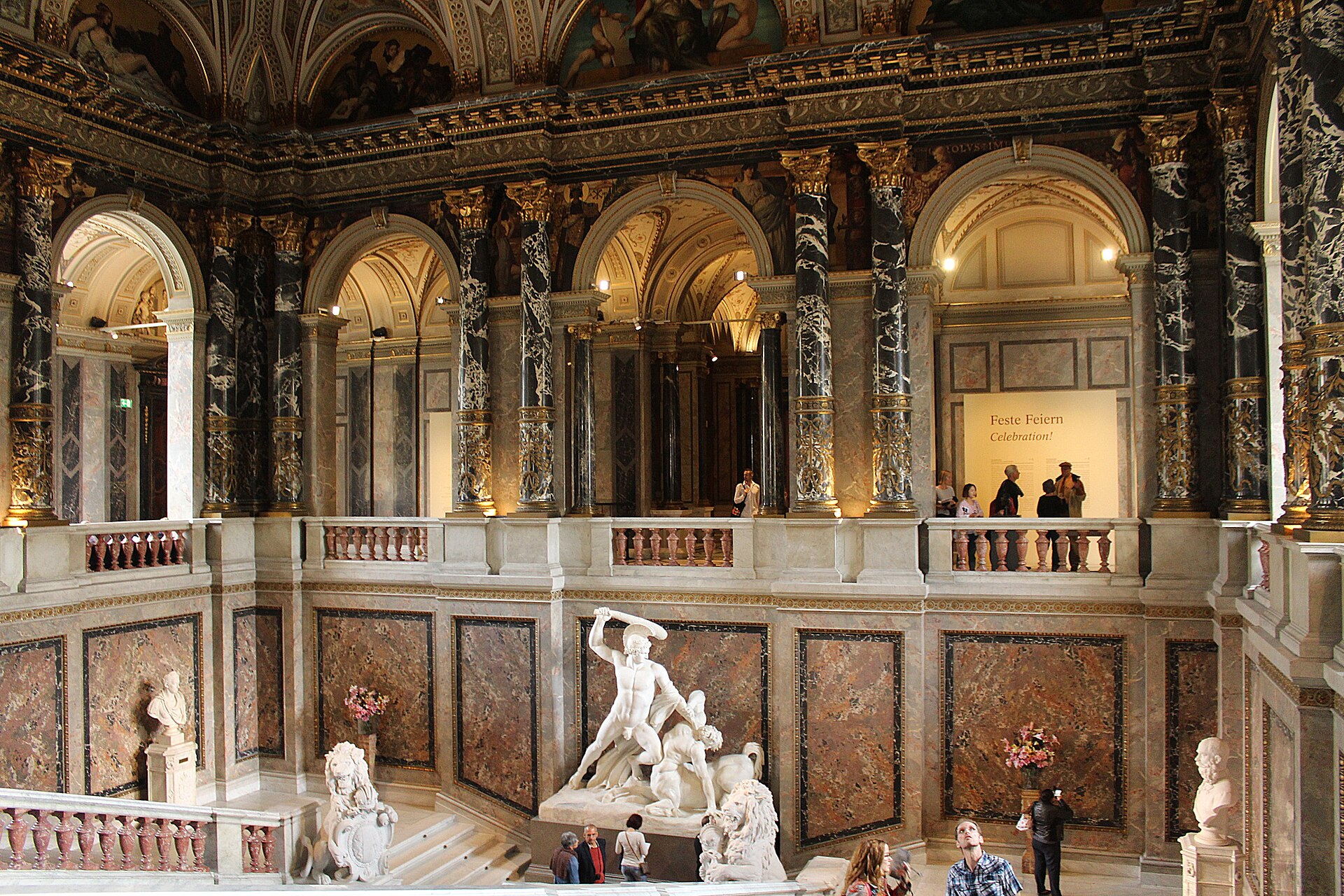
Staircase hall of the Kunsthistorisches Museum: Kunsthistorisches Museum Wien, das Treppenhaus by Dguendel, CC BY 4.0, via Wikimedia Commons.
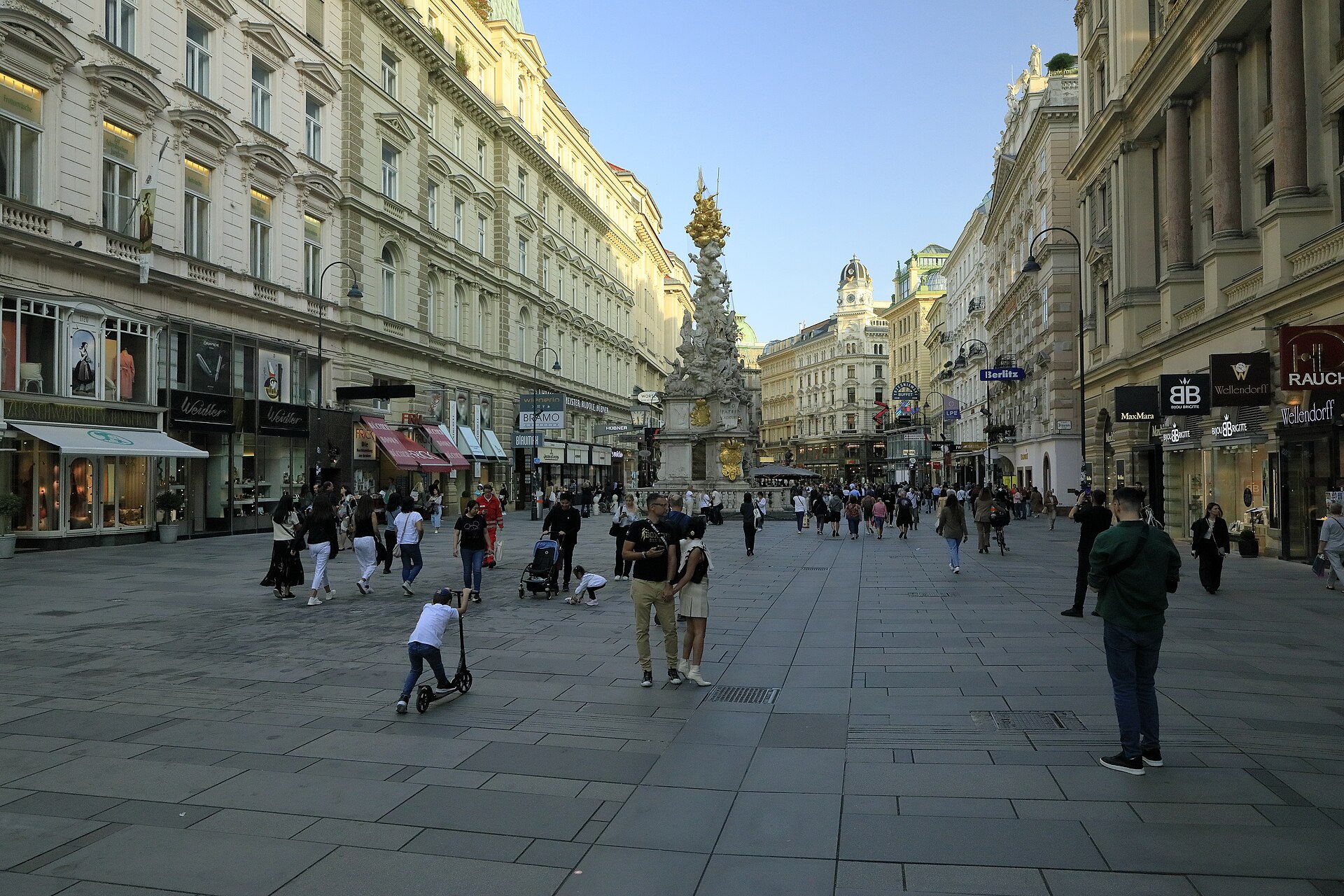
The Graben with the Plague Column: L02 855 Wien, Graben mit Pestsäule by Falk2, CC BY-SA 4.0, via Wikimedia Commons.