Vienna State Opera: Tickets, Standing Room & Insider Guide (2026)
Complete Vienna State Opera guide: how to buy 13 euro standing-room tickets, dress code, repertoire, tours, and what to expect from one of opera's holiest places.

Photo by Karl MPhotography
- Why the Vienna State Opera Matters
- The Building Itself
- How Tickets Actually Work
- Dress Code: What You Actually Need to Wear
- Inside the Auditorium
- What to See: The Repertoire
- Arriving and the Pre-Show
- The Opera Calendar Year
- Vienna State Opera vs. Volksoper vs. Theater an der Wien
- Common Mistakes to Avoid
- Budget Strategy: Opera Without Breaking the Bank
- The Guided Tour (When You Can’t See a Performance)
- Practical Information
- FAQ
- Related Vienna Guides
This article contains advertising. Our booking links are routed through a partner that adds commission tracking automatically, so if you book through one we earn a commission from the provider, at no extra cost to you. It never affects what we recommend. Affiliate disclosure
The Vienna State Opera is one of the world’s most prestigious opera houses, and unlike most great cultural institutions it remains genuinely accessible to ordinary travelers — with standing-room tickets from just €13 and 50+ different productions every season. The Wiener Staatsoper performs roughly 350 nights per year from September through June, cycling through more than 60 operas and ballets with the Vienna Philharmonic in the pit and many of the world’s leading singers on stage. This guide explains exactly how to get tickets (including the famous standing-room queue), what to wear, when to arrive, and what to expect from your evening at one of opera’s holiest places.
Why the Vienna State Opera Matters
Founded in 1869 as the first major building on the Ringstrasse, the Wiener Staatsoper was conceived as a temple to bourgeois culture in a Habsburg capital that took music seriously. The list of music directors reads like a roll call of opera history: Gustav Mahler (1897–1907), Richard Strauss, Karl Böhm, Herbert von Karajan, Lorin Maazel, Claudio Abbado, Seiji Ozawa, Franz Welser-Möst. The orchestra in the pit doubles as the Vienna Philharmonic, which plays the New Year’s Concert in the Musikverein every January 1st.
What separates Vienna from rival opera capitals is the sheer scale of the repertoire. Whereas the Metropolitan Opera or Royal Opera House Covent Garden run a handful of productions in rotation, the Staatsoper performs a different opera nearly every night, often without rehearsal — singers fly in from Berlin, Milan, or New York to perform in productions they may not have seen since the previous season. The result is high-stakes, high-craft music-making in the original Habsburg setting where Mahler and Strauss premiered works that defined twentieth-century opera. For a fuller view of the city’s stage culture, see our Vienna culture and arts pillar.
The Building Itself

The opera house was designed by August Sicard von Sicardsburg and Eduard van der Nüll in a neo-Renaissance style with French neo-Baroque elements. Public reception was so hostile when it opened that van der Nüll committed suicide and Sicardsburg died of a stroke ten weeks later — neither lived to see the building praised. Emperor Franz Joseph, stung by the criticism, famously limited himself to “It was very nice. I enjoyed it very much” for every subsequent public comment.
The auditorium was destroyed by Allied bombing in March 1945 and rebuilt in modernized form by 1955 — the reopening with Beethoven’s Fidelio conducted by Karl Böhm marked the symbolic end of post-war occupation. Today the hall seats 1,709 with 567 additional standing places, making it one of opera’s largest stages.
Even if you don’t see a performance, the 40-minute guided tour shows you the auditorium, the tea salon, the imperial intermission rooms, and the iron curtain that drops between acts — at €13–14 (€7 for under-27s), it’s one of Vienna’s best-value cultural visits. Tours run daily in multiple languages; check the official site for the day’s English-language slot.
How Tickets Actually Work
Vienna State Opera tickets divide into three categories with very different rules and prices.
1. Reserved Seats (€15–€280)
Standard seats go on sale exactly 60 days before each performance (so March performances appear in early January). The cheapest seats are in the upper galleries with restricted sightlines — perfectly fine for the music, frustrating if you want to see the stage. Mid-price (€60–110) seats in the parterre boxes or balcony offer the best combination of sound, sightline, and value. Premium parterre seats run €180–280 for star casts. Buy directly from wiener-staatsoper.at — third-party resellers add 25–40% markup and often sell tickets they don’t actually hold.
2. Standing Room (€13–€18) — The Bargain

The Staatsoper sells 567 standing-room tickets per performance, and this is the deal that makes Vienna opera famous. Three price tiers: parterre (ground floor, behind the orchestra seats, €18), gallery (best of the three, €15), and balcony standing (€13). All three include a small personal subtitle monitor at the railing with English, German, Italian, French, and Russian translations.
Two ways to buy standing tickets:
- Online from 10:00 the day of performance: Tickets appear at exactly 10:00 a.m. Vienna time on the official site. You need a free account. Maximum two tickets per account. Tickets are pre-assigned to numbered positions at the railing, so you don’t queue or save a spot. This is the easy modern way.
- At the standing-room box office 80 minutes before curtain: A second batch is sold at a separate Stehplatz cash desk on the side of the building (signed clearly). For sold-out star nights — Anna Netrebko, Jonas Kaufmann, opening galas — you’ll want to queue 2–3 hours ahead. For normal performances, arrive 90 minutes early and you’ll almost certainly get a ticket.
Insider tip: The “BundestheaterCard” is a free Austrian Federal Theatre membership card. Pay €20 to upgrade to “Standing Room PLUS” and you can buy one standing ticket per performance from 10:00 the day before the event — securing your spot before general sale opens. Worth it if you’re attending three or more performances.
3. Day-of-Sale Cheap Seats
Any unsold seats are released as discounted tickets to students and seniors at the box office on the day. If you’re under 27 with student ID, you can buy unsold seats — sometimes including parterre — for €15. Show up at the main box office on Operngasse 2 from 14:00 the day of performance.
Dress Code: What You Actually Need to Wear
There is no formal dress code at the Vienna State Opera — you will not be turned away in business casual. However, there are minimum standards that the house takes seriously, and there’s a strong social expectation that this is dress-up territory.
Minimum Acceptable
The opera house explicitly refuses entry for: flip-flops, sandals, very short shorts, tank tops or undershirts as outerwear, and head coverings that obstruct sightlines. Sneakers and jeans are technically allowed but you’ll feel under-dressed, especially in the parterre and lower galleries.
Recommended Standard
- Men: Dark suit or blazer with dress shirt; tie optional but appreciated. Closed leather shoes. Sweater under a jacket is fine for matinées.
- Women: Cocktail dress, smart trousers with elegant top, or modest evening dress. Heels optional — there’s a lot of stair-climbing in the older sections.
- Premieres and gala nights: Black tie or dark suit; long evening dress. The first night of the season and the New Year’s Eve performance attract serious dressing.
For more on Vienna evening style, our Vienna packing list covers what to bring for the opera and concerts.
Inside the Auditorium
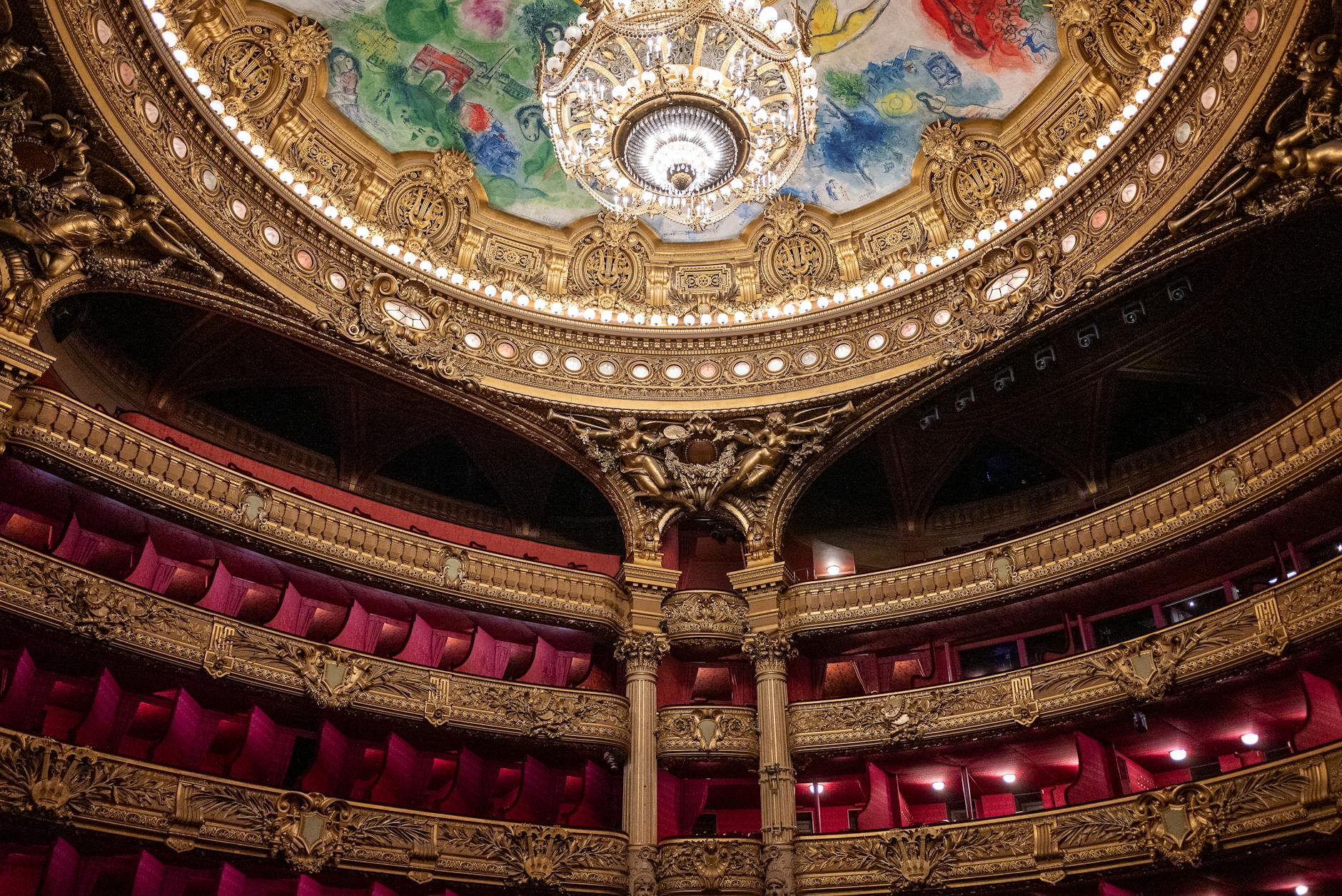
The reconstructed 1955 auditorium uses a horseshoe plan with five tiers: parterre (orchestra-level seats and standing), balcony (1st tier), gallery (2nd and 3rd tiers), and an upper gallery in the gods. Acoustics are warm and forgiving — even the standing positions at the back of the balcony get the orchestra clearly and singers without distortion.
The painted ceiling and crystal chandelier are reconstructions of the 1869 originals lost in the war. Look up before the lights dim: the chandelier raises into the dome during the performance, exposing the painted ceiling above.
The iron stage curtain (the Eiserne Vorhang) is repainted annually by a different contemporary artist — past artists have included Maria Lassnig, Jeff Koons, Olafur Eliasson, and Tauba Auerbach. It’s lowered between Acts I and II of most productions and is one of Vienna’s stranger contemporary art commissions.
What to See: The Repertoire
The Staatsoper performs roughly 60 different operas per season, weighted toward the central German-Austrian-Italian repertoire: Mozart, Verdi, Puccini, Wagner, Strauss. A typical week might include Don Giovanni on Monday, La Bohème on Tuesday, Tosca on Wednesday, Le Nozze di Figaro on Friday, and Die Fledermaus on Saturday.
Reliable Crowd-Pleasers
- Mozart operas: Don Giovanni, Die Zauberflöte, Le Nozze di Figaro, Così fan tutte — short (under 3 hours), tuneful, in the language Mozart wrote them.
- Verdi favorites: La Traviata, Rigoletto, Aida, Un Ballo in Maschera — high drama and arias you already know.
- Puccini: La Bohème, Tosca, Madama Butterfly, Turandot — the most accessible operas for first-timers.
- Strauss “Die Fledermaus”: The traditional Austrian New Year’s Eve operetta — light, funny, with a champagne aria in Act II.
Harder But Rewarding
- Wagner’s Der Ring des Nibelungen — performed as a cycle over four nights, usually one cycle per season. 16 hours of music; not a first-time choice.
- Strauss’s Der Rosenkavalier, Salome, Elektra — the house has historic association with these works and performs them frequently.
- Contemporary commissions — the Staatsoper premieres one or two new works each season; consult the season brochure.
Arriving and the Pre-Show
The opera house sits at Opernring 2, directly above the Karlsplatz/Oper U-Bahn station (U1, U2, U4). Trams 1, 2, 71, and D stop at the door. Arrive at least 30 minutes before curtain — there are coat checks (€2–3) on multiple levels, restrooms throughout, and the experience of finding your seat is part of the evening. The first time visiting Vienna tips guide has more tips on navigating Vienna’s transit.
The cloakroom is mandatory in winter — coats, large bags, and umbrellas cannot be brought into the auditorium. Standing-room visitors have a separate, simpler cloakroom on the side of the building.
The intermissions (typically 25 minutes) include a famous buffet selling sparkling wine, sandwiches, and Sachertorte at non-extortionate prices (sparkling wine €6–8, sandwiches €4–6). The grand staircase, foyers, and Schwind Foyer with its murals are worth wandering during the break.
The Opera Calendar Year
- September 1: Season opens, often with a Mozart or Verdi production.
- November–December: Heaviest performance schedule.
- December 31: Traditional Die Fledermaus, often with star guest cameos.
- February (Thursday before Ash Wednesday): Vienna Opera Ball — the auditorium is transformed into a ballroom. Tickets €315 standing, €350+ seated, evening dress mandatory.
- April–May: Spring premieres and visiting conductors.
- End of June: Season closes.
- July–August: Opera house is closed for the summer. The Staatsoper streams live performances to a giant screen on the plaza in front (free outdoor opera in July/August — bring a picnic).
Vienna State Opera vs. Volksoper vs. Theater an der Wien
Vienna has three professional opera houses, and they serve different purposes:
- Staatsoper (Vienna State Opera): The grand house — major international repertoire, world-class casts, premium prices, biggest building. This guide.
- Volksoper: The “people’s opera” — light opera, operettas, musicals, ballet. Lower prices (€8 standing, €20–80 seated), more relaxed atmosphere, fantastic for families and operetta-lovers (Die Fledermaus, Die Lustige Witwe, My Fair Lady). Located on Währinger Straße, U6 Volksoper.
- Theater an der Wien: Historic theater where Beethoven’s Fidelio premiered (and where the Magic Flute premiered next door). Now a chamber opera venue specializing in early music and modern repertoire.
Operetta fans should consider the Volksoper as their primary destination — the Staatsoper rarely performs Lehár or Kálmán. See our things to do in Vienna guide for more.
Common Mistakes to Avoid
- Booking through third-party resellers. Sites like ViaGoGo and even some legitimate-looking opera ticket sites mark up by 30–50%. Always start at wiener-staatsoper.at.
- Buying from the costumed sellers in the plaza. The “Mozarts” outside the opera house sell tickets to the Schönbrunn Palace Orchestra and similar tourist-targeted Mozart concerts — these are not Vienna State Opera tickets, and the Mozart concerts are heavily criticized by locals. The real State Opera tickets come from inside the building.
- Choosing the wrong night. Sundays and Saturday evenings often feature the biggest stars but also the highest prices. Tuesday or Wednesday performances frequently get the same cast at 30% less.
- Showing up in shorts in summer. Yes, even in July when the auditorium is closed — guided tours have a soft dress code.
- Forgetting the cloakroom. €3 each for two coats × 25-minute queue after the show = the question of whether to return for them.
- Skipping the surtitles. Even fluent German speakers use them — opera diction is notoriously hard to follow. Every seat and every standing position has a screen.
Budget Strategy: Opera Without Breaking the Bank
Vienna opera is the rare cultural experience where €13 buys an authentic seat (well, standing position) at world-class performances. A budget-conscious strategy:
- Book online at 10:00 a.m. the day of performance for €13 balcony standing.
- Show up 90 minutes early to claim your numbered spot at the railing.
- Bring a small bag with bottled water and a snack — intermission can be busy.
- Skip the cloakroom by traveling with a thin jacket you can drape over the railing.
- Stay through the curtain calls — Vienna audiences applaud for 15–25 minutes after major performances; the singers love it.
Combined with our Vienna on a budget tips, you can have a complete cultural Vienna evening for under €40 including transport and intermission drinks.
The Guided Tour (When You Can’t See a Performance)
Daily 40-minute tours in German, English, French, Italian, and Spanish run roughly hourly between 10:00 and 16:00 (fewer in winter, more in summer). The tour shows the auditorium (with stage and curtain), the imperial tea salon, the marble staircase, the Schwind Foyer murals, and the Gustav Mahler bust. Tickets €13–14 adult, €7 under-27. No advance booking needed for groups under six — show up at the main entrance and join the next tour. The English tour is usually at 10:30 or 14:00 — check at the official site.
Practical Information
- Address: Opernring 2, 1010 Vienna
- U-Bahn: Karlsplatz/Oper (U1, U2, U4)
- Tram: 1, 2, 71, D — stop “Oper”
- Box office: Operngasse 2, side of building. Open daily 9:00–18:00 (until 14:00 Saturdays).
- Performance length: 2.5–4.5 hours with 1–2 intermissions
- Standing room queue starts: 80 minutes before curtain for that day’s box office release
- Season: September through June; closed July and August
- Closed days: 24 December, Good Friday
- Online ticket release: 10:00 a.m. Vienna time the day of performance for standing room
FAQ
How do I get the cheapest Vienna State Opera tickets?
Buy standing-room tickets online at 10:00 a.m. Vienna time on the day of performance through wiener-staatsoper.at. Prices start at €13 for balcony standing, €15 gallery, €18 parterre. Each comes with a personal subtitle monitor.
Is there a dress code at the Vienna State Opera?
There is no formal dress code, but the house refuses entry for flip-flops, very short shorts, undershirts as outerwear, and head coverings that block sightlines. Smart casual is the practical minimum; cocktail dress or suit is the recommended standard. Gala nights expect black tie or dark suits.
Can I buy Vienna State Opera tickets at the door?
Standing-room tickets are sold at the separate Stehplatz box office starting 80 minutes before curtain. Reserved seats are sometimes available at the main box office until 30 minutes before curtain but usually sell out for popular productions.
How long are Vienna State Opera performances?
Most operas run 2.5 to 4 hours including one or two intermissions of 20–25 minutes each. Mozart and Verdi works tend to be 2.5–3 hours; Wagner and Strauss can run 4–5 hours.
Are there English subtitles at the Vienna State Opera?
Yes — every seat and every standing position has a small personal monitor at the railing with subtitles in English, German, Italian, French, Russian, and Japanese. You can switch languages or turn the screen off during the performance.
When is the Vienna State Opera closed?
The opera house is closed July and August every year, on 24 December, and on Good Friday. The 2026 season runs September 1, 2025 through June 30, 2026, with the 2026/27 season opening in September 2026.
What’s the difference between the Vienna State Opera and the Volksoper?
The Staatsoper performs major international opera repertoire (Mozart, Verdi, Wagner, Strauss) with world-class casts at premium prices. The Volksoper performs operetta, light opera, ballet, and musicals at lower prices in a more relaxed atmosphere. Most first-time visitors choose the Staatsoper for the prestige experience; operetta lovers should prioritize the Volksoper.
Can I take photos inside the Vienna State Opera?
Photography is allowed in the foyers, staircases, and during intermission. Photography and video are strictly prohibited during the performance itself, including the moments when the curtain rises or falls.
Standing room here is the best deal in the building, but it is not the only cheap ticket in Vienna — the Musikverein sells standing places from around €6, and the Konzerthaus puts you in a good seat for €25. Our guide to Vienna concert tickets compares every venue and price band in the city.
The Hotel Sacher stands directly behind the opera house, and a slice of Original Sacher-Torte at Café Sacher before or after a performance is a long Viennese tradition. The café queue can be long in the afternoon; the Sacher Confiserie on Kärntner Straße sells boxed cakes without the wait. Our guide to Sacher vs Demel compares it with Demel’s rival cake.