Vienna in December: Christmas Markets, Crowds & Cold
The practical half of a Viennese December: the exact closure calendar around the 8th, 24th, 25th and 26th, how the crowds build week by week, what things cost at peak, and which days are genuinely worth booking.

Photo by Zoran Cindrić
- Vienna in December at a Glance
- The Weather: Cold, Dark and Usually Not White
- The Closure Calendar: The Part Most Guides Get Wrong
- How the Crowds Build, Week by Week
- Prices: The Most Expensive Month
- The Markets in December: A Short, Honest Guide
- The Viennese Snow Globe, and Other Genuinely Good Presents
- What to Do Beyond the Markets
- Getting Around in December
- What December Is Not Good For
- Where to Stay in December
- Frequently Asked Questions
- Related Vienna Guides
- Photo Credits
This article contains advertising. Our booking links are routed through a partner that adds commission tracking automatically, so if you book through one we earn a commission from the provider, at no extra cost to you. It never affects what we recommend. Affiliate disclosure
Vienna does December better than almost anywhere, and it also does it to more people than almost anywhere. The same square that felt magical on a Tuesday evening in late November holds a slow-moving, shoulder-to-shoulder crowd on the second Saturday of December, and the room you could have had for a hundred euros in the first week of November costs three times that. Vienna in December is worth the money and the crowds — but only if you know which days are which, and which of the city’s many holiday closures are about to catch you out.
This guide is the practical half of a Viennese December: the weather, the exact closure calendar around the 8th, the 24th, the 25th and the 26th, how the crowds build week by week, and what actually happens in the strange quiet days between Christmas and New Year. Dates and prices were checked in September 2026; confirm anything time-critical on the venue’s own site before you travel.
Vienna in December at a Glance
| Average high | About 4°C |
|---|---|
| Average low | About −2°C |
| Daylight | Around 8 hours 24 minutes — the shortest days of the year |
| Sunset | Around 16:00 all month |
| Snow | Falls most years; rarely lies in the city centre |
| Crowds | Building from the 1st, peaking 12–23 December |
| Hotel prices | The year’s highest, alongside New Year |
| 8 December | Public holiday — but shops open. The biggest shopping day of the year |
| 24 December | Shops close around 13:00. Most markets close early or for good |
| 25 & 26 December | Full public holidays. Shops shut |
| 31 December | Silvesterpfad, free, from about 14:00 across the inner city |
The Weather: Cold, Dark and Usually Not White
December in Vienna averages a high of about 4°C and a low of about −2°C. That is genuinely cold — colder than London, Paris or Amsterdam in the same month — but it is a dry, continental cold rather than the damp that makes November unpleasant, and it is much easier to dress for.
The bigger factor is darkness. December has the shortest days of the Viennese year, about eight hours and twenty-four minutes, with the sun down by four in the afternoon and dusk beginning well before that. In practice you get one useful block of daylight from about nine to half past three, and everything after that is lit.
This is less of a problem than it sounds, because December in Vienna is a night-time month by design. The markets look their best after dark, the lights on the Graben and Kärntner Straße come into their own, and the entire concert and opera season is built around evenings. Plan your daylight for the things that need it — palaces, gardens, viewpoints — and let the rest happen in the dark.
Will there be snow?
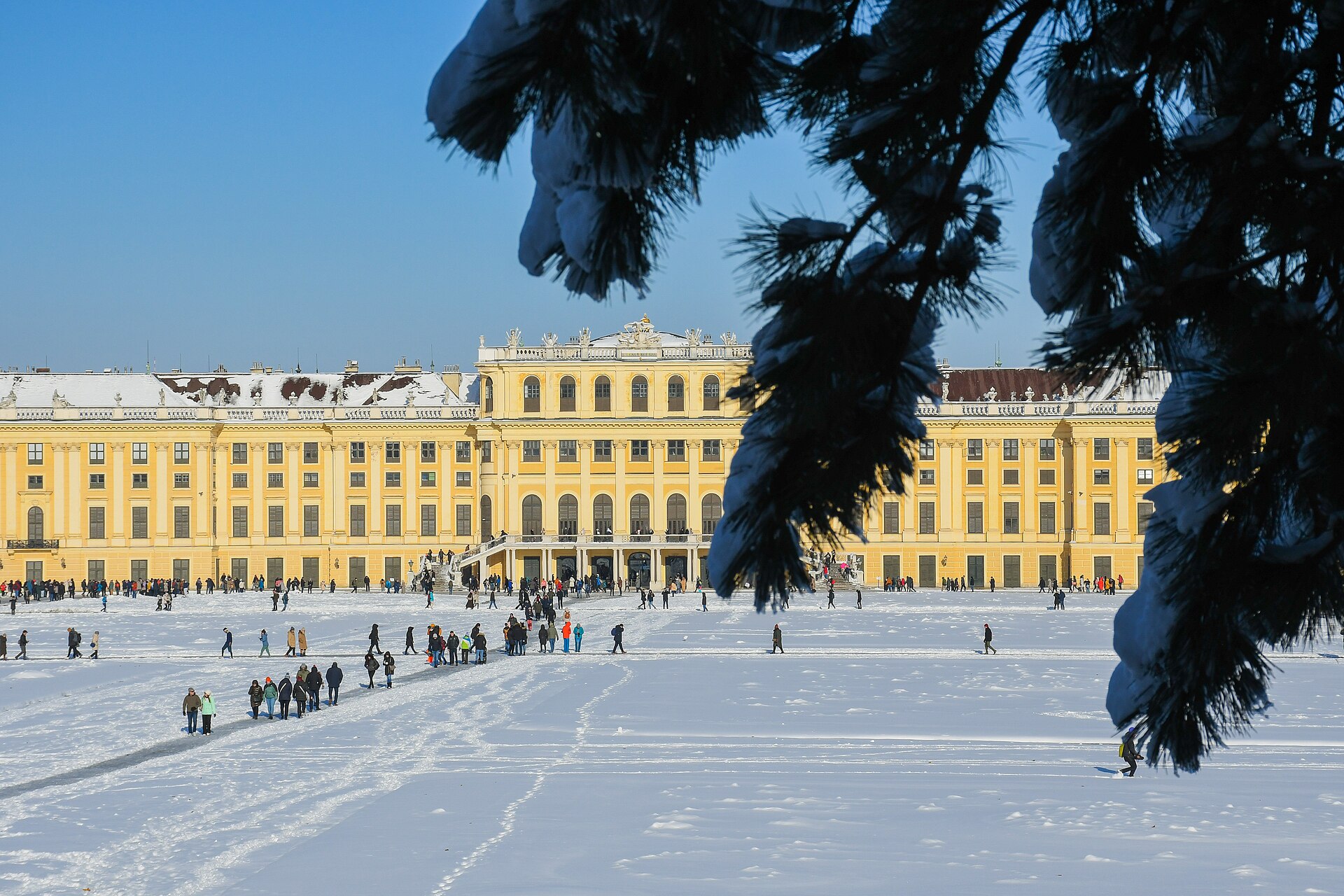
Probably some, and probably not the postcard version. Vienna gets snowfall most Decembers, but the city sits low and warm enough that it usually turns to slush within a day. A properly white Vienna — Schönbrunn under snow, the Ring silent — happens, and it is extraordinary when it does, but it is a lottery rather than a booking decision. Statistically, January and February are the more reliable months for it.
Pack for cold and wet feet rather than for a ski holiday: a genuinely warm coat, waterproof boots with grip, gloves, and a hat. Standing still at a market for an hour in a 2°C wind is colder than walking around in it. Our Vienna packing list has the full version.
The Closure Calendar: The Part Most Guides Get Wrong
Austria has a specific and slightly counterintuitive set of December holiday rules, and getting them wrong is the difference between a good day and a wasted one.
Tuesday 8 December — Mariä Empfängnis
The Feast of the Immaculate Conception is a full public holiday in Austria. Offices, schools and banks close. But retail is permitted to open on this one holiday, and most shops do — a special exemption in force since 1995 — which turns it into the single busiest shopping day of the Austrian year.
If you are here for the markets and the atmosphere, 8 December is a day to avoid the shopping streets entirely. Kärntner Straße, the Graben and Mariahilfer Straße are as busy as they get, and every market is full of Viennese families having a day out. If you actually want to shop, it is the day everything is open. Choose deliberately; do not stumble into it.
Thursday 24 December — Heiliger Abend
Christmas Eve, and the real event in Austria — presents are exchanged on the evening of the 24th, not the morning of the 25th. The city shuts down over the course of the day.
- Shops, including the supermarkets — Billa, Spar, Hofer — close around 13:00. Buy food before then or you will be eating at a station kiosk.
- Most Christmas markets close early or close for good. A handful run reduced hours, roughly 11:00–16:00. Do not plan a Christmas Eve market evening; by six o’clock the city is genuinely empty.
- Restaurants largely close for the evening, because the staff are having Christmas Eve. Hotel restaurants and a scattering of international places stay open. If you are in Vienna on 24 December, book dinner well in advance. This catches out an enormous number of visitors every year.
- Public transport runs a reduced service and winds down through the evening.
- Churches are the exception and the point. Midnight Mass at the Stephansdom or one of the great Baroque churches is one of the genuinely memorable things you can do in this city. Arrive early; it fills.
Friday 25 and Saturday 26 December
Christstag and Stefanitag are both full public holidays. Shops and shopping centres are shut on both — the only reliable exceptions are petrol station shops and shops inside railway stations, which is worth knowing if you need anything at all.
Museums and restaurants vary, and vary a lot: some major museums open on both days, some open on one, some close for both. This is the one thing on this page you should check individually before you go, on each institution’s own site, for these two specific dates. The museum guide tells you which are worth the effort; only the museum can tell you if it is open on Stefanitag.
Christmas Day itself, if you have nowhere to be, is one of the strangest and best days to walk Vienna. The inner city is nearly empty, the lights are all on, and the Ringstrasse without traffic is a thing very few visitors ever see.
27–30 December
The city restarts. Shops reopen, the surviving markets reopen, and Vienna fills again with a different crowd — short-break visitors in for New Year. Schönbrunn and the Prater winter market run right through into January. Museums are back to normal hours and are, briefly, quite busy.
Thursday 31 December
The Silvesterpfad, Vienna’s New Year’s Eve Trail, turns the inner city into an open-air festival: free entry, stages and stalls across Rathausplatz, Freyung, Am Hof, the Graben, Stephansplatz, Kärntner Straße, Neuer Markt and Riesenradplatz in the Prater, starting around two in the afternoon and running past midnight. 2026 is its 35th edition. There is a waltz on the Graben at midnight, which is exactly as Viennese as it sounds.
Our dedicated guide to New Year’s Eve in Vienna covers the whole thing properly — the trail, the concert options, the balls, the fireworks question and where to stand.
How the Crowds Build, Week by Week
This is the practical calendar that determines what your trip feels like.
| Dates | What it is like |
|---|---|
| 1–7 December | Busy but manageable. Markets fully open, weekends already heavy |
| 8 December | The peak domestic day. Shops open, everything full |
| 9–11 December | A brief midweek lull. Genuinely good |
| 12–23 December | The crush. Weekend evenings at Rathausplatz are shuffling pace |
| 24 December | Everything closes through the day. Empty by evening |
| 25–26 December | Quiet, shut, and strangely lovely if you are prepared |
| 27–30 December | Refills with New Year visitors. Museums busy |
| 31 December | Silvesterpfad. Inner city closed to traffic and extremely full |
The best days of a Viennese December, if you can choose them, are the weekday evenings of 9 to 11 December and anything in the first week. The worst is a Saturday evening between the 12th and the 20th at Rathausplatz — which is, unfortunately, precisely when most people book.
If your dates are flexible at all, the honest recommendation is to shift a week earlier: the last ten days of November have every market open, none of this, and materially lower prices. We make that case in full in our guide to Vienna in November.
Prices: The Most Expensive Month
December, along with the New Year period, is Vienna’s annual pricing peak. Hotel rates in the second and third weeks routinely run two to three times the November floor, and the good mid-range places sell out well in advance. Book early, or accept a compromise on location.
Things that do not get more expensive: public transport, museum entry, opera standing room, and the coffee houses. The State Opera’s Stehplatz remains €13–18, sold on the day, and December is one of the best months in the season for what is actually on stage. Our State Opera guide explains how the standing-room queue works.
Punsch and Glühwein at the markets run roughly €4–6 a cup plus a refundable deposit on the mug. Prices are posted at the stall, and the district markets are consistently cheaper than Rathausplatz. Our Vienna trip cost breakdown has the seasonal numbers, and money-saving tips covers the rest.
The Markets in December: A Short, Honest Guide
Our full Christmas markets guide ranks them all. For December specifically, three things are worth adding.
Closing dates vary and matter. Several markets shut on 23 December. Rathausplatz and Stephansplatz run to 26 December. Schönbrunn and the Prater winter market continue to 6 January 2027, which makes them the only real option between Christmas and New Year.
Go to the small ones. Rathausplatz is the spectacle and everyone goes there. Spittelberg — a lattice of Biedermeier lanes in the 7th district — has the best crafts and the nicest atmosphere. Karlsplatz is the one Viennese people actually choose, with a strong art-and-design bias and a children’s area. Am Hof and Freyung are handsome and central and considerably calmer than the square around the corner.
Do not eat your main meal at a market. Market food is fine and it is not Viennese cooking. A Käsekrainer, a Kartoffelpuffer or a bag of Maroni with a Punsch is the correct use of a market. For the actual food, see traditional Viennese dishes and our restaurant picks.
The Viennese Snow Globe, and Other Genuinely Good Presents
If you want to bring something back that is actually from here rather than from a market stall’s wholesale catalogue, three things are worth knowing.
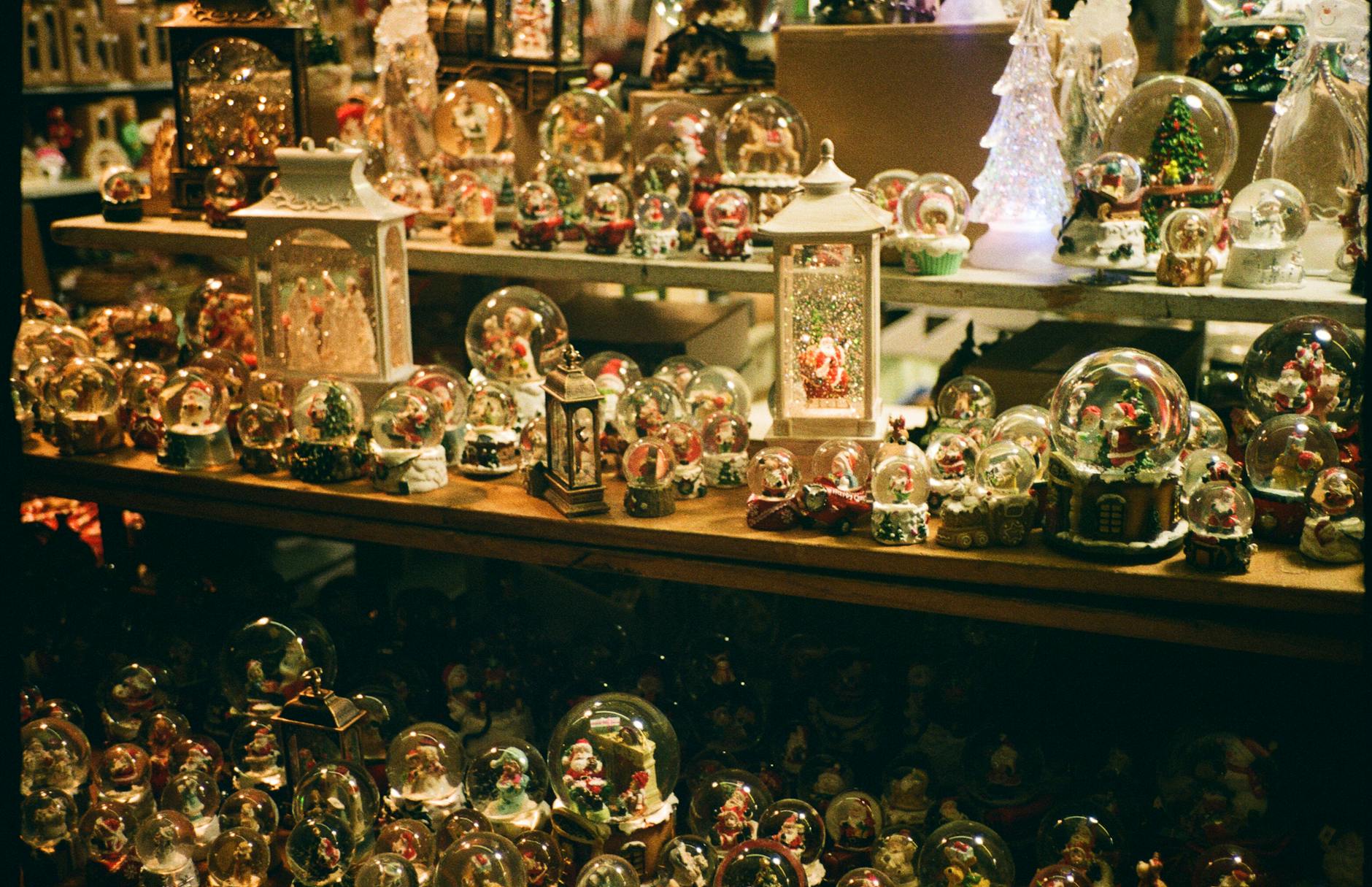
The snow globe was invented in Vienna. Erwin Perzy patented it here in 1900, more or less by accident while trying to improve a surgical lamp, and the family firm still makes them by hand in the 17th district. There is a small museum and shop at the workshop. It is the least ironic souvenir in the city.
Manner wafers, pumpkin seed oil and good coffee beans all cost a third of the airport price in an ordinary supermarket and are more genuinely Viennese than anything with a Mozart silhouette on it.
Skip the Mozartkugeln. The original is a Salzburg product, the mass-market versions are in every supermarket in Austria, and the Christmas market price is roughly double. Our Vienna shopping guide has the better options.
What to Do Beyond the Markets
The markets are two hours of a trip, not a trip. December in Vienna is also the deepest point of the cultural season.
- The State Opera. Standing room at €13–18, sold on the day. Nothing else in Europe comes close on value.
- A church concert. Advent brings a great deal of choral and Baroque music into the churches, much of it free or nearly so, and much of it better than the costumed tourist concerts. Our classical music guide explains how to tell them apart.
- The Vienna Boys’ Choir at the Hofburgkapelle on Sunday mornings during the season.
- The Kunsthistorisches Museum on a dark afternoon, which is what it was built for.
- Coffee and cake, properly. December is the one month when the great coffee houses’ pastry counters are running at full stretch. See the coffee house guide and our desserts and pastries guide.
- Ice skating — but note the timing. The big Wiener Eistraum on Rathausplatz is a January to March event, not an Advent one, because the square is a Christmas market until Boxing Day. During the market season a smaller rink runs alongside it in the Rathauspark. The Wiener Eislaufverein near the Konzerthaus is open through the winter.
- Ride tram 1 or 2 around the Ring after dark for the price of a transport ticket. The lit Ringstrasse palaces from a warm tram is the cheapest good hour in December.
- Walk the Innere Stadt on Christmas morning if you are here for it. You will not see the city that empty again.
Getting Around in December
Vienna’s public transport does not care what month it is, which is one of the quiet reasons the city handles Advent as well as it does. The U-Bahn, trams and buses run through snow and through the holidays on adjusted timetables, and the network is heated, frequent and cheap: a single is €2.40, a 24-hour pass €6.00, a 72-hour pass €17.10. Our guide to Vienna transport tickets and passes works out which is cheapest for the length of your stay.
Three December-specific notes. First, the inner city is progressively closed to traffic on 31 December for the Silvesterpfad, and parts of it are pedestrianised on busy market evenings — walking and the U-Bahn are faster than any taxi from about four o’clock onwards. Second, services thin out considerably on the evening of 24 December and run holiday timetables on the 25th and 26th; check before relying on a late connection. Third, the U-Bahn runs all night at weekends year-round, which covers New Year comfortably. The U-Bahn guide and the tram guide cover the network properly.
If you are flying in, note that ÖBB has closed the central section of the inner-city S-Bahn until late 2027, which has changed how the airport trains run — the detail is in our Vienna Airport guide and our airport transfer comparison.
What December Is Not Good For
- A quiet trip. This is the busiest month of the Viennese year outside high summer, and the busiest in the inner city full stop.
- A cheap trip. Hotel rates peak. If budget is the priority, come in November.
- Guaranteed snow. It falls, it melts. January and February are the better bet.
- Day trips. The Wachau and the wine villages are largely shut, the Danube boats have stopped for the season, and daylight runs out at four. Our day trips guide flags what is seasonal.
- Long daylight photography. One usable block, roughly 09:00 to 15:30.
- Ball season. It begins on New Year’s Eve and runs to Shrove Tuesday. December has none of it — see the ball season guide.
- Turning up on the 24th without a dinner reservation. Said once above; it deserves saying again.
Where to Stay in December
Location matters more this month than any other, for one reason: the daylight runs out at four and you will be walking back to your hotel in the cold and the dark, repeatedly. A room fifteen minutes’ walk from a U-Bahn station that is charming in May is a nuisance in December.
The Innere Stadt puts you inside the market circuit and inside the lights, and costs accordingly. The 7th district around Spittelberg and the MuseumsQuartier is the best compromise — walkable to everything, a genuinely good market on the doorstep, and better value than the first district. The 4th and 6th around Karlsplatz and the Naschmarkt work well for the same reasons. Anywhere on the U1, U2, U3 or U4 within a few stops of the centre is fine.
Book early. December sells out in a way no other month does, and the last rooms available in the second week are rarely the ones you want. Our guide to where to stay in Vienna breaks the districts down properly, and mid-range hotels in Vienna covers the bracket most people are actually booking in.
Frequently Asked Questions
Is December a good time to visit Vienna?
Yes, if you want the Christmas atmosphere and accept the cost and the crowds — Vienna’s Advent is genuinely one of the best in Europe. If what you want is the markets without the crush, the last ten days of November give you the same thing for less money and with a fraction of the people.
How cold is Vienna in December?
Average high around 4°C, average low around −2°C. Colder than most of western Europe, but dry rather than damp, and easier to dress for than November.
Does it snow in Vienna in December?
Usually at some point, but it rarely lies in the city for more than a day or two. If snow is the reason for your trip, January and February are more reliable.
Are shops open on 8 December in Vienna?
Yes. Mariä Empfängnis is a public holiday, but retail has been permitted to open on it since 1995 and most shops do. It is the busiest shopping day of the Austrian year, so plan around it rather than into it.
What is open in Vienna on Christmas Day?
Public transport, some museums, hotel restaurants and a scattering of others. Shops and shopping centres are closed on both 25 and 26 December, with petrol station and railway station shops the only reliable exceptions. Check individual museums directly — their holiday hours vary considerably.
What time do shops close on Christmas Eve in Vienna?
Around 13:00, supermarkets included. Most Christmas markets close early or for good on the 24th, and the great majority of restaurants close for the evening. Book dinner in advance if you are here.
When do Vienna’s Christmas markets close?
It varies by market. Several close on 23 December; Rathausplatz and Stephansplatz run to 26 December; Schönbrunn and the Prater winter market continue to 6 January 2027.
Is there ice skating at Rathausplatz in December?
Only a small rink alongside the market in the Rathauspark. The full Wiener Eistraum, which covers the whole square, runs from late January to early March — the square is a Christmas market until Boxing Day.
How busy is Vienna in December?
Very, from about the 12th to the 23rd, and particularly on weekend evenings in the inner city. The first week and the midweek days around 9–11 December are noticeably calmer, and 25 to 26 December is genuinely quiet.
What happens in Vienna on New Year’s Eve?
The Silvesterpfad, a free open-air trail of stages and stalls across the inner city and the Prater, running from about 14:00 well past midnight, with a waltz on the Graben at twelve. Our New Year’s Eve guide covers it in full.
One date is worth carrying forward from this page: the Christmas season does not end on Boxing Day. Schönbrunn and the Prater winter market run to 6 January, and then everything stops at once. Our guide to Vienna in January picks up from there — the Epiphany closures, ball season, and the emptiest museums of the year.
Related Vienna Guides
- Vienna Christmas Markets: The Complete Guide
- Vienna in November
- Vienna in Winter
- New Year’s Eve in Vienna
- The Rathausplatz Christkindlmarkt
- The Schönbrunn Christmas Market
- What to Pack for Vienna
- Vienna Classical Music Guide
- The Best Time to Visit Vienna
Photo Credits
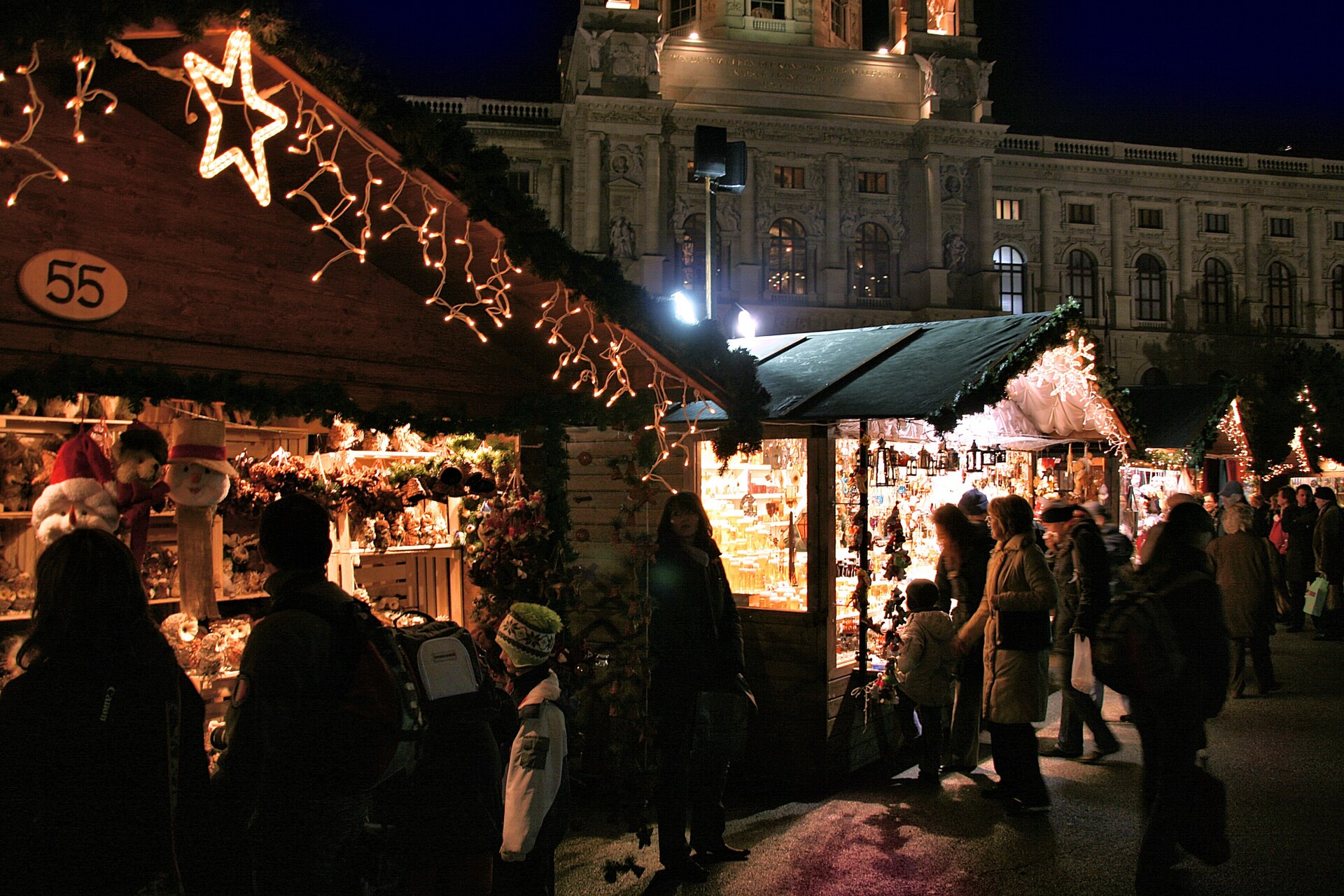
Christmas market stalls at night: Weihnachtsmarkt in Austria – Wien Weihnachtsmarkt by Marek Ślusarczyk, CC BY 3.0, via Wikimedia Commons.
Schönbrunn under snow: Schloss Schönbrunn, Winter 2023 by Michellethewise, CC0 1.0, via Wikimedia Commons.