Schönbrunn Christmas Market: Complete Guide (2026-2027)
Schoenbrunn Christmas market 2026-2027. Opening dates, best stalls, food highlights, what sets it apart from the central markets, and tips for the most magical visit.

Photo by Ian Ramírez
- Schönbrunn Christmas Market 2026-2027 essentials
- What Sets Schönbrunn Apart from Rathausplatz
- What to eat and drink at Schönbrunn
- What to buy at Schönbrunn
- Activities at the Schönbrunn market
- Combining Schönbrunn market with palace visit
- Best times to visit Schönbrunn Christmas market
- Schönbrunn Christmas market with kids
- Schönbrunn Christmas market with mobility limitations
- What to wear and bring
- Schönbrunn market FAQ
- Combining Schönbrunn market with other Vienna activities
- Combining Schoenbrunn Christmas market with palace tour
- Schoenbrunn market vendor categories
- The Schoenbrunn imperial Christmas tradition
- The Schoenbrunn imperial Christmas tradition
- Schoenbrunn market practical logistics
- Schoenbrunn Christmas market for senior travelers
- Schoenbrunn market for international tourists
- The Schönbrunn experience: what makes it special
- Schoenbrunn market summary
- Comparing the experiences
- The future of Schoenbrunn Christmas market
- Tips for repeat visitors
- Year-by-year Schoenbrunn evolution
- Schoenbrunn vs other palace Christmas markets in Europe
- Schoenbrunn parting thoughts
- Related Vienna Guides
- Photo Credits
This article contains advertising. Our booking links are routed through a partner that adds commission tracking automatically, so if you book through one we earn a commission from the provider, at no extra cost to you. It never affects what we recommend. Affiliate disclosure
Set against the imperial palace backdrop with more than 90 huts of curated crafts and traditional Austrian food, Schönbrunn offers what Rathausplatz cannot: a sense of unhurried elegance, quality artisan offerings, and a setting that feels like a Christmas storybook. This 2026-2027 guide covers opening dates, what to eat and buy, when to visit for best atmosphere, and how it compares with the central markets.
Schönbrunn Christmas Market 2026-2027 essentials
Opening dates: November 6, 2026 to January 6, 2027, without a break.
After Christmas: There is no separate New Year market. The Christmas market simply carries on past the holidays to January 6, 2027, on shorter hours from Christmas Day.
Opening hours: Daily 10:00 – 21:00 from November 6 to December 23. December 24 10:00 – 16:00. December 25 to January 6 daily 10:00 – 19:00.
Location: In front of Schönbrunn Palace, on the courtyard known as Schloss Schönbrunn Vorplatz.
How to get there: U4 to Schönbrunn or Hietzing station; from either, the market is about 600 metres on foot. Bus 10A also serves the area. Free parking nearby is rare; use public transport.
Entry: Free.
What Sets Schönbrunn Apart from Rathausplatz
Schönbrunn differs from Rathausplatz in several ways:
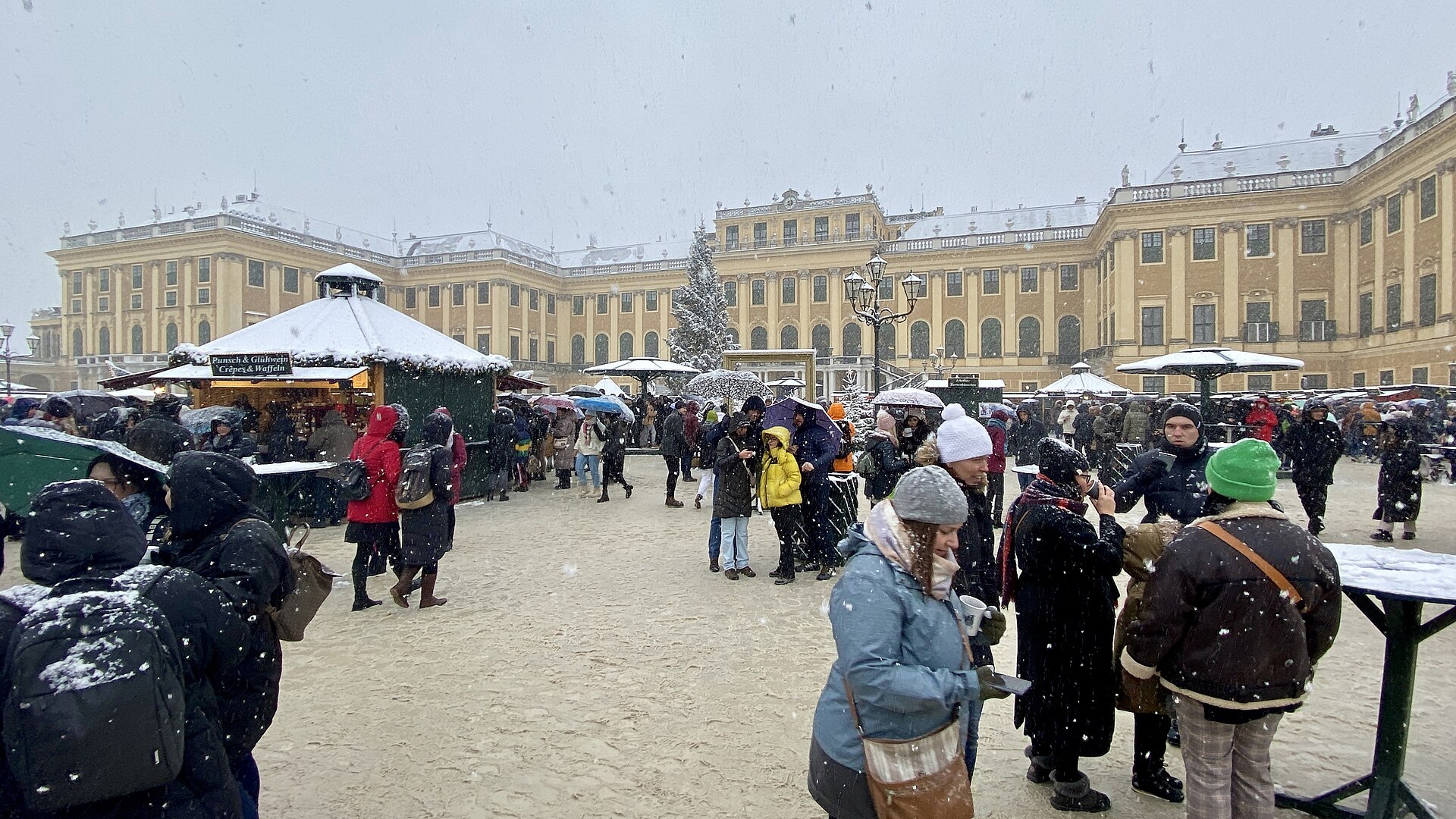
The setting: The yellow imperial palace facade lit up against the night sky is one of Europe’s most photogenic Christmas scenes. Even visitors who’ve seen many Christmas markets find Schönbrunn’s setting exceptional.
Quality vendors: Schönbrunn’s vendor selection skews toward serious artisans, traditional craftspeople, and quality food producers rather than mass-produced ornament sellers.
Spaciousness: The palace forecourt is much larger than Rathausplatz. Even at peak times, you have room to breathe and move.
Less tourist-focused: Schönbrunn attracts a higher proportion of local visitors, particularly Viennese families. The atmosphere is more authentic.
Food quality: Come hungry: the Glühwein and food vendors are a good reason to visit in their own right.
What to eat and drink at Schönbrunn
Schönbrunn’s food scene is curated more carefully than other Vienna markets:
Schönbrunn Glühwein: Several producers offer different styles. The recipe at the central stall is particularly noted. Standard Glühwein: 4-5 euros plus 4 euro mug deposit. Glühwein with rum: 5-7 euros.
Punsch varieties: Multiple stalls offer rum punch, fruit punch, “Jagatee” (hunter’s tea), and Bombardino (Italian-style hot drinks). 5-7 euros.
Bratwurst and Käsekrainer: Quality sausages from named producers, often Burgenland or Styrian. 5-7 euros each.
Stelze (Pork knuckle): Roasted pork knuckle on a paper plate, a hearty Austrian Christmas market specialty. 12-18 euros.
Maroni (Roasted chestnuts): The market’s chestnuts are roasted on site. 5-7 euros for a small bag.
Kartoffelpuffer with apple sauce: Traditional potato pancakes. 5-7 euros.
Apfelstrudel mit Vanille: Hot apple strudel with vanilla sauce. 5-7 euros.
Lebkuchen and gingerbread: Spiced Christmas biscuits that keep well, which makes them an easy present to take home. 4-15 euros depending on size.
Schönbrunn-specific specialties: Look for the “Kaiserliche Würstel” stall serving imperial-style sausages with mustard.
What to buy at Schönbrunn
The shopping at Schönbrunn rewards browsing. Top categories:
Hand-blown Christmas tree ornaments: Several producers from the Krems and Wachau regions. 15-50 euros for quality pieces.
Beeswax candles: Local Austrian beekeepers selling candles, ornaments, and honey products.
Wooden Christmas crib figures (Krippenfiguren): Traditional nativity scenes hand-carved in Tyrol. 25-200 euros depending on size.
Hand-knitted woolens: Hats, gloves, scarves from named producers. Higher quality than Rathausplatz equivalents. 35-80 euros.
Schnaps and liqueurs: Austrian fruit brandies in attractive bottles. Marillenschnaps (apricot), Williams (pear), and Zirbenschnaps (Swiss pine) are specialties. 15-40 euros per bottle.
Pottery and ceramics: Austrian and Bohemian-style designs. 20-150 euros.
Hand-painted Christmas tree balls: Part of the market’s range of handmade Christmas decorations.
Schönbrunn-specific: The market mug each year is collectible. Many visitors return annually to add to their mug collection.
Activities at the Schönbrunn market
Beyond shopping and eating, Schönbrunn offers activities not found at other markets:
Ice skating rink: Free rink on the forecourt for visitors with their own skates. Skate rental costs €4 a pair up to age 14 and €5 from age 15. The skating rink is one of two at Vienna Christmas markets (Rathausplatz is the other).
Ice stock (Eisstockschiessen): A traditional Austrian curling-like game on ice. Equipment provided. Fun for groups.
Ferris wheel: Small Ferris wheel at the market, often a popular attraction for children. 4-6 euros per ride.
Children’s carousel: Traditional carousel for younger children.
Christmas concerts: Free chorus performances on weekends, scheduled throughout the day. Children’s choir performances are particularly popular.
Visit Father Christmas: Designated Father Christmas appearances on December weekends; check schedule.
Workshops: Many vendors offer demonstrations of their craft. Watching a glass blower or wood carver work is a memorable Christmas market experience.
Combining Schönbrunn market with palace visit
If you’re visiting Schönbrunn for the Christmas market, consider also touring the palace:
Schönbrunn Palace tickets: The Palace Ticket, covering the whole piano nobile, costs €42 for adults and €30 for children aged 6-18; the State Apartments ticket costs €30 for adults and €20 for children. The interior shows the Habsburg residence rooms.
Schönbrunn Christmas atmosphere: Even the palace gardens (free entry) are atmospheric in winter with frost and occasional snow.
Gloriette walk: The walk to the Gloriette viewpoint at the top of the gardens is uphill all the way and offers spectacular palace views from above. The Gloriette has a cafe in summer (closed in winter except for special events).
For full Schönbrunn coverage including palace ticket strategy, see our Schönbrunn Palace complete guide.
Best times to visit Schönbrunn Christmas market
Best atmosphere: Our pick is an evening visit, from dusk onwards. The lights kick in and the market feels its most magical.
Best for browsing without crowds: Tuesday through Thursday afternoons. Many local shoppers do their Christmas market browsing on weekdays.
Best for photography: Around dusk, when the palace facade is lit but the sky still has color. On short winter days that comes in the late afternoon.
Best for kids: Saturday or Sunday afternoons when children’s programming peaks.
Worst times: Mid-day weekdays the market feels empty and less atmospheric. Avoid arriving before noon on weekdays.
Schönbrunn Christmas market with kids
Schönbrunn is exceptionally family-friendly:
Wide spaces accommodate strollers easily.
Carousel and Ferris wheel for kids.
Children’s programming on weekends.
Hot chocolate and kid-friendly food at multiple stalls.
The palace gardens themselves are kid-friendly.
No-alcohol-allowed children’s area for family safety.
For more family-focused tips, see our first time visiting Vienna tips and family hotels Vienna guides.
Schönbrunn Christmas market with mobility limitations
The Schönbrunn market is generally accessible:
Paved forecourt, mostly flat.
Wide pathways suit wheelchairs and walkers.
Adequate seating areas with covered stations.
Step-free access from the U4 Schönbrunn station.
Public restrooms with accessible options.
The palace itself has elevator access; the gardens have step-free paths to the Neptune Fountain. The Gloriette walk involves stairs.
What to wear and bring
Vienna in December is cold, with temperatures around freezing and snow possible:
Layered warm clothing: Hat, gloves, scarf essential.
Waterproof footwear: Snow boots or waterproof walking shoes.
Small daypack: For purchases and souvenirs.
Cash: 50-100 euros for purchases. Many stalls take cards but small ones may not.
Camera or phone with good low-light capability: Best photography is after dark with lit palace.
Schönbrunn market FAQ
When does Schönbrunn Christmas market open in 2026? November 6, 2026.
When does it close? January 6, 2027. It stays open right through Christmas and New Year, with shorter hours from December 25.
Is it free to enter? Yes, entry to the market is free. You only pay for food, drinks, and goods.
How long does a visit take? Plan 90 minutes minimum for a relaxed browse. 3 hours if you also walk the palace gardens.
Can I park there? Limited paid parking is available but fills up quickly. Use the U-Bahn instead.
Are the food and drinks expensive? Moderate. 5-7 euros for sausages and pancakes, 4-5 euros for Glühwein. Less expensive than Vienna restaurants.
Can I buy palace tickets at the market? Yes, the palace ticket counter is right at the market entrance. Buy palace tickets online to skip queues.
Is Schönbrunn market better than Rathausplatz? It depends on what you want. Schönbrunn has the palace setting. For first-time visitors who want spectacle, Rathausplatz delivers it, with the illuminated City Hall behind the stalls. Visit both if you have time.
Are there bathrooms? Yes, multiple public restrooms at the market. Small fee (1 euro typically).
Can I bring my dog? Yes, leashed dogs are welcome at the outdoor market. The food and beverage stalls are generally pet-friendly.
Is photography allowed? Yes, freely. The palace facade at night is particularly photogenic.
Combining Schönbrunn market with other Vienna activities
A typical December Vienna day combining Schönbrunn market:
Morning: Tour Schönbrunn Palace interior (book skip-the-line tickets).
Lunch: Eat at the market or at a nearby restaurant.
Afternoon: Browse the market and walk the palace gardens.
Sunset and evening: Return to the market for lit atmosphere and Glühwein.
Late evening: U-Bahn back to central Vienna for dinner.
Alternatively, combine with a second Christmas market visit (Rathausplatz or Belvedere) for a full Christmas market day.
Combining Schoenbrunn Christmas market with palace tour
A full Schoenbrunn day combining palace + market:
Morning: Schoenbrunn Palace interior tour (book skip-the-line tickets online).
Lunch: The Schoenbrunn Cafe (in the palace) or palace garden restaurant.
Afternoon: Walk the palace gardens, Gloriette walk, Tiergarten zoo if interested.
Sunset: Return to the Christmas market just as lights come on.
Evening: Browse market stalls, dinner at a stall or restaurant, U-Bahn back.
This format creates a 6-7 hour Schoenbrunn day with both the palace experience and the magical market atmosphere.
Schoenbrunn market vendor categories
The vendor mix at Schoenbrunn covers:
Hand-crafted goods: Christmas ornaments, candles, ceramics, wooden items.
Traditional food: Sausages, baked goods, sweet treats.
Hot drinks: Gluhwein, punch, hot chocolate, mulled cider.
Imported goods: Higher-quality international items.
Other: Books, music, miscellaneous.
The Schoenbrunn imperial Christmas tradition
Schoenbrunn was the Habsburg summer residence and the imperial family celebrated Christmas here in the 19th century. While the modern market is not directly tied to imperial Christmas traditions, the palace’s role as the imperial Christmas setting adds historical resonance to visiting today.
The Schoenbrunn imperial Christmas tradition
Schoenbrunn was the Habsburg summer residence and the imperial family celebrated certain Christmas traditions here, particularly during Emperor Franz Joseph’s reign. Although the modern Christmas market is not directly connected to imperial Christmas practices, the palace’s role as the imperial Christmas backdrop adds historical resonance.
Empress Sisi famously preferred the Habsburg summer residences during Christmas seasons, with the family often spending winter holidays at Schoenbrunn or Bad Ischl. The setting’s imperial associations contribute to the market’s distinctive atmosphere.
Schoenbrunn market practical logistics
For practical visit planning:
U-Bahn connection: U4 to Schoenbrunn or Hietzing. Either way it is roughly 600 metres to the market.
Bus alternatives: Bus 10A serves the area.
Parking: Limited paid parking. Use public transport.
Restrooms: Multiple at the market and palace. Small fee 1 euro.
Cash: Bring 50-100 euros cash for smaller vendors and tips; not every stall is guaranteed to take cards.
Layered clothing: Cold outside, warm inside food stalls.
Camera with low-light capability: The palace facade at night is the most photographed spot.
Schoenbrunn Christmas market for senior travelers
For older visitors, Schoenbrunn has particular advantages:
Step-free access from U-Bahn.
Wide pathways accommodate walkers.
Plenty of seating areas.
Heated rest stations.
Less crowded than Rathausplatz.
Calmer overall atmosphere.
Schoenbrunn market for international tourists
The international tourist contingent at Schoenbrunn is more diverse than Rathausplatz, drawing visitors from across Europe, North America, and Asia. Most vendors speak basic English. Multi-language menus available at major food stalls.
The Schönbrunn experience: what makes it special
Schönbrunn Christmas market is the rare tourist attraction that lives up to and often exceeds expectations. The combination of:
Imperial palace setting
Quality artisan vendors
Excellent food and drink
Family-friendly atmosphere
Less tourist crush than central markets
…makes Schönbrunn the Vienna Christmas market we recommend most warmly for first-time visitors who want both spectacle and substance.
For the broader Christmas market picture, see our complete Vienna Christmas markets ranked guide, and for full December planning, our Vienna Christmas markets pillar.
Schoenbrunn market summary
The Schoenbrunn Christmas Market stands out for its imperial setting, quality vendors, manageable crowds, and excellent food: a distinctly Vienna Christmas experience that no other market quite matches. For first-time visitors who want both spectacle and substance, Schoenbrunn is the strongest single recommendation.
Comparing the experiences
If choosing between Vienna’s major Christmas markets:
For spectacle and scale: Rathausplatz.
For imperial elegance and quality: Schoenbrunn.
For artisan crafts and local feel: Spittelberg.
For art-focused shopping: Karlsplatz Art Advent.
For convenient central access: Stephansplatz or Am Hof.
Most visitors with 2-3 days time visit 3-5 markets for comparison and variety.
The future of Schoenbrunn Christmas market
The market has evolved significantly over decades while maintaining its imperial character. Modern additions include sustainability initiatives, expanded children’s programming, and digital ticketing for palace visits. Future plans hint at continued growth in vendor selection and possible extension into early January.
For travelers who love continuity, the core experience remains unchanged: imperial setting, quality vendors, family-friendly atmosphere, and the magical lit palace facade. Schoenbrunn delivers the same essential experience year after year.
Tips for repeat visitors
Repeat Schoenbrunn visitors can deepen their experience by:
Trying different mug designs annually.
Visiting at different times of day for varied atmosphere.
Exploring less-visited stall sections at the market’s edges.
Attending the children’s program performances.
Visiting on weekdays vs weekends for atmosphere comparison.
Combining with the palace gardens in winter (less-visited).
Year-by-year Schoenbrunn evolution
The Schoenbrunn Christmas Market has evolved annually. Recent additions include enhanced lighting installations, new artisan partnerships, expanded children’s programming, and improved accessibility infrastructure. Each year brings small but meaningful changes while preserving the core imperial character.
Schoenbrunn vs other palace Christmas markets in Europe
Other notable European palace Christmas markets include Versailles in France, Buckingham Palace area in London, and Catherine Palace in St. Petersburg. Schoenbrunn distinguishes itself with the warmer Austrian Christmas tradition, more accessible scale, and the unique combination of palace tour plus market in a single location.
Schoenbrunn parting thoughts
Whether this is your first Vienna Christmas market or your tenth, Schoenbrunn delivers consistently. The combination of imperial setting, quality vendors, and atmospheric lighting creates a Vienna Christmas experience worth dedicating an evening to. Plan your visit, dress warmly, savor the Gluhwein, and leave time for the magic to settle in.
Related Vienna Guides
Photo Credits
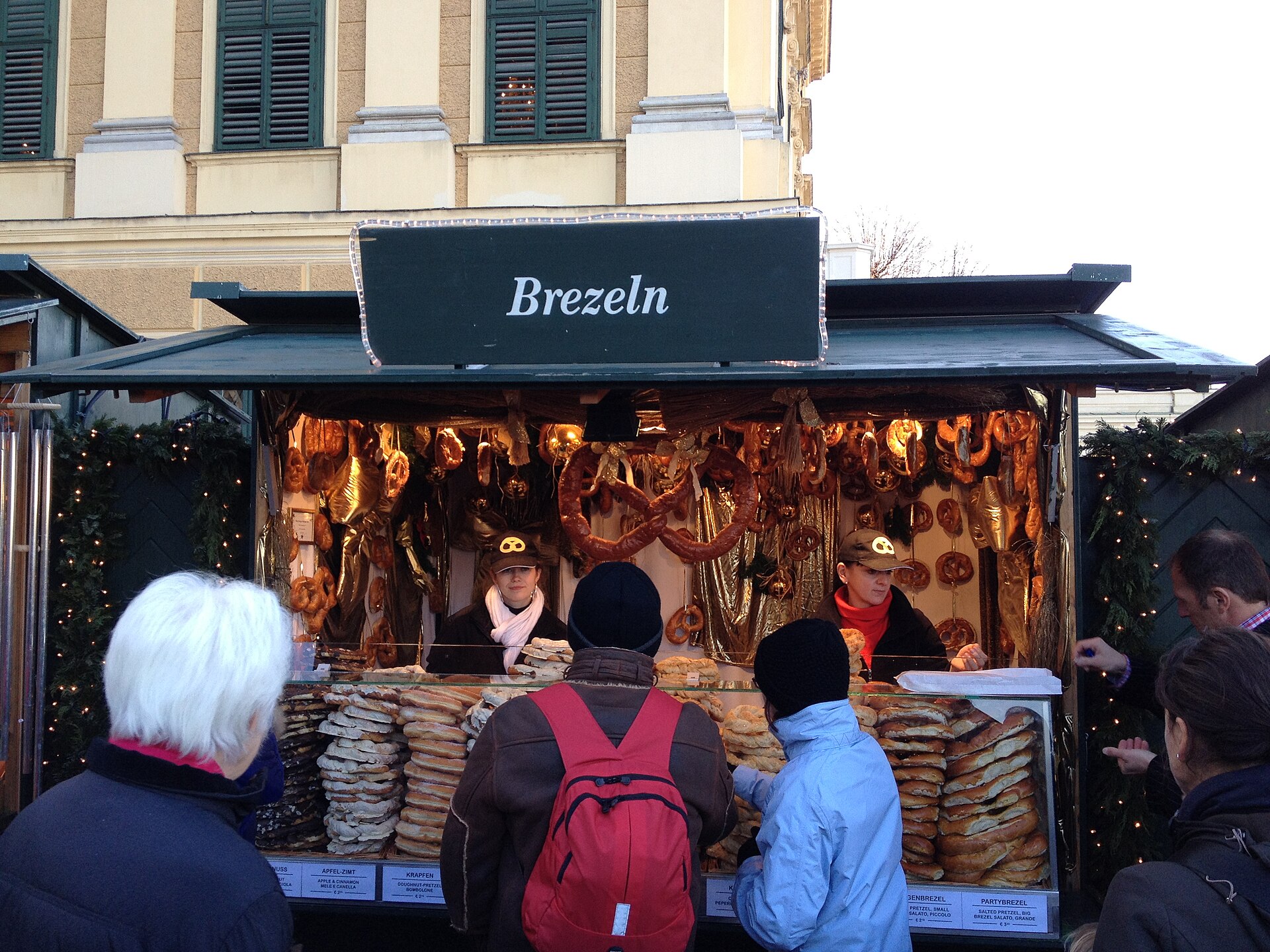
A pretzel stall at Schönbrunn: Booth with pretzels at Schönbrunn Palace, Vienna (8337512724) by Michal Osmenda, CC BY 2.0, via Wikimedia Commons.
Snowfall at Schönbrunn’s Christmas market: Weihnachtsmarkt Schönbrunn 2023 03 by Funke, CC BY-SA 4.0, via Wikimedia Commons.