Karlskirche Vienna: Tickets, the Dome, Concerts & Visitor Guide
A Greek portico, two Roman columns and a Baroque dome, reflected in a pool with a Henry Moore in it. What it costs, what happened to the panorama lift, and whether the concerts are worth it.
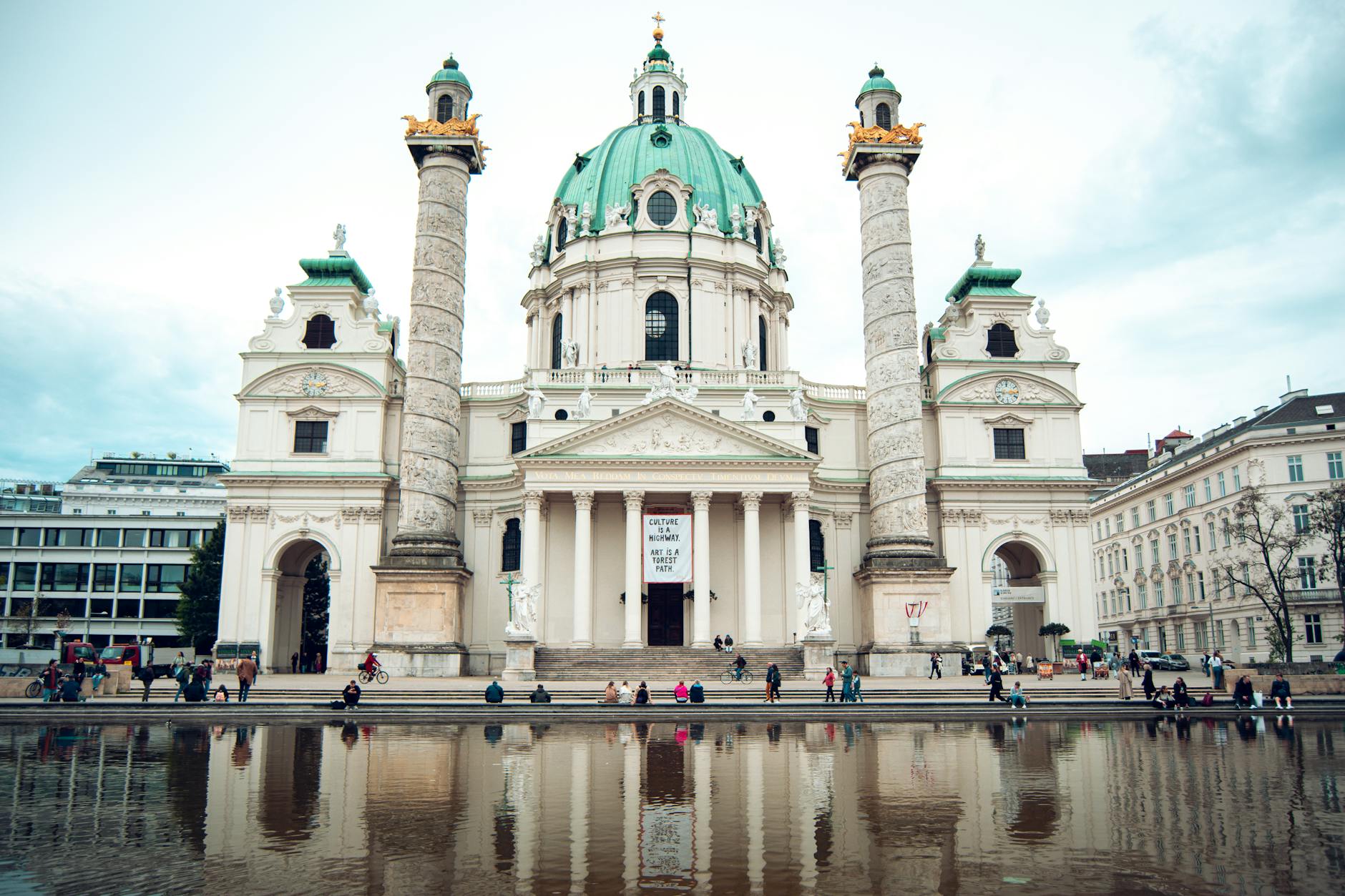
Photo by Mihai Vlasceanu
- Tickets, Prices and Opening Hours
- The Panorama Lift Is Gone
- Inside the Church
- Why It Looks Like That
- The Concerts Under the Dome
- The Pool, the Square and the Free View
- Getting There
- Building a Half-Day Around Karlsplatz
- Why the Church Is Always Being Repaired
- Our Honest Verdict
- Frequently Asked Questions
- Related Vienna Guides
- Photo Credits
This article contains advertising. Our booking links are routed through a partner that adds commission tracking automatically, so if you book through one we earn a commission from the provider, at no extra cost to you. It never affects what we recommend. Affiliate disclosure
Two Roman triumphal columns stand in front of a Greek temple portico, behind which a green copper dome rises between a pair of towers that would not look out of place on a Chinese pavilion. None of it should work together and all of it does. Karlskirche Vienna is the most confident building in the city and the one that best explains what the Habsburgs thought they were: heirs to Rome, to Greece, to Christendom and to everything else worth inheriting, all of it assembled on one facade in 1737 and reflected, most evenings, in a shallow pool with a Henry Moore sculpture sitting in it.
This guide covers what it costs to go in, the opening hours, what happened to the famous panorama lift — it is gone, and a great many websites have not caught up — what you actually see inside, the concerts held under the dome and whether they are worth the money, the best free view of the exterior, and how the church fits into the strange collage of a square it stands on. Prices and hours were checked in October 2026 against the church’s own visitor information.
Tickets, Prices and Opening Hours
| Ticket | Price |
|---|---|
| Adult | €9.50 |
| Student | €6 |
| Children under 10 | Free |
| Groups of 6 or more | €8.50 per person |
| Coming to pray | Free |
A word about those figures. They are the prices on the church’s own visitor information page. €9.50 for an adult is not a large sum and it is not going to derail your budget, and the money goes towards the upkeep of a building that needs constant care.
The important part is the last line of the table. Anyone coming to the church to pray is admitted free. This is a working parish church, not a museum with an altar in it, and the charge exists to fund an ongoing restoration programme on a building that has needed one more or less continuously since it was finished. Mass is said daily and the church is open to worshippers outside ticketed hours.
Opening hours
- Monday to Saturday: 09:00–18:00
- Sunday and public holidays: 11:30–19:00
- Mass: service times are listed on the parish’s website
Those are the hours on the church’s own site, with no break in the middle of the day.
The Sunday hours are the ones to note: the church does not open to ticketed visitors until 11:30, because the mornings belong to the congregation. Turning up at ten on a Sunday expecting to walk round with a camera is a wasted journey, though you are entirely welcome to attend the service.
The Panorama Lift Is Gone
For twenty years, from 2002, a scaffolding lift inside the church carried visitors thirty-two metres up to a platform directly beneath the dome, where you could stand at eye level with a fresco painted three hundred years ago for people to squint at from the floor. It was one of the genuinely unusual experiences in Vienna, and it is the thing most visitors arrive expecting.
It was dismantled in late November 2022. The scaffolding came down and has not gone back up.
The lift was dismantled in late November 2022. Any listing that still promises a dome platform is out of date, and if you book something on that basis you may be disappointed at the door.
What replaced it is a guided route through rooms of the church that are not otherwise open, ending at a viewing platform above the main portal with a view out over the inner city. There is also a large architectural model of the church — about two and a half metres tall, built at 1:28 — which is more interesting than a model of a building has any right to be, because it lets you see the structural logic that the finished stone conceals. The parish has talked about opening the former imperial loge above the altar as a further stage.
Is the replacement as good as the lift? No. Standing an arm’s length from a Baroque fresco is not a thing you can substitute. But the rooms are worth seeing, the platform view is real, and the honest framing is that you are now paying to see a great church properly rather than paying for a ride.
Inside the Church
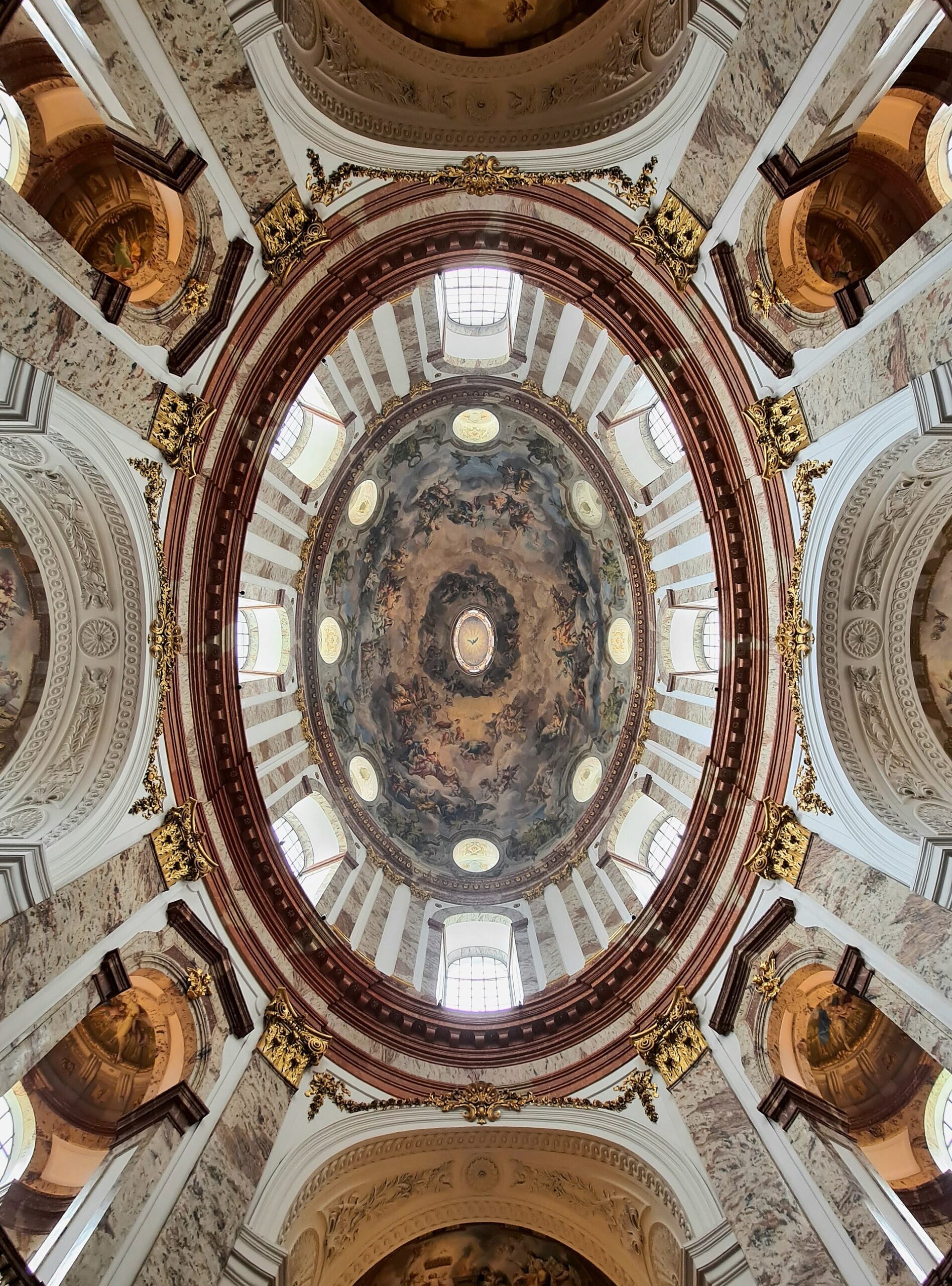
The interior is an oval under a dome, which is the Baroque solving of a problem — how to make a centralised plan feel processional — and it works from the moment you walk in. The space is bigger than the exterior leads you to expect and the light comes from above rather than the sides, so the whole room brightens and dims with the weather outside.
Things to look for:
- The dome fresco by Johann Michael Rottmayr, painted in the 1720s — the intercession of Saint Charles Borromeo, with the saint borne up into a sky full of cloud, angels and allegory. It is enormous and, from the floor, deliberately hard to read in detail, which was rather the point when it was painted.
- The high altar relief, all gilded rays and stucco cloud, in the full theatrical manner.
- The side altars, several with paintings by Daniel Gran and other court artists of the period.
- The Museo Borromeo, a small treasury display of liturgical objects and church history included with the ticket.
Why It Looks Like That
Vienna was hit by a plague epidemic in 1713. Emperor Charles VI vowed to build a church to Saint Charles Borromeo — the 16th-century Archbishop of Milan who had worked among plague victims, and, conveniently, the emperor’s own name saint. A design competition followed and Johann Bernhard Fischer von Erlach, the dominant architect of the Austrian Baroque, won it. He died in 1723 and his son Joseph Emanuel finished the job; the church was completed in 1737.
The famous strangeness of the facade is not a muddle. Every element is a claim:
- The portico is a Greek temple front — classical antiquity.
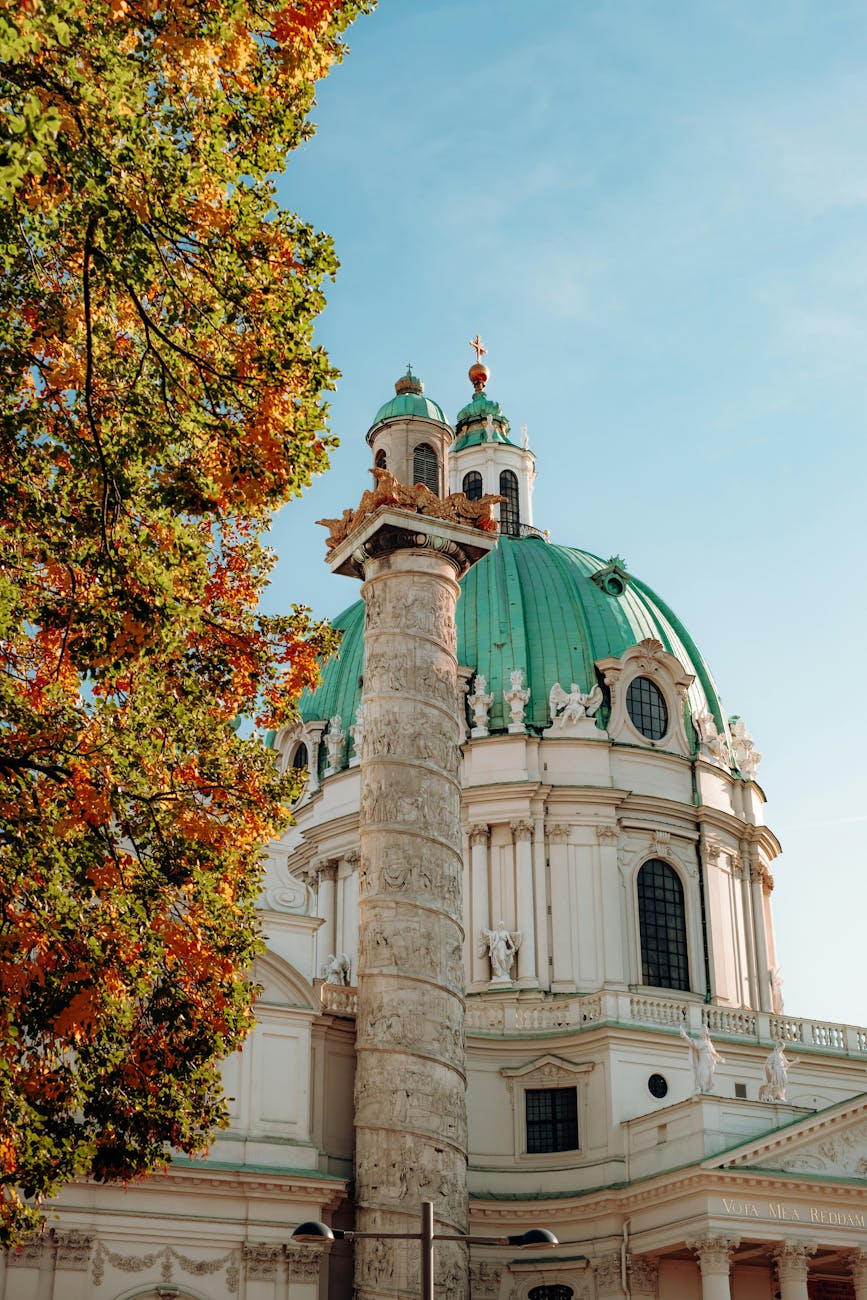
- The two columns are direct quotations of Trajan’s Column in Rome, wrapped in spiral reliefs telling the life of Borromeo instead of a military campaign — imperial Rome, and the Pillars of Hercules of the Habsburg device.
- The dome is Roman Baroque, in the line that runs from St Peter’s.
- The flanking towers are Austrian Baroque with a pagoda-ish silhouette that architectural historians have argued about for two centuries.
Put together, it says: the Holy Roman Emperor is the inheritor of all of this at once. It is architecture as a political sentence, and it is far more interesting once you know that than it is as a pretty building. Our Baroque Vienna guide follows the same argument across the rest of the city.
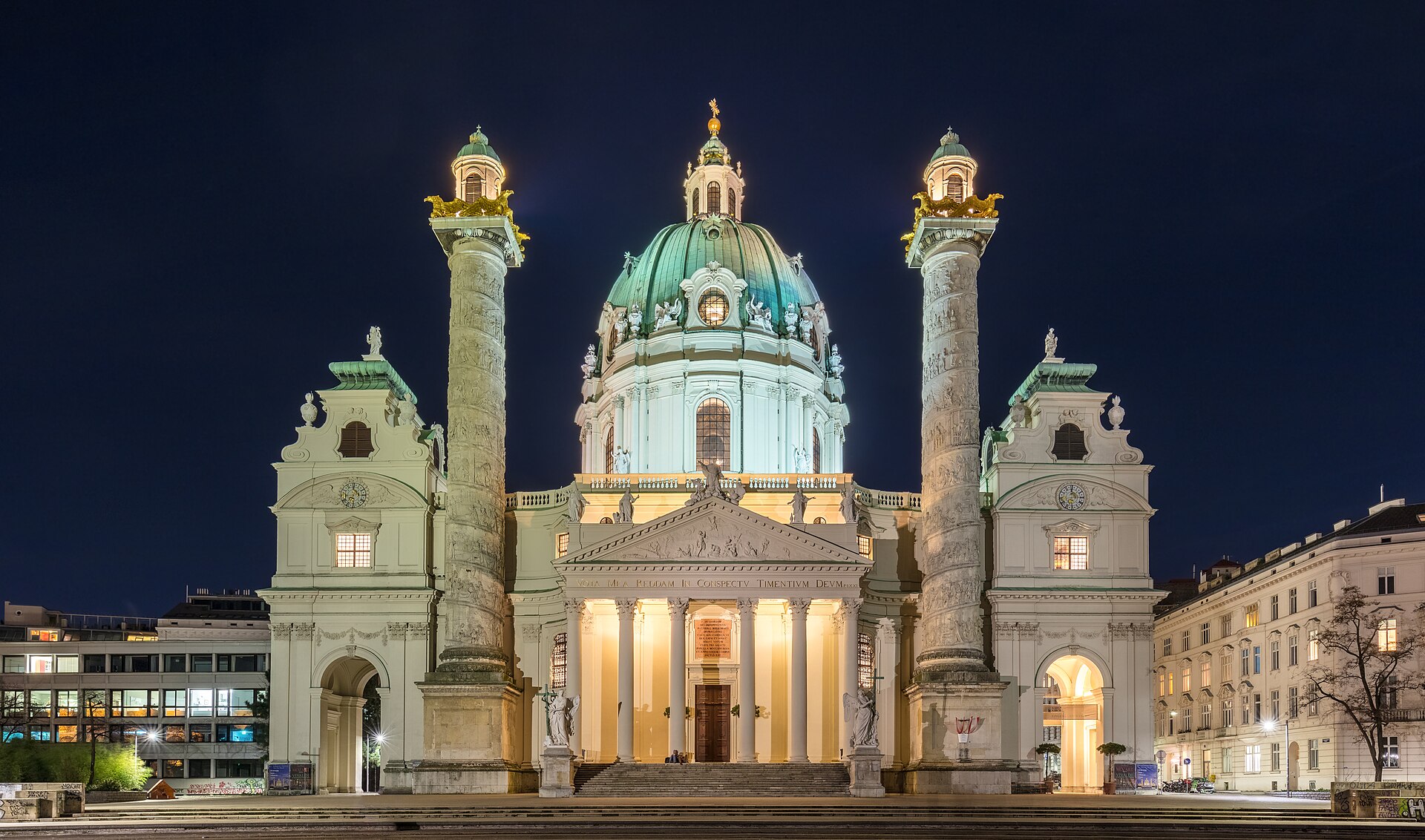
The inscription over the portico — VOTA MEA REDDAM IN CONSPECTU TIMENTIUM DEUM, “I will pay my vows in the sight of them that fear the Lord” — is the emperor keeping his promise, in stone, in public, where everyone can see that he did.
The Concerts Under the Dome
Karlskirche hosts concerts most evenings, overwhelmingly Vivaldi’s Four Seasons played by a small period-instrument ensemble, with Mozart and Bach filling out the programme. It is a genuinely beautiful room to hear music in: the oval and the dome give it a long, generous acoustic that suits Baroque strings.
Be clear-eyed about what it is, though. These are tourist-facing concerts at tourist-facing prices, in the same bracket as the costumed Mozart concerts around the Ring, and the musicianship — while usually perfectly decent — is not the reason they exist. You are paying largely for the setting, which is fair enough if the setting is what you want.
If you want the best classical music Vienna offers for the least money, it is not here. Standing room at the Musikverein costs about €12 and puts you in the Golden Hall with the Vienna Symphony; standing room at the State Opera is €13 to €18. Both are covered in our concert tickets guide, and the broader picture is in our classical music guide.
And the standing warning applies here as everywhere in Vienna: do not buy concert tickets from costumed sellers on the street. The wigs on Kärntner Straße and around Karlsplatz are selling something, and it is rarely what you think you are buying — more on that in our Vienna tourist traps guide.
The Pool, the Square and the Free View
The reflecting pool in front of the church, with Henry Moore’s bronze Hill Arches sitting in it, is where the photograph everyone takes gets taken. It costs nothing, it is accessible at any hour, and on a still evening it doubles the building.
Timing, if you care about the picture:
- Golden hour, from the far end of the pool, looking north — warm stone, green dome, still water.
- Blue hour and after dark, when the floodlights come up and the sky is still deep blue rather than black. This is the best twenty minutes of the day here and most people have already left.
- Windless mornings, when the reflection is unbroken and the square is empty.
More of the same thinking is in our Vienna photography spots guide.
Karlsplatz itself is one of the odder spaces in Vienna — less a square than a collection of things that happen to be near each other. On or around it you have the Karlskirche, Otto Wagner’s two Jugendstil Stadtbahn pavilions, the Wien Museum, the Musikverein, the Technical University, Resselpark and a major U-Bahn interchange, all in different architectural languages and none of them arranged to make a coherent picture. Our Secession and Jugendstil guide covers the Wagner pavilions, which are two minutes away and free to look at.
In late November and December the square hosts the Art Advent market, which is the least commercial of Vienna’s big Christmas markets and easily the best of them for actual craft — see our Christmas markets guide.
Getting There
Karlsplatz 10, 1040 Wien.
- U1, U2 or U4 Karlsplatz — three lines meet here, and the Resselpark exit puts you on the church side. This is one of the best-connected points in the city.
- Several tram lines, the WLB Badner Bahn and the U1, U2 and U4 all serve Karlsplatz and the Oper, a short walk away.
- Walking from the State Opera takes about seven minutes; from Naschmarkt, about eight.
The Karlsplatz U-Bahn complex is large and confusingly signed, and the walk from the U1 platforms to daylight is longer than you expect. Give yourself an extra five minutes — our U-Bahn guide has more on the interchanges that catch people out.

Building a Half-Day Around Karlsplatz
The church takes an hour including the outside. The square around it will absorb an entire afternoon if you let it, and almost nothing on this list needs a booking.
- Karlskirche — 40 minutes inside, 20 outside at the pool.
- Otto Wagner Pavilions — five minutes’ walk. Two Stadtbahn stations erected in 1898, in green-and-gold Jugendstil, one of which is a small museum. Free from the outside and among the best-loved objects in the city.
- Wien Museum — on the square. The city’s own history museum, from Roman Vindobona to Red Vienna, and one of the better-value large museums here.
- The Secession Building — a short walk west, with Klimt’s Beethoven Frieze in the basement and a gilded dome the Viennese have always called the golden cabbage.
- Naschmarkt — ten minutes west along the Wienzeile, past two Otto Wagner apartment buildings with majolica and gold on their facades. Lunch here. See our Naschmarkt guide.
- Musikverein — two minutes from the church, and worth walking past even if you are not going in.
That sequence covers Baroque, Jugendstil, the Secession and a market in about four hours, on foot, in a part of Vienna most visitors cross rather than stop in. It is one of the better-value afternoons in the city and it ends with food.
Why the Church Is Always Being Repaired
If you have seen photographs of Karlskirche with scaffolding on it, that is not bad luck. The building has been in more or less continuous restoration for decades, and the reason is structural rather than cosmetic.
It was built on a vineyard beside the Wien river, and a building this size takes constant care. Add three centuries of Viennese frost, two world wars and busy roads around the church, and the maintenance bill never stops.
This is what the admission charge pays for, and it is why the parish frames it as a contribution rather than a ticket. If a specific part of the interior is your reason for coming, it is worth a phone call to the rectory first.
Our Honest Verdict
The exterior is the masterpiece, and the exterior is free. If you do nothing else, walk to the far end of the pool at dusk and look at it. That is the experience, it costs nothing, and it is among the best twenty minutes available in Vienna at any price.
Going inside for around €8 is still worth doing, particularly if you take the guided route to the platform and look at the model — but manage your expectations about the dome. The fresco is magnificent and you will be looking at it from sixty feet below, the way everyone did for the first two hundred and eighty years of the building’s life. If you came specifically for the lift, that opportunity closed in 2022 and the internet has not noticed.
Skip the evening concert unless the room is the point. You are paying a premium for a Baroque interior and a Vivaldi programme you can hear better and cheaper elsewhere; Musikverein standing room at a fraction of the price will give you an incomparably better hour of music. What is genuinely worth the money is the combination of the ticket, the platform and then a slow circuit of the outside afterwards, when you can finally see how the columns, the portico and the dome are arguing with each other.
Frequently Asked Questions
How much does it cost to enter Karlskirche?
€9.50 for adults and €6 for students, with children up to 10 free and €8.50 per person for groups of six or more. Anyone coming to pray is admitted free.
Is the Karlskirche panorama lift still there?
No. The lift that carried visitors 32 metres up to the dome frescoes was dismantled in late November 2022 after twenty years in place. Many websites still advertise it. It has been replaced by a guided route through the church to a viewing platform above the main portal, and a large architectural model of the building.
What are the Karlskirche opening hours?
Monday to Saturday 09:00 to 18:00, and Sunday and public holidays 11:30 to 19:00. Mass times are listed on the parish’s website.
Can you visit Karlskirche for free?
Yes, if you are coming to pray or to attend Mass. The admission charge applies to sightseeing visits and funds the restoration. The exterior, the pool and the square around it are free at all times, and the exterior is arguably the better half of the building.
Who built Karlskirche and why?
Emperor Charles VI vowed to build it during the plague epidemic of 1713, dedicating it to Saint Charles Borromeo, who had ministered to plague victims in Milan and was also the emperor’s name saint. Johann Bernhard Fischer von Erlach won the design competition; his son Joseph Emanuel completed the church in 1737.
Are the Karlskirche concerts worth it?
The room is beautiful and the acoustic suits Baroque strings. The programmes are tourist-facing, mostly Vivaldi’s Four Seasons, and priced accordingly. If the setting is what you want, it delivers; if the music is what you want, Musikverein standing room at about €12 is a far better use of the money.
How long do you need at Karlskirche?
Thirty to forty minutes inside, including the treasury and the platform route. Add another twenty minutes outside for the pool, the columns and a circuit of the exterior, which is the part people rush and should not.
What is the sculpture in the pool outside?
Hill Arches, a bronze by Henry Moore, installed in the reflecting pool in front of the church in the late 1970s. It divides opinion sharply and photographs extremely well.
Which U-Bahn goes to Karlskirche?
U1, U2 and U4 all stop at Karlsplatz. Use the Resselpark exit, which comes out on the church side of the square. The interchange is large, so allow a few extra minutes to get out of it.
The white building beside the church is the Wien Museum, the city’s own history museum, and its permanent exhibition is free. Since the 2023 extension its terrace level also has a view of the Karlskirche dome. Our guide to the Wien Museum covers what to see inside and how to combine it with a visit here.
Related Vienna Guides
- Baroque Vienna: An Architecture Guide
- Stephansdom: Vienna’s Cathedral
- Vienna’s Gothic Churches
- The Musikverein: Tickets and the Golden Hall
- How to Buy Vienna Concert Tickets
- The Secession and Vienna’s Jugendstil
- The Best Photography Spots in Vienna
- Vienna’s Christmas Markets
- Free Things to Do in Vienna
- Vienna Attractions: The Complete List
Photo Credits
Karlskirche floodlit at night: Iglesia de San Carlos Borromeo, Viena, Austria, 2020-01-31, DD 164-166 HDR by Diego Delso, CC BY-SA 4.0, via Wikimedia Commons.
The dome fresco: The Dome Fresco of the Karlskirche by TCsongor, CC BY-SA 4.0, via Wikimedia Commons.