Haus des Meeres: Vienna’s Flak Tower Aquarium
Ten thousand animals, a shark tank and a rooftop bar stacked inside a Second World War anti-aircraft tower. Prices, the €16 weekday evening ticket (counter only, from 17:30, not public holidays), and whether it is worth €23.50 at midday.
- Tickets and Prices 2026
- What Is Inside
- The Rooftop Terrace
- The Tower Itself
- A Floor-by-Floor Plan
- Feeding Times and What to Time Your Visit Around
- Getting There
- Practicalities
- Seeing the Other Flak Towers
- Haus des Meeres or the Zoo?
- Our Honest Verdict
- Frequently Asked Questions
- Related Vienna Guides
- Photo Credits
This article contains advertising. Our booking links are routed through a partner that adds commission tracking automatically, so if you book through one we earn a commission from the provider, at no extra cost to you. It never affects what we recommend. Affiliate disclosure
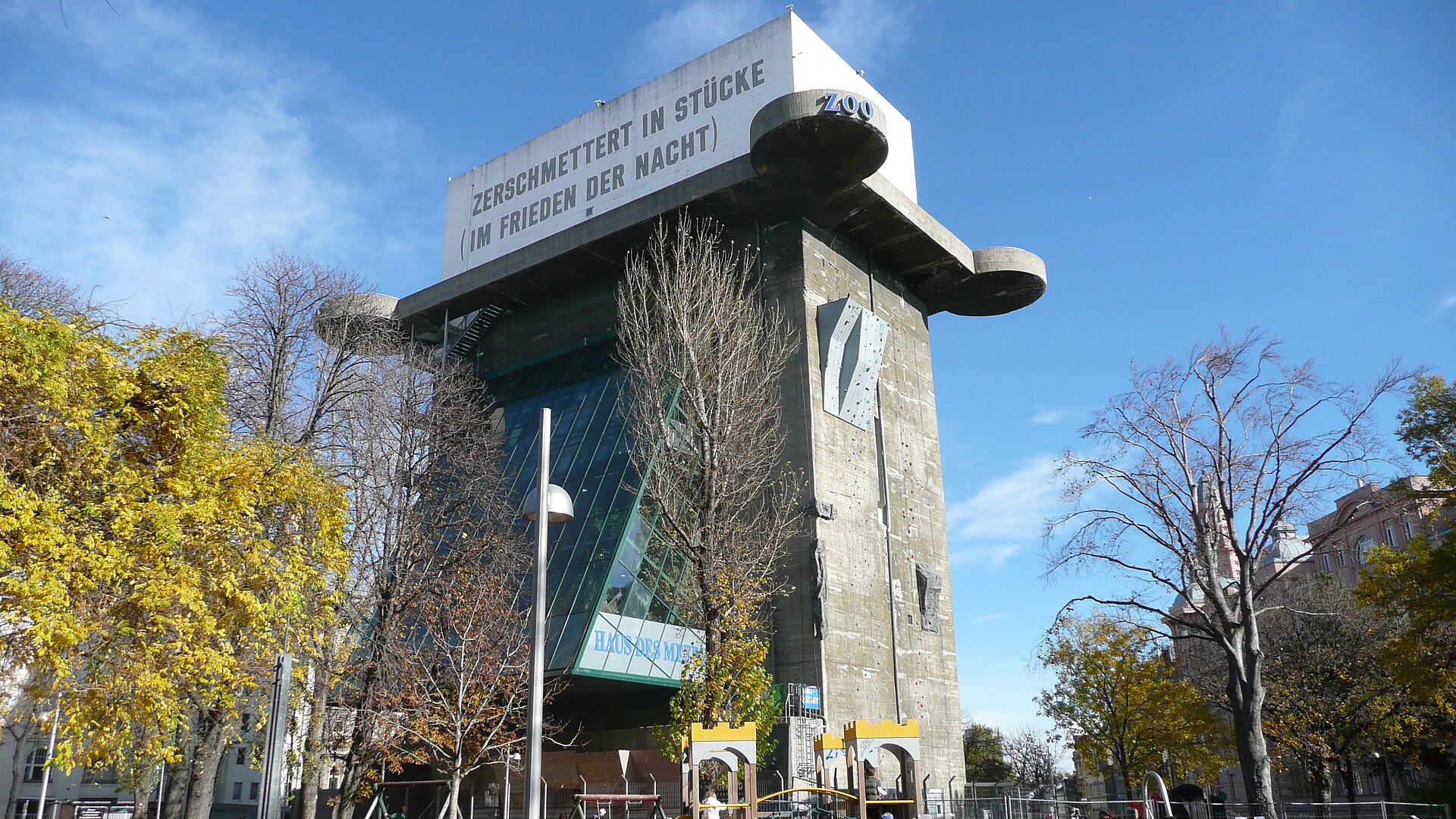
You are standing in a park in the 6th district, surrounded by ordinary apartment blocks, looking up at a slab of grey concrete, a wartime fire-control tower that was originally forty-seven metres high. Inside it there are ten thousand animals, a shark tank, free-flying birds, a crocodile, and a bar on the roof. Haus des Meeres Vienna is an aquarium inside a Nazi anti-aircraft tower, and the fact that neither half of that sentence is a metaphor is the whole reason to go.
This guide covers 2026 prices including the evening ticket that saves you €7.50, opening hours and when to avoid, what is on each of the ten floors, the rooftop terrace and its view, the flak tower’s own history, how it compares with the zoo, and our honest verdict on an attraction that is either the most interesting building in Vienna or an overpriced squeeze depending entirely on what time you turn up. Prices were checked on the aquarium’s own website in September 2026; confirm before you travel.
Tickets and Prices 2026
| Ticket | Price | Where to buy |
|---|---|---|
| Adult | €23.50 | Online |
| Child 6–15 | €9.80 | Online |
| Small child 3–5 | €6.50 | Online |
| Student (to 27, with ID) | €16.50 | Counter only, Mon–Fri, not public holidays |
| Senior (64+, or with a pensioner’s card) | €16.50 | Counter only, Mon and Tue, not public holidays |
| Visitors with disabilities | €16.50 | Counter only |
| Evening ticket, Mon–Fri from 17:30 | €16.00 | Counter only, on the day, not public holidays |
| Weekday annual ticket, adult | €55.00 | Counter |
| Weekday annual ticket, child 3–15 | €25.00 | Counter |
Two things to notice. First, several of the best rates — student, senior, and the evening ticket — are counter only, so if you qualify for one of them, do not buy online. Second, the weekday annual ticket at €55 is only 2.3 times the adult day rate, which is a remarkable deal for anyone living here and a completely irrelevant one for a visitor.
The evening ticket is the answer
From 17:30, Monday to Friday (public holidays excepted), an adult pays €16 at the counter instead of €23.50. That is a third off, and it comes with the two things this building most needs: fewer people and better light on the roof.
Haus des Meeres at 11:00 on a Saturday is a lift queue, a stairwell of pushchairs and a shark tank three deep in children. Haus des Meeres at 18:00 on a Wednesday is half empty, the animals are more active in several of the houses, and the terrace catches the sunset over the 7th district. Same building, €7.50 cheaper, an entirely different experience. If your schedule can take it, this is not a marginal recommendation.
Opening hours
Open daily from 09:00 to 20:00, public holidays included. It does not close for the usual Viennese museum days, which makes it one of the reliable Monday and Tuesday options when half the city’s institutions are shut.
Arriving at 19:30 gives you thirty minutes and is not enough. Two hours is the right allowance; two and a half if you are stopping on the roof.
What Is Inside
Eleven storeys, stacked inside a structure built for fire control and air-raid shelter rather than fish. The route runs upwards, which is unusual and works: you start at the bottom with the tanks and finish on the roof with the city.
The aquarium floors
The lower levels hold the fish. The centrepiece is the big tropical tank with reef sharks and rays circling a coral reconstruction, viewed from a curved window and from a short walk-through tunnel that puts the water over your head. There are Mediterranean tanks, Danube and freshwater displays, a coral nursery, and a long run of smaller vitrines with the kind of species that reward standing still for two minutes — seahorses, lionfish, moray eels in holes.
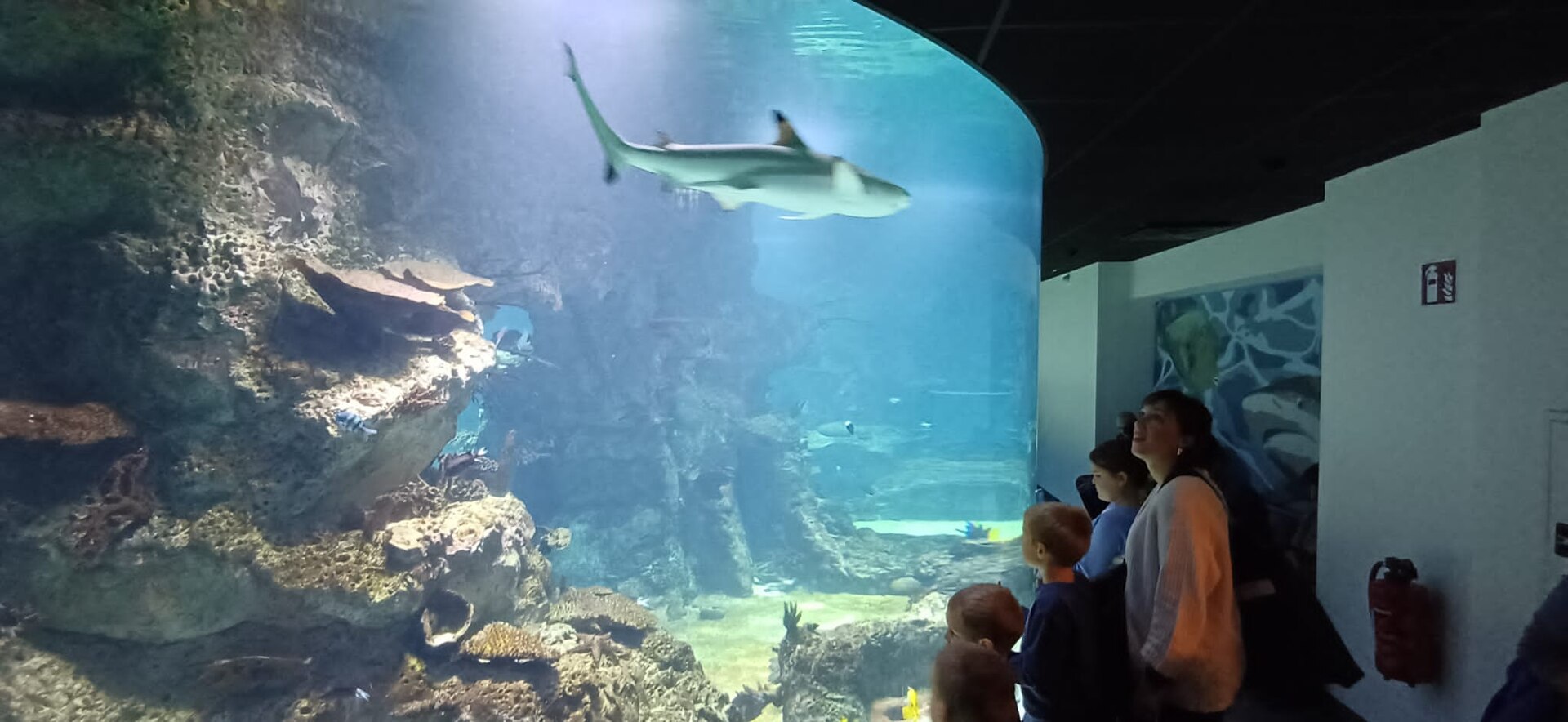
Feeding times are posted at the entrance and they are the structure of a good visit — the shark feed in particular draws a crowd and is worth timing your arrival around. Ask at the desk; the schedule changes.
The Tropical House
The best floor, and the one that surprises people. The Tropenhaus is a warm, humid, planted space where the birds fly free around you and small monkeys — squirrel monkeys and tamarins — move through the branches at head height with no glass in between. There are sloths. There is a good chance a bird will land near you.
It is genuinely a lovely twenty minutes and it is also where the crowding hurts most, because it is not a large room. Go in the evening and you may have it nearly to yourself.
Crocodiles, snakes and the Vivarium
Upper floors hold the reptile and amphibian collection: a crocodile enclosure you can look down into, constrictors and vipers in lit vitrines, tarantulas, poison dart frogs, turtles. It is a proper terrarium collection rather than a token few tanks, and the Aqua Terra Zoo in the official name is earned.
Parents of arachnophobes: the spider section is unavoidable on the route. Fair warning.
The bunker inside the aquarium
Parts of the original flak tower interior have been left as they were — raw concrete, narrow passages, the machinery of a wartime structure — with historical documentation about the tower and Vienna’s air war. It is a jarring and effective few minutes, sitting as it does directly between a tank of tropical fish and a room of iguanas.
Access to the historical sections has varied over the years, so check on the day whether it is open. The wider story of what these towers were and why they are still standing is in our Vienna in the Second World War guide.
The Rooftop Terrace
The top of the tower now holds the 360° Ocean Sky restaurant and bar, with an open terrace and panoramic views over the city.
From up there you get an unobstructed view across Vienna in every direction — Stephansdom’s spire, the Ringstraße domes, the Wienerwald hills to the west, the modern towers along the Danube to the north-east. Vienna has very few tall buildings in the centre, which means the ones that exist have disproportionate views, and this one is standing in the middle of a low-rise district with nothing anywhere near it.
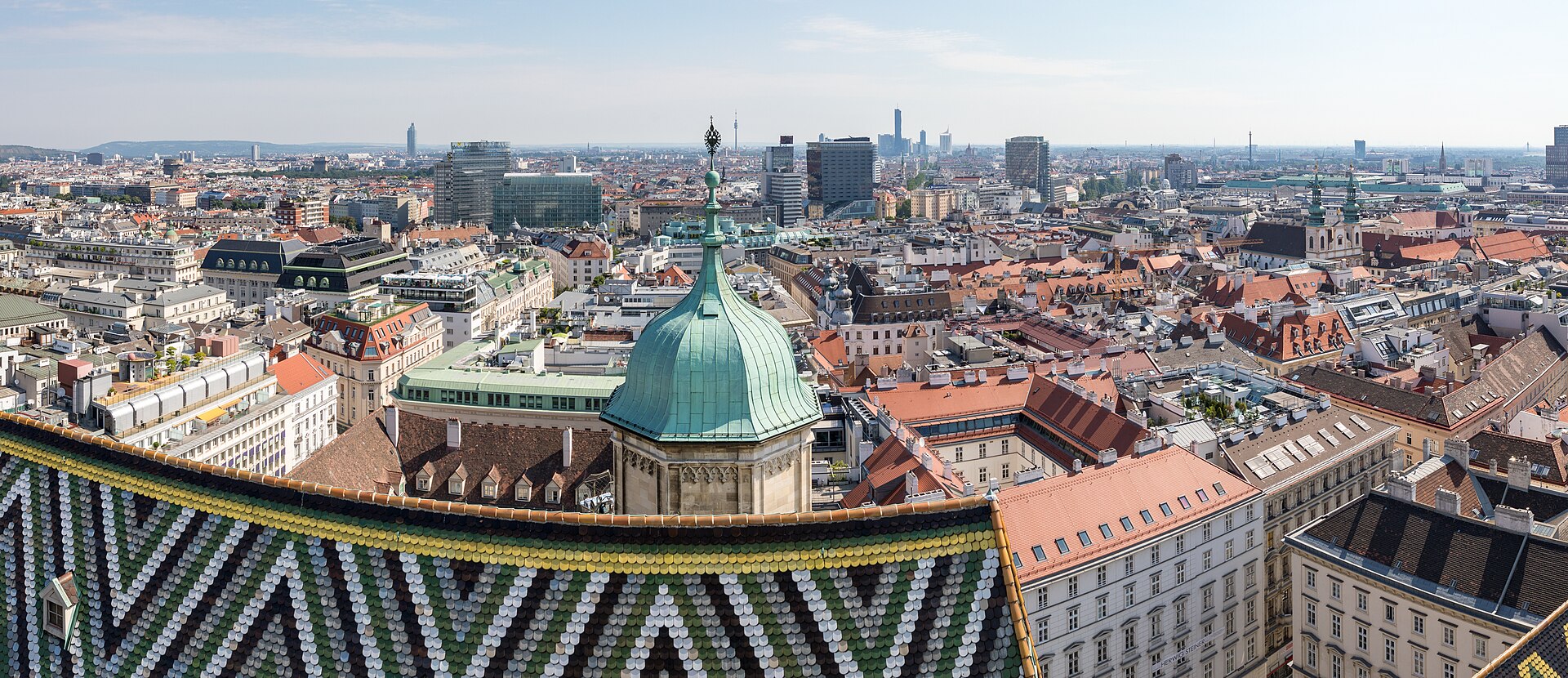
The bar on the terrace serves drinks and food with a view attached, priced accordingly. You can also reach the restaurant levels without an aquarium ticket, which is worth knowing if the view rather than the fish is what you are after — check current arrangements on arrival, because they have changed more than once. For the alternatives, our rooftop bars guide covers the rest of the city’s high places.
The Tower Itself
This matters, and most visitors walk in without knowing any of it.
Between 1942 and 1945 the Nazi regime built three pairs of flak towers in Vienna — a Gefechtsturm carrying the guns and a Leitturm carrying the fire-control equipment, working as a pair. The one in Esterházypark is the fire-control tower; its gun-tower partner stands nearby, behind the Stiftskaserne. Two more pairs survive in Arenbergpark and the Augarten.
They were built with concrete walls about 2.5 metres thick. After the war nobody could work out how to remove them: demolishing something that solid in the middle of a dense residential district was judged more dangerous than leaving it. So they stayed, and Vienna has spent eighty years deciding what to do with six enormous concrete objects it did not want.
The answers have varied. One holds contemporary art storage. One has a data centre in it. Some stand unused. And one became an aquarium: the society behind it was founded in 1957, Haus des Meeres opened on 7 June 1958 with 40 small display tanks, and over the following decades it spread through the tower floor by floor until it had colonised the whole structure and gained a bar on the roof.
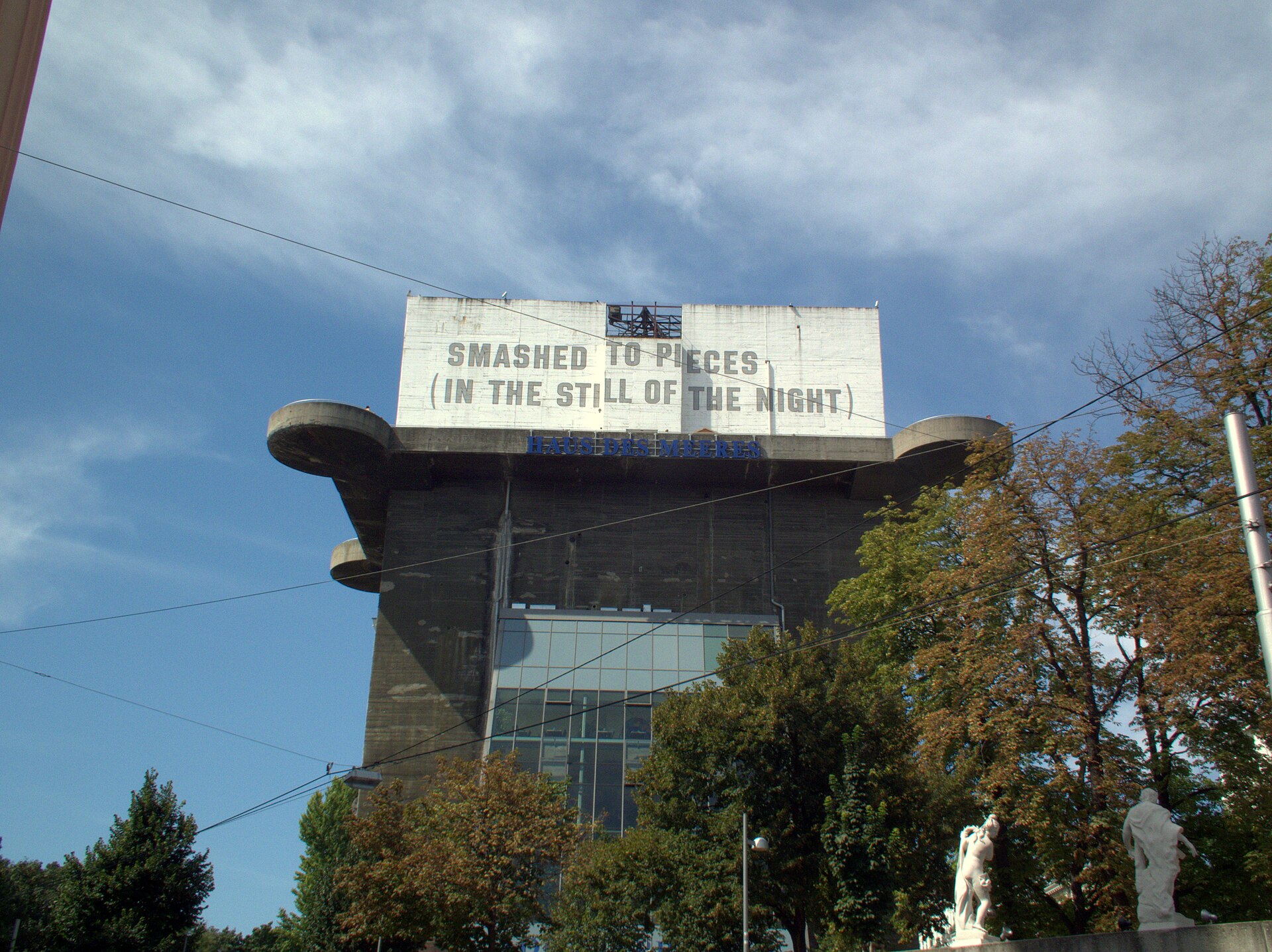
In 1991 the American artist Lawrence Weiner installed his text across the upper wall — SMASHED TO PIECES (IN THE STILL OF THE NIGHT) — which stayed until the aquarium’s expansion, when the lettering was overpainted. For a few decades it was about as good an answer to the question of what to do with a flak tower as anyone had managed.
A Floor-by-Floor Plan
The building is vertical and the route is essentially one way up, but the order in which you linger makes a real difference to how the two hours feel.
- Take the stairs from the entrance, not the lift. This is the single most useful piece of advice on this page. The lifts are the bottleneck; the stairwell is nearly always empty.
- Aquarium levels first — 40 minutes. Work up through the Mediterranean and freshwater tanks to the big reef tank and the tunnel. Check the feeding board on the way in and plan around it.
- Tropical House — 25 minutes. Slow down here. The free-flying birds and the monkeys are the part you will remember, and rushing it is the commonest mistake.
- Reptiles, amphibians and the crocodile — 20 minutes. Denser and quieter than the floors below.
- The bunker sections, if open — 10 minutes, and worth it precisely because of the tonal whiplash.
- Roof terrace — 20 minutes minimum, longer if the light is good. Finish here; nothing works as an anticlimax after the view.
That is a shade over two hours. Compress the reptiles if you are short of time, never the Tropical House or the roof.
Feeding Times and What to Time Your Visit Around
The scheduled feeds are what turn a walk past tanks into something with events in it, and they are posted at the entrance rather than published reliably in advance. The shark feed is the headline, and the piranha and penguin feeds draw their own crowds.
Two practical points. First, ask at the desk on the way in and write the times on your hand, because there is no announcement system that reaches the whole building. Second, a feed pulls everyone in the tower to one spot, which means the rest of the building empties for ten minutes — if you are not interested in watching a shark eat, that is the moment to go and stand in front of the reef tank alone.
Getting There
Fritz-Grünbaum-Platz 1, 1060 Wien — in Esterházypark, just off Mariahilfer Straße in the 6th district.
- U3 Neubaugasse is the closest station, about three minutes’ walk.
- U3 Zieglergasse is a similar distance from the other side.
- Bus 13A or 14A stop nearby if you are coming across the districts rather than along the Ring.
- Walking from the MuseumsQuartier takes about twelve minutes up Mariahilfer Straße.
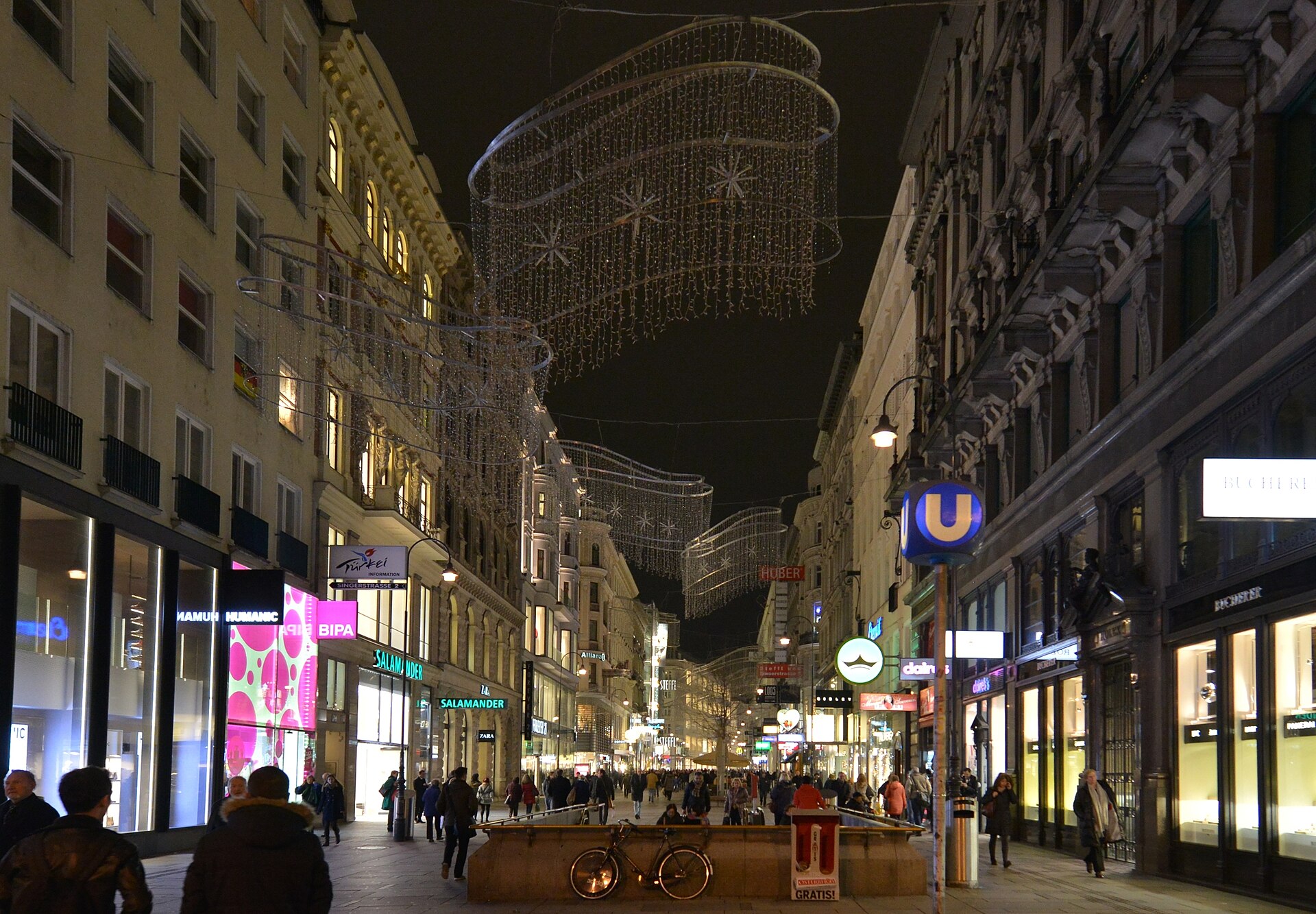
The square is named after Fritz Grünbaum, the Viennese cabaret performer and writer murdered at Dachau in 1941 — another layer on a site that already has several. Mariahilfer Straße, Vienna’s main shopping street, is thirty seconds away, which makes this easy to combine with an afternoon covered in our Vienna shopping guide and the surrounding streets in our Neubau and Mariahilf guide.
Practicalities
- Lifts serve every floor, which makes the building accessible — but there are not many of them and at busy times the queue for the lift is the queue for the whole visit. Take the stairs if you can; you will overtake everybody.
- Pushchairs are manageable but awkward. The corridors are narrow because the walls are concrete and cannot be moved.
- It is warm. The Tropical House in particular is kept hot and humid, and you will want to have left a coat somewhere.
- Photography is fine; flash at the tanks is not, for obvious reasons.
- Allow two hours, two and a half with the roof. Ninety minutes is a rush.
- Open every day, which makes it a useful Monday or Tuesday option when the museums close — see our rainy day guide for the other reliable ones.
Seeing the Other Flak Towers
If the tower interests you more than the fish — and for a certain kind of visitor it will — the other five are all findable on foot or a short U-Bahn ride, and walking between a couple of them is one of the stranger self-guided tours in Vienna.
- Stiftskaserne, Mariahilfer Straße — this tower’s own partner, the fire-control tower of the pair, a few hundred metres away and still in military hands. You can see it clearly from the street; you cannot go in.
- Arenbergpark, 3rd district — two towers in a public park, one used for contemporary art storage. Twenty minutes from here by tram and the easiest pair to photograph together.
- Augarten, 2nd district — the most unsettling of the lot, because they stand in an otherwise beautiful baroque park with people playing football around the base. They are enormous.
All six remain conspicuous wartime structures, and Haus des Meeres itself recalls the origin and original function of its tower in its museum displays, corridors and stairwells. Our Second World War guide fills in the wider story, and our photography spots guide covers where to shoot them from.
Haus des Meeres or the Zoo?
| Haus des Meeres | Tiergarten Schönbrunn | |
|---|---|---|
| Adult ticket | €23.50 (€16 weekday evening, not public holidays) | €29 |
| Child | €9.80 (6–15) | Varies by age |
| Location | City centre, 6th district | U4 Hietzing |
| Time needed | Allow about 2 hours | Allow half a day or more |
| Indoor/outdoor | Entirely indoor | Almost entirely outdoor |
| Best for | Rain, evenings, a short slot, older children | A full day, good weather, any age |
They are not competing for the same afternoon. The zoo at Schönbrunn is a half-day expedition in a baroque park with pandas in it; Haus des Meeres is two indoor hours you can drop into an existing plan. If the weather is good and you have a whole day, go to the zoo. If it is raining, or it is six in the evening, or you have two hours between other things, come here.
Our Honest Verdict
The building is more interesting than the aquarium, and that is not a criticism — it is the correct way round for this attraction and the reason it is worth your time.
As an aquarium judged against Lisbon, Genoa or Valencia, Haus des Meeres is small, the tanks are modest, and the route is cramped. It could not be otherwise: it is inside a wartime bunker with metre-thick walls that nobody can move. As an experience — climbing floor by floor through a Nazi anti-aircraft tower past sharks and free-flying birds to a bar with a view over the whole city — there is nothing else like it anywhere, and the tension between the container and the contents is the point.
At €23.50 for an adult it is not cheap for two hours, and at midday on a summer Saturday, with a lift queue and the Tropical House full, we would say it is not worth it. At €16 on a Wednesday evening, with the light going and the terrace half empty, it is one of the more memorable things you can do in Vienna. The same building, the same animals, a third less money, and a completely different verdict.
Children of roughly six to twelve will love it at any price. Under-fives will find the crowds and the corridors harder than the animals, and the €6.50 rate for three to five year-olds does not fix that. Teenagers and adults should go for the roof and the concrete as much as for the fish — more of Vienna’s odd corners are in our hidden gems guide.
Frequently Asked Questions
How much is Haus des Meeres in 2026?
€23.50 for adults online, €9.80 for children 6–15 and €6.50 for small children 3–5. At the counter, students up to 27 with ID pay €16.50 Monday to Friday, and seniors with a pensioner’s card or aged 64+ pay €16.50 on Mondays and Tuesdays, in both cases excluding public holidays. Visitors with disabilities pay €16.50 with ID. There is an evening ticket at €16 for adults, sold at the counter on the day from 17:30, Monday to Friday, excluding public holidays.
What are the opening hours?
Daily 09:00 to 20:00, public holidays included. It is open every day of the week, which makes it useful on Mondays and Tuesdays when many Vienna museums close.
Is Haus des Meeres really in a Second World War flak tower?
Yes. The Esterházypark tower is one of six built in Vienna between 1942 and 1945 as anti-aircraft gun and fire-control platforms; it is a fire-control tower, built in 1943–1944. The aquarium opened in it on 7 June 1958 and has expanded through the building over the decades since.
How long does a visit take?
Two hours is right, two and a half if you go up to the rooftop terrace. Ninety minutes is possible but rushed, and arriving at the 19:30 last entry leaves you far too little time.
Can you go to the rooftop without a ticket?
The restaurant and bar levels have generally been reachable without an aquarium ticket, but the arrangement has changed more than once, so ask at the entrance. If the view is what you want rather than the animals, it is worth checking on arrival.
Is Haus des Meeres good for young children?
For six to twelve year-olds, very. For under-fives it can be hard work: the corridors are narrow, the lifts queue at busy times and the Tropical House gets crowded. Going on a weekday evening solves most of that.
Is it wheelchair accessible?
Yes — a lift reaches every floor. The constraint is capacity rather than access: at peak times the lifts are slow because everyone is using them.
What is the writing on the outside of the building?
“SMASHED TO PIECES (IN THE STILL OF THE NIGHT)” was a text work by the American artist Lawrence Weiner, installed on the tower in 1991. It was overpainted during the aquarium’s expansion, and the venue’s own name now appears on the freed-up fields.
Is Haus des Meeres worth it?
At the €16 weekday evening rate (counter only, from 17:30, not on public holidays), yes — for the building, the rooftop view and the Tropical House as much as for the tanks. At €23.50 at midday on a busy weekend it is harder to justify, because the aquarium is small and the crowding is the limiting factor rather than the animals.
Related Vienna Guides
- Vienna with Kids: The Complete Guide
- Vienna in the Second World War
- Tiergarten Schönbrunn: The World’s Oldest Zoo
- Neubau and Mariahilf: Vienna’s Best Neighbourhoods
- Vienna’s Best Rooftop Bars
- What to Do in Vienna When It Rains
- Vienna’s Hidden Gems
- Shopping in Vienna
- Things to Do in Vienna
- Vienna Attractions: The Complete List
Photo Credits
The Esterházypark flak tower: Flakturm Esterhazypark Wien 003 by DALIBRI, CC BY-SA 3.0, via Wikimedia Commons.
The reef tank: Fish tank in Haus des Meeres by Gvjekoslav, CC0, via Wikimedia Commons.
Haus des Meeres in Esterhazypark: Flak Tower Esterhazypark 5 by Brücke-Osteuropa, Public domain, via Wikimedia Commons.
Mariahilfer Straße in the evening: Mariahilfer Strasse Wien, Nov2014 1 by Friedrich Böhringer, CC BY-SA 3.0 at, via Wikimedia Commons.