Cafe Hawelka: Vienna’s Bohemian Institution
Café Hawelka on Dorotheergasse: the family and the artists behind it, the Buchteln, opening hours, cash and table-sharing, when to go and whether it lives up to the legend.
- Café Hawelka at a Glance
- The History: Leopold and Josefine
- The Artists, Writers and Regulars
- What the Room Is Like
- What to Order
- Opening Hours, Payment and the Unwritten Rules
- When to Go
- Hawelka Through the Year
- Getting There and What Is Nearby
- A Small-Café Walk Around Hawelka
- Hawelka Compared with Other Famous Coffee Houses
- Is Café Hawelka Worth It? Our Verdict
- Frequently Asked Questions
- Related Vienna Guides
- Photo Credits
This article contains advertising. Our booking links are routed through a partner that adds commission tracking automatically, so if you book through one we earn a commission from the provider, at no extra cost to you. It never affects what we recommend. Affiliate disclosure
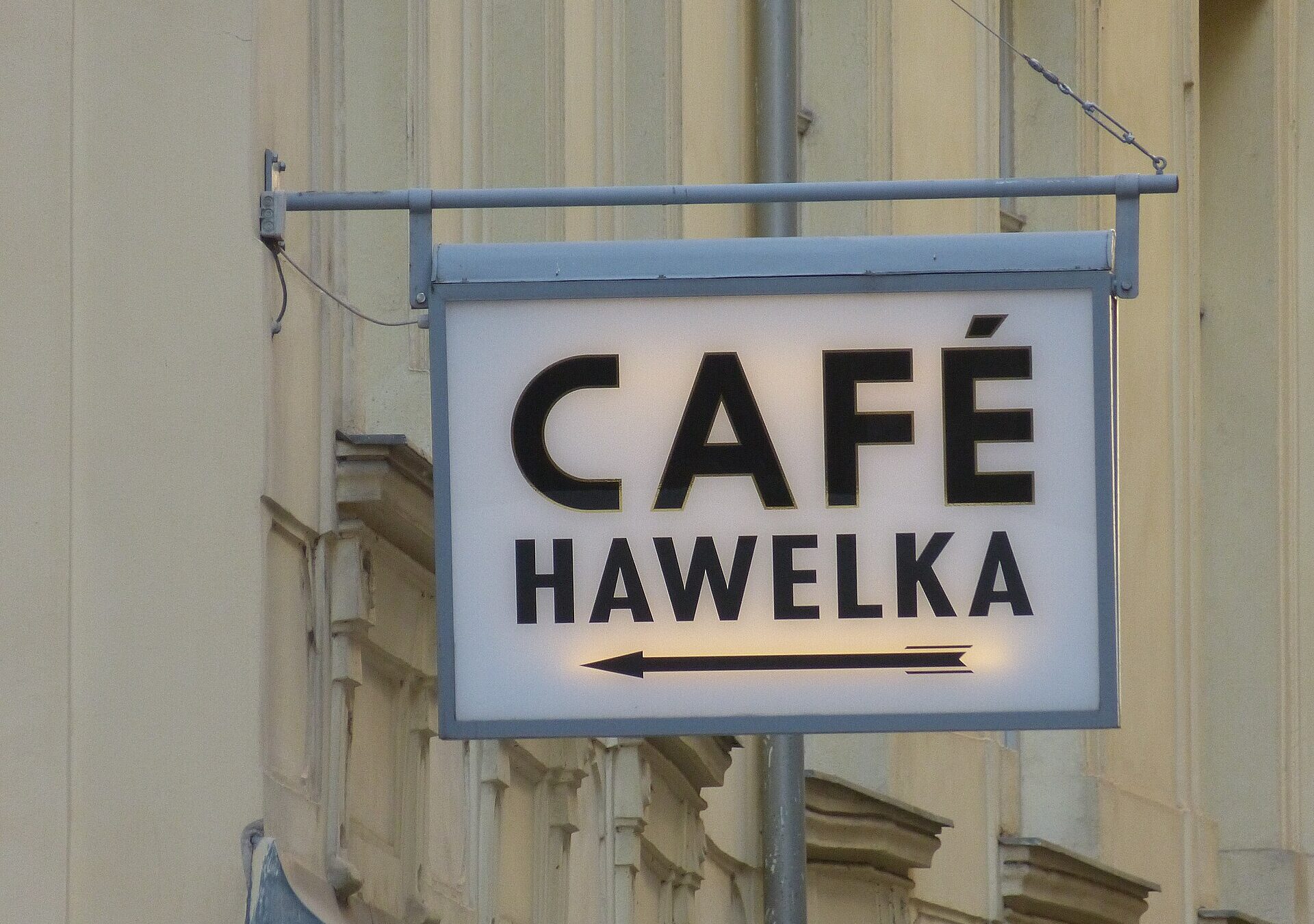
Café Hawelka does not look as though anyone has decorated it since the 1950s, and that is the point. The wood panelling has gone the colour of strong tea, the upholstery on the benches is worn thin at the edges, the walls are covered in yellowing exhibition posters, and the light is so low that on a winter afternoon you need a moment for your eyes to adjust. Cafe Hawelka is the anti-grand café: small, cramped, a little shabby, run by the same family for more than eighty years, and for several decades after the war the place where Vienna’s writers, painters, actors and assorted misfits drank coffee, argued and ate plum-filled Buchteln late into the night.
This guide covers the café’s history and the Hawelka family, the artists and writers who made its reputation, what the room is like, what to order (and why you should come for the Buchteln), opening hours, payment and the unwritten rules, the best times to go, what is nearby on Dorotheergasse, and our honest verdict. Opening hours come from the café’s own website, checked in September 2026. Hawelka does not publish a menu with prices online, so where we cannot verify a figure we say so.
Café Hawelka at a Glance
| Details | |
|---|---|
| Address | Dorotheergasse 6, 1010 Vienna |
| Nearest U-Bahn | Stephansplatz (U1, U3), about five minutes’ walk |
| Opening hours | Monday–Thursday 09:00–24:00; Friday–Saturday 09:00–01:00; Sunday 09:00–22:00 |
| Phone | +43 1 512 8230 |
| Family-run since | 1939 at this address |
| Famous for | Josefine Hawelka’s Buchteln, the post-war artists’ scene and an unchanged interior |
| Payment | Historically cash only. Reports differ on cards, so bring cash. |
| Reservations | Not the kind of place you book for coffee; expect to share or wait at busy times |
| Best time to go | Weekday morning, or late evening from Monday to Saturday |
| Worth it? | Yes, if you want atmosphere and history over comfort. No, if you want space, light or a big menu. |
The History: Leopold and Josefine
The story of Café Hawelka is the story of one couple. Leopold Hawelka ran his first coffee house, Café Alt Wien, from 1936. Together with his wife Josefine, he took over a run-down café on Dorotheergasse, then called Café Karl, in May 1939. The premises had an unexpected past: before it was Café Karl it had been the Chatham-Bar, which opened in 1913 and was billed as the first American bar in Vienna.
They had barely started when the war began. The café closed in September 1939 and Leopold was called up. When the couple came back in 1945, they found that the building had survived without a single broken windowpane. They reopened in December 1945, in a city that was bombed, hungry and divided into four occupation zones, and that is where the Hawelka legend begins.
Over the following decades the division of labour became part of the café’s identity. Leopold ran the room, famously placing guests at tables himself and seating strangers together without asking their opinion. Josefine ran the kitchen, and in particular the ovens, where she baked the Buchteln — sweet yeast buns filled with plum jam — that came out warm in the evenings and became the café’s signature. Josefine died in 2005. Leopold kept coming to the café into extreme old age and died at the end of 2011 at the age of 100, which made him one of the most famous centenarians in Austria and something of a living monument.
The café is still run by the Hawelka family. The next generations have kept the interior, the Buchteln and the atmosphere, and they have added a Hawelka coffee roastery with its own shop across the street at Dorotheergasse 7 (temporarily closed for renovation as of September 2026).
The Artists, Writers and Regulars
Every Viennese coffee house has a list of famous guests, but Hawelka’s is unusually rich because of when it flourished. In the 1950s, 1960s and 1970s, when Vienna was grey, conservative and provincial, the café became one of the few places where the city’s avant-garde gathered. It was cheap, it was open late, it was warm in winter, and Leopold tolerated people who could not always afford a second coffee.
The names the café itself cites include:
- Writers: Friedrich Torberg, Heimito von Doderer, Hilde Spiel, Hans Weigel, H.C. Artmann and, among international visitors, Elias Canetti, Henry Miller and Arthur Miller.
- Painters: Friedensreich Hundertwasser and Ernst Fuchs, one of the founders of the Vienna School of Fantastic Realism.
- Actors and performers: Oskar Werner, Helmut Qualtinger and André Heller.
- Passing celebrities: Andy Warhol, among others.
The posters and pictures that paper the walls belong to that world, and nobody has seen any reason to take them down. The café also found its way into Austrian pop culture: the Viennese singer-songwriter Georg Danzer had a 1970s hit about a naked man turning up at Hawelka, which is still the first thing many Austrians of a certain age think of when they hear the name.
Hundertwasser went on to design the Hundertwasserhaus in the 3rd district, one of the most photographed buildings in Vienna. For the city’s later avant-garde, from Actionism to today’s murals, see our street art and contemporary art guide.
What the Room Is Like
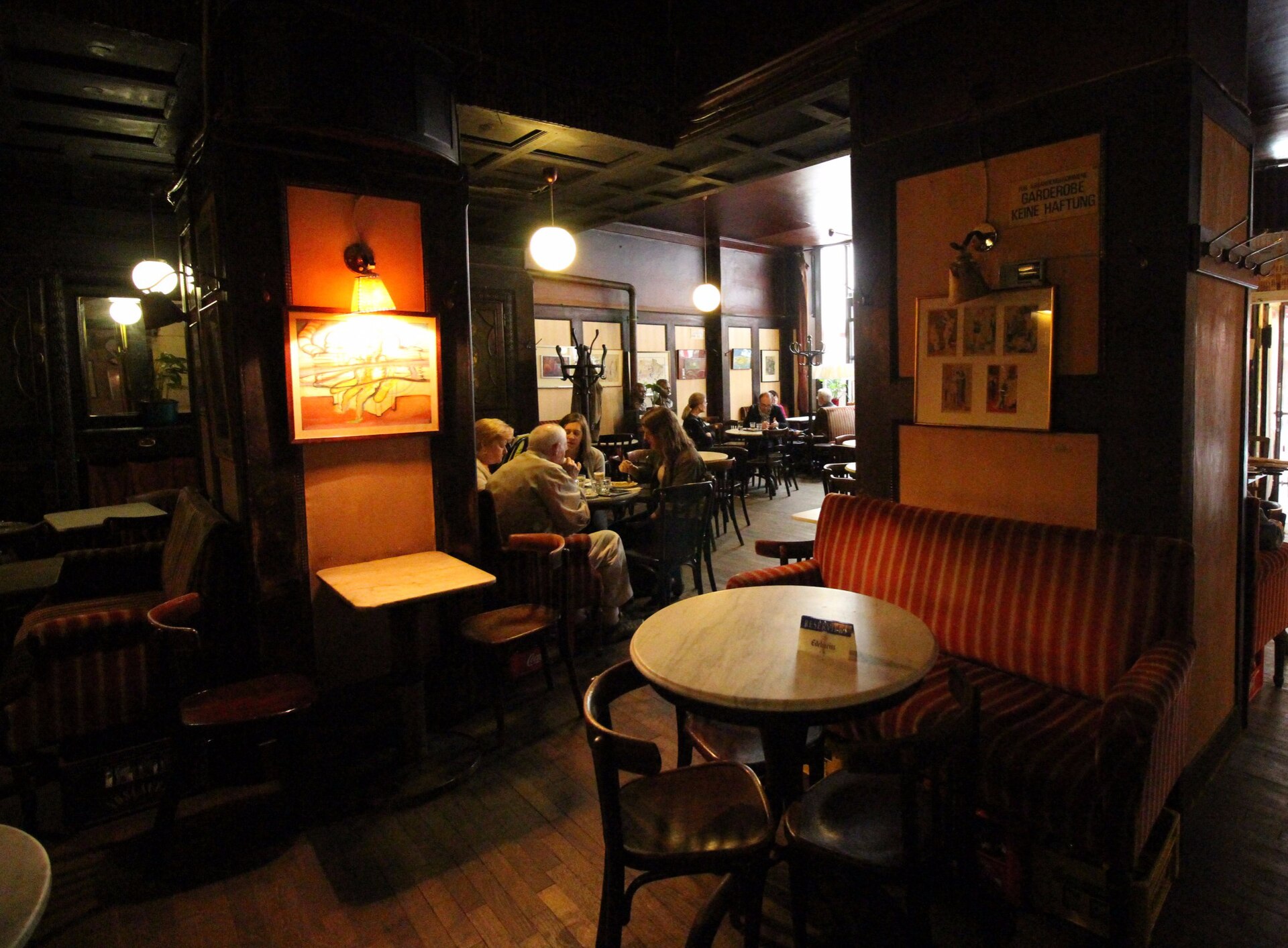
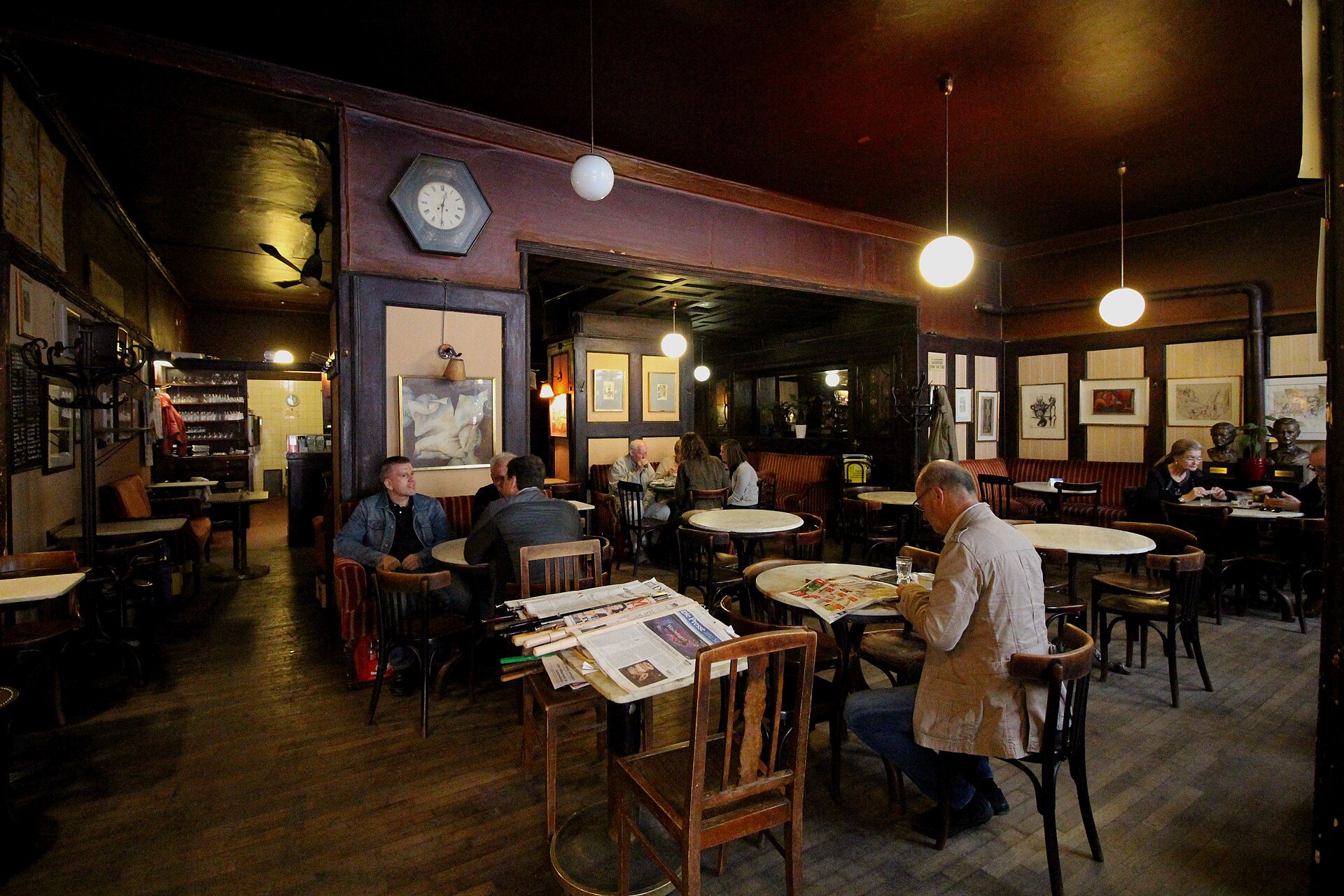
Walk in from Dorotheergasse and the first impression is how small and dark it is. There is a single main room with a few alcoves, tightly packed with small marble tables, bentwood chairs and long upholstered benches along the walls. The ceiling is low compared with the grand cafés, the wood panelling is dark, and the walls are covered with posters, pictures and notices. There is a coat stand that is always overloaded in winter.
Hawelka used to be famously smoky. Smoking has been banned in Austrian restaurants and cafés since November 2019, so that part of the experience has gone, but the room still looks as though it remembers the smoke. It is not a place for spreading out a map or working on a laptop, and it is not wheelchair friendly; the space between tables is narrow.
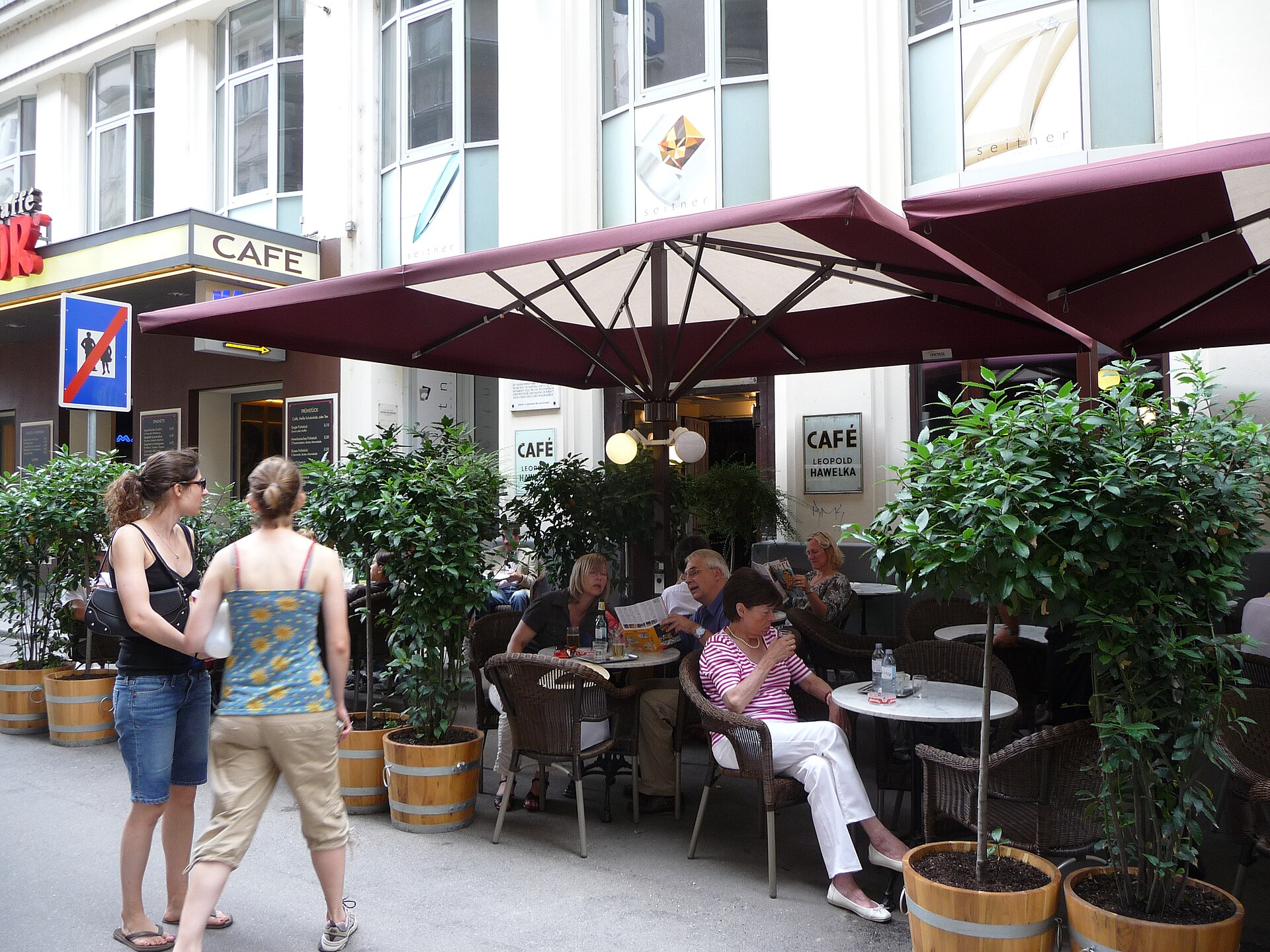
In warm weather there are tables outside on Dorotheergasse under large umbrellas. They are pleasant for people-watching on a quiet side street, but you lose what makes Hawelka worth visiting. Sit inside.
What to Order
The Buchteln
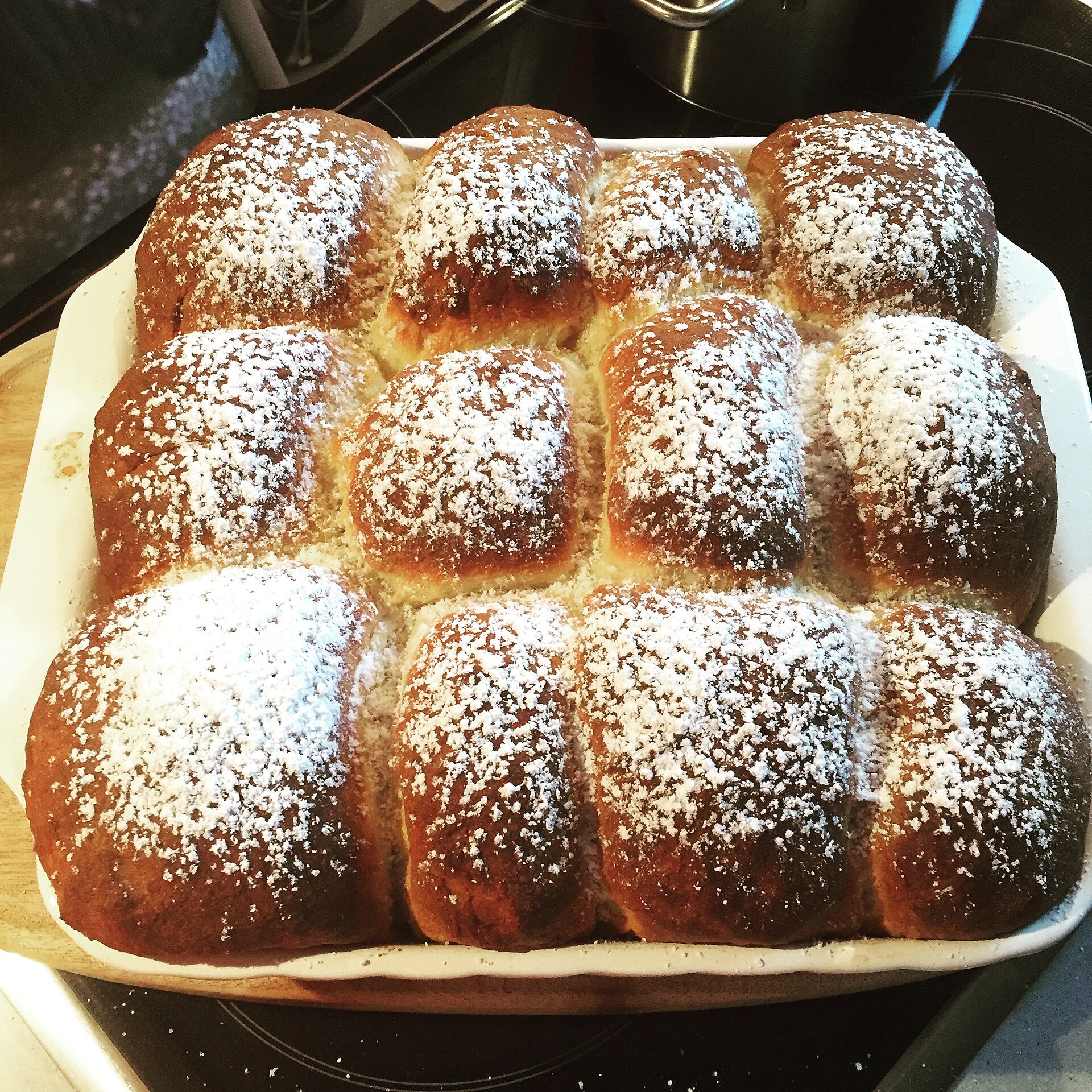
Come for the Buchteln. These are soft, sweet yeast-dough buns, baked close together in a tray so that they pull apart, filled with Powidl (thick plum jam) and dusted with icing sugar. At Hawelka they are served warm, and they are the reason many people come at all. They are made to Josefine Hawelka’s recipe and have been the café’s signature for decades.
When they appear is a matter of some confusion. Traditionally they came out of the oven late in the evening, and that is what most older guidebooks say. More recent reports variously describe them arriving in the afternoon, in the early evening and later at night, and they can run out. The best advice is to ask your waiter when you arrive, and if they are not ready yet, order a coffee and wait. It is not a bad way to spend an evening.
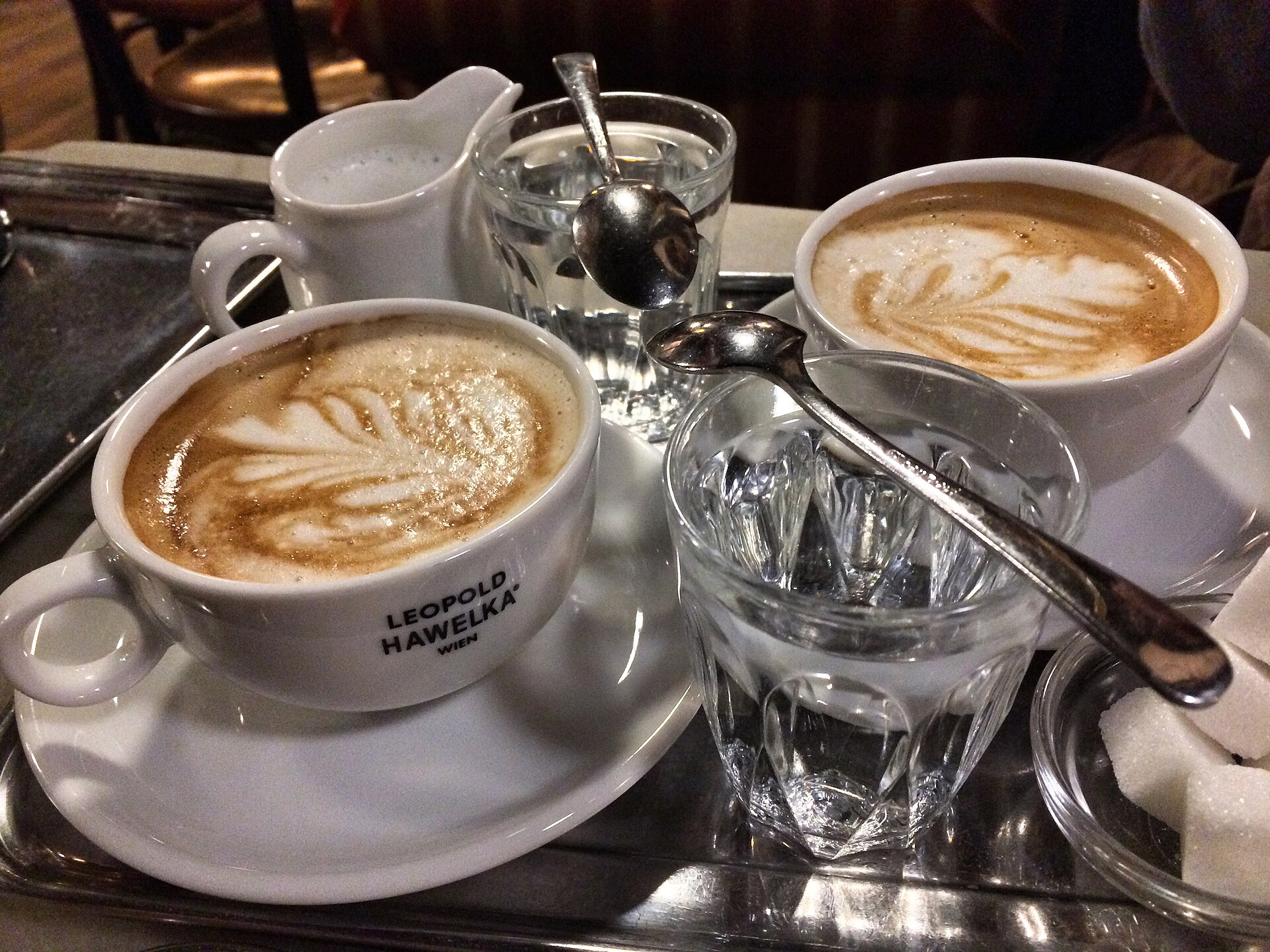
Coffee
The coffee is Hawelka’s own, from the family’s roastery. Order a Melange or a Kleiner Brauner with the Buchteln; if you want something stronger, a Großer Schwarzer (a double black coffee) is the traditional late-night order. Every coffee comes with a glass of water. The café does not publish its prices online. As a rough benchmark, a Melange costs €6.90 at Café Landtmann on the Ring, one of the most expensive places in the city; Hawelka is a small family café on a side street, but it is also in the most visited part of the 1st district, so do not expect bargain prices. For a guide to the whole coffee list, see our Viennese coffee menu guide.
Food
Hawelka is a café, not a restaurant. There is a short list of snacks and simple dishes and a small choice of cakes, but if you want a full Viennese meal, eat elsewhere and come here afterwards. For restaurants nearby, our guide to the Innere Stadt and our best restaurants in Vienna list have plenty of options.
Opening Hours, Payment and the Unwritten Rules
Opening hours
- Monday to Thursday: 09:00–24:00
- Friday and Saturday: 09:00–01:00
- Sunday: 09:00–22:00
These come from the café’s own website, checked in September 2026. It opens later than most coffee houses — Hawelka has never been a breakfast place — and closes much later, which is part of its character. Check before visiting on public holidays.
Paying
For most of its history, Café Hawelka was cash only, and many visitors still report that it is. Some recent reports say cards are accepted. Bring enough cash to be safe. When you pay, say the total you want to pay including a tip of around five to ten per cent. Our guide to money and payments in Vienna covers cash machines and card acceptance in general.
The unwritten rules
- Expect to share a table. Hawelka is small, and seating strangers together has been part of the tradition since Leopold’s day. Ask “Ist hier frei?” (Is this free?) before you sit at a table with someone.
- Do not expect to reserve. This is a walk-in café. If it is full, wait by the door for a few minutes or come back later.
- Do not take flash photos. The room is dark and full of people who came for the atmosphere. A quick, quiet photo is fine; a photo shoot is not.
- Stay as long as you like, but order. Nobody will hurry you, but a table taken for an hour with one small coffee on a busy evening is pushing the tradition.
- Be patient with the service. Waiters are busy and the room is cramped. Catch an eye rather than waving.
When to Go
- Weekday mornings, from 09:00: the quietest time, with newspaper readers and space to look around. No Buchteln, but you see the room.
- Weekday afternoons: busier with visitors, especially in summer and in the Christmas season.
- Evenings: the best atmosphere and the Buchteln, but also the busiest time. Friday and Saturday stay open until 01:00, which makes Hawelka one of the few historic coffee houses where you can end a night out.
- After the opera or a concert: Hawelka is a ten-minute walk from the State Opera and a natural place for a late coffee.
For other late-night options, see our guide to late-night food in Vienna.
Hawelka Through the Year
A small dark room feels very different depending on the season, and Hawelka is a place that rewards bad weather.
- November to February is Hawelka at its best. Coats pile up on the stand, the windows steam, and the contrast between the cold street and the warm room is the whole point. It is also the busiest season, especially during Advent, when visitors to the Christmas markets on Stephansplatz and Am Hof come looking for somewhere to thaw out. Go in the morning or late in the evening. Our Vienna in winter guide has more ideas for cold days.
- Spring and autumn are the easiest seasons for finding a seat, particularly on weekdays.
- Summer is the least atmospheric time. The room can be warm, the street tables take the pressure off, and many locals are away. If you visit Vienna only in July or August, you can still go, but set your expectations accordingly.
Getting There and What Is Nearby
Café Hawelka is at Dorotheergasse 6, a narrow street that runs south from the Graben towards the Albertina and the Hofburg. From Stephansplatz (U1, U3), walk along the Graben and turn left into Dorotheergasse; the café is on the left after a couple of minutes. The whole walk takes about five minutes.
Dorotheergasse is one of the most interesting short streets in the 1st district, and Hawelka is easy to combine with:
- Trześniewski, at the Graben end of Dorotheergasse, the stand-up sandwich bar famous for its small open sandwiches.
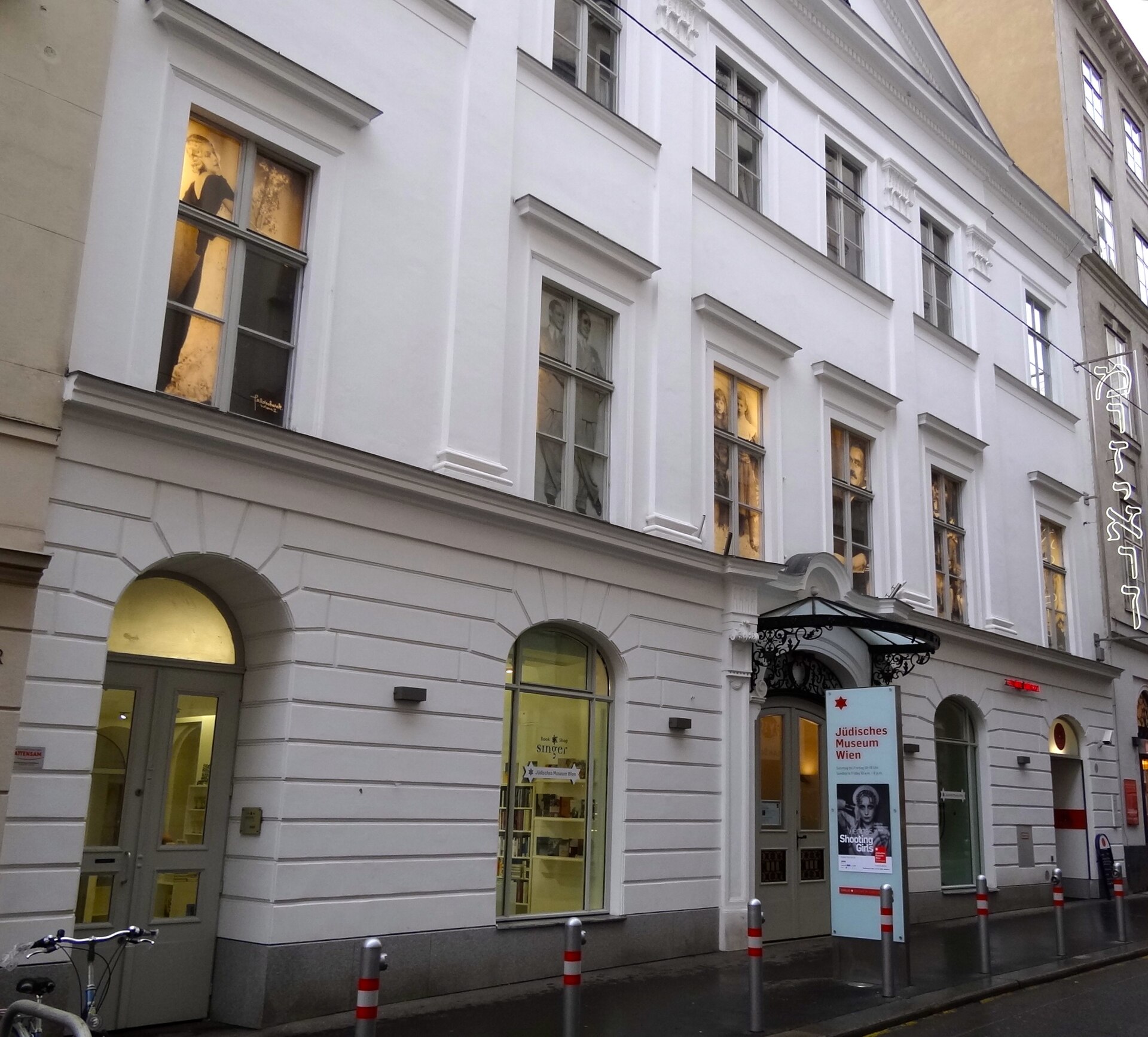
- The Jewish Museum Vienna at Dorotheergasse 11. Our Jewish Vienna guide covers it.
- The Dorotheum, Vienna’s historic auction house, further down the street, which is free to walk around.
- The Graben and Kohlmarkt, the city’s grandest shopping streets, and Demel, the imperial confectioner.
- The Hofburg, the Albertina and the Spanish Riding School, all within five to ten minutes.
- Stephansdom, five minutes away. See our St Stephen’s Cathedral guide.
A Small-Café Walk Around Hawelka
Hawelka belongs to a particular tradition inside the Viennese coffee house: not the palatial Ringstraße cafés built to impress, but the small, smoky, slightly worn rooms in the old town where people actually spent their evenings. Several of them are within ten minutes’ walk of Dorotheergasse, and stringing three or four together is one of the best ways to spend a grey afternoon in the 1st district. Opening hours at small family cafés change often, so check each one before you set out.
- Café Bräunerhof, Stallburggasse 2, around the corner from Hawelka. The writer Thomas Bernhard was its most famous regular, and it still has the feel of a place for reading the papers in peace.
- Café Hawelka, Dorotheergasse 6. Go late in the walk if you want the Buchteln.
- Café Korb, Brandstätte 9, near Stephansplatz. An old coffee house with a 1950s interior and a basement that has hosted art and performance, run for decades by a well-known Viennese personality.
- Kleines Café, Franziskanerplatz 3. Tiny, wood-panelled and on one of the prettiest small squares in the city; in summer its tables spill out beside the Franciscan church.
- Café Frauenhuber, Himmelpfortgasse 6, near Kärntner Straße. It claims to be the oldest coffee house in Vienna still operating, and the building has a musical history that goes back to Mozart’s time.
None of these is a secret, but all of them see far fewer visitors than the big names, and together they give a much truer picture of how the Viennese used their coffee houses than a single visit to a famous one. Our Vienna walking tours guide has more routes through the old town if you want to keep going.
If you like the Buchteln
Buchteln (also called Wuchteln) come from the Bohemian kitchen that shaped so much of Viennese baking. The dough is an enriched yeast dough, the buns are filled — traditionally with Powidl, sometimes with apricot jam or Topfen — rolled in melted butter and baked packed tightly in a tin, so that they rise into each other and stay soft at the sides. At home they are often served with vanilla sauce. You will find them in bakeries and on the menus of traditional Gasthäuser, and Vollpension, the café staffed by pensioners, serves them at breakfast. Our guide to Viennese desserts and pastries covers the rest of the family, from Germknödel to Kaiserschmarrn.
Hawelka Compared with Other Famous Coffee Houses
| Café | Character | Best for |
|---|---|---|
| Café Hawelka | Small, dark, bohemian, family-run, unchanged | Late-night atmosphere and Buchteln |
| Café Central | Grand vaulted palace room, very famous (closed for renovation since March 2026) | The architecture |
| Café Landtmann | Polished Ringstraße grand café with politicians and actors | A reliable, bookable grand café |
| Café Sperl | Faded Ringstraße-era elegance with billiard tables | A long, quiet morning |
| Demel | Imperial confectioner with a café | Cakes and sugar work |
For the full picture, see our guide to Vienna’s coffee houses, and our pages on Café Central and Café Landtmann.
Is Café Hawelka Worth It? Our Verdict
Yes, but go with the right expectations.
Hawelka is not beautiful in the way Café Central is beautiful, and it is not comfortable in the way Café Landtmann is comfortable. It is cramped, dim, a little worn and often full of other visitors who have read the same guidebooks. The menu is short, and the service can be brusque when the room is busy. If you arrive at 15:00 on a Saturday in July expecting a spacious grand café, you will probably leave disappointed.
But few places in Vienna have been run by the same family, in the same room, with so little change, for so long. The history here is not a plaque on the wall; it is the furniture, the posters and the recipe. Come on a weekday evening, get a seat on a bench, order a Melange and wait for the Buchteln, and you will understand why generations of Viennese writers and artists treated it as a second home.
Who should go: anyone interested in Vienna’s post-war culture, lovers of old-fashioned places, night owls, and anyone who has seen enough gilded Habsburg interiors for one trip.
Who might skip it: travellers who want space, light, a full meal, a card machine they can rely on, or an accessible room.
Frequently Asked Questions
Where is Café Hawelka?
At Dorotheergasse 6 in the 1st district, just off the Graben, about five minutes’ walk from Stephansplatz (U1, U3).
What are Café Hawelka’s opening hours?
Monday to Thursday 09:00 to midnight, Friday and Saturday 09:00 to 01:00, and Sunday 09:00 to 22:00, according to the café’s website in September 2026.
What time are the Buchteln served at Hawelka?
In the evening, traditionally late. Reports of the exact time vary and they can sell out, so ask your waiter when you arrive.
Does Café Hawelka take cards?
It was cash only for most of its history, and many visitors still report that it is. Reports differ, so bring cash.
Can I reserve a table at Café Hawelka?
It is essentially a walk-in café. At busy times you may have to share a table or wait briefly.
Who were Café Hawelka’s famous guests?
The café names writers such as Friedrich Torberg, Heimito von Doderer, Hilde Spiel, H.C. Artmann, Elias Canetti, Henry Miller and Arthur Miller; the painters Friedensreich Hundertwasser and Ernst Fuchs; performers such as Oskar Werner, Helmut Qualtinger and André Heller; and Andy Warhol.
Is Café Hawelka still family-run?
Yes. Leopold and Josefine Hawelka took over the café in 1939, and it is still run by their family.
Is Café Hawelka good for breakfast?
Not really. It opens at 09:00 and is at its best in the evening. For breakfast, see our guide to breakfast and brunch in Vienna.
Related Vienna Guides
- Vienna Coffee Houses Guide
- Café Central Vienna
- Café Landtmann
- Viennese Coffee Menu Guide
- Vienna Desserts and Pastries
- Innere Stadt Vienna Guide
- Evening Activities in Vienna
- Vienna Hidden Gems
Photo Credits
Interior of Café Hawelka: Café Hawelka 01 by Sniper Zeta, CC BY-SA 4.0, via Wikimedia Commons.
Main room of Café Hawelka: Café Hawelka 03 by Sniper Zeta, CC BY-SA 4.0, via Wikimedia Commons.
Buchteln: 20161006 Buchteln 025 by weisserstier from Wien, Austria, CC BY 2.0, via Wikimedia Commons.
Outdoor tables at Café Hawelka: Café Hawelka Exterior by Flickr user 77295011@N06, CC BY-SA 2.0, via Wikimedia Commons.
Café Hawelka sign: Wien – Cafe Hawelka by Wolfgang Sauber, CC BY-SA 4.0, via Wikimedia Commons.
The Jewish Museum on Dorotheergasse: JuedischesMuseumWien3 by HeMei, CC BY-SA 3.0, via Wikimedia Commons.
Melange at Café Hawelka: Hawelka coffee by Johnny Saunderson, CC BY-SA 4.0, via Wikimedia Commons.