Cafe Central Vienna: Queue Times, Menu & Is It Worth It?
Café Central's 2026 renovation and reopening, how the queues and reservations work, what to order, whether it is worth the wait, and the coffee houses nearby to try instead.
- Café Central at a Glance
- The Renovation: What Is Happening
- What Café Central Is, and Why People Queue
- Queue Times: How It Worked Before the Closure
- Reservations
- A Visit, Step by Step
- The Menu
- Is Café Central Worth It?
- Seeing Café Central on a Budget
- Visiting With Children
- Café Central Compared
- Coffee Houses to Visit Instead, or as Well
- Getting There and Making a Morning of It
- Café Central Through the Year
- Common Mistakes
- Tips for Visiting
- Frequently Asked Questions
- Related Vienna Guides
- Photo Credits
This article contains advertising. Our booking links are routed through a partner that adds commission tracking automatically, so if you book through one we earn a commission from the provider, at no extra cost to you. It never affects what we recommend. Affiliate disclosure
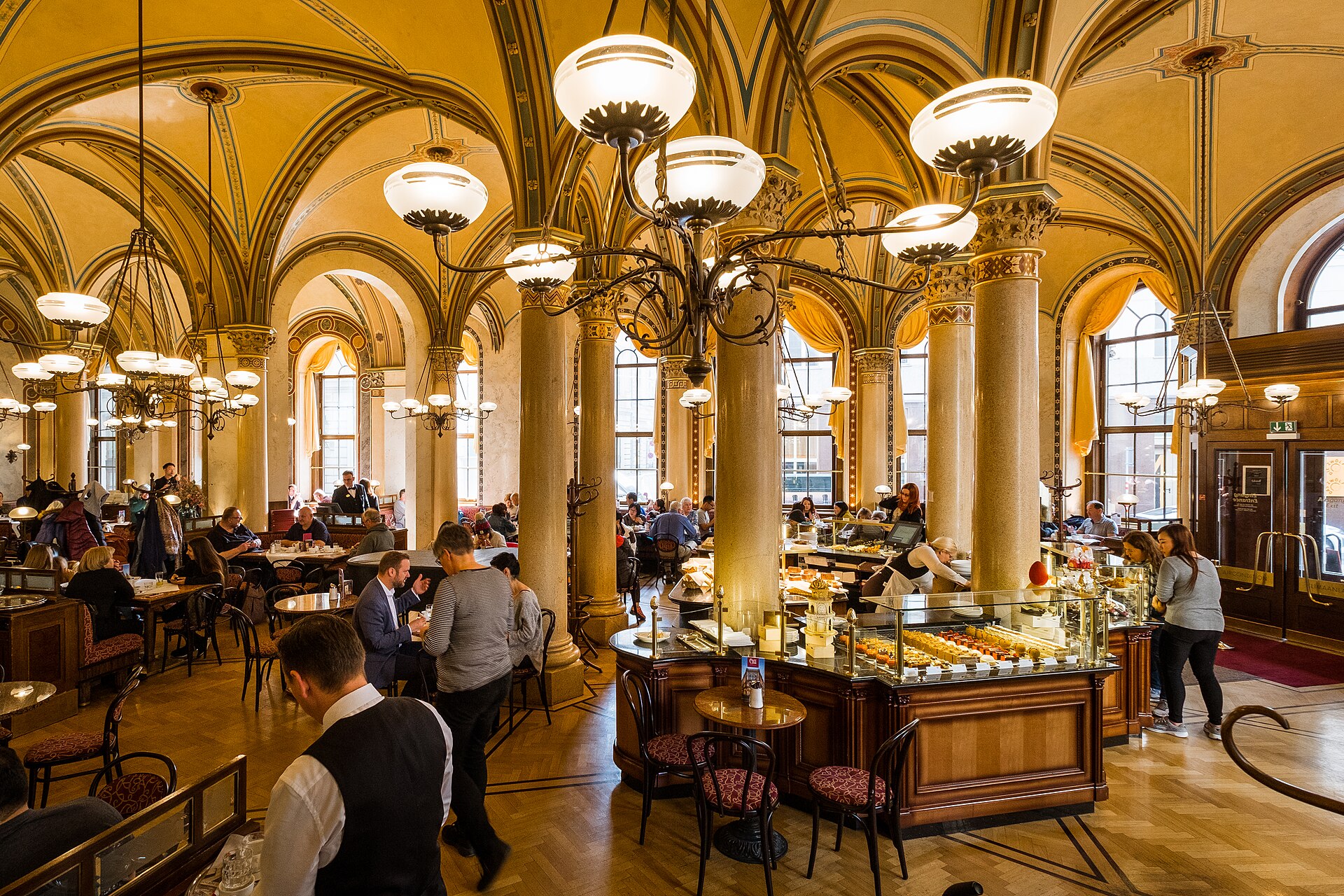
For most of the last few decades, the queue outside the corner of Herrengasse and Strauchgasse has been as much a part of the view as the building. On a summer afternoon it could run twenty or thirty people deep, most of them clutching phones open at the same photograph of vaulted ceilings and marble columns. Search for Cafe Central Vienna in 2026, though, and the first thing you need to know is not how long that queue is. It is whether the doors are open at all.
This guide covers where things stand with the renovation that closed Café Central in March 2026, what the café is and why people queue for it, how the queues and reservations worked before the closure and what to expect when it reopens, what is on the menu, whether it is worth your time, and the coffee houses nearby that are open while you wait. The status was checked against the café’s own announcements in September 2026. Reopening dates slip, so check the café’s website before you go.
Café Central at a Glance
| Details | |
|---|---|
| Status | Closed since 16 March 2026 for a general renovation |
| Reopening | Scheduled for winter 2026 |
| Temporary alternative | DECENTRAL, the café’s pop-up at the Freyung |
| Address | Palais Ferstel, Herrengasse 14, corner of Strauchgasse, 1010 Vienna |
| Nearest U-Bahn | U3 Herrengasse, a minute’s walk |
| Hours before the closure | Monday to Saturday 07:30–22:00; Sunday 10:00–22:00 |
| Live piano before the closure | Daily except Tuesday, 16:30–21:30 |
| Reservations | Taken online before the closure; suspended during the works |
| Best time to go (once open) | Weekday opening at 07:30, or after 20:00 |
| Worth it? | For the room, yes. For the coffee alone, no. |
The Renovation: What Is Happening
Café Central closed on 16 March 2026, in its 150th year, for what its operator calls a comprehensive general renovation. The reopening is scheduled for winter 2026, and online reservations have been suspended for the duration of the work.
The good news for anyone who loves the place is that this is mostly invisible work. The renovation concentrates on the building’s services — heating, ventilation and air conditioning, plumbing, electrics and fire protection — along with the kitchens and production areas. It is being carried out under Austria’s monument-protection rules. The vaulted room, the columns and the furniture that people come to photograph are not being redesigned.
If you are travelling before the reopening: the café is scheduled to reopen in winter 2026, so check its website shortly before your trip. If it has reopened, expect the first weeks to be busy with locals as well as visitors. If it has not, the pop-up and the coffee houses listed below are good substitutes.
DECENTRAL, the pop-up
While the main café is closed, its operator runs a temporary spin-off called DECENTRAL at the Freyung, the square a couple of minutes’ walk away on the other side of the Palais Ferstel. The café describes it as its modern counterpart, and it serves patisserie, homemade pastries, savoury focaccia, coffee specialities and more inventive drinks. It is not a copy of the historic room, and it does not pretend to be. It is the place to go if you want to taste the kitchen’s cakes while the main café is shut.
What Café Central Is, and Why People Queue
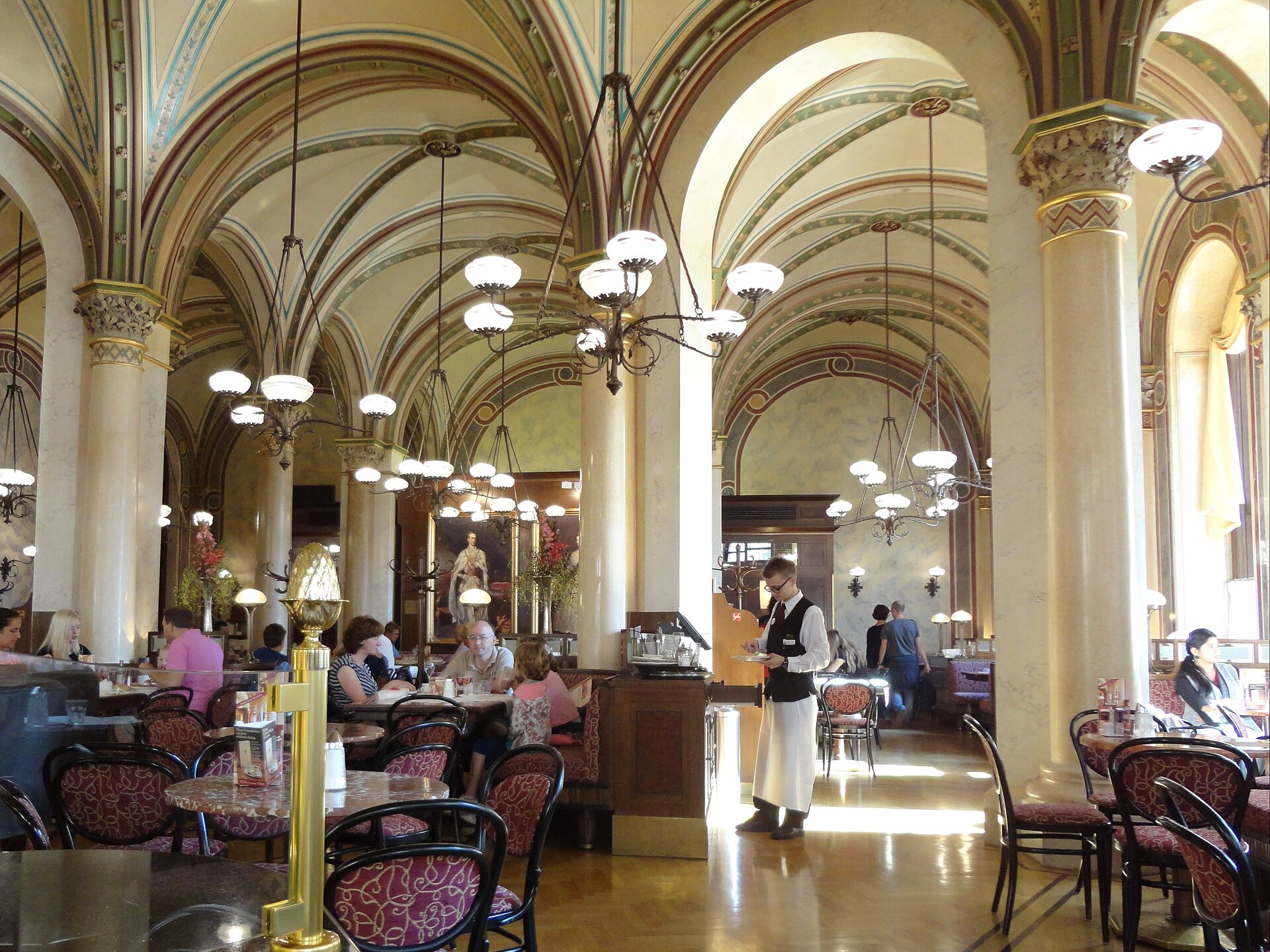
Café Central opened in 1876 in the Palais Ferstel, a grand historicist building by the architect Heinrich von Ferstel, originally built for the national bank and the stock exchange. It is the room rather than the coffee that most people come for: tall vaults on marble columns, painted ribs and arches, Thonet chairs, marble-topped tables and the long glass counter of cakes.
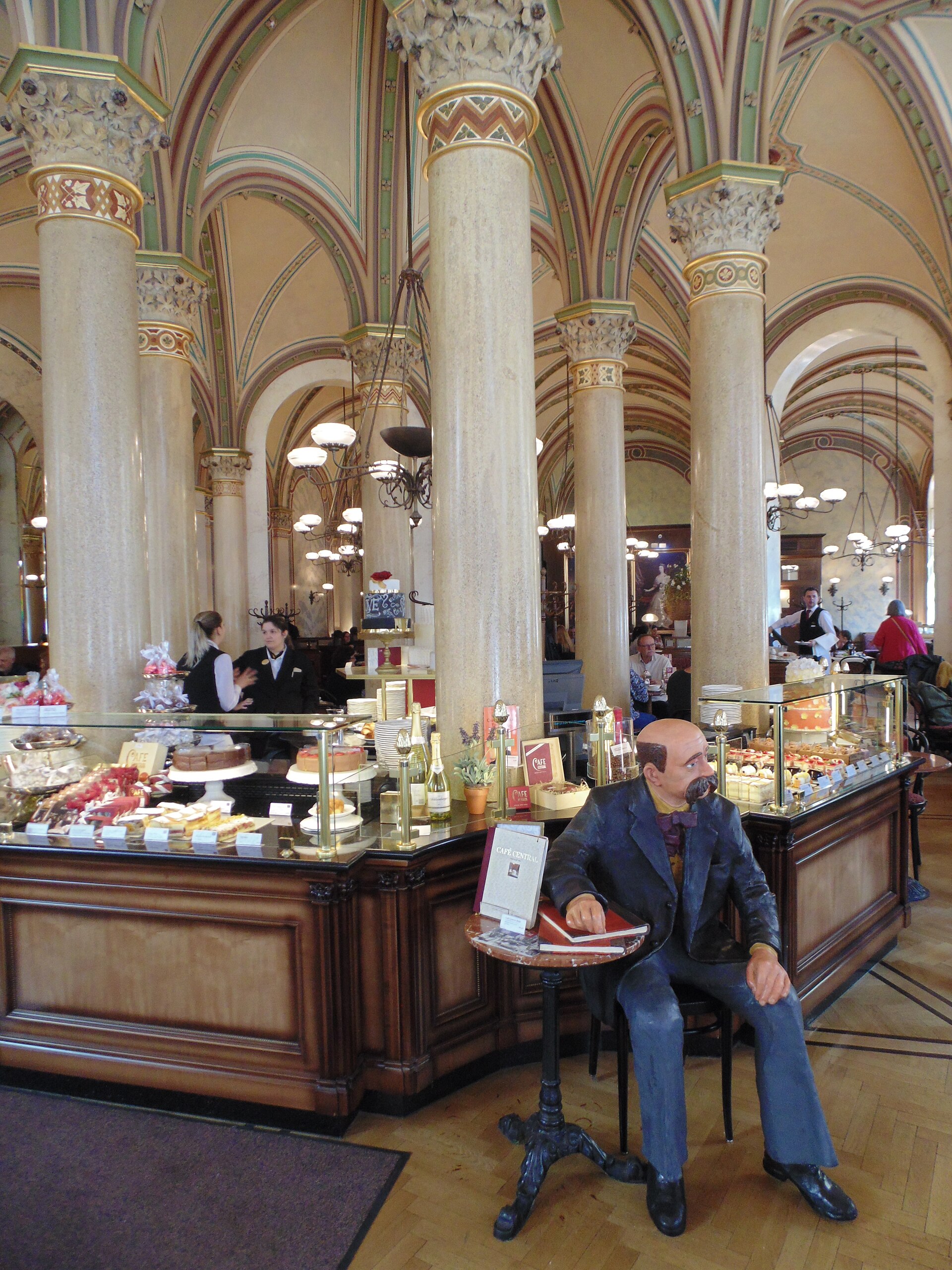
Its reputation rests on the people who used it as an office, a salon and a mailing address in the decades before the First World War. The writer Peter Altenberg spent so much of his life here that a life-size figure of him sits by the entrance. Leon Trotsky played chess here in his Vienna exile years, the architect Adolf Loos and the writers of the Jung-Wien circle were regulars, and a steady stream of the city’s intellectuals argued at its tables. It is the most famous example of the Viennese coffee house as a public living room, which is why it is on every first-time itinerary.
The coffee-house culture it represents, including the history and the rules of how to behave in one, is covered in our guide to Vienna’s coffee houses. This page is about Café Central specifically: getting in, what to order, and whether it is worth it.
Queue Times: How It Worked Before the Closure
Café Central did not run a strict no-reservations policy, but the majority of visitors turned up without a booking, and that is what created the queue. Staff at the door seated people as tables came free. The pattern was predictable enough to plan around.
| Time | What to expect |
|---|---|
| Weekdays, 07:30–09:30 | Usually walk straight in. The quietest and best time to see the room. |
| Weekdays, 10:00–12:00 | A queue starts to build, especially in summer and around Christmas. |
| 12:00–17:00 | The peak. Visitors commonly reported waits of 20 to 45 minutes in high season, and longer on the busiest days. |
| 17:00–20:00 | Still busy; the piano from 16:30 draws people in. |
| After 20:00 | Quietens down again. Good for a late cake and the last of the piano. |
| Sundays | Opening at 10:00 meant no early-morning window; queues formed from late morning. |
| Tuesdays | No piano, which made evenings a little quieter. |
Seasons matter as much as hours. July and August, the Christmas-market weeks in December and Easter are the busiest; a wet Tuesday morning in February is the easiest. Tour groups arriving mid-morning could add a surge at any time of year.
What to expect when it reopens
The reopened café may change how it handles bookings and the door. Assume the queues will return quickly: pent-up demand from months of closure, and a wave of locals curious to see the renovated room, will make the first weeks busier than usual. Check the website for a reservation system before you travel, and if one exists, use it.
Reservations
Before the closure, Café Central took table reservations online, and a booking was the single best way to avoid the queue. Groups could arrange tables through the operator’s group and guest relations team. During the renovation, online reservations are suspended.
Once it reopens:
- Look for the online reservation option on the café’s website.
- Book a few days ahead for weekends and any time in summer or December.
- Arrive on time; a table held for a booking will not be held for long at a café this busy.
- If you cannot book, go at opening time on a weekday instead.
A Visit, Step by Step
Café Central works slightly differently from a neighbourhood coffee house, mainly because of the numbers. Knowing the routine takes the awkwardness out of it.
- Wait to be seated. In most Viennese coffee houses you choose your own table. At Café Central, with a queue at the door, a member of staff seats people in order. If you have a reservation, say so as soon as you reach the front.
- Hang your coat. The bentwood coat stands are there to be used, and on a winter day they fill up quickly.
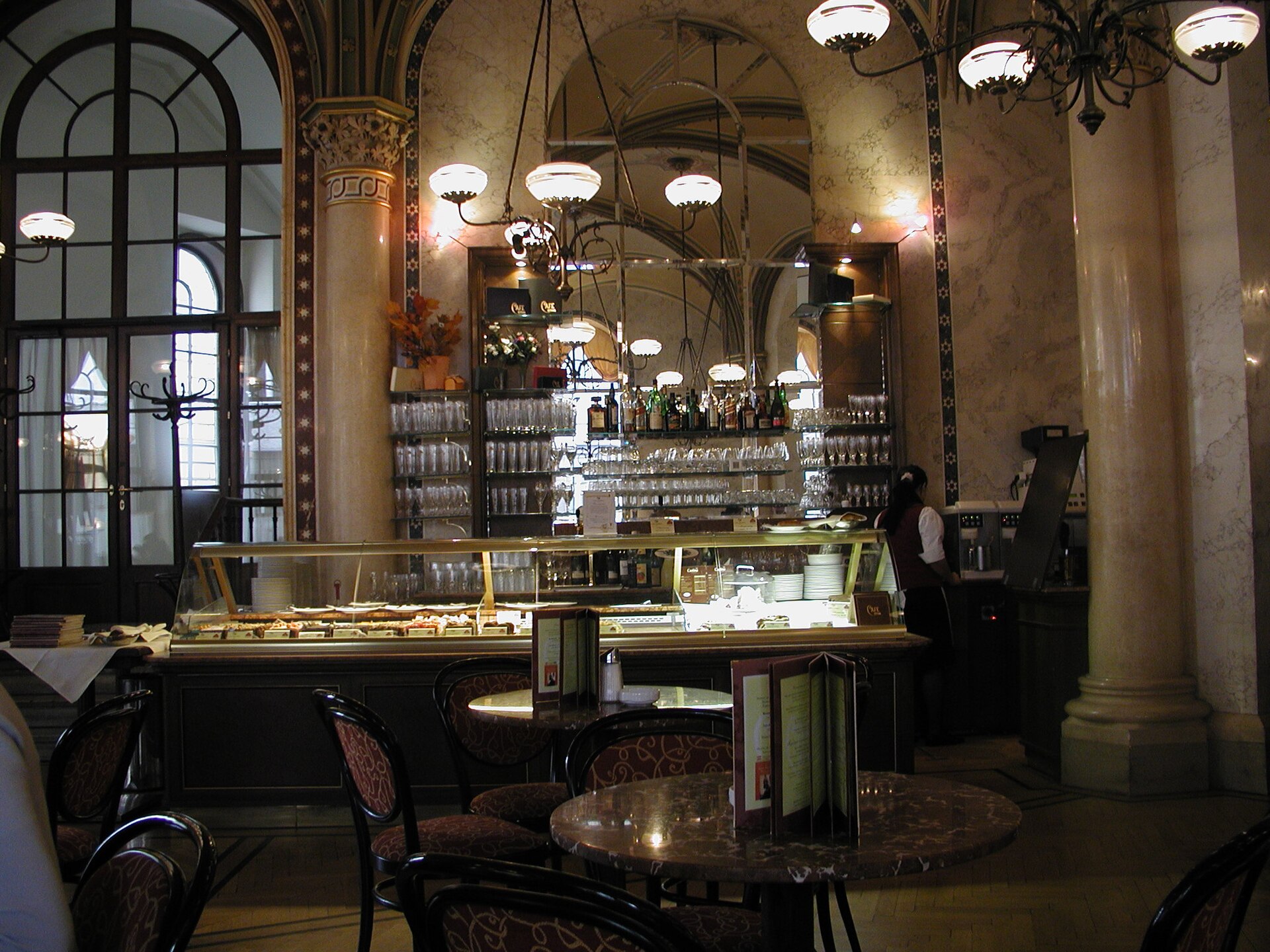
- Look at the cake counter. You can walk over and choose, or ask your waiter what is on the tray today.
- Order everything at once if you are on a schedule. Service is courteous and unhurried, and it is quicker to give one order than three.
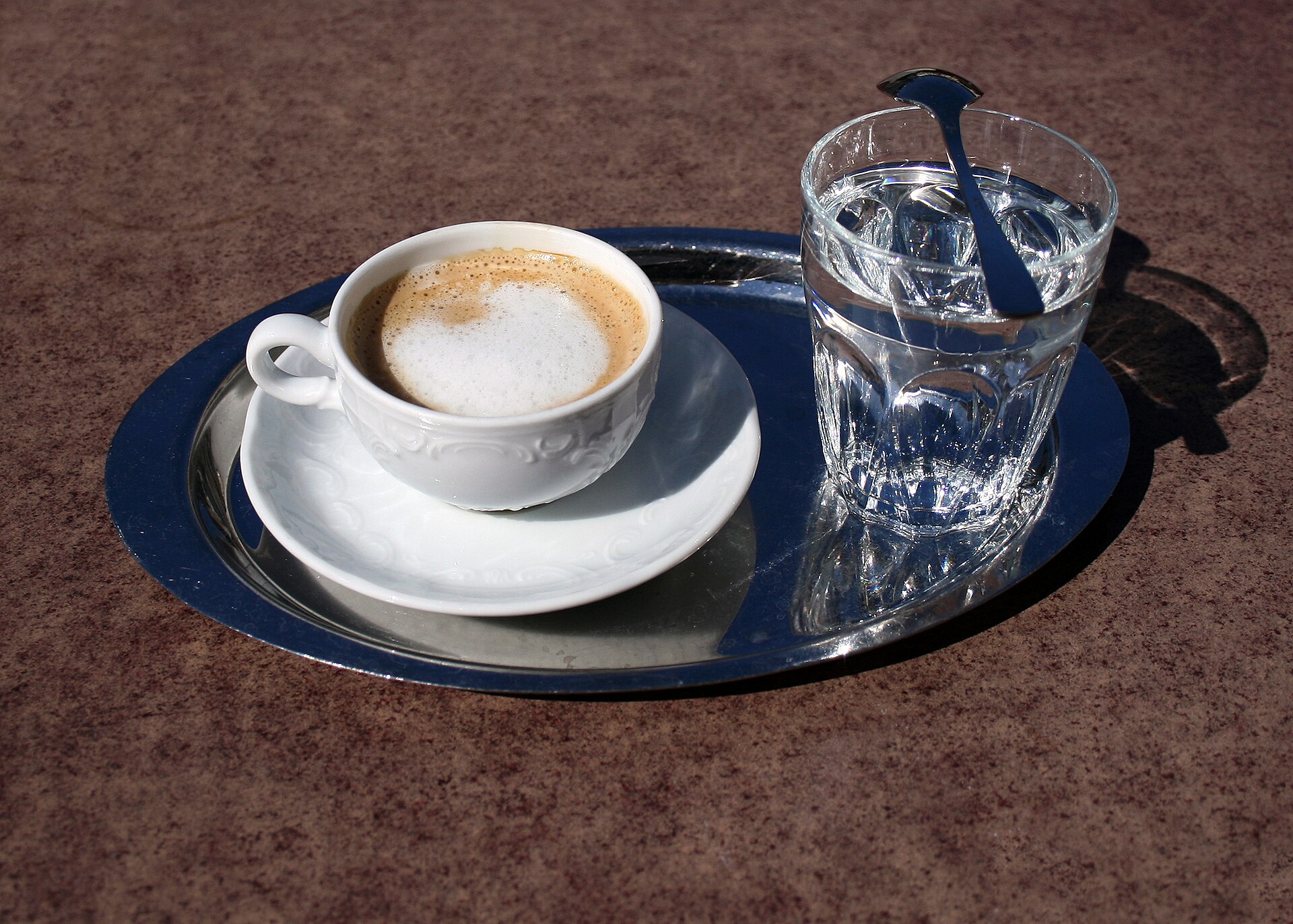
- Take your time. Your coffee arrives on a silver tray with a glass of water. Nobody will hurry you away, even when there is a queue; that is the whole point of a coffee house, though at the busiest times it is polite not to linger for hours over one Melange.
- Ask for the bill. Catch your waiter’s eye and say “Zahlen, bitte”. You pay at the table, by card or in cash, and add the tip as you pay.
Allow about an hour for coffee and cake, and ninety minutes for breakfast or a meal, plus the queue if there is one.
The Menu
Café Central is a full coffee house, not just a café, and the menu runs from breakfast to dinner. Before the closure, prices sat well above a neighbourhood coffee house, which is the cost of sitting in one of the most famous rooms in the city. Check the menu at the door after the reopening.
Coffee
Everything is served in the Viennese way, on a small silver tray with a glass of water. The classics:
- Wiener Melange: espresso with steamed milk and a cap of milk foam. The default order.
- Einspänner: a strong black coffee in a glass, topped with whipped cream.
- Verlängerter: an espresso lengthened with hot water, closest to an americano.
- Kleiner or Großer Brauner: a single or double espresso served with a little milk or cream on the side.
- Kaisermelange: a Melange with egg yolk and brandy, a curiosity worth trying once.
Coffee houses are not where you go for third-wave espresso. The coffee at Café Central is fine, and nobody queues for it.
Cakes and pastries
The cakes are the better reason to order. The counter holds the Viennese standards — Apfelstrudel, Sachertorte, Topfenstrudel, cream slices and seasonal fruit tarts — alongside the house’s own tortes. If you have eaten Sachertorte already, pick something you have not tried. Our guide to Vienna’s desserts and pastries explains the difference between a Strudel, a Schnitte and a Torte.
Breakfast
Breakfast is one of the best ways to visit, because it coincides with the quietest hours. Expect Viennese breakfast combinations with bread rolls, butter, jam, ham and cheese, eggs cooked several ways, and a soft-boiled egg in a glass, the Viennese way.
Lunch and dinner
The savoury menu covers Austrian classics, including Tafelspitz, the boiled beef with apple-horseradish and chive sauce that was the Emperor’s favourite, and Wiener Schnitzel. There is at least one vegan dish. The food is competent. Nobody should come to Café Central for the best schnitzel in Vienna; our Wiener Schnitzel guide has better places for that.
Is Café Central Worth It?
Yes, if you go for the right reasons at the right time. The room is genuinely beautiful, one of the great interiors of nineteenth-century Vienna, and sitting in it with a Melange and a slice of cake is a real pleasure. At 08:00 on a weekday, with the light coming through the tall windows and the tables half empty, it is everything the photographs promise.
No, if:
- You would have to queue for more than about twenty minutes. The coffee is not better than elsewhere, the cakes are not better than at Demel or Sperl, and a crowded, hurried Café Central at 14:00 in August is not the experience you are queuing for.
- You want a quiet, local coffee house. Café Central is almost entirely a visitor experience now. Cafés such as Sperl, Bräunerhof or Prückel feel much more like the living-room coffee house of legend.
- You want a proper meal. Eat elsewhere and come back for cake.
- You are on a tight budget. You pay for the room. A neighbourhood coffee house gives you the same ritual for less.
The honest verdict: go once, go early, order cake, look up, and leave the queue to someone else.
Seeing Café Central on a Budget
You do not need to eat a full meal to enjoy the room. The cheapest way to experience Café Central properly is a single coffee at a quiet hour, which gets you the same seat under the same vaults as a three-course dinner. A Melange and a slice of cake is the sensible middle ground, and breakfast at opening time is the best value for the time you spend there.
If money is tight, skip the meal, take your time over one coffee, and walk through the Palais Ferstel passage for free afterwards. Our guide to Vienna on a budget has plenty of other ways to see the city’s grand interiors without paying grand prices.
Visiting With Children
Children are welcome in Viennese coffee houses, and Café Central is no exception, but it is a room built for sitting still. Go at a quiet time, when a restless toddler will not be squeezed between tables, order cake early, and keep the visit short. A queue in the middle of an August afternoon is a hard sell to a six-year-old; a hot chocolate and a slice of strudel at 08:00 is much easier. For the rest of the trip, our guide to Vienna with kids has ideas that suit children better.
Café Central Compared
If you only have time for one or two of Vienna’s famous coffee houses, this is how the best-known names differ.
| Coffee house | The room | Crowd | Best for | Queue risk |
|---|---|---|---|---|
| Café Central | Vaulted, columned, spectacular | Mostly visitors | Seeing the most famous interior | High |
| Café Landtmann | Grand, wood-panelled Ringstraße elegance | Mixed; politicians, theatre-goers, visitors | A smart lunch or post-theatre coffee | Moderate |
| Demel | Ornate confectioner’s rooms | Mostly visitors | Cake, above all | Moderate to high |
| Café Sperl | Unchanged nineteenth-century hall with billiards | Locals and visitors | Atmosphere without the crush | Low |
| Café Hawelka | Dark, cramped, bohemian | Mixed | An evening with Buchteln | Moderate |
| Café Bräunerhof | Plain, quiet, newspaper-filled | Regulars | The real, unperformed coffee house | Low |
| Café Prückel | Spacious 1950s | Locals | A long, relaxed sit | Low |
The pattern is simple: the more famous the room, the more of your visit is spent with other visitors. That is not a reason to skip Café Central. It is a reason to pair it with one of the quieter places on the list.
Coffee Houses to Visit Instead, or as Well
Whether Café Central is closed, the queue is too long, or you simply want more than one coffee house, these are all within walking distance.
- DECENTRAL, at the Freyung: Café Central’s own pop-up during the renovation, and the obvious first stop while the main café is shut.
- Café Landtmann, on the Ringstraße by the Burgtheater: grand, elegant and a favourite of politicians and actors. Sigmund Freud was a regular.
- Demel, on the Kohlmarkt: the former imperial court confectioner, with the finest cakes in the Innere Stadt and a window into the pastry kitchen.
- Café Hawelka, on Dorotheergasse: dark, smoky-looking and bohemian, famous for its Buchteln, sweet yeast buns served in the evening.
- Café Bräunerhof, on Stallburggasse: the most authentic in the centre, with newspapers, quiet regulars and no fuss.
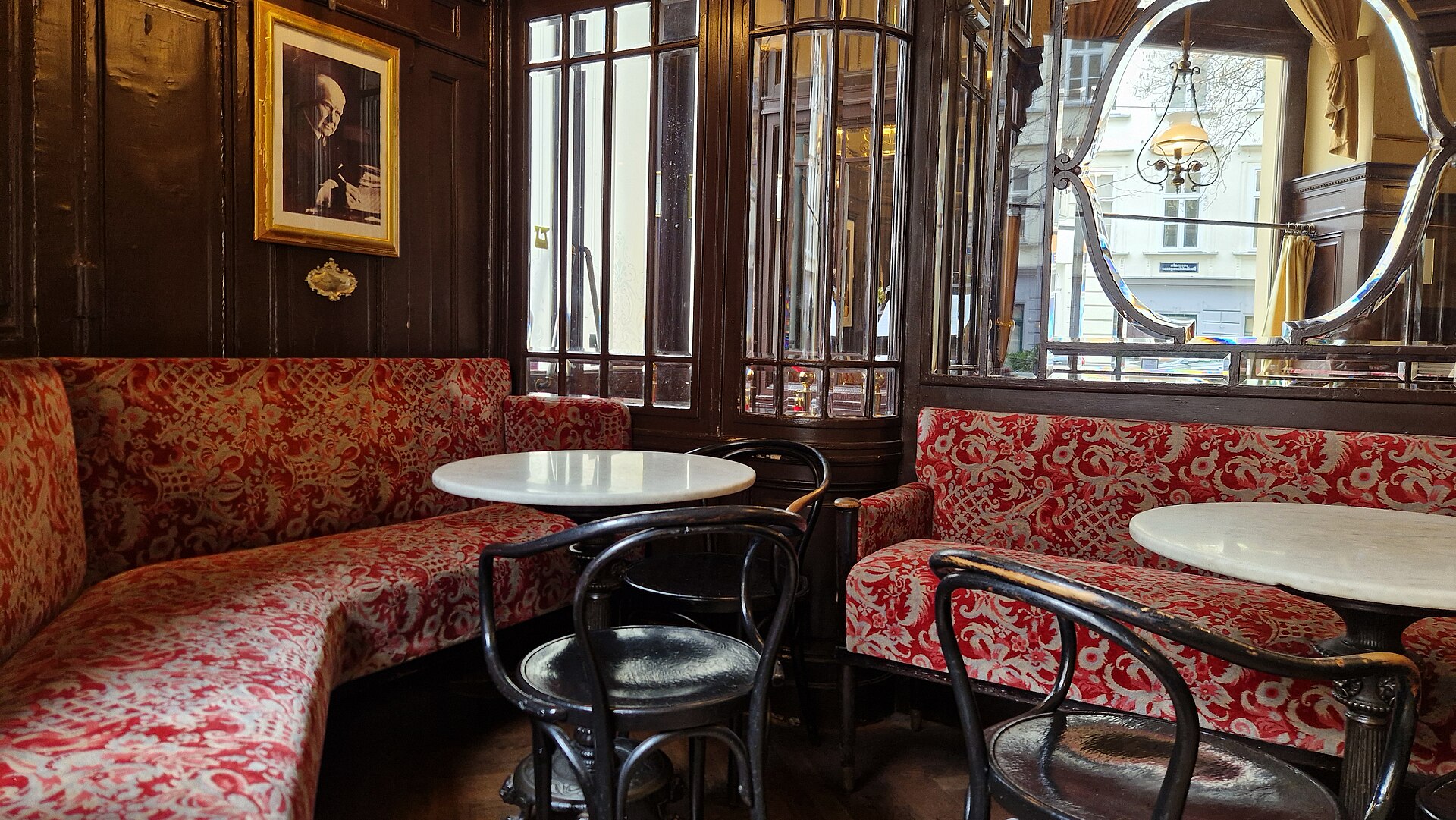
- Café Sperl, in Mariahilf: an unchanged nineteenth-century room with billiard tables, just outside the Ring and far less crowded.
- Café Prückel, on the Stubenring: 1950s interior, a local crowd and plenty of space.
Getting There and Making a Morning of It
Café Central is in the heart of the old city, a minute from U3 Herrengasse. It is a five-minute walk from the Hofburg via Michaelerplatz, and from the Freyung and the Schottenstift on the other side.
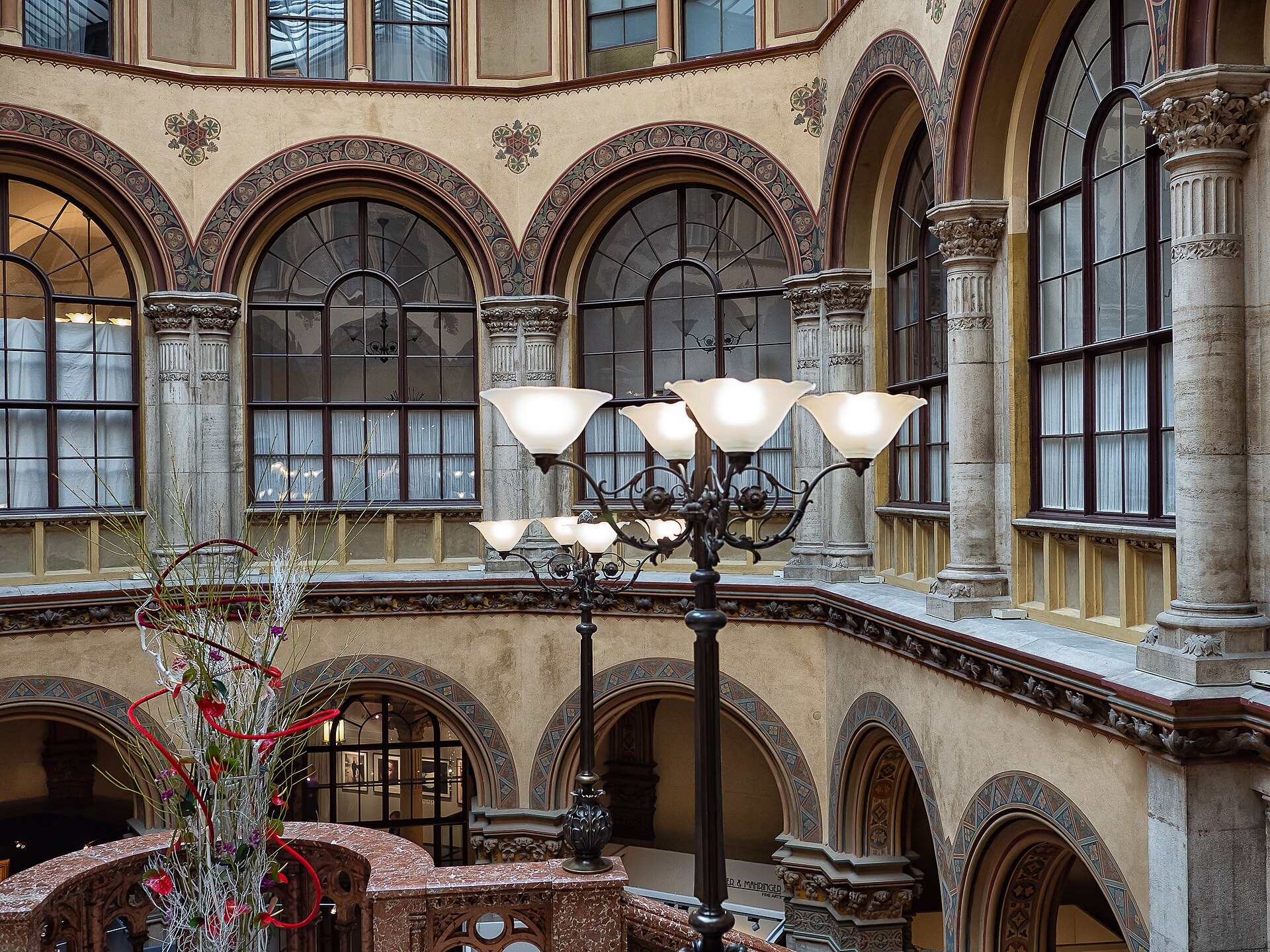
The Palais Ferstel itself is worth a few minutes. A covered shopping passage runs through the building from Herrengasse to the Freyung, with a glass-roofed courtyard and a fountain dedicated to the Danube. Its painted arcades and arched windows are the same style as the café, and walking through it is a good way to see the building even when the café is closed.
A good half-day in the neighbourhood: breakfast at Café Central (or DECENTRAL) at opening time, a walk down Herrengasse to Michaelerplatz, the Hofburg mid-morning (the Sisi Museum area is closed until the redesigned museum opens on 19 November 2026), and a slice of cake at Demel on the Kohlmarkt on the way out. Our guide to the Innere Stadt fills in the rest of the district.
Café Central Through the Year
- Autumn: the café is still closed, and DECENTRAL at the Freyung stands in for it. Late October around the Nationalfeiertag on 26 October is a busy holiday period in the centre.
- Winter: the coffee house at its most inviting, when the cold outside makes an hour over a Melange feel earned. From mid-November the Freyung, just behind the Palais Ferstel, hosts one of the city’s traditional Christmas markets, which brings extra crowds to the neighbourhood through December.
- Spring: generally easier, except around Easter, when the Freyung has its Easter market and visitor numbers rise.
- Summer: the peak for queues. Go at opening time or late in the evening, and make the most of the air conditioning that the renovation is upgrading.
Common Mistakes
- Turning up at 14:00 in August without a booking and spending forty minutes on the pavement.
- Assuming it is open. Until the reopening has happened, check first.
- Ordering the schnitzel and judging Viennese cooking by it.
- Waiting for the bill to arrive. It will not. Ask for it.
- Treating it as the only coffee house worth seeing. It is the most famous, not the most characterful.
- Missing the building. The Palais Ferstel passage next door is free, uncrowded and just as handsome.
Tips for Visiting
- Check the status before you go, until the reopening has happened and settled.
- Go at opening time on a weekday for the room at its best and no queue.
- Book if you can, especially at weekends, in summer and in December.
- Do not rush. Viennese coffee-house service is unhurried, and nobody will bring the bill until you ask for it. Say “Zahlen, bitte” when you are ready to pay.
- Look at the cake counter before you sit down, so you know what to order.
- Tip by rounding up, usually by about 10%, telling the waiter the total you want to pay as you hand over the money. Our Vienna tipping guide explains how.
- Take photos quietly. People are eating; a few pictures without flash are fine, a photo shoot is not.
- Visit the Palais Ferstel passage on your way in or out.
Frequently Asked Questions
Is Café Central in Vienna open?
Café Central closed on 16 March 2026 for a general renovation. The reopening is scheduled for winter 2026, so check the café’s website for the exact date before you go.
What can I do while Café Central is closed?
Visit DECENTRAL, the café’s temporary pop-up at the Freyung, or one of the other historic coffee houses nearby, such as Café Landtmann, Demel, Café Hawelka or Café Bräunerhof.
How long is the queue at Café Central?
Before the closure, visitors commonly reported queues of 20 to 45 minutes between noon and late afternoon in high season. At opening time on weekdays, you could usually walk straight in. Expect queues to return quickly after the reopening.
Can you reserve a table at Café Central?
Yes, before the closure the café took reservations online, and booking was the best way to avoid the queue. Online reservations are suspended during the renovation; check the website for the booking system when it reopens.
What time does Café Central open?
Before the closure it was open from 07:30 to 22:00 Monday to Saturday and from 10:00 to 22:00 on Sunday. Check the café’s website for its hours after the reopening.
Is there live music at Café Central?
Before the closure, a pianist played daily except Tuesday, from 16:30 to 21:30.
What should I order at Café Central?
A Wiener Melange and a slice of cake from the counter. If you are there in the morning, order breakfast. For a full meal, Tafelspitz is the classic.
Is Café Central worth visiting?
For the room, yes, especially early on a weekday. It is not worth a long queue: the coffee and food are no better than at other historic coffee houses, and several nearby are quieter and more authentic.
How do I get to Café Central?
Take the U3 to Herrengasse; the café is a minute’s walk away, at Herrengasse 14 on the corner of Strauchgasse, inside the Palais Ferstel.
Related Vienna Guides
- Vienna Coffee Houses Guide
- Vienna Desserts and Pastries
- Innere Stadt Vienna Guide
- Hofburg Palace Guide
- Traditional Viennese Dishes
- Wiener Schnitzel Guide
- Vienna Tipping Guide
- First-Time Vienna Tips
Photo Credits
Main room of Café Central: Cafe Central Wien 2015-i by GFHund, CC BY 4.0, via Wikimedia Commons.
Cake counter and bar at Café Central: Cafe Central Wenen by Pv at Dutch Wikipedia, CC BY-SA 3.0, via Wikimedia Commons.
Courtyard of the Palais Ferstel: (Tudoi61) Palais Ferstel-2a(1) by Tudoi61, CC BY-SA 4.0, via Wikimedia Commons.
Inside Café Central: Cafe Central (47575508682) by a.canvas.of.light, CC BY 2.0, via Wikimedia Commons.
Peter Altenberg at Café Central: W00163 by O.Mustafin, CC0, via Wikimedia Commons.
Café Sperl seating: Cafe Sperl Eingang by Geolina163, CC BY-SA 4.0, via Wikimedia Commons.
Melange at Café Hofburg: Café Hofburg Wien 2008 Melange 1 by Manfred Werner (Tsui), CC BY-SA 4.0, via Wikimedia Commons.