Zentralfriedhof: Beethoven, Falco & Vienna’s Central Cemetery
How to visit Vienna's Central Cemetery: which gate to use, the seasonal opening hours, where Beethoven, Schubert and Falco lie, the funeral museum and a three-hour route.
- The Zentralfriedhof at a Glance
- Why a Cemetery Is Worth Half a Day of a City Break
- Getting There: Tram 71, the U3 and the S7
- Opening Hours and the Best Time to Go
- The Musicians’ Graves in Group 32A
- Falco, Udo Jürgens and Hedy Lamarr: The Pop-Culture Graves
- The Church, the Presidents and an Awkward Name
- The Old Jewish Section at Gate 1
- The Bestattungsmuseum: Vienna’s Funeral Museum
- Quieter Corners: Sections, Parks and Wildlife
- A Three-Hour Route Through the Highlights
- Etiquette and Practical Tips
- Common Mistakes to Avoid
- Combine It With: St. Marx, the Nameless and the Gasometers
- Frequently Asked Questions
- Related Vienna Guides
- Photo Credits
This article contains advertising. Our booking links are routed through a partner that adds commission tracking automatically, so if you book through one we earn a commission from the provider, at no extra cost to you. It never affects what we recommend. Affiliate disclosure
Type Zentralfriedhof Vienna into a map and the pin lands a long way from anything a first-time visitor would call Vienna: out in Simmering, the 11th district, past the stonemasons’ yards and the flower stalls, at the end of a long tram ride from the Ring. What waits behind the wall is one of the largest cemeteries in Europe: about 240 hectares, roughly 330,000 graves and around three million burials. It is also, improbably, one of the best afternoons Vienna has to offer.
This guide covers how to get there and which gate to use, the opening hours through the year, where to find Beethoven, Schubert, Brahms, the Strausses and Falco, the presidential crypt and the Jugendstil church, the old Jewish section, the funeral museum, and a route that fits the highlights into about three hours. Hours and prices were checked in October 2026; treat them as the right order of magnitude and confirm anything time-critical before you travel. The Habsburgs, incidentally, are not here — they are in the city centre, and our guide to the Kaisergruft covers the Imperial Crypt.

The Zentralfriedhof at a Glance
The short version, for anyone deciding whether it fits their trip:
| What | Cost | Notes |
|---|---|---|
| Entry to the cemetery | Free | Open daily; hours change with the season (table below) |
| Getting there | One standard Vienna ticket | Tram 71 from the Ring to Zentralfriedhof 2. Tor |
| Bestattungsmuseum (funeral museum) | €9 | Opens on limited days only — check before you go |
| Fiaker tour from Gate 2 | €65 (30 min) / €110 (60 min) per carriage | Mid-March to 1 November |
| Driving in by car | A small daily fee (€5 at last check) | Restricted around All Saints’ Day |
| Time needed | — | Two to three hours for the highlights; half a day with the museum and the Jewish section |
Nothing here needs booking, which is part of the appeal. You turn up, you walk, and the city’s whole cultural history is laid out under the trees for nothing.
Why a Cemetery Is Worth Half a Day of a City Break
The Viennese have a relationship with death that outsiders find either morbid or charming, depending on temperament. There is a phrase for a good funeral — a schöne Leich, a beautiful corpse — and people genuinely used to save for one. The city has a funeral museum, a cemetery for the drowned, a crypt full of Habsburg sarcophagi and, here, a necropolis big enough to need its own bus service. The Zentralfriedhof is where that attitude is easiest to understand, because it is less a sad place than a park that happens to be full of graves.
It opened in 1874, laid out on open land far beyond the city limits by the Frankfurt architects Karl Jonas Mylius and Alfred Friedrich Bluntschli. The Viennese hated it. It was a long, muddy journey from town, and it was interdenominational at a time when that still raised eyebrows. So the city did something that now looks like a marketing campaign: it created honorary graves (Ehrengräber) and moved famous residents in. Beethoven and Schubert were brought here, and a memorial to Mozart followed. Composers, painters, actors and scientists have been accumulating ever since, and it worked — being buried at the Zentralfriedhof became something the Viennese aspired to.
The place has its own pop-cultural afterlife too. Wolfgang Ambros gave it a song, Es lebe der Zentralfriedhof, released in 1975 just after the cemetery’s centenary. And the tram that serves it gave the language an idiom: to say someone has “taken the 71” (den 71er genommen) is to say they have died. In the years around the First World War, when the city ran short of hearses, trams on the route really did carry coffins out to Simmering at night.
Getting There: Tram 71, the U3 and the S7
The cemetery runs for a couple of kilometres along Simmeringer Hauptstraße, and everything depends on getting off at the right gate. The stop for the main entrance carries its gate in its name, Zentralfriedhof 2. Tor, which makes this easier than it sounds.
Tram 71 from the Ring (the best option)
Tram 71 runs along the Ring and turns off at Schwarzenbergplatz, then heads out down Rennweg, past St. Marx and along Simmeringer Hauptstraße to the cemetery gates. Ride it out from Schwarzenbergplatz to Zentralfriedhof 2. Tor; it runs frequently all day, and a standard Vienna ticket covers it because the cemetery is inside the city’s core fare zone. If you have a 24-hour or 7-day ticket, this trip is one of the better uses of it. Our Vienna tram guide covers how the network works and how to read the stops.
U3 to Simmering, then the tram
If you are staying near the U3 — Westbahnhof, Neubaugasse, Volkstheater, Stephansplatz, Landstraße — ride it to Simmering and change to tram 71 at its Simmering U3 stop for the run along Simmeringer Hauptstraße. It is the easy route if you are already on the U3. The U-Bahn guide has the full line map.
S7 to Wien Zentralfriedhof (the back gate)
The S-Bahn station Wien Zentralfriedhof on the S7 sits by Gate 11, at the far side of the cemetery from the honorary graves. It is handy if you are coming from the airport side of the city, and much less useful otherwise: the walk from Gate 11 to the musicians’ graves is long. Note too that during the closure of the central S-Bahn trunk line (from September 2026 to the end of October 2027) the S7 runs only as far as St. Marx rather than Wien Mitte, so from the centre the tram is simpler. Our airport transfer guide explains the closure in detail.
Taxi, car and Fiaker
A taxi from the Innere Stadt takes roughly twenty minutes outside rush hour. Private cars can drive into the cemetery for a daily fee — €5 at last check — though this is restricted around All Saints’ Day, and there is little reason to unless mobility is an issue. The Fiaker drivers who wait at Gate 2 between mid-March and 1 November offer a 30-minute loop for €65 and an hour for €110, priced per carriage rather than per person. For anyone who finds long walks hard, that is a genuinely good way to see the place; for everyone else, walking is better and free. Our Fiaker guide covers the welfare debate and the city-centre rates.
Which gate to use
| Gate | What is there | Use it for |
|---|---|---|
| Gate 1 (1. Tor) | The old Jewish section | Arthur Schnitzler and the overgrown graves of the Ringstrasse generation |
| Gate 2 (2. Tor) | Main entrance, Info Point, honorary graves, church, funeral museum, Fiaker stand | Almost every visit should start here |
| Gate 3 (3. Tor) | The Protestant section | A quieter approach once you know the layout |
| Gate 4 (4. Tor) | The new Jewish section, still in use | Visiting a specific grave |
| Gate 11 (11. Tor) | S7 station at the back of the cemetery | Arriving by S-Bahn |
The Info Point is at the main entrance, Gate 2, Simmeringer Hauptstraße 234, 1110 Vienna, and is staffed Monday to Friday, 08:00–15:00. At weekends there is nobody to ask, so photograph the large map board just inside the gate before you set off. It will save you at least one wrong turn.
Opening Hours and the Best Time to Go
The cemetery is open every day of the year, with hours that follow the daylight:
| Period | Opening hours |
|---|---|
| 3 November to end of February | 08:00–17:00 |
| March | 07:00–18:00 |
| April to September | 07:00–19:00 (Thursdays from May to August until 20:00) |
| 1 October to 2 November | 07:00–18:00 |
Those closing times are real; the gates do shut, and the grounds are big enough that walking out from the far corners takes a while. Arrive with at least two hours in hand.
Season by season
- October is the classic month. The trees along the main avenues turn yellow and copper, the light is low and golden by mid-afternoon, and the crowds of summer have thinned. Our Vienna in autumn guide has more ideas for the season.
- All Saints’ Day (1 November) is a public holiday that brings especially large numbers of visitors. Families come to tend graves, thousands of candles burn in red glass, extra trams run and the car restrictions kick in. It is moving to see, but it is a working day for the cemetery rather than a sightseeing one — behave as you would at any family gathering, and expect crowds around the honorary graves. The Vienna in November guide covers the holiday closures elsewhere in the city.
- Winter brings fog, bare trees and a 17:00 closing time with dusk well before it. Atmospheric for photographers, cold for everyone else; go in the late morning.
- Spring and summer are green and shady, and the Thursday evening openings from May to August are the cemetery at its most peaceful, with long light and almost nobody else about.
The Musicians’ Graves in Group 32A
The plots are numbered, and the honorary graves are clustered along the main avenue from Gate 2, before you reach the church. The one everyone comes for is Group 32A, a semicircular grove that holds the greatest concentration of composers anywhere in the world. Our guide to Vienna’s composers covers their lives and the houses they lived in; this is where most of them ended up.
Beethoven and Schubert
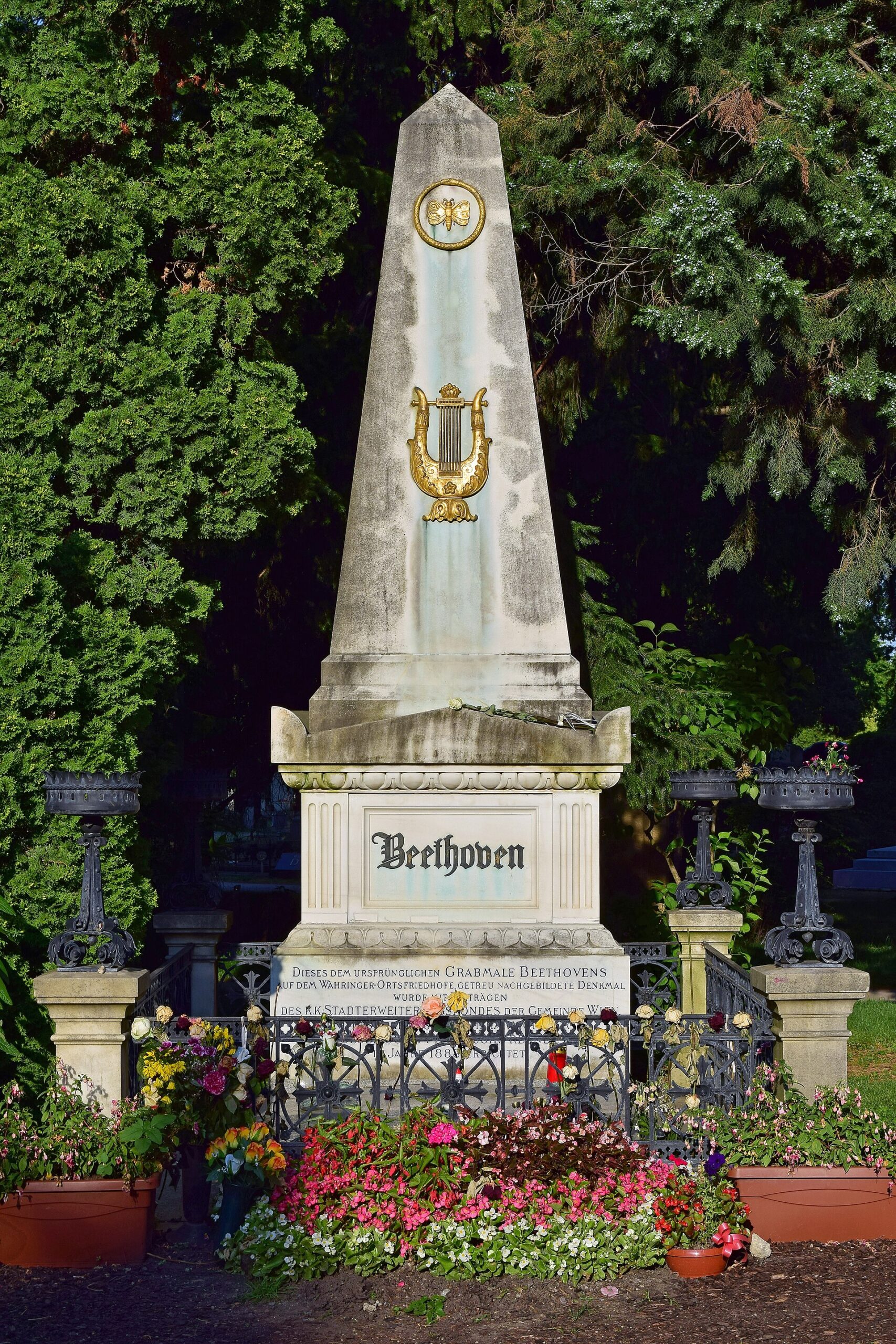
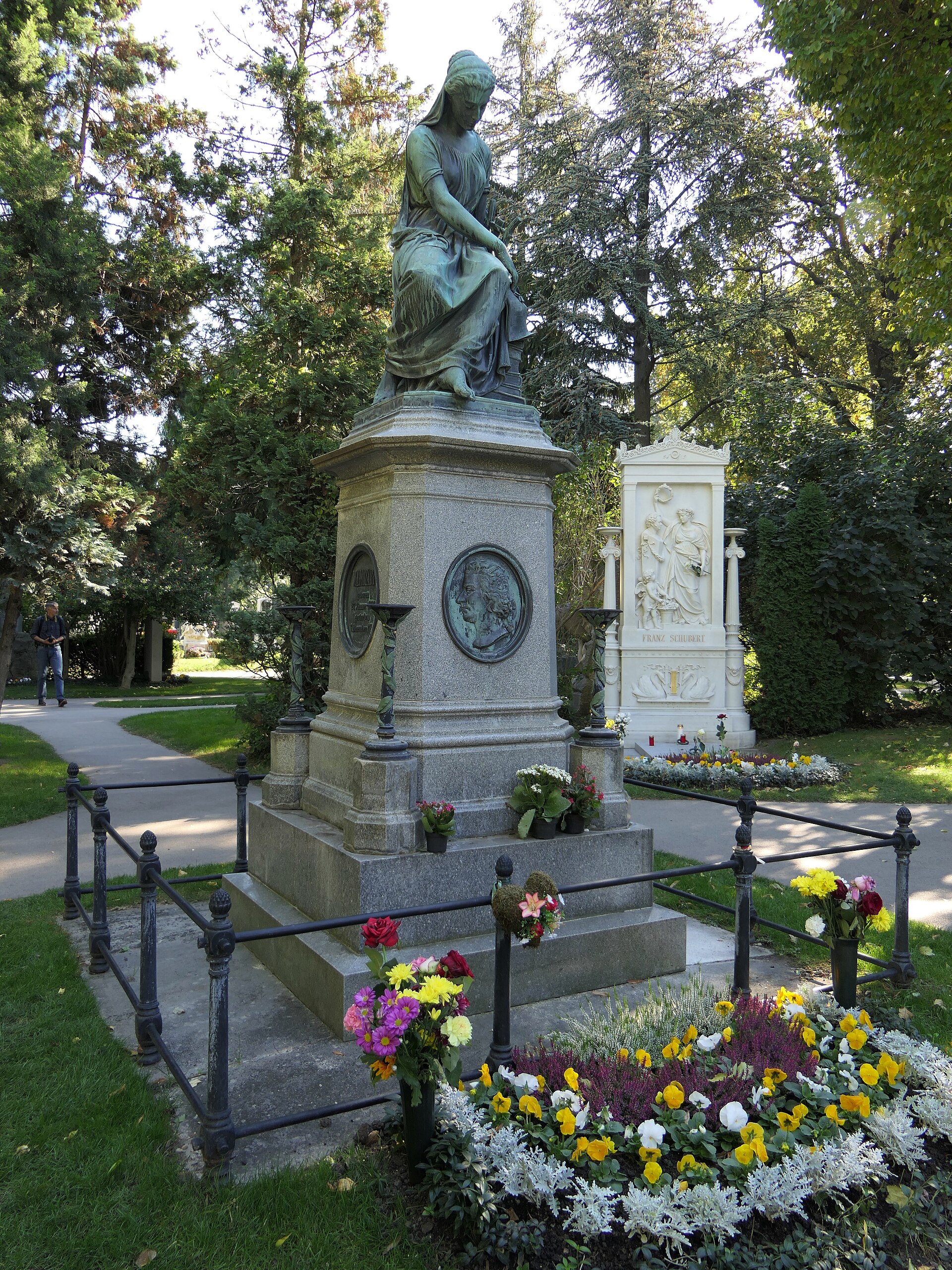
Beethoven’s grave is the white obelisk with a gilded lyre and, above it, a butterfly inside a ring formed by a snake swallowing its tail — symbols of the soul and of eternity. The inscription explains that it reproduces his first tomb in the Währing local cemetery. Schubert, who idolised Beethoven and was buried near him in 1828 at his own request, lies a few steps away under a white marble monument carved with an allegorical relief. The two were moved here together, so they are neighbours twice over.
Mozart, who is not actually here
Between them stands the memorial to Mozart: a bronze mourning muse seated on a granite pedestal with his portrait in a medallion. It is a monument, not a grave. Mozart was buried in 1791 in an unmarked shaft grave at the St. Marx cemetery in the 3rd district, in line with the burial regulations of the day, and the exact spot can no longer be determined. If you want the real site, St. Marx is on the way back into town — more on that below.
Brahms and the Strauss family
Johannes Brahms and Johann Strauss II were friends — Brahms once wrote the opening bars of The Blue Danube on a fan belonging to Strauss’s wife and added “unfortunately not by Brahms” underneath — and they lie a few steps apart. Strauss’s father, Johann Strauss I, and his brother Josef are nearby, as is Joseph Lanner, the elder Strauss’s rival in the waltz business. Christoph Willibald Gluck and Hugo Wolf complete the group. It is a good idea to bring a playlist; standing at Strauss’s grave with the Danube waltz in your headphones is unashamedly touristy and completely worth doing.
Schoenberg, Salieri and the moderns
Arnold Schoenberg, the composer who blew tonality apart, has an honorary grave in the neighbouring Group 32C, marked by a stark stone cube designed by the sculptor Fritz Wotruba. Antonio Salieri lies in Group 0, close to the main gate. The story that he poisoned Mozart began as Viennese gossip and was made famous by Pushkin and the film Amadeus; historians reject it. In life he was a generous teacher whose pupils included Beethoven, Schubert and Liszt.
Falco, Udo Jürgens and Hedy Lamarr: The Pop-Culture Graves
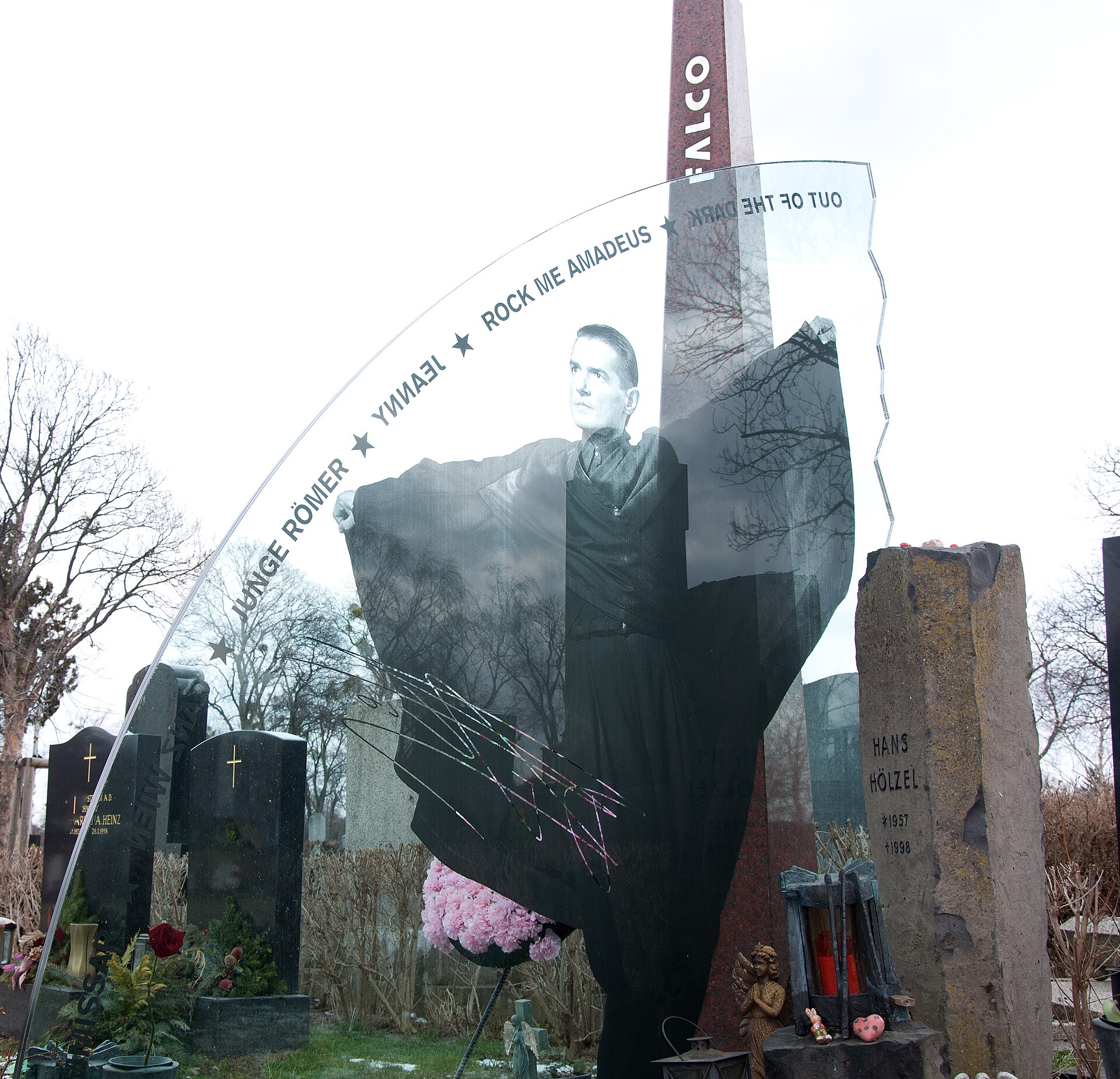
The grave with the most fresh flowers on any given day is not Beethoven’s. It is Falco’s, in Group 40, a few minutes’ walk from the composers. Hans Hölzel, who took the stage name Falco, took Rock Me Amadeus to the top of the US charts in 1986, still the only German-language song to manage it, and died in a car crash in the Dominican Republic in 1998, aged 40. His monument is as theatrical as he was: a tall red granite slab with his name running up it, a curved pane of glass etched with his figure in a sweeping cape and the titles of his hits, and a rough-hewn stone engraved with his real name. Fans still leave candles, roses and the occasional note.
Close by in Group 33G are two more stars. Udo Jürgens, the singer and songwriter who won the Eurovision Song Contest for Austria in 1966 with Merci, Chérie and died in 2014, has a white marble grand piano for a gravestone. Hedy Lamarr, the Viennese-born Hollywood actress who also co-patented a frequency-hopping system that later fed into wireless technology, has an honorary grave here too; her ashes were brought home and buried in 2014.
The wider honour roll rewards wandering. Look out for the actors Curd Jürgens, Hans Moser and Helmut Qualtinger; the physicist Ludwig Boltzmann in Group 14C, whose tombstone carries his entropy formula, S = k·log W, above the bust; and the architect Adolf Loos, who sketched his own gravestone — a plain, unornamented block, exactly what you would expect from the man who wrote Ornament and Crime.
The Church, the Presidents and an Awkward Name
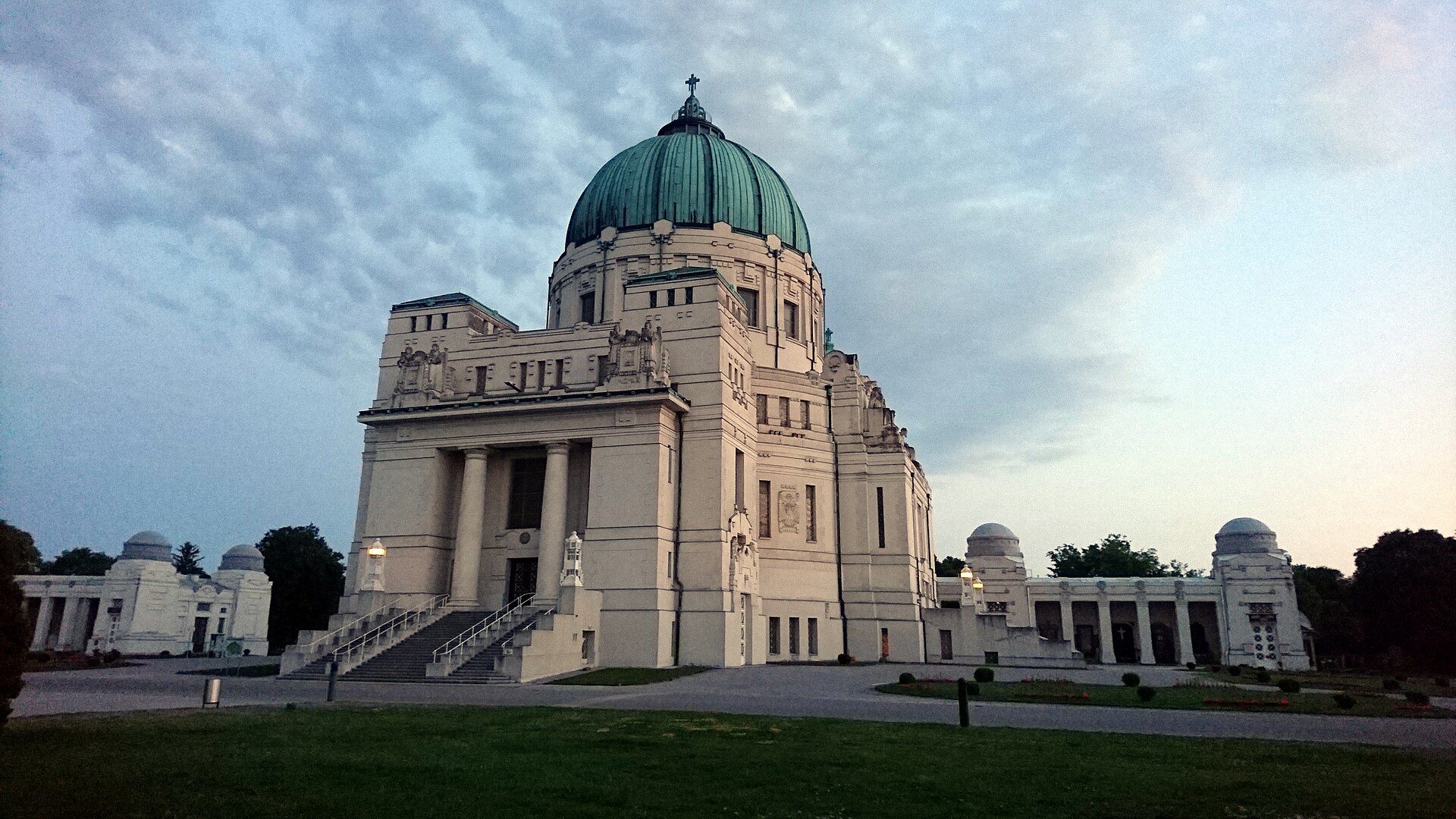
The green copper dome you can see from most of the cemetery belongs to the Friedhofskirche zum heiligen Karl Borromäus, built between 1907 and 1910 to designs by Max Hegele, who also designed the main gate. It is one of the major Jugendstil buildings in Vienna, and far less visited than it deserves — monumental outside, light and geometric inside, with stained glass and mosaics by Leopold Forstner. If the doors are open, go in. Our guide to Art Nouveau and Jugendstil in Vienna puts Hegele and Forstner in context.
In front of the church is the Präsidentengruft, the presidential crypt, where the presidents of the Second Republic are buried: Karl Renner, Theodor Körner, Adolf Schärf, Franz Jonas, Rudolf Kirchschläger, Kurt Waldheim and Thomas Klestil. It is a sober, low-key memorial, and a useful stop for anyone interested in the country’s post-war history.
Under the church itself lies Karl Lueger, mayor of Vienna from 1897 to 1910, and for decades the building was known as the Dr.-Karl-Lueger-Gedächtniskirche. Lueger built gasworks, trams and water mains, and he was also a populist who made antisemitism a mainstream political tool — Hitler later praised him by name. Vienna has spent years arguing about how to remember him, and it is worth knowing whose crypt you are standing over. Our history of Vienna covers the period.
The Old Jewish Section at Gate 1
Walk through Gate 1 and the cemetery changes character completely. The old Jewish section is overgrown — ivy over the headstones, long grass between the rows, stones tilted by tree roots — and the reason is the darkest chapter in the city’s history. After 1938 Vienna’s Jews were driven into exile or murdered, and many of the families who would have tended these graves were gone. Parts were damaged in the November pogrom and during the war. Restoration work continues, but much of the section remains as time and absence have left it.
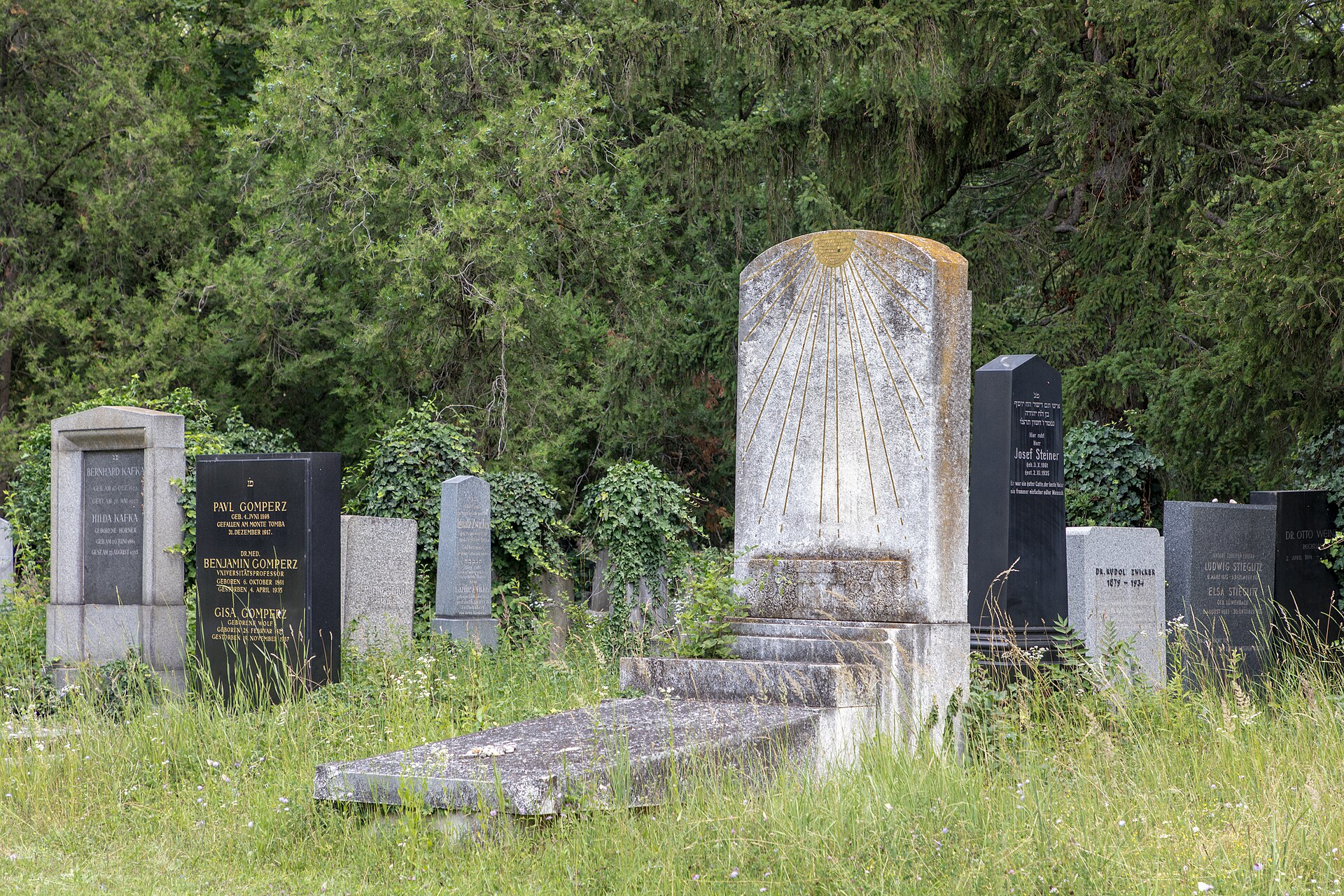
It is the most affecting part of the Zentralfriedhof, and the quietest. The writer and dramatist Arthur Schnitzler is buried here, and the surnames on the stones read like a directory of the families who built Vienna’s banks, newspapers, medical faculty and salons around 1900. Deer graze between the graves, which sounds sentimental and is simply true.
A few practical points. Check the opening of the Jewish sections at the Info Point before you go, especially on Saturdays and Jewish holidays. It is customary for men to cover their heads, and a cap will do. Gate 1 is a short walk or tram ride back towards town from Gate 2, along Simmeringer Hauptstraße. The new Jewish section, reached through Gate 4, is best left to people visiting specific graves. For the bigger story, read our guide to Jewish Vienna.
The Bestattungsmuseum: Vienna’s Funeral Museum
Beneath ceremonial hall 2, a short walk inside Gate 2, the city’s funeral service runs a museum about itself, and it is better than that sounds. Around 250 objects in roughly 300 square metres trace how Vienna has buried its dead from the late eighteenth century to now: hearses, mourning dress, elaborate funeral invitations, and the paraphernalia of the schöne Leich.
The star exhibit is Emperor Joseph II’s reusable coffin of 1784. The reforming emperor decreed that, to save wood, bodies should be carried to the grave in a coffin with a hinged bottom that dropped the corpse into the ground and could then be used again. The Viennese were so outraged that he withdrew the order within months. Elsewhere there are devices sold to people terrified of being buried alive, which tells you something about the nineteenth-century imagination, and a gift shop with a fine line in gallows humour.
Admission is €9, with a discount for Vienna City Card holders. The catch is the opening days: at the time of writing the museum opens only midweek (Wednesday to Friday, 10:00–16:00), with longer hours on All Saints’ Day. Check bestattungsmuseum.at before you go. If it is open on your day, give it forty-five minutes; if it is not, do not rearrange your trip around it.
Quieter Corners: Sections, Parks and Wildlife
The Zentralfriedhof was designed to take everyone, and it shows. Beyond the Catholic main body there are Protestant, Orthodox, Islamic and Buddhist sections, and a landscaped garden of remembrance, the Park der Ruhe und Kraft (“park of rest and strength”), which opened in 1999. Near the main gate, the arcades hold the grand family vaults of nineteenth-century money, all bronze doors and marble angels.
The cemetery is also part of Vienna’s eastern green belt, and the wildlife has noticed. Deer live in the quieter sections, European hamsters — now critically endangered across Europe — dig their burrows in the lawns, and the old trees are loud with birds. An electric cemetery bus loops through the grounds, stopping at around nineteen points; ask at the Info Point for the current timetable. For a coffee and cake, the Oberlaa konditorei runs a café in a restored pavilion inside the cemetery.
A Three-Hour Route Through the Highlights
This is the loop we would give a friend with an afternoon to spare. It works from April to September as written; in winter, start two hours earlier because of the 17:00 closing.
- 13:00 — Tram 71 from Schwarzenbergplatz (or the U3 to Simmering and the 71 from there).
- 13:30 — Off at Zentralfriedhof 2. Tor. Photograph the map board; on weekdays, pick up information at the Info Point.
- 13:40 — Group 32A: Beethoven, the Mozart memorial, Schubert, Brahms and the Strausses. Allow half an hour; this is the bit you came for.
- 14:10 — Schoenberg’s cube in Group 32C, then the honour roll around it.
- 14:30 — The church and the presidential crypt. Go inside if it is open.
- 14:50 — Falco in Group 40, then Udo Jürgens and Hedy Lamarr in Group 33G.
- 15:20 — Coffee at the café, or the Bestattungsmuseum if it is a Wednesday to Friday.
- 16:00 — Back to Gate 1 for the old Jewish section, a short walk or tram ride away (ask about its hours at the Info Point first).
- 16:45 — Tram 71 back towards town, with an optional stop at St. Marx.
That is a fair amount of walking — count on five or six kilometres by the end — but all of it is flat, and the main avenues are paved.
Etiquette and Practical Tips
- Funerals happen every day. If you come across one, keep your distance, keep your voice down and do not photograph mourners.
- Photography of graves and monuments is fine; flying a drone is not.
- Stay on the paths and do not sit on graves or lean on monuments, however inviting the shade looks. Benches are plentiful along the avenues.
- Accessibility: the main avenues are flat and paved, but side paths are gravel or grass and some sections, especially the old Jewish one, are uneven. The Fiaker or the cemetery bus help if walking distances are a problem.
- Toilets and food: there are toilets at the main entrance, and the café is the obvious place to eat inside. Simmeringer Hauptstraße outside has bakeries and simple restaurants.
- Finding a specific grave: the Friedhöfe Wien website has an online search for the deceased that gives the group, row and number. Do this before you go: with some 330,000 graves, a private grave is very hard to find by browsing.
Common Mistakes to Avoid
- Getting off at the wrong gate. Gate 2 is the main entrance; Gate 11, where the S-Bahn leaves you, is a long walk from the honorary graves.
- Arriving an hour before closing. You will spend it walking briskly and leave annoyed.
- Trying to see everything. At 240 hectares, you cannot. Pick three or four targets and let the rest be wandering.
- Looking for Mozart’s grave. It is a memorial; his actual resting place is somewhere in St. Marx.
- Going to the Jewish section on a Saturday or Jewish holiday without checking. Ask at the Info Point on a weekday before you go.
- Assuming the museum is open. It keeps limited days; check first.
- Treating it as a theme park. It is a working cemetery with fresh graves and grieving families. Most visitors get this right without being told.
Combine It With: St. Marx, the Nameless and the Gasometers
St. Marx Cemetery
The Biedermeier cemetery of St. Marx in the 3rd district closed for burials when the Zentralfriedhof opened and has been left as a romantic, slightly melancholy park ever since — famous in May for its lilac. This is where Mozart was buried. The exact spot is unknown, and the monument marking the approximate site, a broken column and a mourning angel, was assembled, so the story goes, by a cemetery keeper from fragments of discarded tombs. Tram 71 passes St. Marx on the way back into town, which makes it a natural coda.
Friedhof der Namenlosen
Further out, on the Danube by the Alberner Hafen, the Cemetery of the Nameless holds the graves of people, many of them never identified, whose bodies were washed up by the river. It is tiny, strange and very moving, and fans of Before Sunrise will recognise it from the film. It takes a bus beyond Simmering to reach, so check the Wiener Linien journey planner and allow a couple of hours for the detour.
The Gasometers and the Imperial Crypt
On the U3 back from Simmering, the Gasometer stop drops you at four brick gas holders from the 1890s converted into flats, offices and a shopping centre — an interesting piece of urban recycling, if not a reason to cross the city. And if the Zentralfriedhof has given you a taste for Vienna’s way with death, the catacombs and crypts of the city centre are the logical next step.
Frequently Asked Questions
Is the Zentralfriedhof free to visit?
Yes. Entry is free every day of the year. The only things you might pay for are the Bestattungsmuseum (€9), a Fiaker tour from Gate 2, or the daily fee to drive a car in.
How long do I need at the Zentralfriedhof?
Two to three hours covers the composers, the church, the presidential crypt and Falco. Add an hour for the old Jewish section and another for the museum and a coffee. Very few visitors need more than half a day.
Where exactly is Beethoven buried?
In Group 32A, a few minutes’ walk from Gate 2 along the main avenue towards the church. His white obelisk stands to one side of the Mozart memorial, with Schubert on the other.
Is Mozart buried at the Zentralfriedhof?
No. The Zentralfriedhof has a memorial to him in Group 32A, but Mozart was buried in 1791 in an unmarked shaft grave at St. Marx cemetery in the 3rd district, and where exactly it lay can no longer be established.
Which tram goes to the Zentralfriedhof?
Tram 71, from the Ring at Schwarzenbergplatz or from the U3 at Simmering. Get off at Zentralfriedhof 2. Tor for the main entrance. The S7 also stops at the back of the cemetery by Gate 11.
Is the Zentralfriedhof open on Sundays and public holidays?
Yes, the cemetery itself opens daily, including Sundays and holidays, on the seasonal hours above. The Info Point is staffed on weekdays only, the Bestattungsmuseum keeps limited days, and it is worth checking the Jewish sections’ opening at the Info Point, especially on Saturdays and Jewish holidays.
Is it worth going on All Saints’ Day?
It is an extraordinary sight, with thousands of candles and whole families at the graves, but it also brings heavy crowds and traffic restrictions to the cemetery. Go if you want to see a Viennese tradition in action and can be discreet about it; avoid it if you want quiet time with the composers.
Can I bring children?
Yes, and plenty of Viennese families do. Children tend to enjoy the scale, the deer and Falco’s glass monument; just set the ground rules about graves and funerals before you go in. Our guide to Vienna with kids has more ideas.
Related Vienna Guides
- Vienna’s Great Composers: Where They Lived and Worked
- The Kaisergruft: Vienna’s Imperial Crypt
- Vienna Underground: Catacombs, Crypts & Ghost Tours
- Jewish Vienna: History and Places to Visit
- Vienna Classical Music Guide
- Vienna Hidden Gems
- Unique Experiences in Vienna
- Vienna Attractions: The Complete Guide
Photo Credits
Karl-Borromäus-Kirche at dusk: Karl-Borromäus-Kirche, evening by Braveheart, CC BY-SA 4.0, via Wikimedia Commons.
Beethoven’s grave in Group 32A: Wiener Zentralfriedhof – Gruppe 32 A – Ludwig van Beethoven by Haeferl, CC BY-SA 4.0, via Wikimedia Commons.
Mozart memorial with Schubert’s tomb: Grabdenkmal für Wolfgang Amadeus Mozart auf dem Wiener Zentralfriedhof by Dr. Bernd Gross, CC BY-SA 3.0 de, via Wikimedia Commons.
Falco’s grave in Group 40: Falcos Grab aktuell by Christian Maushake, CC BY-SA 3.0, via Wikimedia Commons.
Old Jewish section near Gate 1: Wien, Zentralfriedhof, Alter Jüdischer Friedhof — 2018 — 3221 by Dietmar Rabich, CC BY-SA 4.0, via Wikimedia Commons.