Schonbrunn Gardens, Gloriette & Maze: The Free Half of Schonbrunn
The park is free, opens at 06:30 and is better than the palace. What costs nothing, what the €16 Exclusive Gardens ticket actually buys, and why the Gloriette view doesn't need a ticket at all.

Photo by Alex Does Pictures
- What Is Free and What You Pay For
- The Gloriette
- The Great Parterre and the Neptune Fountain
- The Maze and the Labyrinth
- The Glasshouses: Palm House and Desert House
- The Orangery, the Roman Ruin and the Quiet Corners
- Which Gate, and Getting There
- The Gardens by Season
- Photographing the Gardens
- A Two-Hour Walking Route
- How the Park Came to Be
- Practicalities in the Park
- Our Honest Verdict
- Frequently Asked Questions
- Related Vienna Guides
- Photo Credits
This article contains advertising. Our booking links are routed through a partner that adds commission tracking automatically, so if you book through one we earn a commission from the provider, at no extra cost to you. It never affects what we recommend. Affiliate disclosure
At seven in the morning the gates at the top of Hietzinger Tor are already open, there is one man walking a dachshund along the lime avenue, and you can stand in the middle of the Great Parterre with nobody in the frame at all. Three hours later the same spot holds four coach parties. The main park of the Schonbrunn gardens is free, it opens at 06:30 every day of the year, and in our opinion it is the best thing in Vienna that costs nothing. The palace behind it costs €42. The baroque parkland in front of it, 1.2 km from east to west, costs nothing at all.
This guide covers what is free and what is not, the Gloriette and the one detail that decides whether you should pay for it, the Maze, the Palm House and the Orangery, the walking routes and how long the climb actually takes, which gate to use, what the park looks like in each season, and our honest verdict on the €16 Exclusive Gardens ticket. Hours and prices were checked on Schönbrunn’s own website in September 2026; the seasonal attractions run to five different date bands of opening hours, so confirm the day before you go.
What Is Free and What You Pay For
This is the whole thing in one table, and it is the part most guides get vague about.
| Area | Cost | Season |
|---|---|---|
| Palace park, Great Parterre, avenues, Neptune Fountain | Free | Daily, all year, from 06:30 |
| The walk up to the Gloriette and the hilltop in front of it | Free | All year |
| Roman Ruin, Obelisk Fountain, Schöner Brunnen, Japanese Garden | Free | All year |
| Gloriette viewing terrace (the roof) | Part of €16 ticket | 27 Mar – 2 Nov |
| Maze & Labyrinth | Part of €16 ticket | 27 Mar – 2 Nov |
| Privy Garden (Kronprinzengarten) | Part of €16 ticket | 27 Mar – 2 Nov |
| Orangery Garden | Part of €16 ticket | 27 Mar – 2 Nov |
| Palm House | Separate ticket | All year |
| Desert Experience House | Separate ticket | All year |
| Tiergarten Schönbrunn (the zoo) | €29 adult | All year, from 09:00 |
The Exclusive Gardens ticket bundles the four seasonal enclosures — Maze, Gloriette terrace, Privy Garden and Orangery Garden — for €16 adult and €11 child. It only exists between late March and early November. Outside that window those four are simply shut, and the rest of the park carries on as normal.
Park opening hours by month
The park opens at 06:30 every single day and closes with the light:
- January–February: 06:30–17:30
- March: 06:30–19:00
- April: 06:30–20:00
- May–August: 06:30–21:00
- September: 06:30–20:00
- October: 06:30–19:00
- November–December: 06:30–17:30
Those summer hours are worth internalising. From May to August you have fourteen and a half hours of access to a baroque park with a hilltop view over Vienna, at no cost, and the tour groups occupy roughly four of them.
Seasonal attraction hours, 2026
The Gloriette terrace, the Maze, the Privy Garden and the Orangery Garden all run on the same clock, which changes five times across the season:
- 27–28 March: 09:30–16:00
- 29 March – 30 June: 09:30–17:30
- 1 July – 31 August: 09:30–18:30
- 1 September – 25 October: 09:30–17:30
- 26 October – 2 November: 09:30–16:00
The Gloriette
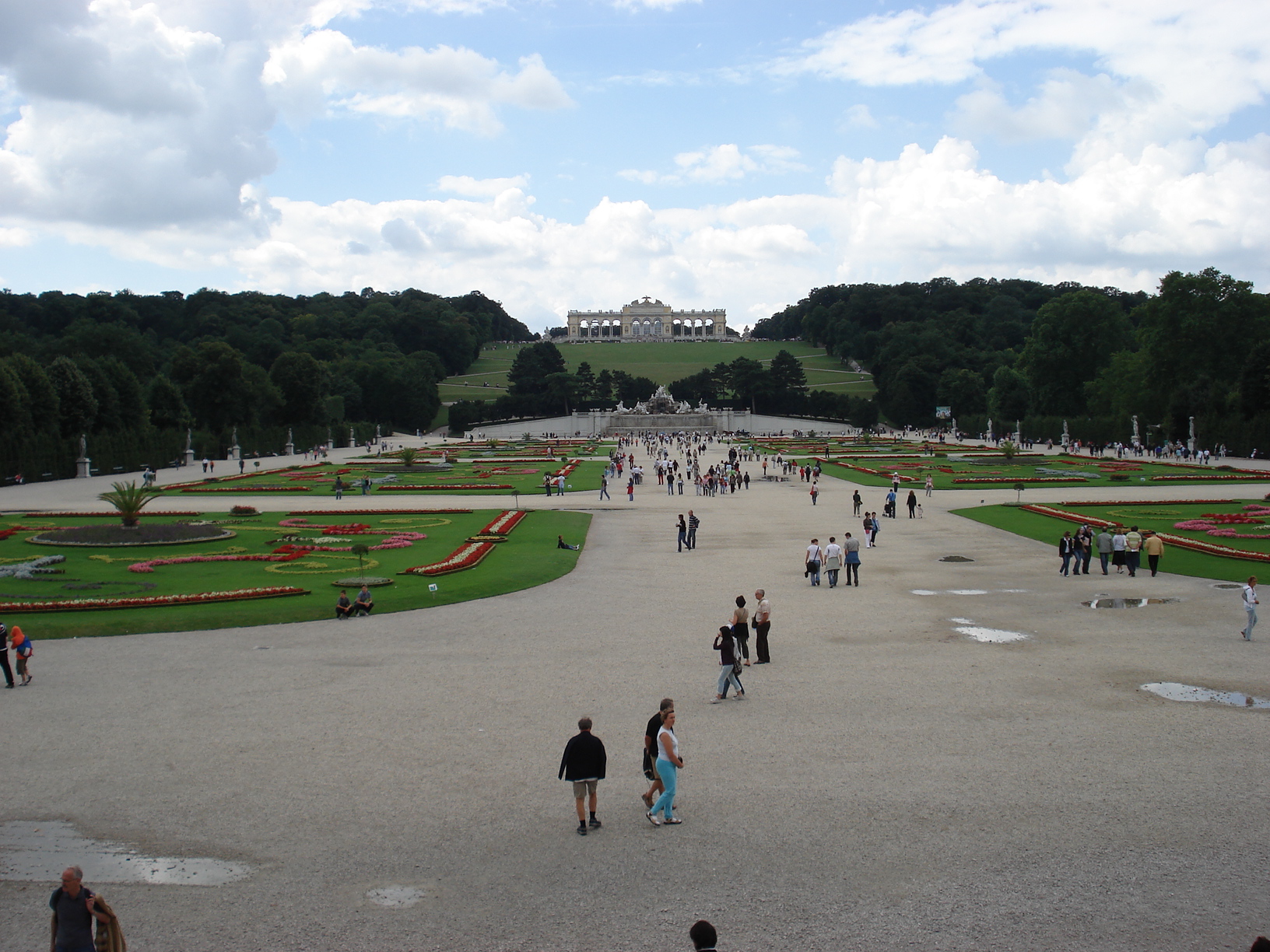
The colonnaded building on the ridge is the reason the view exists. It was put up in 1775 as the final flourish of the garden’s redesign, and it is a piece of landscape theatre, positioned so that the palace has something to look at and so that whoever stands beside it can look back down the axis and see the Habsburg empire arranged in symmetry beneath them. In the nineteenth century the glazed central hall was often used as a dining room. Much of the stone was recycled from a half-demolished Renaissance palace elsewhere in Vienna, which is a very Viennese detail.
Here is the thing that decides your €16: the walk up to the Gloriette, the hilltop, and the view back down over the palace and the city are all free. You can stand directly in front of the colonnade, take the photograph everybody takes, and pay nothing. What costs money is the viewing terrace on the roof, reached by a staircase inside, which puts you perhaps fifteen metres higher.
Is fifteen metres worth it? On a clear day with good visibility across to the Kahlenberg, marginally yes, and the terrace is a genuinely lovely place to stand. On a grey day, no. The hilltop view is ninety per cent of the terrace view, and the ninety per cent is free.
Inside the Gloriette there is a café, which is expensive in the way that cafés at the top of hills in front of famous views always are. The coffee is fine. The setting is the product. If you want an actual Viennese coffee house afterwards, our coffee house guide is a better use of the same €12.
The climb, honestly
From the Neptune Fountain at the bottom to the Gloriette is around fifteen to twenty minutes at a normal pace, on gravel, rising roughly sixty metres. It is a steady incline rather than a scramble, and there are benches. Two routes go up: the direct gravel path straight up the slope behind the fountain, which is steeper, and the longer curving path to either side, which is gentler and shaded — take the side path up and the direct one down.
The gravel is loose in places and the gradient is real, so this is a genuine walk rather than a stroll. Anyone with mobility limitations should know that there is a paid panorama train that loops the park with stops near the Gloriette, which removes the climb entirely.
The Great Parterre and the Neptune Fountain
The formal ground between the palace and the hill is the Great Parterre: symmetrical bedding, clipped hedge walls and a line of marble statues along each side, mostly gods and figures from classical mythology, installed in the 1770s. The bedding is replanted twice a year and is at its most absurd in high summer, when the pattern reads clearly from the palace terrace.
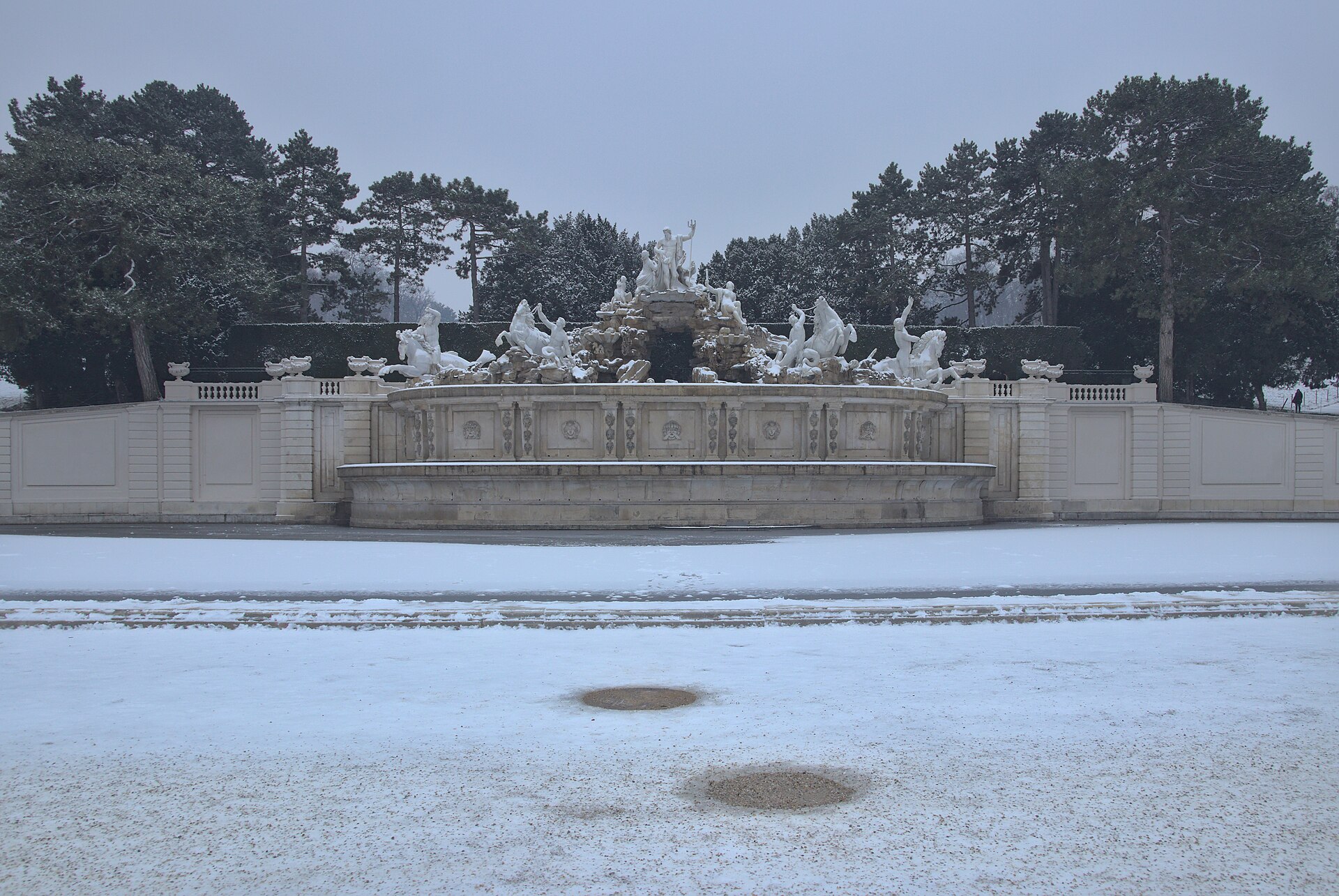
At the foot of the slope sits the Neptune Fountain, finished around 1780 — a stone grotto with the sea god above and a chaotic scrum of tritons, nymphs and rearing horses below. You can walk behind it, through the arch under the rockwork, which almost nobody does and which frames the palace nicely on the way back.
Off to the west, past the fountain, is the Schöner Brunnen itself — the “beautiful spring” that gave the whole estate its name, now housed in a small pavilion with a nymph pouring water from an urn. It is easy to miss and worth three minutes.
The Maze and the Labyrinth
There has been a maze at Schönbrunn since the 1720s. The original was cleared in the 19th century and the current one was planted in 1999 on part of the same ground, with a viewing platform in the middle and a separate “Labyrinth” area next to it full of mirrors, a giant kaleidoscope, climbing nets and mathematical puzzles laid into the ground.
This is the part of the €16 ticket that earns its money, and it earns it entirely for children. A hedge maze you can get properly lost in, followed by a playground disguised as an educational installation, is about as good as it gets for an eight-year-old who has spent the morning being told not to touch things. Adults on their own will do the maze in twelve minutes and wonder what the fuss was.
Children aged 14 and under are only admitted with an adult — a rule the staff enforce, and worth knowing if you had pictured sending the kids in while you sat outside. More options for the same trip are in our Vienna with kids guide.
The Glasshouses: Palm House and Desert House
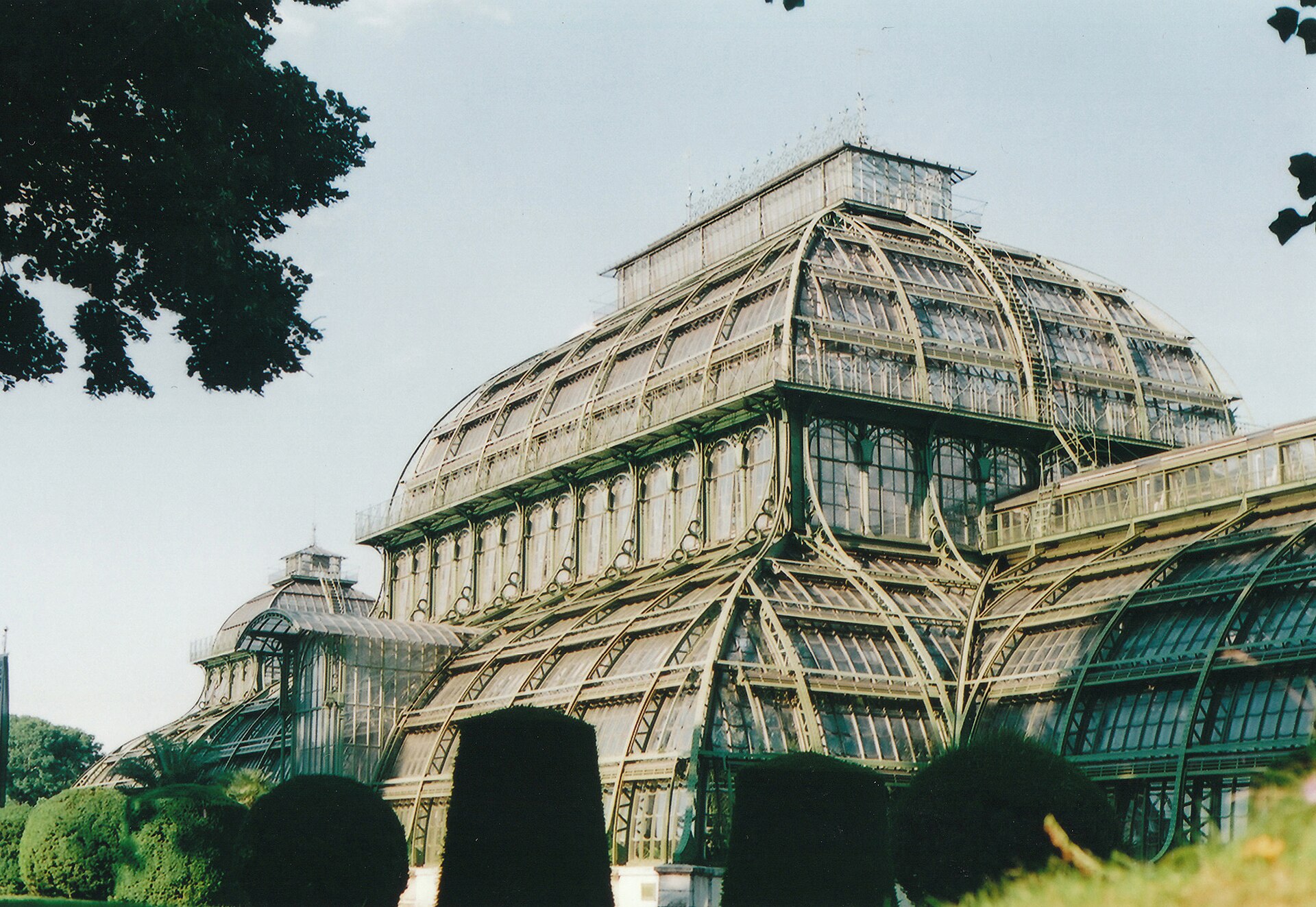
The Palm House is the most beautiful structure in the park and it is not on most itineraries. Built in 1881–82, it is an iron-and-glass cathedral 113 metres long in three linked pavilions, each held at a different climate — cold, temperate and tropical — so you walk from a cool pavilion into rainforest humidity without leaving the building. The ironwork alone is worth the ticket, and on a cold Vienna afternoon the tropical pavilion is the warmest, wettest, strangest room in the city.
Next to it, the Desert Experience House occupies the old Sundial House and does the opposite: succulents, arid-zone planting and a small population of desert animals. It is a quick visit and pairs naturally with the Palm House.
Both are open year-round and both are ticketed separately from the Exclusive Gardens bundle. If you are also doing the zoo, the combination tickets are the way in — the Tiergarten Schönbrunn guide has the current bundle prices, and the zoo-plus-glasshouses combination is meaningfully cheaper than buying the three separately.
The Orangery, the Roman Ruin and the Quiet Corners
The Orangery along the eastern edge is one of the world’s largest baroque orangeries, 189 metres long, built to overwinter citrus trees and later the setting for court festivities, including banquets arranged by Joseph II. It is also where, in 1786, Mozart and Salieri were set against each other in a one-evening composing contest staged for the court — a piece of history that the Amadeus version of events has thoroughly mangled, and which the building itself says nothing about.
Elsewhere in the park, largely ignored:
- The Roman Ruin (1778) — a deliberately built fake ruin in a pond, half-sunk and moss-covered, which is exactly the sort of thing the 18th century thought was profound. It is genuinely atmospheric in fog.
- The Obelisk Fountain — at the end of the eastern diagonal avenue, with an obelisk on the backs of four stone turtles, crowned by a golden sphere and an eagle.
- The Japanese Garden — small, tucked behind the Palm House, laid out in 1913 and restored in the 1990s. Ten minutes and a bench.
- The Kronprinzengarten (Privy Garden) — the formal enclosed garden beside the palace’s east wing, part of the €16 ticket, and pleasant rather than essential.
- The western woods — beyond the formal axis the park turns into ordinary woodland with running tracks and dog walkers, and it is where the people who actually live in Hietzing and Meidling use it.
Which Gate, and Getting There
- U4 Schönbrunn → the main gate (Haupttor). The obvious approach, straight up the axis.
- U4 Hietzing → Hietzinger Tor, on the western side. Closer to the zoo, the Palm House and the Desert House, and a far calmer entrance.
- Meidlinger Tor, on the eastern side, is the local entrance and puts you near the Orangery.
- Tram 10 or 60 to Schloss Schönbrunn, or to Hietzing, which also gives access to the park.
- Bus 10A stops at Schloss Schönbrunn, and bus 58A serves the Hietzing side.
The strategic move: enter at Hietzing, walk east through the woods and up to the Gloriette, come down the axis with the palace in front of you, and leave by the main gate. You get the best view as an arrival rather than a departure, and you walk against the crowd flow the entire way. Ticketing and route detail for the U4 is in our Vienna U-Bahn guide.
The Gardens by Season
| Season | What it looks like | Verdict |
|---|---|---|
| March–April | Bulbs, bare limes, the seasonal gardens reopening late March | Cold light, very few people, excellent |
| May–June | Full bedding, 21:00 closing | May is our favourite |
| July–August | Peak colour, peak crowds, peak heat on the exposed parterre | Go at 07:00 or at 19:00, not at noon |
| September–October | Lime avenues turning yellow, low sun down the axis | The photographer’s season |
| November–February | Seasonal gardens closed, park empty, occasional snow | Atmospheric and completely free |

Winter deserves a specific word. From November the four paid gardens are shut, which sounds like a reason to stay away and is the opposite. The park itself stays open and free, the avenues are empty, and the Christmas market on the palace forecourt runs from early November right through to early January — see our Schönbrunn Christmas market guide for dates and what it is actually like. A cold, bright January morning on the Great Parterre with nobody in it is one of the better free experiences in Europe, and our Vienna in winter guide has more in the same spirit.
Photographing the Gardens
Three shots, in order of how much better they are than everyone else’s:
- From the Gloriette hilltop, early. Palace, parterre and fountain stacked down the axis with the city behind. Go at opening.
- From the palace terrace looking up. The reverse shot, and the one that shows the bedding pattern. Best in late afternoon when the light comes from behind you.
- The side avenues. Arched lime trees, gravel, deep shade, nobody in them. The most Viennese photograph in the park and the one nobody takes.
Sunrise in early summer is around 05:00, which is before the gates open, so the park’s 06:30 opening is the practical limit for early light. More locations in our Vienna photography spots guide.
A Two-Hour Walking Route
If you have a morning and no ticket, this is the circuit we would walk. It covers everything free, involves one climb, and ends where the trams are.
- Start at Hietzinger Tor (U4 Hietzing). Straight in, turn left, and walk east along the tree-lined path rather than heading for the palace. You are already past the crowd.
- Palm House and Japanese Garden — ten minutes. Look at the glasshouse from outside even if you are not going in; the ironwork reads better from the lawn than from within.
- Cut south into the woods and pick up the curving path that climbs to the ridge. Twenty minutes, shaded, gentle, and almost empty.
- The Gloriette. Come out of the trees onto the hilltop and turn round. This is the view. Give it fifteen minutes and a bench.
- Down the direct path to the Neptune Fountain — five minutes, steeper, with the palace growing in front of you the whole way.
- Behind the fountain, through the arch under the rockwork, then west to the Schöner Brunnen pavilion. Five minutes, and you will be almost alone.
- The Roman Ruin and the Obelisk Fountain — fifteen minutes east along the back of the park, on paths that see a fraction of the traffic the axis does.
- Return down the Great Parterre to the palace and out through the main gate to U4 Schönbrunn.
Two hours at a walking pace, two and a half if you stop properly. Add an hour if you are doing the Maze, and half a day if you are adding the zoo — the practicalities of combining them are in our things to do in Vienna guide.
How the Park Came to Be
There was a hunting lodge here in the 16th century, wrecked during the Turkish siege of 1683. What replaced it was meant to be enormous — Johann Bernhard Fischer von Erlach’s first design put a palace on the hilltop where the Gloriette now stands, on a scale intended to answer Versailles. Fischer von Erlach’s grander first design was never built; a smaller palace went up at the bottom of the slope instead.
The park as you walk it is essentially Maria Theresa’s. From the mid-18th century the grounds were redesigned in the French formal manner — the axis, the parterre, the hedge walls, the statues, the fountains — and finished off in the 1770s with the Gloriette on the ridge as the visual full stop. The empty hilltop that had been meant for a palace got a building with no purpose except to be looked at, which is arguably a better outcome.
The park was opened to the public in the 1770s, well before the monarchy ended, and it has functioned as an ordinary Viennese park ever since. That is the thing to hold onto as you walk it: this is not a preserved royal enclosure that tourists are admitted to. It is the local park for Hietzing and Meidling, with joggers, prams and dog walkers in it, that happens to have a Habsburg palace at one end. The wider family story is in our Habsburg dynasty guide.
Practicalities in the Park
- Food and drink inside the park is limited and priced accordingly — the Gloriette café, a few kiosks, and the restaurants clustered near the main gate. Bring water in summer; the parterre has no shade at all.
- Toilets are near the main gate, by the Gloriette and at the zoo entrance, and there is a charge at some of them. Plan around it, because the park is large.
- Dogs are allowed on leads in the park but not in the ticketed gardens or the glasshouses.
- Cycling is not permitted on the main paths, though the park sits on good cycle routes — see our Vienna cycling guide for the approach.
- Benches are plentiful along the avenues and scarce on the parterre and the climb. The best ones are on the ridge either side of the Gloriette.
- Surfaces are gravel throughout, which is hard work with a buggy on the slope and fine everywhere flat.
- The Imperial Carriage Museum sits in the old winter riding school near the main gate, is open year-round and is separately ticketed — worth knowing if the weather turns while you are here.
Our Honest Verdict
The gardens are better than the palace. That is not a provocation; it is what most people conclude by the end of the day and are slightly embarrassed to say out loud. The palace interior is 45 rooms of Habsburg furniture behind ropes, visited on a timed Palace Ticket at €42. The gardens are one of Europe’s great baroque landscapes, 1.2 km from east to west, open from 06:30 to 21:00 in summer, free, with no slot to book and nobody moving you along.
On the €16 Exclusive Gardens ticket, our verdict splits cleanly:
- With children: buy it. The Maze and Labyrinth alone justify it, and the €11 child rate is fair.
- Without children, on a clear day: marginal. The Gloriette terrace is nice. It is not €16 nicer than the free hilltop ten metres away.
- Without children, on a grey day, or outside late March to early November: don’t. You would be paying for two formal gardens and a staircase.
What is genuinely underrated and separately ticketed is the Palm House, which more people should visit and almost nobody photographs. What is overrated is the Gloriette café. And what costs nothing at all and beats both is arriving at half past six in the morning, walking up the side avenue in the cold, and having the whole thing to yourself for an hour. Our Vienna on a budget and free things to do guides are built on exactly this kind of arithmetic.
Frequently Asked Questions
Are the Schönbrunn gardens free?
Yes. The palace park, the Great Parterre, the avenues, the Neptune Fountain, the Roman Ruin, the Japanese Garden and the walk up to the Gloriette are all free, every day of the year, from 06:30. Four garden attractions are ticketed: the Maze, the Gloriette roof terrace, the Privy Garden and the Orangery Garden, at €16 for adults, and only between late March and early November. The Palm House, the Desert House and the zoo also charge admission.
Do you have to pay to go up to the Gloriette?
No — the walk up the hill and the hilltop in front of the Gloriette are free, and that is where the famous view is. Only the viewing terrace on the roof, reached by an internal staircase, is part of the €16 ticket. The extra height is modest.
How long does it take to walk to the Gloriette?
Fifteen to twenty minutes from the Neptune Fountain, on gravel, climbing about sixty metres. Take the curving side path up, which is gentler and shaded, and the direct path down.
What are the Schönbrunn park opening hours?
The park opens at 06:30 daily and closes with the light: 17:30 in January, February, November and December; 19:00 in March and October; 20:00 in April and September; and 21:00 from May to August.
When is the Schönbrunn Maze open?
From 27 March to 2 November 2026, from 09:30, closing at 16:00 at each end of the season, 17:30 in spring and early autumn and 18:30 in July and August. Children of 14 and under must be accompanied by an adult.
Is the Exclusive Gardens ticket worth it?
With children, yes — the Maze and Labyrinth are the best part of the park for them. Without children it is marginal, because the Gloriette’s free hilltop view is nearly as good as the paid terrace and the two formal gardens are pleasant rather than remarkable.
Can you visit the gardens without visiting the palace?
Absolutely, and a great many people should. The palace needs a timed €42 ticket, and booking online in advance is strongly recommended; the main park needs no ticket at all. Walking the park and skipping the interior is a completely legitimate way to do Schönbrunn.
Which U-Bahn station is best for Schönbrunn gardens?
U4 Schönbrunn for the main gate and the classic approach up the axis. U4 Hietzing for the western side, which is closer to the zoo, the Palm House and the Desert House, and considerably quieter.
Are the gardens open in winter?
Yes, every day from 06:30, though in 2026 the four seasonal enclosures close after 2 November and reopen in the spring. Winter is the emptiest and arguably the most atmospheric time to walk the park, and the Christmas market runs on the palace forecourt from early November.
Related Vienna Guides
- Schönbrunn Palace: Tickets, Tours and What to See
- Tiergarten Schönbrunn: The World’s Oldest Zoo
- Vienna’s Parks and Gardens
- Free Things to Do in Vienna
- The Schönbrunn Christmas Market
- The Best Photography Spots in Vienna
- Where to Stay Near Schönbrunn
- Baroque Vienna: An Architecture Guide
- Romantic Vienna: A Guide for Couples
- Vienna Attractions: The Complete List
Photo Credits
Neptune Fountain in snow: 2018-12-02 AT Wien 13 Hietzing, Schlosspark Schönbrunn, Neptunbrunnen by Paul Korecky, CC BY-SA 2.0, via Wikimedia Commons.
The Palm House: 2002-07-Wien-Schoenbrunn-Palmenhaus-1 by Gunnar Klack, CC BY-SA 4.0, via Wikimedia Commons.
The Great Parterre and Gloriette: Wien Schlosspark Schönbrunn und Gloriette – panoramio by Nikolai Karaneschev, CC BY 3.0, via Wikimedia Commons.