Naturhistorisches Museum Wien: Venus of Willendorf, Dinosaurs & Dome Tours
Around thirty million objects in thirty-nine halls, some of them newly renovated — the Venus of Willendorf, a world-class meteorite collection, and free entry for everyone under 19.

Photo by Magda Ehlers
- Tickets, Prices and Opening Hours 2026
- What Is Actually Here
- The Roof Tour: The Best Thing Nobody Books
- A Suggested Route Through the Halls
- The Building and Where the Collection Came From
- Naturhistorisches or Kunsthistorisches?
- Getting There and Practicalities
- What’s Around the Museum
- Temporary Exhibitions and Special Programming
- Our Honest Verdict
- Frequently Asked Questions
- Related Vienna Guides
- Photo Credits
This article contains advertising. Our booking links are routed through a partner that adds commission tracking automatically, so if you book through one we earn a commission from the provider, at no extra cost to you. It never affects what we recommend. Affiliate disclosure
In the prehistory section on the museum’s lower exhibition level there is a small room of its own, the Venus Cabinet, with one object in it, eleven centimetres high. People walk past it. Then somebody reads the label, stops, and the whole family reverses. The Natural History Museum Vienna holds around thirty million objects across thirty-nine halls, and the one everybody comes for is a limestone figurine the size of a thumb that somebody carved roughly thirty thousand years ago and left in the mud of the Wachau. Admission is €18. Everyone under nineteen gets in free.
This guide covers 2026 prices and the free-for-under-19s policy that makes this the best family museum in the city, the Tuesday closure and the late Wednesday opening, what is in which hall, the roof tour almost nobody books, how it compares with the identical building across the square, and our honest verdict on a museum that is partly a museum of what museums used to be. Prices and hours were checked on the NHM’s own website in September 2026; confirm before you travel. Halls 31 and 32 are closed for renovation, while halls 29 and 30 have reopened.

Tickets, Prices and Opening Hours 2026
| Ticket | Price | Notes |
|---|---|---|
| Adult | €18.00 | Standard admission |
| Reduced | €14.00 | Concession categories vary; ask at the desk |
| Under 19 | Free | Groups must register in advance |
| Annual pass | €44.00 | Pays back on the third visit |
| Roof tour (Dachführung) | €12.00 | Rising to €15 from 1 September 2026; entry ticket also required |
Free for everyone under nineteen is the headline and it changes the arithmetic of a family trip to Vienna completely. Two adults and three teenagers walk into a thirty-million-object natural history museum for €36. There is nothing else in this city at that price, and the museum is one of the two or three best things to do with children here regardless of cost — our Vienna with kids guide puts it near the top for exactly this reason.
Opening hours
- Thursday to Monday: 09:00–18:00
- Wednesday: 09:00–20:00 — the late night, and the best time to come
- Tuesday: closed
Wednesday evening is the move. The museum stays open until 20:00, and after dark the Victorian galleries are lit artificially, which is an atmosphere the daytime cannot give you. If your schedule has any flexibility at all, put this on a Wednesday.
The Tuesday closure is shared with the Leopold Museum and several others, and it is the single most common cause of a wasted morning in Vienna. Write the closed days into your itinerary before you book anything — our best museums in Vienna guide lists them together.
What Is Actually Here
Thirty-nine halls over two main levels. The lower one takes you through minerals and meteorites, then fossils and dinosaurs, then prehistory and anthropology; the zoological halls — invertebrates, fish, reptiles, birds, mammals — fill the level above.
Two and a half hours is a sensible visit. Four hours is a thorough one. You cannot do it in ninety minutes and should not try.
The Venus of Willendorf
The Venus Cabinet beside Hall 11, on the lower exhibition level, is hers alone. She is eleven centimetres of oolitic limestone, carved about 29,500 years ago and found in 1908 at Willendorf in the Wachau valley.
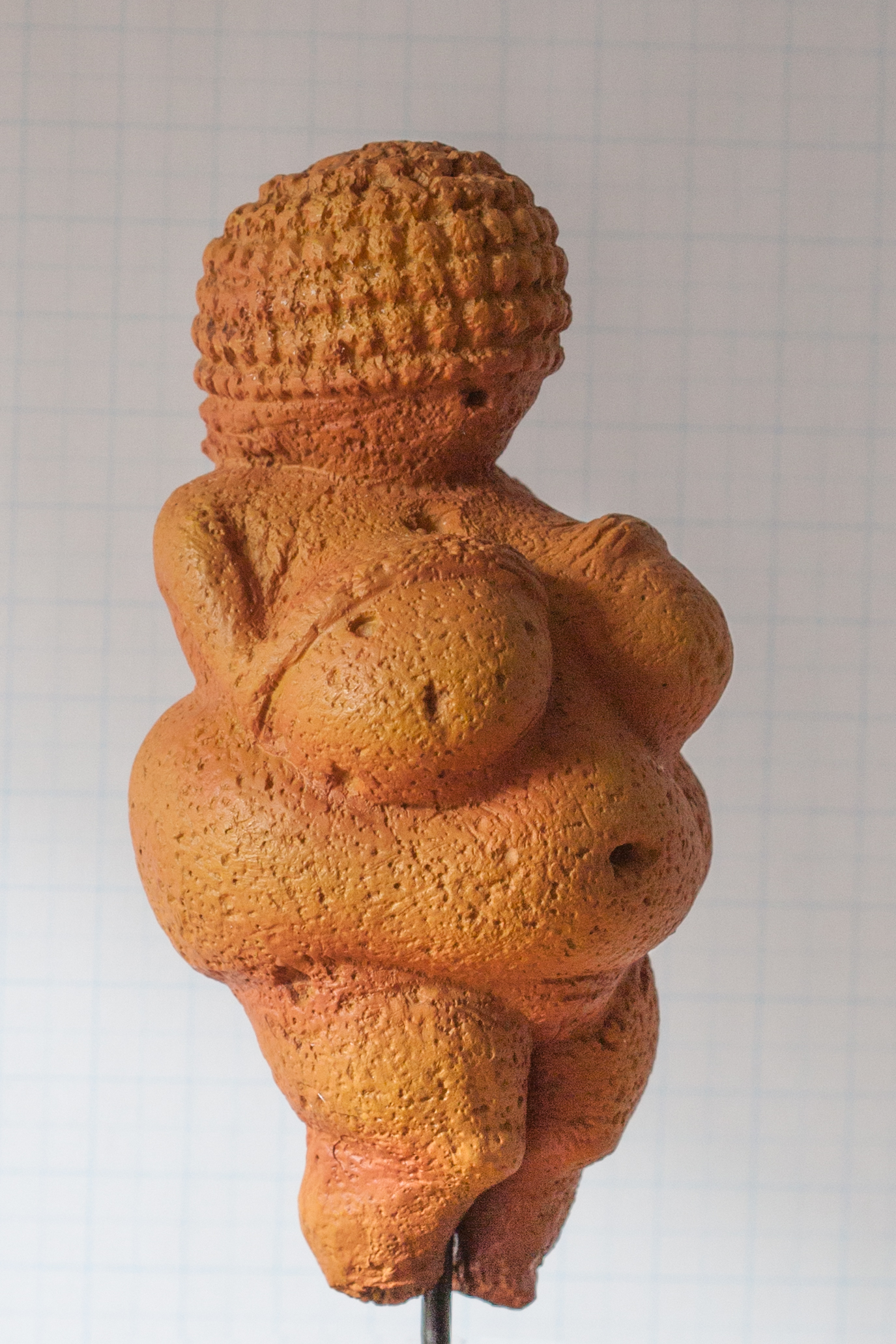
The details that get you are the small ones. The limestone she is carved from does not occur at Willendorf, so somebody carried either the stone or the finished object a long distance. There are traces of red ochre on her surface. She has no face — the head is entirely covered in a patterned surface that might be braided hair, might be a woven cap, and has been argued about for a hundred years. Whoever made her was as modern as you are, and thirty thousand years is roughly twelve hundred generations.
Nearby, and almost always overlooked, is the Venus of Galgenberg — nicknamed Fanny — a smaller, older, dancing figure found in Lower Austria in 1988 and dated several thousand years earlier still. She is the better piece of sculpture. Nobody stops.
Both came out of the Danube valley upstream of Vienna, which is worth knowing if you are planning a Wachau day trip — you can stand at Willendorf itself, where there is a small museum and a marker at the find site.
The meteorite hall
One of the largest and oldest meteorite collections on public display anywhere, and the hall it lives in was rebuilt in the last fifteen years, so it is the one part of the museum that looks contemporary. There is a piece of Mars in it. There is a piece of the Moon. There are irons the size of an armchair that fell out of the sky onto somebody’s field and were dragged to Vienna by cart in the 1700s.
Hold a hand near the Martian meteorite case and do the arithmetic on how it got here: blasted off a planet by an impact, in solar orbit for some millions of years, through the atmosphere, onto the Moroccan desert, into a display case on the Ringstraße. The hall does not oversell this and does not need to.
Dinosaurs and the fossil halls
The dinosaur hall is where every child in the building ends up. There are mounted skeletons and casts, an animatronic allosaurus that moves and roars on a timer and reliably terrifies a percentage of under-fives, and a good deal of Austrian and central European material that you will not see elsewhere.
The fossil halls either side are more rewarding for adults — the ammonites, the fish in slabs of Solnhofen limestone, the sequence of horse skeletons showing forty million years of leg. It is old-fashioned comparative display and it works.
Prehistory: the Hallstatt material
The museum’s prehistoric collection is one of the most important in Europe. Hallstatt is the name to know: the village gave its name to the Hallstatt culture, the archaeological culture of the Early Iron Age.
It is a quieter hall than the dinosaurs and it is the one we would send a curious adult to first.
The zoological halls, and what they really are
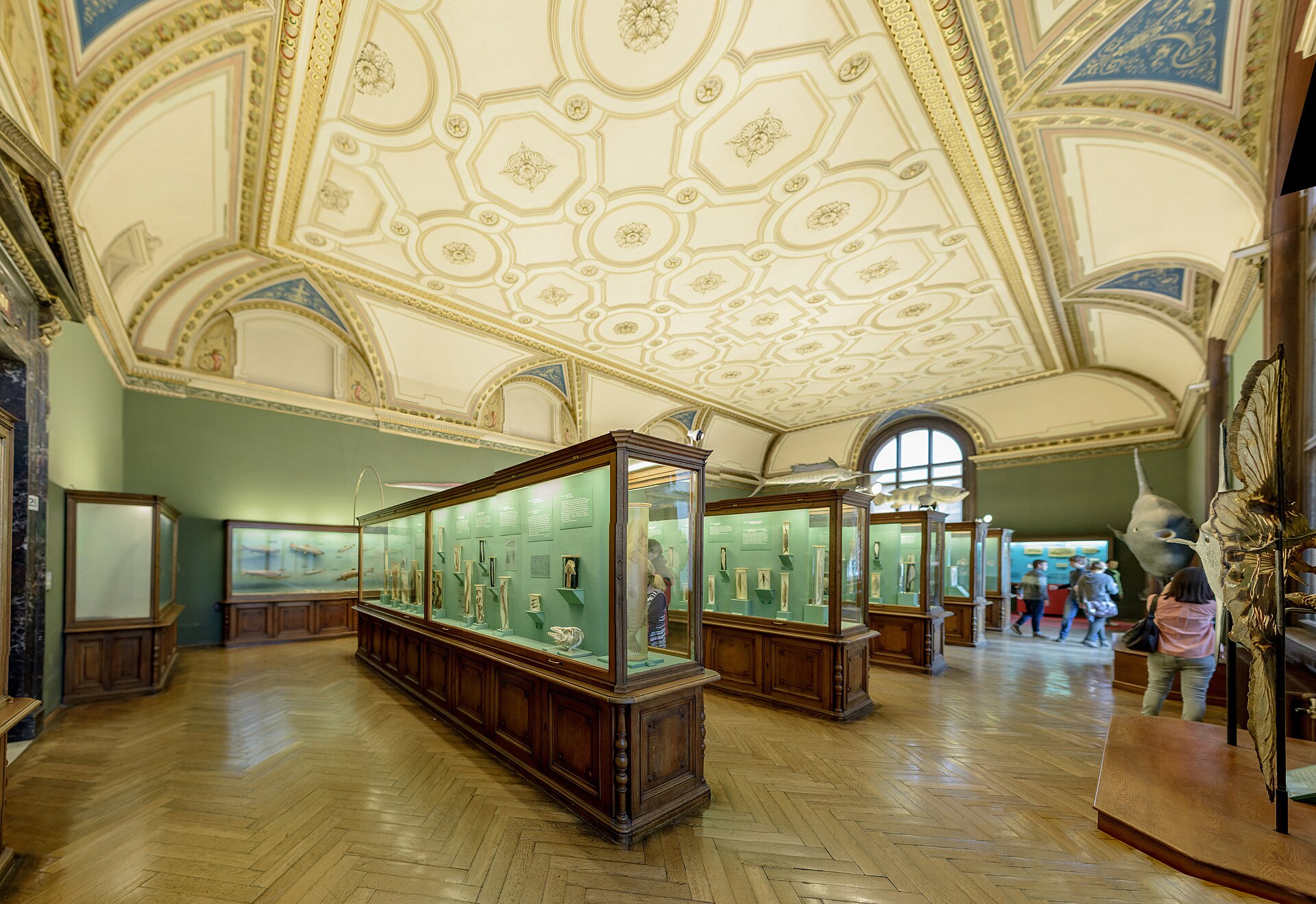
Upstairs and round the back are rooms of taxidermy in wooden cases: birds arranged by family, mammals by continent, cabinets of shells and beetles and pinned butterflies laid out with Victorian thoroughness. Some of the mounts are a century and a half old. Some of the animals in them no longer exist anywhere.
Modern natural history museums do not display like this any more, and the NHM’s decision not to modernise most of these halls is the most interesting thing about the institution. You are looking at two exhibits simultaneously: the specimens, and the nineteenth-century idea of knowledge that arranged them. The painted ceilings, the gilded cornices, the brass fittings on the cabinets — all of it is saying something about empire, classification and confidence, and none of it is saying it quietly.
Whether you find that thrilling or slightly melancholy depends on the day. It is not neutral, and the museum increasingly acknowledges as much in its newer labelling.
Deck 50 and the Digital Planetarium
Two modern additions. Deck 50 is a science-communication space up on Level 3, with a laboratory, a performance stage and hands-on activities that visitors can join in. The Digital Planetarium upstairs puts on full-dome shows through the day — astronomy, deep time, the occasional children’s programme — and requires a separate ticket on top of admission.
Show times and planetarium prices change constantly, so check the museum’s own programme page on the day rather than trusting anything, including this page, written in advance.
The Roof Tour: The Best Thing Nobody Books
The Dachführung takes you out onto the roof of the museum, between the sculptures, at the height of the Ringstraße’s skyline, with the Hofburg on one side and the MuseumsQuartier on the other. It has its own ticket, booked on top of your entry ticket.
Conditions, and they are firm ones:
- Minimum age 12. No exceptions.
- Not barrier-free — there are stairs and roof surfaces, and the museum is explicit about this.
- You need a valid admission ticket as well as the tour ticket.
- It runs on a schedule and books out, particularly in summer. Reserve online before you arrive.
On top of the €18 admission, the tour gets you a rooftop view of central Vienna from a building most people only ever see from below, with a guide. Compared with paying for an observation deck somewhere else in the city, it is very good value, and it is the single most underbooked thing in this building.
The mineral and gemstone halls
The first rooms you walk into, and the ones most visitors hurry through on the way to the dinosaurs. Slow down. The cases are full of things that look invented, and in Hall 4 a showcase holds minerals that glow under ultraviolet light.
The object to find is the gemstone bouquet — an artificial flower arrangement made in the mid-18th century from a few thousand diamonds and coloured stones, set in silk and wire, given by Maria Theresa to her husband Franz Stephan. It is simultaneously exquisite and completely absurd, which is a reasonable summary of the Habsburg court, and it sits in a case that people walk past because they are looking for rocks.
There is also, in the same section, a substantial display on Austrian geology — the Alps as a slow-motion collision, with the rock samples to prove it. If you are heading for the mountains later in your trip, twenty minutes here is a surprisingly good briefing.
A Suggested Route Through the Halls
Thirty-nine halls in a building designed for a slower century is a lot to absorb, and the numbering does not run in a straight line. This is the order we would take them in.
- Minerals and gems (ground floor, first rooms) — 30 minutes. Do them properly while you are fresh, including the fluorescent minerals in the Hall 4 showcase and the gemstone bouquet.
- Meteorites — 20 minutes. The rebuilt hall, and the best-presented part of the building.
- Fossils and dinosaurs — 30 minutes, or an hour if there are children with you, because there is no such thing as a quick visit to a room with an animatronic allosaurus in it.
- Stay on the lower level for prehistory — 30 minutes. Venus of Willendorf, the Galgenberg figure and the Hallstatt material together. This is the intellectual core of the museum.
- Anthropology — 15 minutes, and read the newer labels, which are noticeably more careful than the old ones.
- Zoological halls — 30 minutes for a good walk through, longer if the cabinets grab you. Do them last; they are the part where fatigue does least damage.
That is roughly three hours including the coffee, and it leaves you having seen everything that matters. If you only have ninety minutes: minerals, meteorites, prehistory, out. Skip the dinosaurs unless children are involved, because they are the one part of this museum you can see done better elsewhere.
The Building and Where the Collection Came From
The museum exists because Franz Stephan of Lorraine, Maria Theresa’s husband, bought Jean de Baillou’s collection of about 30,000 natural-history objects in 1750. That collection — fossils, shells, minerals, corals, curiosities — is the seed of everything here, and some of the objects in the cases have been in Habsburg hands for nearly three centuries.
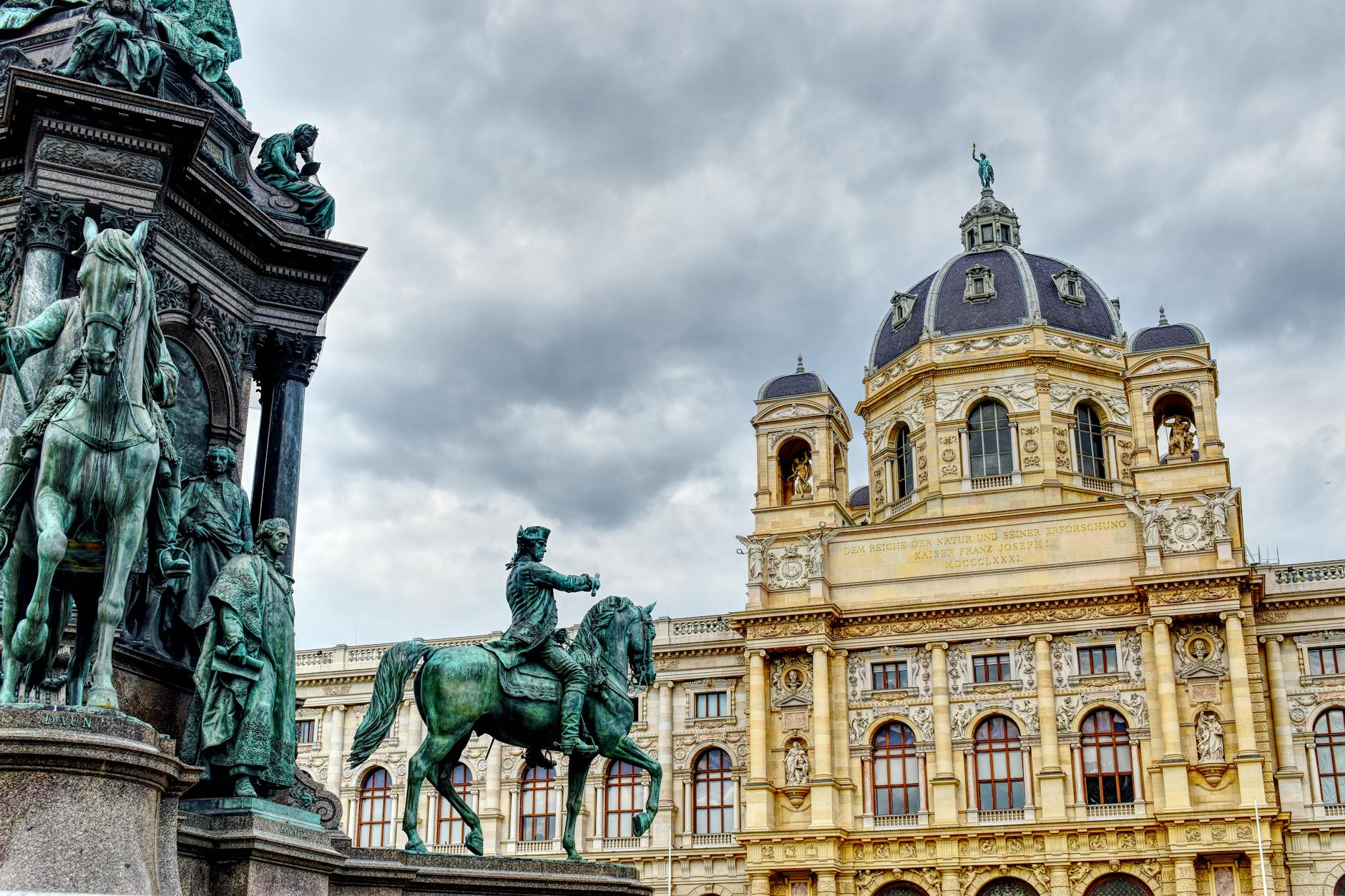
By the mid-19th century the imperial collections had outgrown the palace, and the Ringstraße project provided the answer. Gottfried Semper, the German architect whose earlier Dresden work included the first court theatre and the picture gallery, drew up the scheme with Carl Hasenauer as part of a planned Imperial Forum: two matching museums facing each other across a formal square, with a monument to Maria Theresa between them, closing the gap between the Hofburg and the new boulevard. The Naturhistorisches opened to the public in 1889.
Look at the outside before you go in. The facade carries statues and reliefs of naturalists, explorers and personifications of the sciences, and the whole programme is an argument: that the natural world can be collected, ordered and understood, and that the empire is the institution to do it. The dome, the allegories, the inscription over the door — none of it is decoration. It is a thesis in stone, and the building has aged into something more complicated than its builders intended.
The NHM is also, still, a working research institution with departments and scientists behind the public halls, which is part of why the displays have not been swept away and replaced with screens. The specimens are not props. They are a collection that people are still using.
Naturhistorisches or Kunsthistorisches?
From outside they are mirror images, facing each other across Maria-Theresien-Platz, designed by Semper and Hasenauer as a matched pair of imperial collections — nature on one side, art on the other. The Naturhistorisches opened in 1889, the Kunsthistorisches two years later in 1891. The symmetry is the point, and standing in the middle of the square between them is one of the better free experiences in Vienna.
| Naturhistorisches | Kunsthistorisches | |
|---|---|---|
| Adult ticket | €18 | Check current rate |
| Under 19 | Free | Free |
| Closed | Tuesday | Varies by season |
| Late opening | Wednesday to 20:00 | One evening weekly |
| The draw | Venus of Willendorf, meteorites, Hallstatt, dinosaurs | Bruegel, Vermeer, Caravaggio, the Kunstkammer |
| With children | Far better | Hard work under about ten |
| Time needed | 2½ hours | 3 hours minimum |
Do not attempt both in one day. People try and it is a mistake — five hours of dense display in matching buildings produces a specific kind of exhaustion where nothing registers after lunch. If you are choosing: children, geology or deep time, come here; paintings, come to the Kunsthistorisches. Both buildings are landmarks of the Ringstraße project, and our Ringstraße guide explains why the two were built as a matched pair at all.
Getting There and Practicalities
Maria-Theresien-Platz, 1010 Wien — on the Ring, between the Hofburg and the MuseumsQuartier.
- U2 or U3 Volkstheater is the closest station, about three minutes away.
- U2 Museumsquartier is equally close from the other side.
- Trams 1, 2, 71, D and 46/49 all stop at Ring, Volkstheater within a few minutes’ walk, and trams 1, 2, D and 71 also serve Burgring.
- Bus 48A to Volkstheater.
Practical notes:
- The café is in the Upper Dome Hall, with high ceilings and good light, and you do not need to rush past it.
- Cloakroom and lockers are by the entrance and backpacks must go in them.
- Photography without flash is generally fine in the permanent halls.
- Accessibility: the main halls are served by lifts, but the roof tour is explicitly not barrier-free.
- Halls 31 and 32 are closed for renovation and halls 29 and 30 have reopened — an ongoing programme, so check what is open if a specific hall is your reason for coming.
- Rain: this is a two-and-a-half hour indoor building three minutes from three U-Bahn lines, which puts it near the top of our rainy day guide.
What’s Around the Museum
Maria-Theresien-Platz is one of the best-placed squares in Vienna, which means you can build a day around this museum without ever getting on a tram.
- The MuseumsQuartier is directly across the Ring through the arch — the Leopold, mumok, the Kunsthalle and a courtyard full of free seating. Ten minutes on foot. See our MuseumsQuartier guide.
- Heldenplatz and the Hofburg are five minutes the other way, across the Burgring and through the Burgtor.
- The Volksgarten, with its rose beds and its Theseus temple, is two minutes north and free.
- Spittelberg, the cobbled lanes behind the MuseumsQuartier, is the best place within ten minutes to eat something that is not a museum sandwich.
- The Ring trams stop outside, and riding lines 1 and 2 along their stretches of the Ring on an ordinary transport ticket is the cheapest sightseeing in the city, though neither runs a full circuit — the routes are in our Vienna tram guide.
The square itself is worth ten minutes before you go in. The Maria Theresa monument in the middle is enormous, the two museums are identical down to the placement of the windows, and standing on the axis between them with the Hofburg behind you is the single clearest view of what the Ringstraße was trying to achieve. It is free, and it takes about as long as reading this paragraph twice.
Temporary Exhibitions and Special Programming
Alongside the permanent halls the NHM runs temporary exhibitions — typically one large show at a time, often on climate, biodiversity or a specific research project the museum’s own scientists are involved in. Whether a show is covered by the standard ticket varies, so look at the exhibition’s own page before you go.
The museum also runs evening events, behind-the-scenes tours into the collection stores, and a long-running series of talks. Most of it is in German, some of it is bilingual, and all of it is listed on the museum’s own events calendar. If you are in Vienna for more than a few days and the subject appeals, it is worth a look — a tour of the collection stores at a working research museum is a very different experience from walking the public halls, and the tickets are not expensive.
Our Honest Verdict
The Naturhistorisches is the most underrated big museum in Vienna, and the reason is that people compare it to natural history museums in other cities and find it old-fashioned. It is old-fashioned. That is the point. London and Berlin have rebuilt their displays for a modern audience; Vienna has largely left an 1889 museum standing, and walking through it is an experience you cannot have in many places any more.
The Venus of Willendorf alone justifies the ticket. The meteorite hall is world class. The Hallstatt material is quietly one of the most important archaeological collections in Europe. And the whole thing is free for everyone under nineteen, which makes it the single best value in the city for families and is not advertised nearly loudly enough.
What is not worth it: trying to pair it with the Kunsthistorisches in one day, and arriving at 11:00 on a Saturday in July, when the dinosaur hall is a scrum. What is worth it: the roof tour, and coming on a Wednesday evening, when the museum stays open until 20:00 and the Victorian galleries are under lamplight.
Frequently Asked Questions
How much does the Natural History Museum Vienna cost?
€18 for adults, €14 reduced, and free for everyone under 19 — groups of under-19s need to register in advance. An annual pass is €44. The roof tour is ticketed separately and requires an admission ticket as well.
When is the Naturhistorisches Museum closed?
Every Tuesday. It opens 09:00 to 18:00 Thursday to Monday, and 09:00 to 20:00 on Wednesdays. The Wednesday late opening is the quietest time to visit.
Where is the Venus of Willendorf?
In the Venus Cabinet beside Hall 11, part of the prehistory section on the lower exhibition level (the Hochparterre). She is eleven centimetres tall, carved in oolitic limestone around thirty thousand years ago, and found at Willendorf in the Wachau in 1908.
How long do you need at the Natural History Museum Vienna?
Two and a half hours for a sensible visit across all thirty-nine halls, four hours if you read the cases properly. Ninety minutes is not enough and leaves you skipping entire floors.
Is the Natural History Museum good for children?
It is one of the best things to do in Vienna with children, and everyone under 19 gets in free. The dinosaur hall with its animatronic allosaurus is the obvious draw, and Deck 50, upstairs on Level 3, has hands-on science activities to join. Two adults with three children pay €36 in total.
What is the NHM roof tour?
A guided tour out onto the museum’s roof, above the Ringstraße, with its own ticket on top of admission. Minimum age 12, not barrier-free, and it runs on a fixed schedule, so reserve online.
Is the Natural History Museum the same as the Kunsthistorisches?
No — they are two separate museums in two matching buildings facing each other across Maria-Theresien-Platz, built as a pair from the 1870s. One holds natural history, the other art. They need separate tickets and should not be attempted on the same day.
Do I need to book tickets in advance?
Not for general admission, which you can buy at the desk. The roof tour and planetarium shows are a different matter and do sell out, particularly in summer and at weekends, so book those online ahead of time.
Is the museum accessible?
The main exhibition halls are served by lifts and are broadly accessible. The roof tour is explicitly not barrier-free and has a minimum age of 12. Contact the museum in advance for specific requirements.
Related Vienna Guides
- Kunsthistorisches Museum: The Complete Guide
- The Best Museums in Vienna
- Vienna with Kids: The Complete Guide
- The Ringstraße: Vienna’s Grand Boulevard
- The Wachau Valley Day Trip
- The MuseumsQuartier
- What to Do in Vienna When It Rains
- Free and Cheap Museums in Vienna
- A Short History of Vienna
- Vienna Attractions: The Complete List
Photo Credits
Museum gallery interior: Naturhistorisches Museum DSC 1908 pano 33 by Henry Kellner, CC BY-SA 3.0 at, via Wikimedia Commons.
Cast of the Venus of Willendorf: Venus von Willendorf, copy-10 by photographer User:Thirunavukkarasye-Raveendran, CC0, via Wikimedia Commons.