Sacher vs Demel: Settling the Sachertorte Argument
The court case, the jam layers and the seals: how Hotel Sacher's Original Sacher-Torte and Demel's version really differ, what a slice costs, and which one to choose.
- Sacher vs Demel at a Glance
- How the Argument Started
- How the Two Cakes Actually Differ
- Eating It at Café Sacher
- Eating It at Demel
- What Else to Order
- A Taste Test in One Afternoon
- Getting There and Practical Tips
- Buying a Whole Cake to Take Home
- What About Everyone Else’s Sachertorte?
- So Which Is Better?
- How a Sachertorte Is Made
- Common Mistakes
- Sachertorte Through the Year
- Frequently Asked Questions
- Related Vienna Guides
- Photo Credits
This article contains advertising. Our booking links are routed through a partner that adds commission tracking automatically, so if you book through one we earn a commission from the provider, at no extra cost to you. It never affects what we recommend. Affiliate disclosure
Two queues form every afternoon in the old centre of Vienna, about ten minutes’ walk apart. One stands under the red awnings of the Hotel Sacher behind the State Opera. The other waits outside a gilded shopfront on the Kohlmarkt, where the lettering still announces an imperial court confectioner. Both are there for the same thing: a slice of dense chocolate cake with apricot jam and a spoonful of unsweetened whipped cream. Which of them is the real Sachertorte took the two houses the best part of a decade in the courts to settle. Settling Sacher vs Demel for yourself takes one afternoon.
This guide tells you how the argument started, what the court case decided, how the two cakes actually differ, what a slice costs and what it is like to eat one at each place, how to buy a whole cake to take home, and which one we would choose. Slice prices are based on reports from 2026 and are approximate; check the menu when you sit down.
Sacher vs Demel at a Glance
| Hotel Sacher | Demel | |
|---|---|---|
| What it is called | Original Sacher-Torte | Demel’s Sachertorte, historically the Eduard-Sacher-Torte |
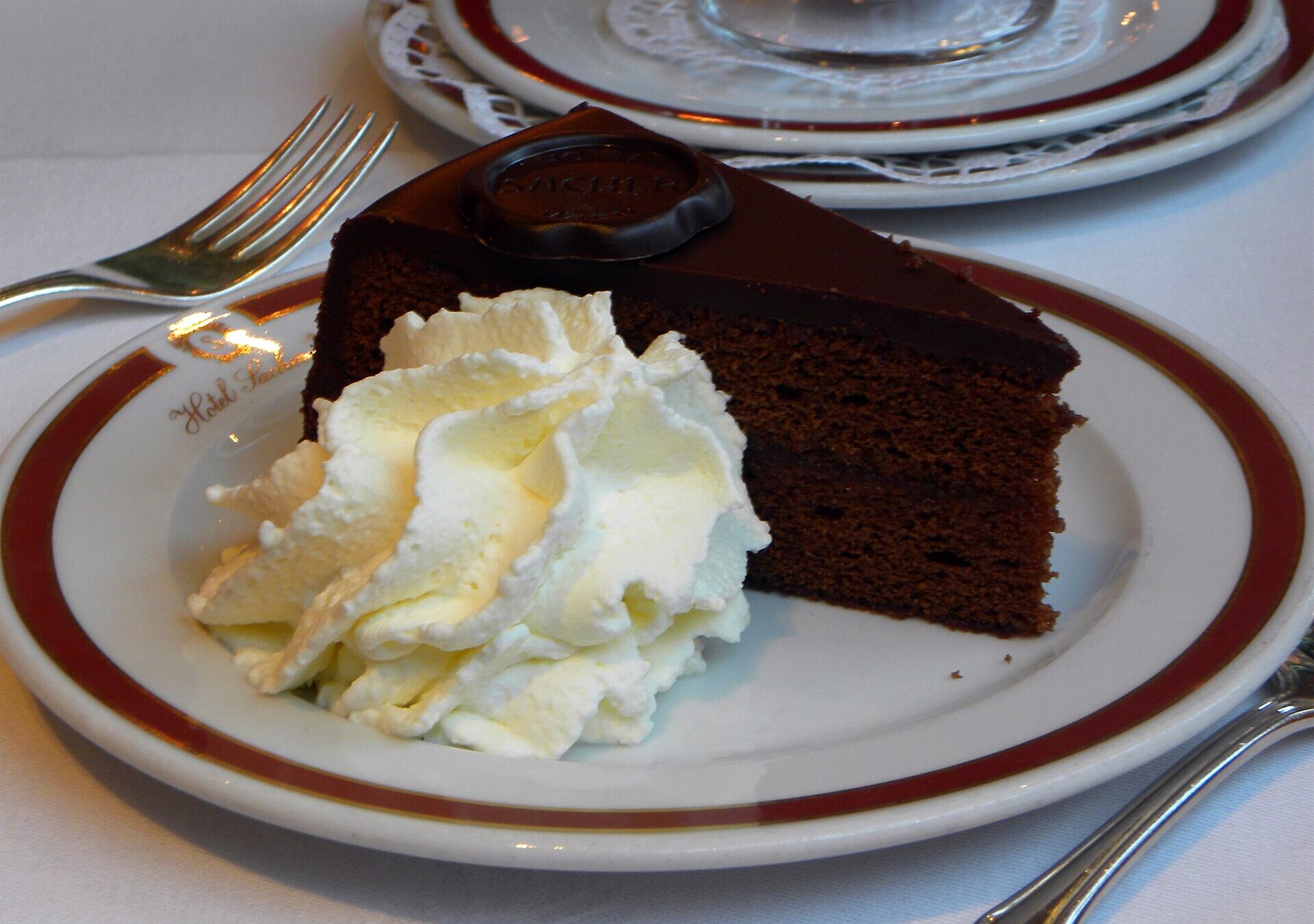
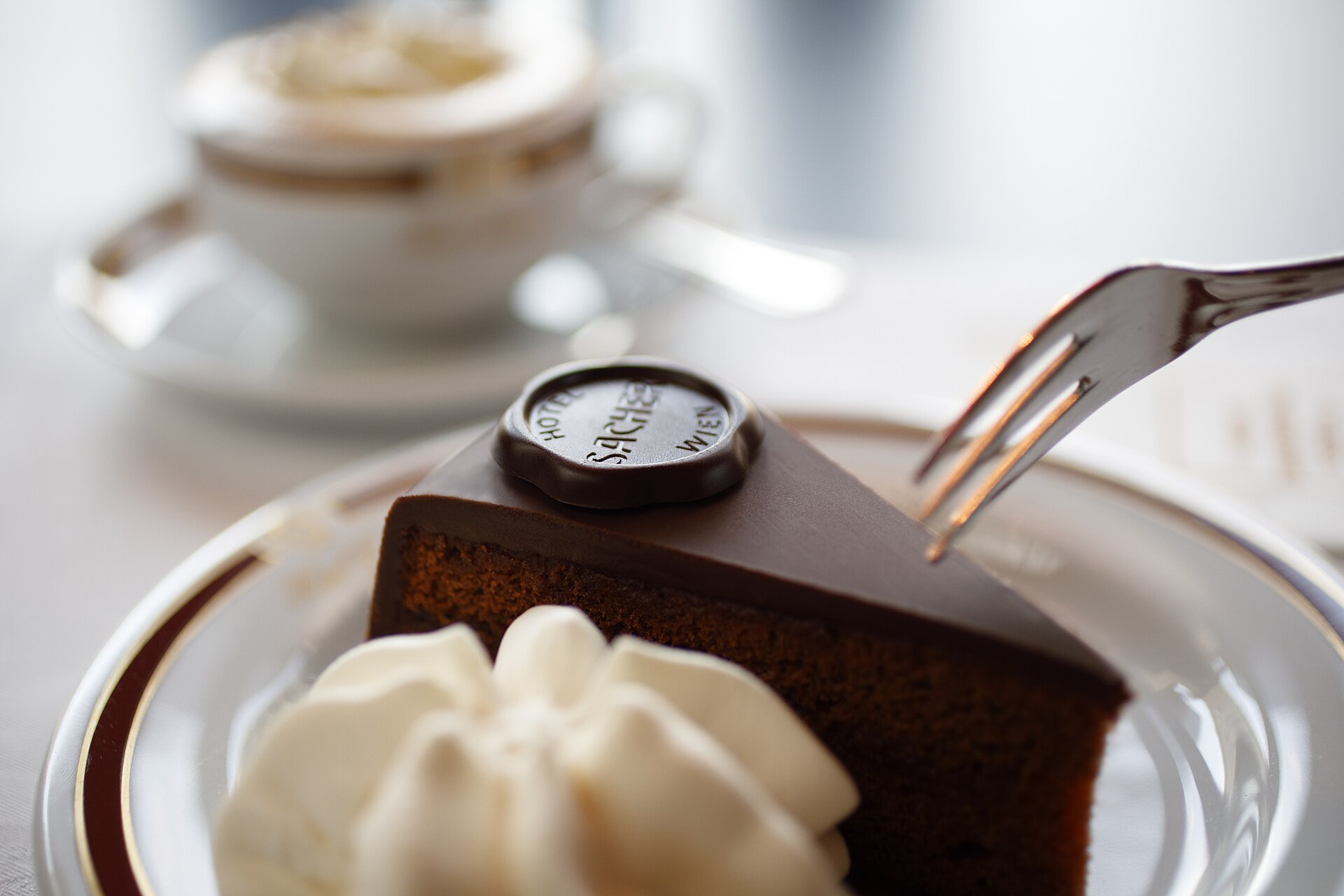
| Seal on the cake | Round chocolate seal reading “Hotel Sacher Wien” | Triangular seal |
| Apricot jam | Two layers: through the middle of the sponge and under the glaze | One layer, directly under the glaze |
| Where to eat it | Café Sacher Wien, in the Hotel Sacher behind the State Opera | Demel, Kohlmarkt 14, near the Hofburg |
| Slice in the café (approx., 2026) | About €9 | About €8 |
| The room | Red velvet, chandeliers, hotel grandeur | Mirrored confectioner’s salons, a window into the pastry kitchen |
| Other cakes | The Sachertorte is the star; a smaller range besides | A huge counter of cakes, tortes and pastries |
| Whole cakes to take away | Sacher Confiserie, and online with worldwide delivery | Demel shop on the Kohlmarkt, and online |
| Queue risk | High in the afternoon | Moderate to high in the afternoon |
How the Argument Started
1832: a sixteen-year-old apprentice
The story begins in the kitchen of Prince Klemens von Metternich, the Austrian chancellor who dominated European politics after Napoleon. In 1832, so the account goes, the prince asked for a special dessert for his guests, the head chef was ill, and the job fell to a sixteen-year-old apprentice named Franz Sacher. He produced a chocolate cake with apricot jam and a chocolate glaze. It pleased the guests, and it bore his name.
Eduard Sacher, Demel and the hotel
Franz Sacher’s son Eduard trained as a confectioner at Demel, the court confectioner on the Kohlmarkt, and is credited with refining his father’s recipe into the cake we know. In 1876 Eduard opened the Hotel Sacher behind the Opera, and the cake became its signature. Under his widow, the formidable cigar-smoking Anna Sacher, the hotel became one of the grandest addresses in imperial Vienna.
The rights move to Demel
After the fall of the empire, the hotel’s fortunes declined, and in the 1930s it ran into serious financial trouble. Eduard Sacher’s son, also called Eduard, went to work at Demel, and brought the right to sell an “Eduard-Sacher-Torte” with him. From then on, both houses sold a cake that claimed the Sacher name.
The court case
In the 1950s the new owners of the Hotel Sacher went to court to stop Demel using the name. The case dragged on for years, across more than one court, and became one of the most famous trademark disputes in Austria, a source of endless newspaper jokes about the “sweet war”. It ended with a settlement in the early 1960s:
- The Hotel Sacher has the exclusive right to call its cake the “Original Sacher-Torte”, and marks it with a round chocolate seal.
- Demel was allowed to sell its version with a triangular seal, originally as the “Eduard-Sacher-Torte”.
The word “Sachertorte” on its own has become a generic name for the style, which is why every coffee house and supermarket in Austria sells one. Only the Hotel Sacher’s is the “Original”.
How the Two Cakes Actually Differ
Put a slice of each side by side and the family resemblance is obvious: a dark, fine-crumbed chocolate sponge, apricot jam, a shiny chocolate glaze, a spoonful of whipped cream. The differences are real, but they are smaller than the history suggests.
The jam
This is the clearest difference, and the easiest one to see on the plate.
- Hotel Sacher slices the sponge and spreads apricot jam through the middle, then coats the outside with jam again under the glaze. Two layers of jam.
- Demel leaves the sponge whole and spreads the jam only directly beneath the glaze. One layer.
The effect is that the Sacher slice has a visible stripe of jam through the centre and a fruitier, slightly moister middle, while the Demel slice reads more purely as chocolate, with the apricot as an accent under the icing.
The sponge
Both are dense, not light, and both are on the dry side by the standards of a modern chocolate cake. That is deliberate. A Sachertorte is meant to be eaten with a spoonful of unsweetened whipped cream and a coffee, and the cream supplies the moisture. Anyone who eats either without the Schlag will find it drier than they expected, and that is where most disappointed reviews come from.
The glaze
Both use a firm chocolate glaze poured over the cake and left to set. Tasters often describe the Demel glaze as a touch more bitter and the Sacher glaze as smoother and sweeter, but the differences are subtle, vary with the batch and are very much a matter of opinion. If you taste them on the same day, you will form your own.
The seal
A round chocolate medallion on a Sacher slice; a triangle on a Demel one. It is the quickest way to tell which is which, and a nice detail to photograph before you eat it.
Eating It at Café Sacher
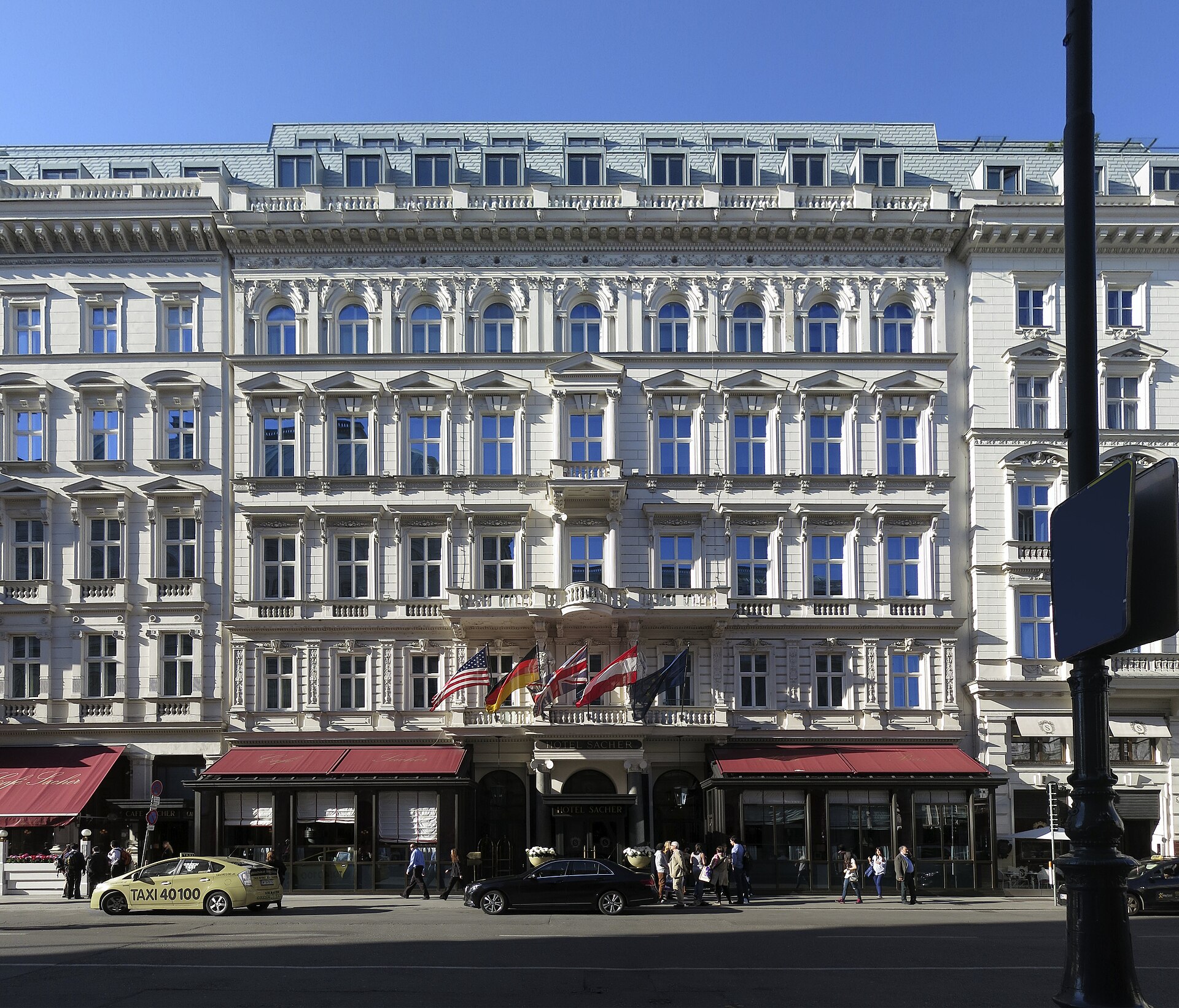
Café Sacher Wien is on the ground floor of the Hotel Sacher, directly behind the State Opera. Inside, it is everything a grand hotel café should be: red velvet banquettes, crystal chandeliers, dark wood, portraits on the walls and waiters in formal dress.
- The queue. Café Sacher is one of the most visited cafés in the city, and in the afternoons, especially in summer and at weekends, a queue forms on the pavement. Mornings are quieter.
- The order. A slice of Original Sacher-Torte “mit Schlag”, with a Melange or an Einspänner. The slice cost about €9 in 2026.
- The experience. Service is formal and practised, and the room is genuinely handsome. You are paying for the setting and the name as much as for the cake.
- Skip the queue. If you only want the cake, not the café, go to the Sacher Confiserie shop, part of the hotel on Kärntner Straße 38, and buy a boxed cake or smaller portions to take away. There is rarely a long wait.
The hotel also runs Café Sacher branches in Salzburg, Innsbruck and Graz, so if you are travelling elsewhere in Austria, the Original is not only a Vienna experience.
Eating It at Demel
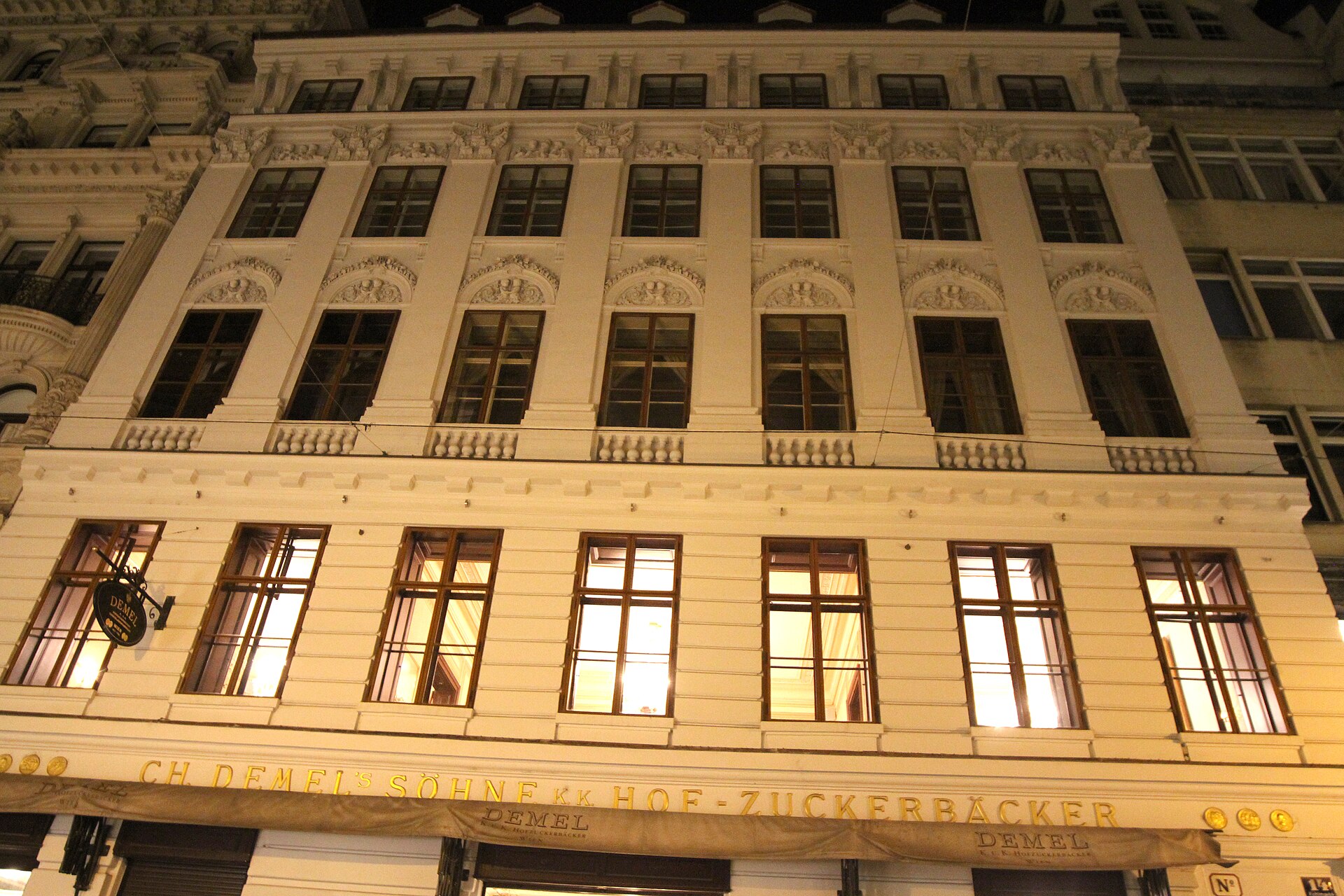
Demel is at Kohlmarkt 14, on the elegant shopping street that runs from the Graben to Michaelerplatz and the Hofburg. Founded in 1786 and for generations the imperial court confectioner, it still looks the part.
- The shop. The front room is a confectioner’s shop of glass cabinets, candied violets, chocolates and gift boxes. Even if you do not sit down, it is worth walking through.
- The cake counter. Demel’s real strength is range. Alongside the Sachertorte there are dozens of cakes, tortes and pastries, including the Annatorte, a chocolate-hazelnut cake named after Anna Demel, which many regulars prefer to either Sachertorte.
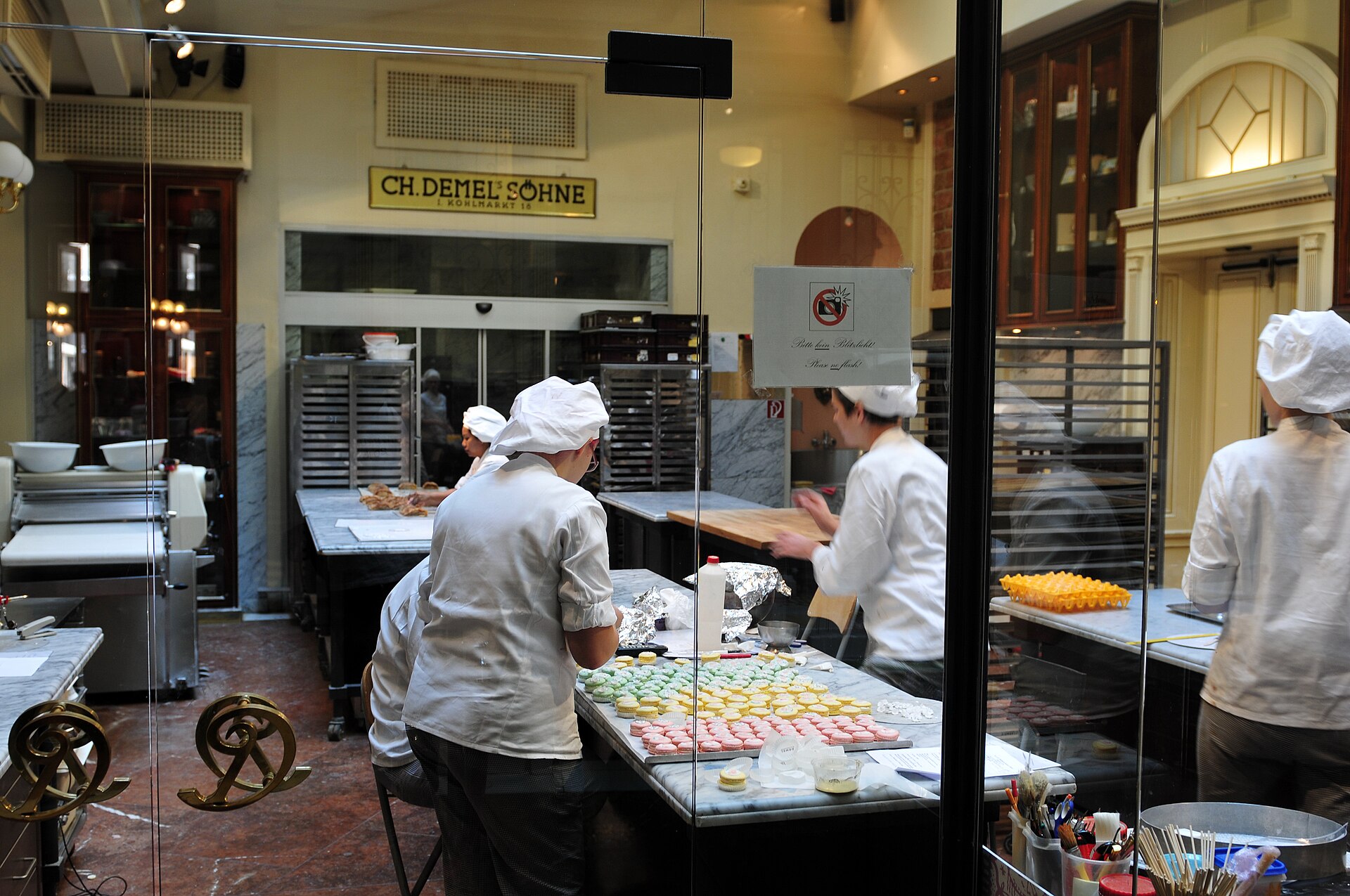
- The kitchen. A glass wall lets you watch the pastry cooks at work, which is a genuine pleasure and a good way to pass a queue.
- The rooms. The café salons are small, mirrored and ornate, more intimate than the Sacher and more crowded at busy times.
- The order. A slice of Demel’s Sachertorte with Schlag, or, if you have already had the Sacher version, the Annatorte. A slice of Sachertorte cost about €8 in 2026.
Demel also has a branch at Vienna Airport, by the C gates, if you want a last slice before you fly.
What Else to Order
If you are sitting down at either house, the Sachertorte does not have to be the only thing on the table.
At Café Sacher
- Apfelstrudel, the Viennese classic, as a lighter contrast to the chocolate.
- A Viennese breakfast in the morning, when the café is calmer and the queue is shorter.
- A glass of sparkling wine with the cake, if you want to lean into the grand-hotel occasion.
At Demel
- Annatorte: chocolate and hazelnut layers under a chocolate coating, named after Anna Demel. The house favourite among many locals.
- Dobostorte: thin sponge layers with chocolate buttercream, crowned with a disc of hard caramel. Hungarian in origin, much loved in Vienna.
- Punschkrapfen: a pink-iced, rum-soaked little cake that looks like a toy and tastes like a cocktail.
- Cremeschnitte or Esterházy-Schnitte, if they are on the counter, for something creamier.
- Candied violets from the shop, the confection famously associated with Empress Elisabeth, to take away.
A Taste Test in One Afternoon
The only way to settle the argument is to eat both, and the two are close enough to do it in a single afternoon without feeling ill, as long as you share.
- Start at Demel late in the morning, when the queue is shortest. Share one slice of Sachertorte and, if you like, one of the Annatorte. Have a Melange.
- Walk off the first round. From the Kohlmarkt, go through Michaelerplatz and along Augustinerstraße past the Hofburg and the Albertina to the Hotel Sacher. It is about ten minutes, and there is plenty to look at.
- Finish at Café Sacher in the early afternoon, or skip the café and buy a small boxed portion at the Confiserie to eat later with coffee at your hotel.
- Judge fairly. Take the Schlag both times. Compare the jam first, then the glaze, then the sponge.
If you want to go further, add a third slice from any traditional coffee house as a control: the generic Sachertorte on a neighbourhood café menu is often very good, and at a fraction of the fame.
Getting There and Practical Tips
Café Sacher
- Getting there: the Hotel Sacher stands directly behind the State Opera. The nearest U-Bahn is Karlsplatz (U1, U2, U4), a few minutes’ walk through the Opernpassage, and the Ring trams stop at Oper.
- Combine it with: the Albertina across the square, a State Opera tour, or standing-room tickets for the evening performance. Our State Opera guide explains the €13–18 standing places, sold on the day.
- Dress: there is no formal dress code for the café, but it is a grand hotel, and smart-casual will feel more comfortable than beachwear.
Demel
- Getting there: Demel is a short walk from U3 Herrengasse and from Stephansplatz (U1, U3), along the Graben and into the Kohlmarkt.
- Combine it with: the Hofburg, the Spanish Riding School and the Michaelerplatz excavations, all within five minutes.
- Look up: the Kohlmarkt is one of the most photogenic shopping streets in the city, with the dome of the Michaelertor at the end of it.
At both
- Pay at the table, and ask for the bill when you are ready; nobody will bring it unprompted.
- Tip about 10% by rounding up as you pay. Our Vienna tipping guide explains the etiquette.
- Cards are accepted, but a little cash is always useful in Vienna.
Buying a Whole Cake to Take Home
A whole Sachertorte is one of the few Viennese foods that travels well, because the firm glaze seals the cake.
From the Hotel Sacher
- Buy at the Sacher Confiserie, Kärntner Straße 38, in several sizes.
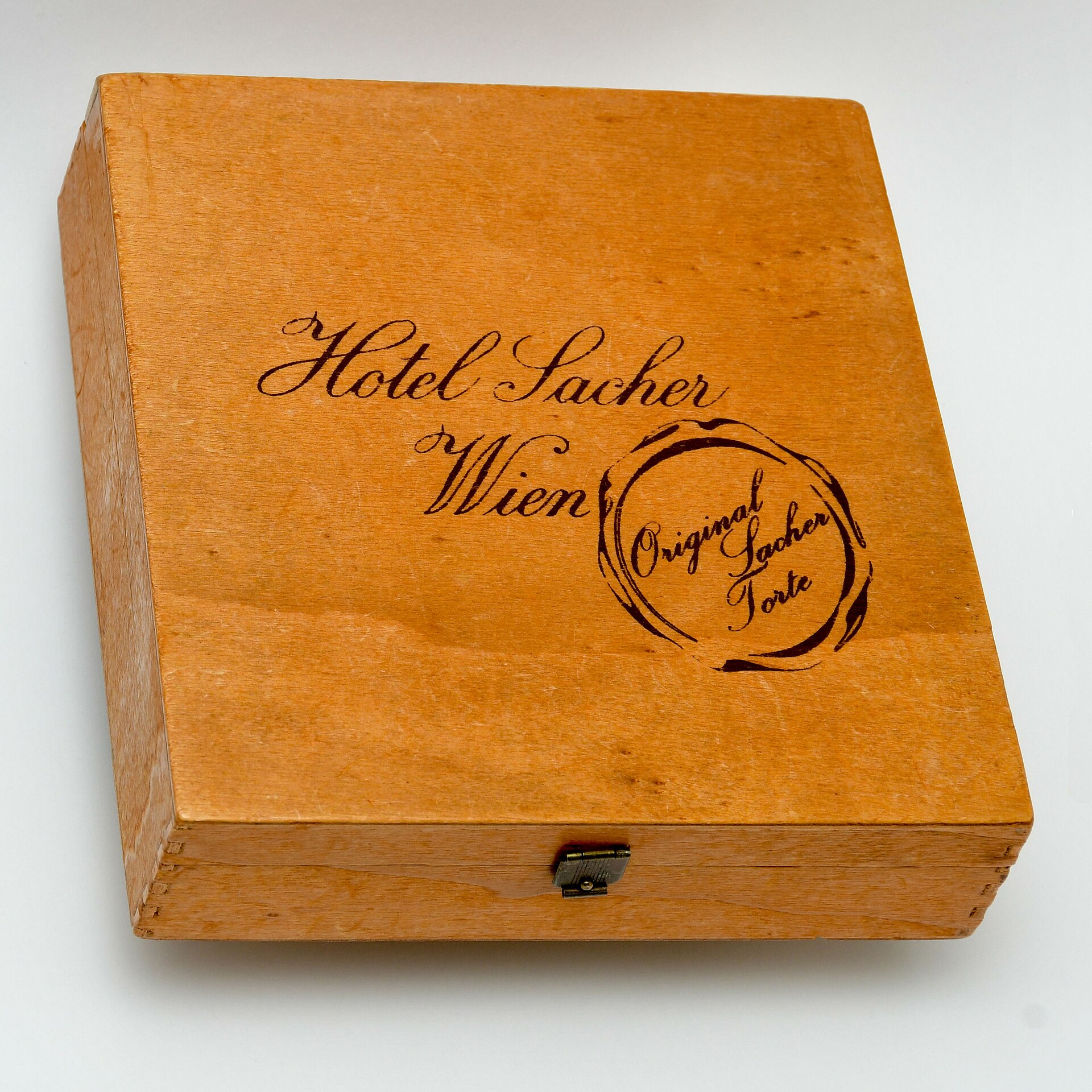
- Cakes come in the hotel’s classic wooden box, which many people keep long after the cake is gone.
- The hotel’s online shop offers worldwide delivery, so you can also send one as a gift without carrying it.
From Demel
- Buy in the shop at Kohlmarkt 14, where Sachertorte and many of the other house specialities are sold boxed.
- Demel also sells online.
Flying with a Sachertorte
A boxed cake goes in your hand luggage without trouble. It is food, not a liquid, and since July 2026 Vienna Airport’s CT scanners mean you do not need to unpack much at security, though a dense cake may still be looked at more closely. Keep it flat and away from heat, and check what food your destination country allows through customs. Our guide to Vienna Airport security has the rules.
The glaze helps a Sachertorte keep for longer than most cakes, but check the best-before date on the box and do not leave it in a hot car or a sunny window.
What About Everyone Else’s Sachertorte?
Because “Sachertorte” is a generic name, you will find it on almost every café menu in Austria, and in every supermarket.
- Traditional coffee houses such as Café Landtmann and Café Sperl bake their own, and some are excellent. Our coffee houses guide will point you to the best rooms.
- Konditorei chains such as Aida and Gerstner sell good-quality versions at lower prices and without the queues.
- Supermarket Sachertorte is sweeter and softer, and perfectly nice with coffee at home, but it is not the same thing.
The honest truth is that a well-made Sachertorte from a good Konditorei is not dramatically worse than either of the famous two. What you pay extra for at Sacher and Demel is the room, the story and the seal.
So Which Is Better?
Our verdict, after eating a great deal of both: the cakes are closer than the rivalry, and the right choice depends on what you want from the visit.
- Choose Café Sacher if you want the ceremony: the grand hotel, the red velvet, the “Original” on the menu and the wooden box to take home. It is the more iconic experience, and the jam through the middle makes it the fruitier, more distinctive cake.
- Choose Demel if you care most about cake. The purer chocolate hit of the single-layer version appeals to many people, the counter lets you try something else as well, and the pastry kitchen and the shop make the visit more interesting than a single slice.
- If you only have time for one, go to Demel and order the Annatorte as well as the Sachertorte. Then buy a boxed Original Sacher-Torte at the Confiserie on your way to the airport, and hold your own taste test at home.
And whichever you choose, do not skip the whipped cream.
How a Sachertorte Is Made
The exact recipes at the Hotel Sacher and Demel are closely guarded. The general method, though, is well known, and making one at home is the best way to understand why the cake tastes as it does.
- The sponge. Butter and sugar are beaten with egg yolks and melted dark chocolate. The egg whites are whisked stiff with more sugar and folded in with a little flour. There is no baking powder; the lift comes from the eggs, which is why the crumb is fine and firm rather than airy.
- The rest. The baked cake is left to cool and settle, often overnight, so that it can be sliced and glazed cleanly.
- The jam. Apricot jam is warmed, sieved smooth and brushed on while hot. At the Hotel Sacher it also goes through the middle; in Demel’s style, only on the outside.
- The glaze. This is the hard part. Sugar and water are boiled to a precise stage and cooked with dark chocolate, then poured over the cake in one confident movement and smoothed with a few strokes. Overwork it and it goes dull; get the temperature wrong and it will not set with that characteristic sheen.
- The cream. Whipped without sugar, served on the side.
A home-made Sachertorte will not taste exactly like either of the famous ones, but you will never again wonder why a slice costs what it does.
Common Mistakes
- Eating it without the whipped cream. The cake is built for it. Without it, the sponge tastes dry.
- Joining the Café Sacher queue at 15:00 in August when you only want the cake. Buy it at the Confiserie instead.
- Buying an “Original Sachertorte” anywhere but the Hotel Sacher. The name is protected. A shop elsewhere selling an “original” is selling a generic Sachertorte, which may be good, but is not the Original.
- Carrying a whole cake around in the summer heat for a day of sightseeing. Buy it on your last day.
- Having only one slice and declaring a winner. Taste both on the same day, or you are comparing a memory with a mouthful.
Sachertorte Through the Year
- 5 December is National Sachertorte Day in Austria, falling in the middle of Christmas-market season, when both cafés are at their busiest.
- December generally is peak time for queues and for buying boxed cakes as presents. Buy early in the day.
- Summer brings long afternoon queues and heat that is not kind to chocolate glaze. Carry cakes in a cool bag.
- January and February, outside the ball-season weekends, are the easiest months for walking straight in.
For the rest of Vienna’s sweet side, from Apfelstrudel to Kaiserschmarrn, see our guide to Vienna’s desserts and pastries. And if the coffee list is as confusing as the cake history, our guide to the Viennese coffee menu explains every drink.
Frequently Asked Questions
What is the difference between Sacher and Demel Sachertorte?
The Hotel Sacher’s Original Sacher-Torte has two layers of apricot jam, one through the middle of the sponge and one under the glaze. Demel’s version has a single layer of jam directly under the glaze. The Sacher cake has a round chocolate seal; Demel’s has a triangular one.
Which is the original Sachertorte?
Legally, the Hotel Sacher’s. After a long court dispute settled in the early 1960s, only the Hotel Sacher may call its cake the “Original Sacher-Torte”. Demel sells its version, historically called the Eduard-Sacher-Torte, with a triangular seal.
How much is a slice of Sachertorte at Café Sacher?
About €9 in 2026, according to recent reports. A slice at Demel was about €8. Check the menu, as prices change.
Is Café Sacher worth the queue?
For the room and the ceremony, yes, if the wait is short. If the queue is long, buy a boxed cake at the Sacher Confiserie on Kärntner Straße instead and eat it with coffee elsewhere.
Where is Demel in Vienna?
At Kohlmarkt 14 in the first district, between the Graben and Michaelerplatz, a few minutes’ walk from the Hofburg. There is also a Demel at Vienna Airport, by the C gates.
Can I take a Sachertorte on a plane?
Yes, in hand luggage. It is a solid food, not a liquid. Keep it flat and cool, and check your destination’s customs rules on food.
Should Sachertorte be eaten with whipped cream?
Yes. The sponge is deliberately dense and slightly dry, and it is designed to be eaten with a spoonful of unsweetened whipped cream. Order it “mit Schlag”.
Who invented the Sachertorte?
Franz Sacher, a sixteen-year-old apprentice in Prince Metternich’s kitchen, in 1832. His son Eduard refined the recipe while training at Demel and made it the signature of the Hotel Sacher, which he opened in 1876.
Related Vienna Guides
- Vienna Desserts and Pastries
- Vienna Coffee Houses Guide
- The Viennese Coffee Menu Decoded
- Café Central Vienna
- Vienna State Opera Guide
- Hofburg Palace Guide
- Traditional Viennese Dishes
- Luxury Hotels in Vienna
Photo Credits
Original Sacher-Torte with chocolate seal: Original Sacher-Torte ©Hotel Sacher by Sacher Hotels Betriebsgesellschaft m.b.H., CC BY-SA 4.0, via Wikimedia Commons.
Hotel Sacher facade and Café Sacher: Cafe Sacher Wien by Thomas Ledl, CC BY-SA 3.0, via Wikimedia Commons.
Demel at Kohlmarkt 14: Kohlmarkt 14-IMG 2856 by PictureObelix, CC BY 3.0, via Wikimedia Commons.
Hotel Sacher wooden cake box: Holzkästchen – Hotel Sacher Wien – Original Sacher Torte by Alex P. Kok, CC BY-SA 4.0, via Wikimedia Commons.
Sachertorte at Hotel Sacher: Wien – Sachertorte II by Häferl, CC BY-SA 3.0 at, via Wikimedia Commons.
Demel’s pastry kitchen: 13-08-30-wien-by-RalfR-066 by Ralf Roletschek, CC BY 3.0, via Wikimedia Commons.