Kaisergruft: Inside the Habsburg Imperial Crypt
Twelve emperors, around 150 Habsburgs, and Maria Theresa's elaborate tomb standing next to her son's plain copper box. €15 to get in, and worth it only if you know who they were.
- Tickets, Hours and Where It Is
- Who Is Down There
- The Three-Part Burial
- The Knocking
- Sisi’s Grave
- What It Is Actually Like
- A Walk Through the Vaults
- Combining It With the Rest of Imperial Vienna
- Is €15 Too Much?
- The Capuchins, and Why They Have It
- Our Honest Verdict
- Frequently Asked Questions
- Related Vienna Guides
- Photo Credits
This article contains advertising. Our booking links are routed through a partner that adds commission tracking automatically, so if you book through one we earn a commission from the provider, at no extra cost to you. It never affects what we recommend. Affiliate disclosure
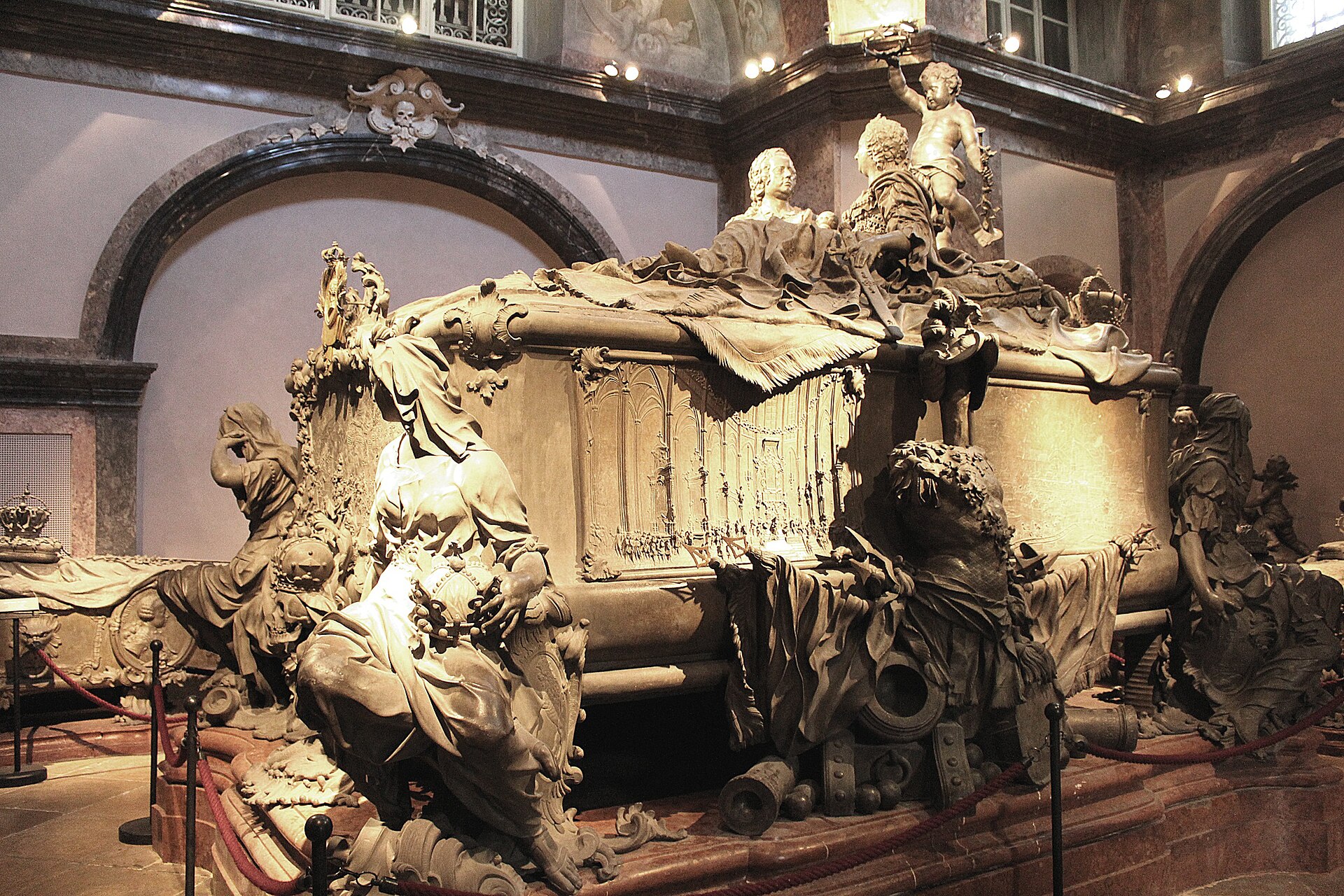
Maria Theresa had her tomb built while she was still alive, and in 1754 she came down to visit it. It is an elaborate rococo double sarcophagus by Balthasar Ferdinand Moll, with her and her husband, Franz I Stephan, at full length on the lid, turned towards each other, about to speak. Directly next to it, on the floor, is a plain copper box with almost no decoration at all. That is her son Joseph II, who thought the whole thing was vulgar and left instructions accordingly. The Imperial Crypt Vienna — the Kaisergruft, under a modest Capuchin church on Neuer Markt — holds around 150 people including twelve emperors, and the argument between those two coffins is the best five minutes in it.
This guide covers what it costs and when it is open, who is actually down there, the tombs to find, the strange Habsburg practice of dividing a body between three buildings, the knocking ceremony still performed at Habsburg funerals, and our honest verdict on whether €15 for a crypt is money well spent. Prices and hours were checked on the Capuchin order’s own site in September 2026.
Tickets, Hours and Where It Is
| Adult | €15 |
| Concession | €13 |
| Opening hours | Daily 10:00–18:00; 1–2 November 10:00–14:00, 24 and 31 December 10:00–16:00, 1 January from 12:00 |
| Last entry | 17:30 (always 30 minutes before closing on the shorter days) |
| Address | Tegetthoffstraße 2, Neuer Markt, 1010 Wien |
Discounts apply for holders of the Vienna City Card, the Vienna Pass, the Flexi Pass and the Kulturpass. The crypt does not publish child, family or group rates, so ask at the desk if that applies to you.
It is open every day of the year, which is worth noting in a city where the museums close on Tuesdays and Mondays in rotation.
Guided tours run daily in German at fixed times, with English and Italian tours on selected days, plus family tours, evening tours and group tours on request. A scheduled tour costs €21 for adults, €19 concession and €14 for children up to 18, admission included; a private group tour is €120 plus admission for up to 30 people. Book one if the family history interests you, because the labelling in the crypt is sparse.
Getting there
- U1 or U3 Stephansplatz, then five minutes’ walk down Kärntner Straße and right into Neuer Markt.
- U1, U2 or U4 Karlsplatz, then about seven minutes north past the State Opera.
- Trams 1, 2, 71 and D stop at Kärntner Ring / Oper.
The entrance is unremarkable and easy to walk past: a plain door in the side of the Capuchin church on the square, with a small sign. Neuer Markt itself has the Donnerbrunnen fountain in the middle of it and a good deal less tourist traffic than the streets either side, which makes it a pleasant place to sit before or after. Our Innere Stadt guide covers the surrounding lanes.
Who Is Down There
The crypt was founded on the wish of Empress Anna, who died in 1618, and the first burials took place in 1633. It has been in continuous use ever since — which is the detail that changes the character of the place, because this is not an archaeological site. It is a working family vault that still receives burials.
Around 150 people rest here, including twelve emperors, eighteen empresses and Queen Maria Anna of Portugal, spread across ten linked vaults that grew as the family did. Only one person buried here is not a Habsburg by blood or marriage: Countess Karoline Fuchs-Mollard, Maria Theresa’s governess, whom the empress had brought down to be buried among the family because she could not bear to have her anywhere else.
The tombs to find
- Maria Theresa and Franz Stephan. The great double sarcophagus, made by Balthasar Ferdinand Moll in the 1750s. Look at the relief on the side — a coronation procession in miniature — and at the figures of mourning at the corners.
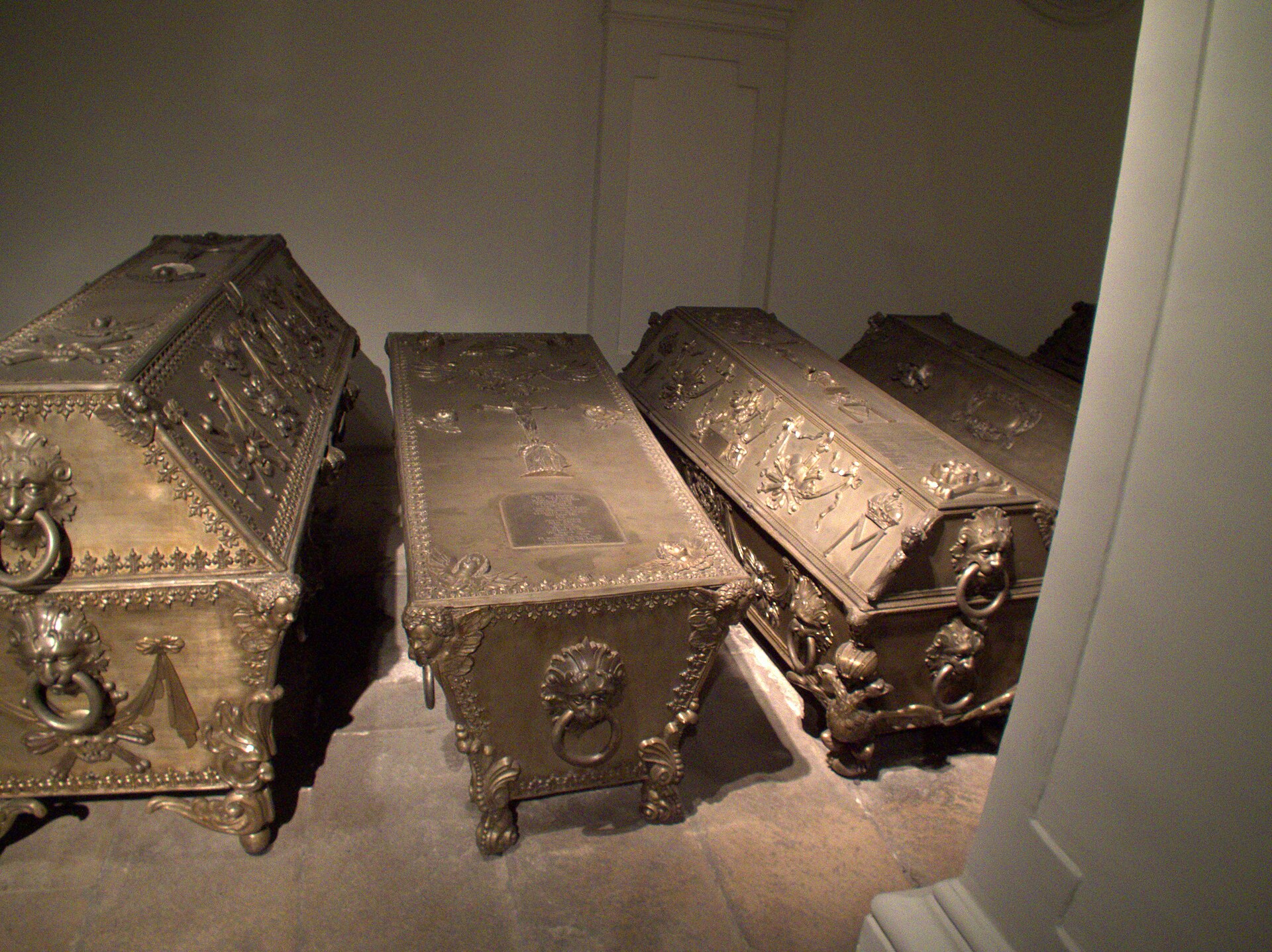
- Joseph II, immediately beside them, in a plain copper coffin. Her son, the reforming emperor who abolished ornate burial and closed inner-city cemeteries, buried exactly as he asked to be. The juxtaposition is deliberate on the crypt’s part and it does more work than any label could.
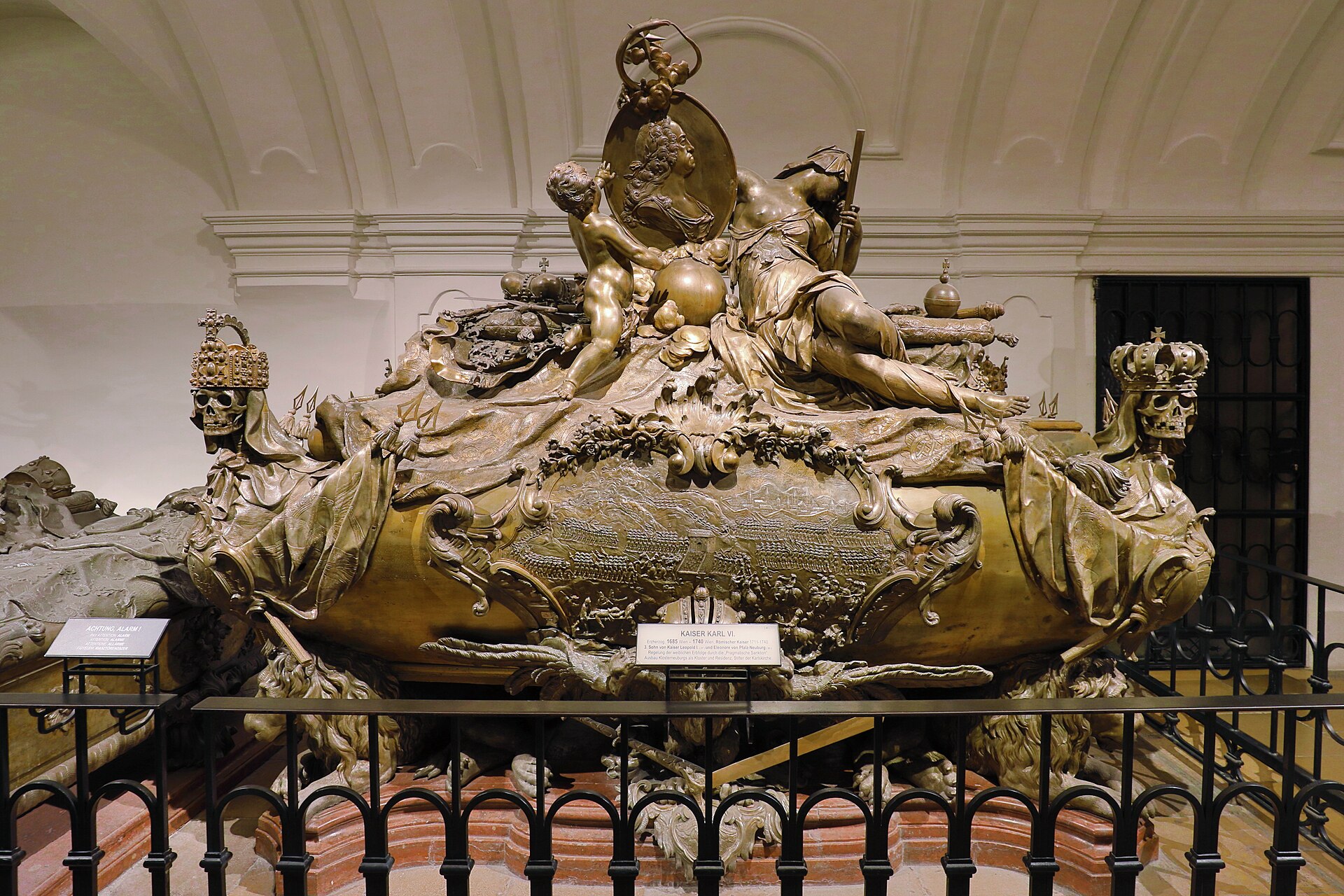
- Karl VI, also by Moll, with crowned skulls at the corners of the sarcophagus and a great deal of bronze drapery. If you have seen one photograph of this crypt, it was probably this.
- Franz Joseph, Elisabeth and Rudolf, together in the Franz-Josephs-Gruft. Three plain metal coffins in a row: the emperor who reigned for sixty-eight years, the empress who was murdered in Geneva, and the crown prince who died at Mayerling in 1889.
- Marie Louise, Napoleon’s second wife and Franz II’s daughter, who came home.
- Zita, the last empress, buried here in 1989, twenty-two years before her son Otto.
- Otto von Habsburg, her son, buried in 2011. His heart went separately to an abbey in Hungary, in keeping with the family habit described below.
- Countess Fuchs, the governess, in the Maria-Theresien-Gruft. A small plaque, easily missed.
The Three-Part Burial
This is the thing nobody tells visitors and the thing that makes the Kaisergruft make sense.
For roughly three centuries the Habsburgs practised getrennte Bestattung — separated burial. A body was divided between three places in Vienna, each with its own institution and its own ceremony:
- The body went to the Kapuzinergruft, here, under the Capuchin church on Neuer Markt.
- The heart went to the Herzgruft, a small chamber in the Augustinerkirche beside the Hofburg, where silver urns sit in wall niches.
- The viscera went into copper urns in the Ducal Crypt beneath Stephansdom, alongside the catacombs.
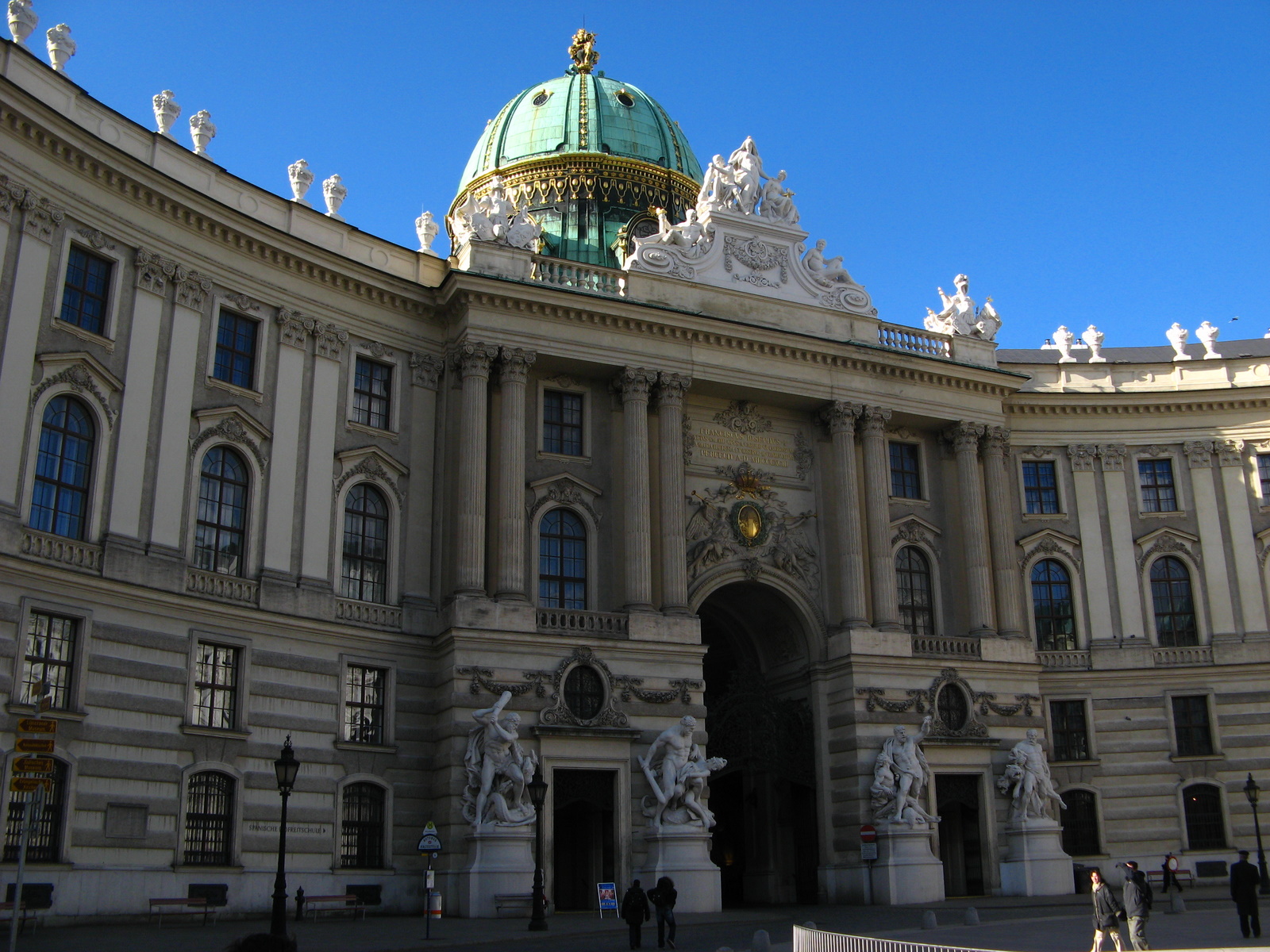
So an emperor is in three buildings all within the old city centre, and if you are doing the crypt at all, the other two are worth knowing about. The Stephansdom catacombs are easy to visit and cost a fraction of this ticket — see our cathedral guide and our guide to Vienna’s crypts and catacombs. Access to the Herzgruft at the Augustinerkirche is much more limited and depends on the church’s own arrangements, so check before making the trip.
The practice tailed off in the 19th century — Franz Joseph is here entire — but it ran long enough that most of the great names are distributed rather than buried.
The Knocking
When a Habsburg is buried here, the funeral procession stops at the closed door of the crypt and a herald knocks three times with a staff.
From inside, a Capuchin friar asks who is there. The herald replies with the full titles: Emperor and King of this, Archduke of that, Grand Duke of the other, the whole inherited accumulation. The friar answers: we do not know him. The herald knocks again and gives the shorter, human list of honours. The friar answers again: we do not know him. The herald knocks a third time and says that here is a poor sinner who begs for God’s mercy. The door opens.
It is not a historical curiosity. It was performed at the church door at Zita’s funeral in 1989 and again for Otto von Habsburg in 2011. Standing in the crypt with that in your head changes the room considerably, and it is the single best piece of context to arrive with — the longer family story is in our Habsburg dynasty guide.
Sisi’s Grave
Empress Elisabeth lies in the Franz-Josephs-Gruft between her husband and her son, in a coffin no grander than theirs. Her sarcophagus is usually the one with flowers, notes and small offerings on and around it, left by people who have followed the Sisi story through the films, the musical, the Sisi Museum at the Hofburg and the rest of her trail across the city.
There is something clarifying about ending that trail here. The museum at the Hofburg spends six rooms arguing that the fairytale is wrong and that Elisabeth was a person with a difficult life and a violent death; this room makes the same case in one object. Three plain coffins in a row, side by side, a family that could not make each other happy, all of them dead within nine years of one another.
What It Is Actually Like
Manage your expectations on the architecture. This is not a Gothic undercroft or a bone chapel: it is a series of plain, whitewashed, low-vaulted rooms with metal coffins standing on the floor, lit adequately and kept immaculately. The drama comes almost entirely from four or five monumental sarcophagi and from what you know about the people inside them.
Practical notes:
- Allow thirty to forty-five minutes. It is not large and there is a natural one-way flow through the vaults.
- It is quiet, and expected to stay that way. The Capuchins run it as a burial place rather than an attraction, and the tone is set accordingly.
- Labelling is minimal. If you do not already know who these people are, a lot of it will be coffins. The guided tour, or half an hour of reading beforehand, transforms the visit.
- It is cool year-round, which is a relief in August and worth a jumper in January.
- Accessibility is limited — it is a 17th-century crypt reached by stairs. Contact the Capuchins in advance if this matters.
- Photography policy is not published on the order’s site. Check the signage at the entrance and assume restraint is expected.
A Walk Through the Vaults
The crypt is not one room. It is ten linked vaults added over three and a half centuries as the family kept needing more space, and walking through them in order is a walk through changing ideas about death, rank and display.
- Gründergruft — the founders’ vault, part of the church completed in 1632; the founders’ coffins were moved in the following year. Two coffins, bare walls, almost monastic. This is where it starts.
- Leopoldsgruft — the late 17th century, and the moment the coffins begin to grow.
- Karlsgruft — full Baroque. Karl VI’s sarcophagus with crowned skulls at its corners, in a vault built in 1710 and extended on his orders in 1720.
- Maria-Theresien-Gruft — the domed high point, with the double sarcophagus in the middle, Joseph II’s plain box beside it, and Countess Fuchs tucked at the edge. If you only look properly at one room, this is it.
- Franzensgruft and Ferdinandsgruft — the early 19th century, when the ornament drops away and the coffins become sober classical boxes.
- Toskanagruft — the Tuscan branch of the family, and a room most visitors walk straight through.
- Neue Gruft — added in the 1960s to relieve pressure elsewhere, and where Marie Louise ended up.
- Franz-Josephs-Gruft — the emperor, Elisabeth and Rudolf, in the plainest room of all.
- The last vaults — the Crypt Chapel, with Zita, Otto and the most recent burials, the latest in 2023.
The trajectory is the interesting part. The family began underground in austerity, spent the eighteenth century competing with itself in pewter and bronze, and finished in plain boxes in a bare white room. Nobody planned that arc, and it is legible as you walk through the vaults.
Combining It With the Rest of Imperial Vienna
Neuer Markt sits just off the Kärntner Straße, a short walk from Stephansplatz, so the crypt slots into almost any central plan. The version we would recommend takes a full day and puts the crypt at the end, where it belongs:
| Time | What | Why |
|---|---|---|
| 09:00 | Imperial Treasury | The regalia — what the family said it was |
| 11:00 | Sisi Museum and Imperial Apartments | How they actually lived |
| 13:30 | Lunch, then Stephansdom | The catacombs hold the viscera urns |
| 15:30 | Coffee on Neuer Markt | The Donnerbrunnen and a quiet square |
| 16:30 | Kaisergruft | Where all of it ends |
Done in that order, the crypt carries a weight it simply does not have on its own. Done in reverse, you look at coffins for €15 and then spend the rest of the day working out who was in them.
Is €15 Too Much?
It is a fair question and the honest answer is: it depends what you compare it with.
| Site | Adult | Suggested time | What you get |
|---|---|---|---|
| Kaisergruft | €15 | 30–45 min | Around 150 burials, Baroque and Rococo funerary sculpture |
| Stephansdom catacombs | €8 | ~30 min | ~11,000 people, plague pits, the ducal crypt urns |
| Michaelerkirche crypt | €10 | ~45 min | 18th-century burials, guided only |
Against the catacombs at €8, the Kaisergruft looks expensive for a smaller site. Against Schönbrunn’s Grand Tour at €42, it looks reasonable. The thing the comparison misses is that several of the sarcophagi here are significant works of eighteenth-century sculpture in their own right, which the catacombs are not — you are paying for Moll’s workshop as much as for the crypt.
The money also goes somewhere specific. The Capuchin order maintains the crypt, and admission is what pays for the conservation of the metalwork, which corrodes and is expensive to stabilise.
The Capuchins, and Why They Have It
The Order of Friars Minor Capuchin is one of the austere branches of the Franciscans — brown habits, pointed hoods, a vow of poverty taken literally. Which raises an obvious question: how did the most ostentatious dynasty in Europe come to be buried under a friary built on those principles?
The answer is that the austerity was the point. Choosing the Capuchins was itself a statement of humility — the emperor laid, in death, among mendicants, in a plain vault, under a church with no tower. That the coffins then grew into multi-tonne rococo sculptures over the following century is one of the quieter ironies of the Habsburg story, and it is visible in a single afternoon’s walk from the founders’ vault to Maria Theresa’s dome.
The friars still live in the house above and still maintain the crypt. Admission funds the conservation work, which is continuous: the coffins are pewter, tin and copper, metals that degrade, and stabilising them is slow and expensive. Many of the sarcophagi have been through conservation and restoration, and some of the themed tours cover the restorers’ work.
The church upstairs is worth two minutes on your way out. It is deliberately plain, almost bare, with nothing of the Baroque theatre of the churches a few streets away — and standing in it after the crypt is the clearest possible illustration of the gap between what the order intended and what the dynasty made of it.
Our Honest Verdict
Go if the Habsburgs have got hold of you. Do not go if they have not.
That sounds glib and it is the most useful thing on this page. The Kaisergruft has no spectacle, no view, no interactive anything and very little explanation. It is a quiet basement with coffins in it. What it has, in enormous quantity, is meaning — but only for a visitor who arrives already knowing who Maria Theresa was, why Joseph II’s plain box next to her is funny and sad at once, what happened at Mayerling, and what it meant when a herald knocked three times on that door in 1989.
The right order for a Vienna trip is: the Hofburg first, then Schönbrunn if you are doing it, then here. Come at the end, when the names have accumulated, and the visit will land. Come cold on your first morning and you will wonder what the €15 was for.
If you only want the underground-Vienna experience rather than the dynasty, the Stephansdom catacombs at €8 are better value and considerably stranger. If you want the dynasty, this is the last room in the story and there is no substitute for it.
Frequently Asked Questions
How much does the Kaisergruft cost?
€15 for adults and €13 concession. Vienna City Card holders pay €12, the Vienna Pass and Flexi Pass are accepted, and Kulturpass holders go in free. Under-6s are free, ages 6–18 pay €8, and groups of ten or more pay €13 each. A family ticket is €34 for two adults and up to three children, or €19 for one adult with up to three children.
What are the opening hours?
Daily from 10:00 to 18:00, with last entry at 17:30. The exceptions: 1 and 2 November it closes at 14:00, 24 and 31 December at 16:00, and on 1 January it opens at 12:00, with last entry always half an hour before closing. It opens every day of the year, which makes it useful on Mondays and Tuesdays when many Vienna museums close.
Who is buried in the Imperial Crypt?
Around 150 people, including twelve Habsburg emperors and nineteen empresses and queens. Among them are Maria Theresa, Joseph II, Franz Joseph, Empress Elisabeth, Crown Prince Rudolf, Marie Louise, Empress Zita and Otto von Habsburg. Countess Fuchs, Maria Theresa’s governess, is the only person buried there who was not a Habsburg.
Is Sisi buried in the Kaisergruft?
Yes. Empress Elisabeth lies in the Franz-Josephs-Gruft between Emperor Franz Joseph and their son Rudolf, in a plain metal coffin that usually has flowers on it.
Why are Habsburg hearts buried separately?
For about three centuries the family practised separated burial: the body to the Kapuzinergruft, the heart to the Herzgruft in the Augustinerkirche, and the viscera to copper urns in the Ducal Crypt under Stephansdom. All three churches are in the old town.
What is the knocking ceremony?
At a Habsburg funeral the herald knocks three times at the crypt door. Twice he lists the deceased’s titles and is told the Capuchins do not know him. The third time he says that here is a poor sinner begging God’s mercy, and the door is opened. It was performed for Empress Zita in 1989 and Otto von Habsburg in 2011.
How long does a visit take?
Thirty to forty-five minutes. It is a compact site with a natural one-way route through ten connected vaults.
Are there guided tours in English?
German tours run daily at set times, and English and Italian tours are offered on selected days. Family, evening and group tours are available on request. Tours including admission are €21 for adults, €19 concession and €14 for under-18s; private groups of up to 30 pay €120 plus admission.
Is the Imperial Crypt worth it?
If you already know the Habsburg story, yes — it is the last room in it, and the Maria Theresa and Joseph II tombs standing side by side are worth the ticket alone. If you do not, €15 buys you a quiet basement of coffins with very little explanation, and the Stephansdom catacombs at €8 will give you more for less.
Related Vienna Guides
- The Habsburg Dynasty in Vienna
- Empress Sisi in Vienna: Following Elisabeth’s Trail
- Sisi Museum and Imperial Apartments
- Underground Vienna: Crypts, Catacombs and Cellars
- Stephansdom: Vienna’s Cathedral
- The Imperial Treasury (Schatzkammer)
- Hofburg Palace: The Complete Visitor Guide
- A Short History of Vienna
- Innere Stadt: Vienna’s First District
- Vienna Attractions: The Complete List
Photo Credits
The double sarcophagus of Maria Theresa and Franz Stephan: Wien-Innenstadt, Kapuzinergruft, Sarkophag Maria Theresia, Kaiserin von Österreich by Dguendel, CC BY 4.0, via Wikimedia Commons.
Sarcophagi in the crypt: Kapuzinergruft Wien 074 by DALIBRI, CC BY-SA 3.0, via Wikimedia Commons.
The Hofburg Michaelertor: 20080215-18 Wenen (157) by Donar Reiskoffer, CC BY 3.0, via Wikimedia Commons.