Cafe Landtmann: Freud’s Cafe on the Ringstrasse
Café Landtmann on the Ringstraße: its history, Freud and the politicians, the rooms and terrace, 2026 coffee prices, opening hours, reservations and an honest verdict.

Photo by Vitaly Gariev
- Café Landtmann at a Glance
- A Short History of Café Landtmann
- The Rooms
- What to Order and What It Costs
- Opening Hours, Reservations and Live Music
- Your First Visit, Step by Step
- When to Go
- Getting There
- What Is Nearby
- The Landtmann Group: Other Cafés by the Same Owners
- Is Café Landtmann Worth It? Our Verdict
- Frequently Asked Questions
- Related Vienna Guides
- Photo Credits
This article contains advertising. Our booking links are routed through a partner that adds commission tracking automatically, so if you book through one we earn a commission from the provider, at no extra cost to you. It never affects what we recommend. Affiliate disclosure
Sit on the terrace of Café Landtmann on a weekday morning and you can usually spot at least one face from the evening news. A politician walks in from the Rathaus across the road, a journalist is already waiting with a Melange and a notebook, and an actor from the Burgtheater next door is reading the reviews. Cafe Landtmann has been the Ringstraße’s most establishment coffee house for a century and a half, and unlike some of its more famous rivals, it is still used by the Viennese it was built for.
This guide covers what Café Landtmann is and where it came from, the Freud connection and the other famous regulars, the rooms and the terrace, what to order and what it costs, opening hours and reservations, the best times to go, and an honest verdict on whether it is worth your time and money. Coffee prices come from Landtmann’s own menu and opening hours from its website, both checked in September 2026; treat them as the right order of magnitude, since Viennese cafés adjust prices most years.
Café Landtmann at a Glance
| Details | |
|---|---|
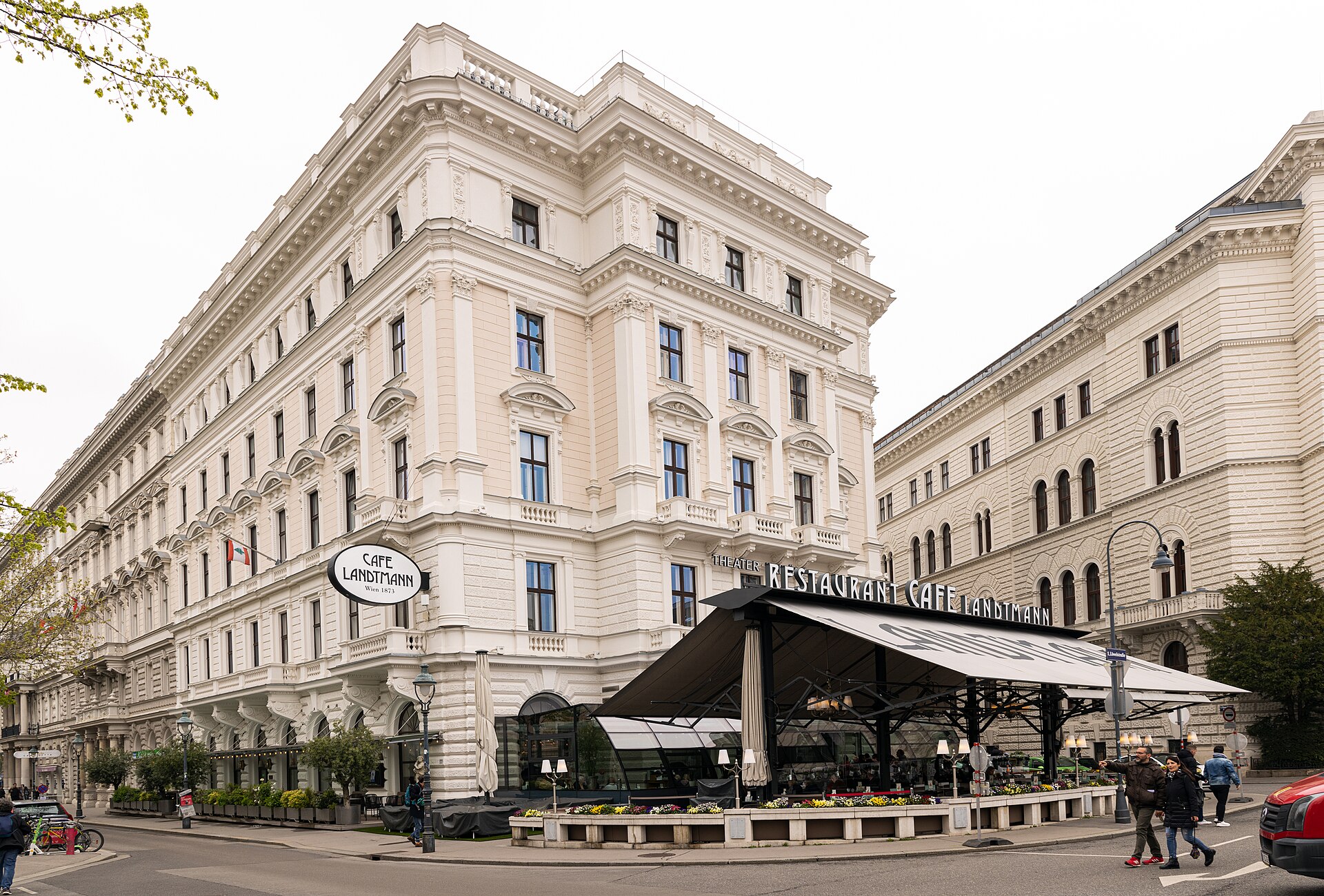
| Address | Universitätsring 4, 1010 Vienna, in the Palais Lieben-Auspitz |
| Opposite | The Rathaus (City Hall); next door to the Burgtheater |
| Opening hours | Monday–Saturday 07:30–24:00; Sunday 07:30–22:00 |
| Reservations | Online, by phone on +43 1 24 100-120, or by email to [email protected] |
| Live music | Wednesdays from 19:00 |
| Wiener Melange | €6.90 |
| Kleiner Brauner | €4.20 |
| Founded | 1873, by Franz Landtmann |
| Owned since 1976 by | The Querfeld family |
| Getting there | Trams on the Ring stop right outside; Schottentor (U2) is a few minutes’ walk |
| Worth it? | Yes, for a genuine grand café with a local crowd. Not for a cheap coffee. |
A Short History of Café Landtmann
Franz Landtmann opened his café on 1 October 1873, in the year of the Vienna World’s Fair, at a moment when the Ringstraße was still being built around it. He advertised it, with no modesty whatsoever, as the most elegant and largest café premises in Vienna. The Burgtheater had not yet moved to its current building next door, and the Rathaus across the road was still under construction. The café was betting on where the city’s political and cultural life was heading, and it bet right.
Landtmann himself did not stay long. The café passed to the brothers Wilhelm and Rudolf Kerl in 1881, who ran it until 1916, and then through a series of owners until the Zauner family took over in 1926. They kept it for half a century, through the interwar republic, the Nazi years, the war and the Allied occupation. In 1976 it was bought by the Querfeld family, who still own it today and have built a small group of Viennese cafés and restaurants around it.
The interior you see is largely the result of a 1929 redesign by Ernst Meller. Look at the wooden panelling and columns: the carved reliefs by Hans Scheibner show scenes from Burgtheater premieres, a nod to the theatre audiences who have been coming in before and after performances since the café opened. In 1974 the café received the Austrian State Award, which entitles it to display the federal coat of arms.
The most visible modern change came in 2007, when the architect Manfred Wehdorn designed a glazed winter garden on the pavement side, adding about 87 square metres and 29 tables — roughly a quarter more capacity — so that the terrace could be used all year round.
Freud and the famous regulars
Café Landtmann is often called Freud’s café, and the connection is real. Sigmund Freud lived and practised at Berggasse 19, about fifteen minutes’ walk away, and the university where he lectured is next door on the Ring. He is one of a long list of regulars the café claims, along with the composer Gustav Mahler, the theatre director Max Reinhardt, the painter Oskar Kokoschka, the actress Paula Wessely, and, as visiting guests, Marlene Dietrich and Gary Cooper.
A word of caution about coffee-house celebrity lists in general: every grand café in Vienna has one, and the more famous the name, the less time the person often spent there. But Landtmann’s location makes its claims more believable than most. If you were a professor at the university, an actor at the Burgtheater, a city councillor at the Rathaus or a member of parliament down the road, this was the obvious place to meet.
If you want to follow Freud further, the Sigmund Freud Museum at Berggasse 19 is the natural next stop; our guide to Sigmund Freud’s Vienna covers the museum, his apartment and the places connected with his life in the city.
The politicians’ café
What makes Café Landtmann different from most historic coffee houses today is that its historical role is still its current one. Parliament, the Chancellery, the Rathaus and the university are all within a few minutes’ walk. Politicians give press statements here, journalists meet sources here, coalition gossip is exchanged here, and on the day after an election the terrace can feel like an annexe of the parliament press room. Nobody will point this out to you, but it is worth knowing when you are wondering why the men at the next table are all in suits on a Saturday.
The Rooms
Café Landtmann is a bigger operation than it looks from the street, and where you sit changes the experience considerably.
The main café
The historic rooms on the ground floor are the reason to come: dark wood panelling, the carved Burgtheater reliefs, brass fittings, upholstered benches, marble-topped tables and the long cake display. Waiters in black and white work the room with the brisk formality that is part of the performance. If the weather is bad or you want the classic coffee-house experience, ask for a table inside.
The winter garden and terrace
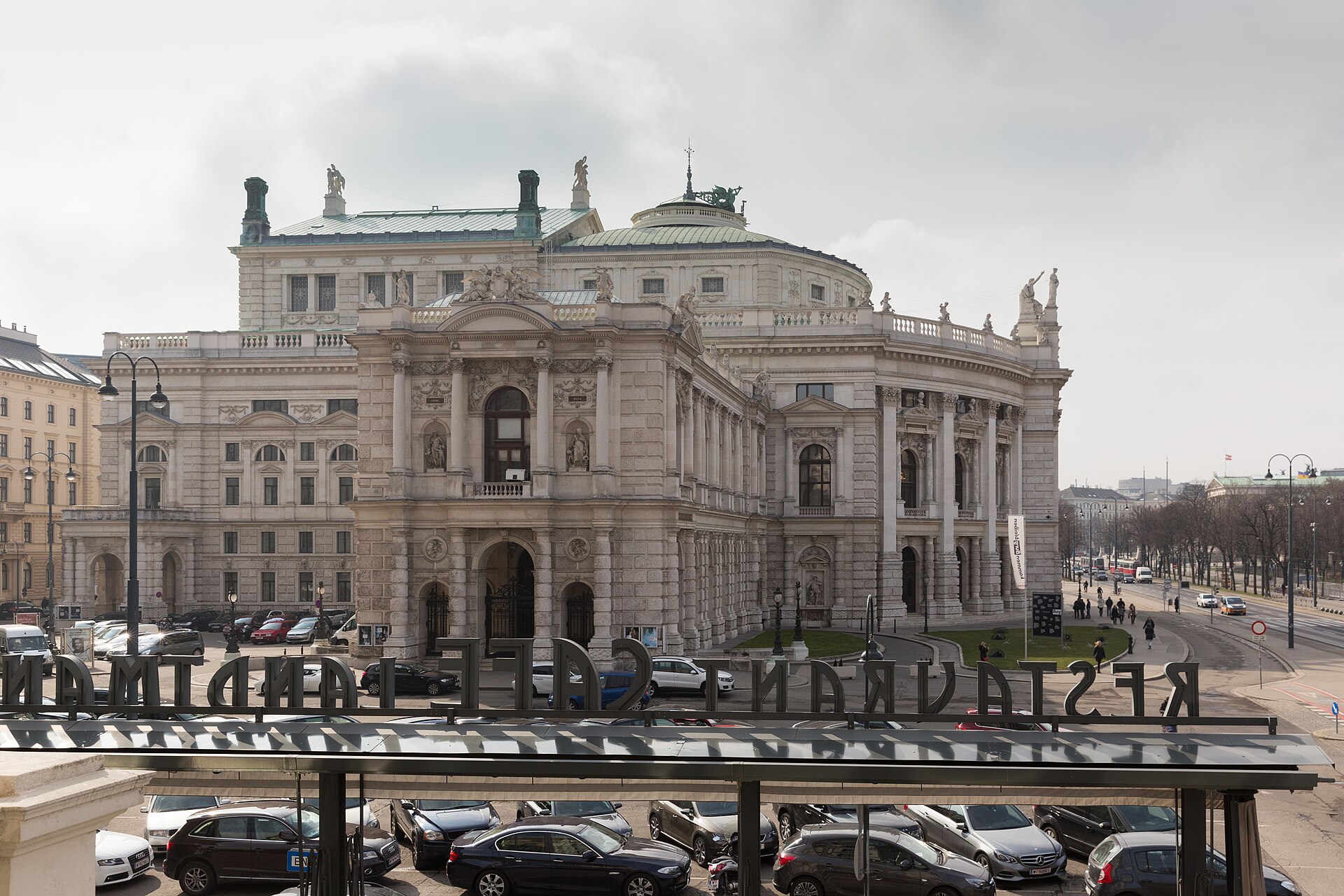
The glazed winter garden and the Schanigarten (pavement terrace) face the Ringstraße, the Burgtheater and the Rathaus. In good weather this is the best seat in the house for people-watching, and in winter the glass pavilion keeps the view without the cold. The trade-off is that you are next to one of Vienna’s busiest roads, and it is less atmospheric than the historic rooms. In summer the terrace fills quickly at lunchtime.
The Bel Etage
Upstairs, Landtmann’s Bel Etage is a set of event rooms used for private functions, receptions and meetings, with windows looking straight across to the Burgtheater. It is not normally part of an ordinary café visit, but if you are organising a group dinner or an event in Vienna, it is worth knowing about.
What to Order and What It Costs
Café Landtmann is a full restaurant as well as a café, with a long menu of Viennese dishes served from breakfast through to late evening. Most visitors, though, come for coffee and cake, and that is what the café does best.
Coffee prices
These are from Landtmann’s coffee and cake menu, as published in its current version (checked September 2026). The same coffee list is used at the group’s Café Mozart and Café Museum.
| Coffee | What it is | Price |
|---|---|---|
| Kleiner Brauner | A single espresso-style mocca served with a little jug of cream or milk | €4.20 |
| Wiener Melange | Coffee with steamed milk and milk foam — the Viennese default | €6.90 |
| Verlängerter | A mocca lengthened with hot water, milk on the side | €6.90 |
| Cappuccino | Italian-style, though in Vienna it may come with whipped cream if you do not specify | €6.90 |
| Salon Einspänner | Strong black coffee in a glass, topped with whipped cream | €7.20 |
| Franziskaner | A Melange topped with whipped cream instead of foam | €7.20 |
| Caffè Latte | Milky coffee in a glass | €7.50 |
Those prices make Landtmann one of the more expensive places for coffee in the city, and we use its Melange as the top-end benchmark across this site. A neighbourhood coffee house will charge noticeably less. Every coffee comes with a glass of water, which will be refilled. For a walk through the rest of the coffee list, see our Viennese coffee menu guide.
Cakes and pastries
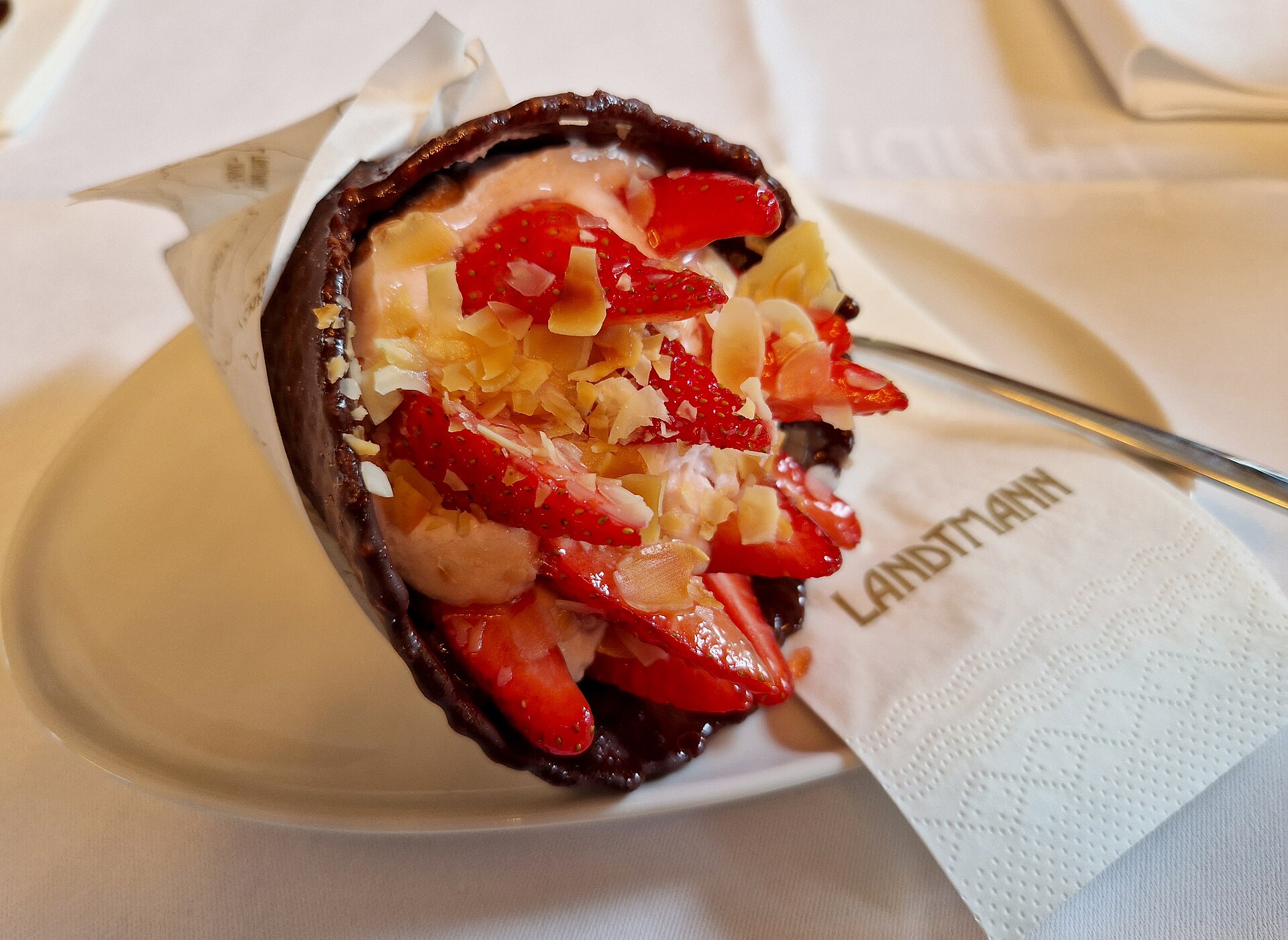
Landtmann makes its own cakes and pastries, and the cake counter is one of the best in the city centre. Expect the Viennese classics — strudels, cream slices, chocolate tortes — alongside a seasonal selection that changes through the year. In summer look for the Erdbeerhörnchen, a chocolate-lined pastry horn filled with strawberry cream and fresh strawberries and scattered with toasted almonds. Cake prices are not published online, so check the menu at the table. The group also runs a patisserie shop under the name Landtmann’s Original.
Breakfast, lunch and dinner
Café Landtmann opens at 07:30 every day, which makes it one of the better central options for a proper breakfast before sightseeing along the Ring. At lunchtime and in the evening it turns into a busy Viennese restaurant, with Wiener Schnitzel and the other classic dishes on the menu. It is not the cheapest place in the city to eat those things, and it is not the best — for schnitzel, see our Wiener Schnitzel guide — but it is reliable, and the late opening (until midnight Monday to Saturday) makes it one of the few grand cafés where you can eat after the theatre.
For breakfast options across the city, from Landtmann to much cheaper cafés, see our guide to breakfast and brunch in Vienna.
Opening Hours, Reservations and Live Music
Hours
- Monday to Saturday: 07:30–24:00
- Sunday: 07:30–22:00
Hours were checked on the café’s own website in September 2026. Opening times can change around Christmas, New Year and public holidays, so check before you go on those dates.
Reservations
Unlike many Viennese coffee houses, Café Landtmann takes reservations. You can book a table through the online reservation system on its website, by phone on +43 1 24 100-120, or by email to [email protected]. For coffee and cake on a weekday, you usually do not need to. We would book for:
- Lunch on weekdays, when the politicians and office workers arrive.
- Sunday afternoon, especially in winter.
- After-theatre dinner on nights when the Burgtheater has a performance.
- Any meal in December, when the Rathausplatz Christmas market brings enormous crowds to the square across the road.
- A terrace table on a sunny weekend.
Live music
Landtmann has live music on Wednesdays from 19:00, with a rotating line-up of musicians. It is background music for a café evening rather than a concert, but it makes Wednesday a good night to go.
Your First Visit, Step by Step
Grand cafés have their own unwritten rules, and Landtmann is more formal than most. None of this is difficult, but knowing it in advance makes the difference between feeling like a guest and feeling like a tourist.
- Wait briefly at the entrance. In the busier rooms a waiter or head waiter will usually direct you to a table, especially at lunchtime. If nobody comes within a minute or so and there are free tables, it is fine to sit down.
- Ask for the room you want. Inside for the historic panelling, the winter garden or terrace for the view. If you have booked, give your name.
- Do not wave. The waiter will bring the menu and come back. Catching an eye is the accepted way to get attention; calling out “Herr Ober” is old-fashioned but still understood.
- Order coffee with cake, not coffee then cake. Choose your cake from the counter or the menu when you order; the waiter will bring both together.
- Take your time. Nobody will bring the bill until you ask for it, and nobody expects you to leave after one coffee. Newspapers are there to be read.
- Pay at the table. Say “Zahlen, bitte”. Cards are accepted. When you pay, tell the waiter the total you want to pay including the tip — roughly five to ten per cent — rather than leaving coins on the table. Our Vienna tipping guide explains why.
A realistic budget for two people having a coffee and a slice of cake each is somewhere around €30 once the tip is included. Add a glass of wine or a savoury dish and it climbs quickly. That is the price of a table on the Ring for as long as you want it, which, seen that way, is not bad value at all.
When to Go
- Weekday breakfast, 07:30–09:30: the best time for the historic rooms, and the most local crowd.
- Mid-afternoon on a weekday: the easiest time for coffee and cake without booking.
- Before or after the Burgtheater: for the atmosphere, but book on performance nights.
- Weekday lunch: busy, loud and political. Fun if you book; frustrating if you don’t.
- Late November to Christmas: the Christmas market on the Rathausplatz makes the whole area extremely crowded. Go early in the day or book. Our Rathausplatz Christmas market guide has the dates.
The café rarely has the long pavement queues that used to form outside Café Central, partly because it is bigger and partly because it is less famous abroad. If there is a wait, it is usually short.
Getting There
Café Landtmann is on the Universitätsring, the stretch of the Ringstraße between the university and the Burgtheater, directly opposite the Rathaus park.
- Tram: trams running along the Ring (including the D, 1 and 71) stop at Rathausplatz/Burgtheater, practically at the door.
- U-Bahn: Schottentor is a few minutes’ walk north along the Ring. The U2/U5 construction works have been changing routes in this part of the city, so check the current Wiener Linien network before relying on a particular line.
- On foot: about ten minutes from the Hofburg and the Volksgarten, and around fifteen from Stephansplatz.
For getting around the city in general, see our Vienna tram guide; the Ring trams are one of the best-value sightseeing rides in the city.

What Is Nearby
Landtmann works well as a pause in a day along the western Ringstraße. Within a few minutes’ walk:
- The Burgtheater, next door, one of the most important German-language theatres in the world. Our Vienna theatre guide explains tours and tickets.
- The Rathaus and Rathausplatz, with its seasonal events — film festival in summer, Christmas market in Advent, ice rinks in winter.
- The University of Vienna main building, whose arcaded courtyard is free to walk into.
- The Parliament, a short walk south along the Ring.
- The Volksgarten, with its rose garden, and the Hofburg beyond it.
- The Votivkirche, the neo-Gothic church a few minutes north.
- The Sigmund Freud Museum at Berggasse 19, about fifteen minutes’ walk.
For the full route around the boulevard, see our Ringstraße guide.

The Landtmann Group: Other Cafés by the Same Owners
The Querfeld family’s group includes several other places you may come across:
- Café Museum on Operngasse, near Karlsplatz — the coffee house originally designed by Adolf Loos and famous for its Secession-era regulars.
- Café Mozart, behind the State Opera near the Albertina — very central, mainly visitors.
- Das Bootshaus, a restaurant on the Alte Donau, the old arm of the Danube, which is a good summer escape from the city centre.
- Gasthaus Napoleon, a traditional Viennese restaurant.
- Landtmann’s Original, the patisserie shop.
Café Landtmann is also one of the confirmed partners in the new southern extension of Terminal 3 at Vienna Airport, due to open in the second quarter of 2027, so you may soon be able to have your last Melange in Austria at the airport. Our Vienna Airport food guide has the current options.
Is Café Landtmann Worth It? Our Verdict
Yes — with a few caveats.
What Landtmann does well is authenticity of a particular kind. It is a working grand café, used by the Viennese establishment for exactly what it was built for, rather than a museum piece. The service is formal and professional, the cakes are good, the rooms are handsome, and the location on the Ring is excellent for a day of sightseeing. It is also much easier to get into than the most famous name on the tourist trail, and you can book.
The caveats are about value and expectations. At €6.90 for a Melange, you are paying top-of-the-market prices, and a neighbourhood café will serve you a coffee that is just as good for less. The food is solid rather than exceptional. The terrace is on a busy road. And if you are looking for a shabby, bohemian, smoky coffee house with a cast of eccentrics, this is the wrong place: Landtmann is polished, prosperous and faintly corporate. For that other kind of Vienna, go to Café Hawelka or Café Sperl instead.
Who should go: anyone who wants to see a grand Ringstraße coffee house still doing its job; theatre-goers; anyone following Freud’s footsteps; visitors who want a reliable breakfast or late supper near the Ring; and anyone who wants the Café Central experience without the queue.
Who might skip it: travellers on a tight budget, and anyone who wants their coffee-house experience to feel lived-in rather than polished.
For a wider comparison of the city’s coffee houses and how to choose between them, see our Vienna coffee houses guide.
Frequently Asked Questions
Where is Café Landtmann?
At Universitätsring 4 in the 1st district, on the Ringstraße next to the Burgtheater and opposite the Rathaus. Trams along the Ring stop right outside.
What are Café Landtmann’s opening hours?
Monday to Saturday from 07:30 to midnight, and Sunday from 07:30 to 22:00 (checked September 2026).
Can you make a reservation at Café Landtmann?
Yes. Book online through the café’s website, by phone on +43 1 24 100-120, or by email at [email protected]. Booking is a good idea for weekday lunch, Sunday afternoons, after-theatre dinner and anything in December.
How much is a coffee at Café Landtmann?
A Kleiner Brauner costs €4.20, a Wiener Melange €6.90 and a Salon Einspänner €7.20, from the café’s current menu.
Did Sigmund Freud go to Café Landtmann?
Yes, Freud is among the café’s best-known regulars. He lived and worked at Berggasse 19, about fifteen minutes’ walk away, and the university where he taught is next door.
Is Café Landtmann better than Café Central?
It depends what you want. Café Central has the more spectacular vaulted room but has historically had long queues, and it has been closed for renovation since March 2026. Landtmann is easier to get into, takes reservations and has a more local crowd.
Does Café Landtmann have live music?
Yes, on Wednesdays from 19:00.
Is there a dress code at Café Landtmann?
No formal dress code. Smart-casual will fit in, but nobody will turn you away for wearing sightseeing clothes.
Related Vienna Guides
- Vienna Coffee Houses Guide
- Café Central Vienna
- Sacher vs Demel: The Sachertorte Question
- Viennese Coffee Menu Guide
- Sigmund Freud’s Vienna
- Vienna Ringstraße Guide
- Vienna Desserts and Pastries
- Breakfast and Brunch in Vienna
Photo Credits
Café Landtmann and the Palais Lieben-Auspitz: Cafe Landtmann Wien April 2022 1 by Kasa Fue, CC BY-SA 4.0, via Wikimedia Commons.
View from the Bel Etage to the Burgtheater: Blick von der Bel Etage des Café Landtmann auf das Burgtheater und den Universitätsring by Hubertl, CC BY-SA 4.0, via Wikimedia Commons.
Erdbeerhörnchen at Café Landtmann: Café Landtmann Erdbeerhörnchen by Geolina163, CC BY-SA 4.0, via Wikimedia Commons.