The Imperial Treasury (Schatzkammer): Habsburg Crown Jewels Guide
A thousand-year-old crown, the Holy Lance, and a narwhal tusk the Habsburgs declared a unicorn horn. €16 online, free under 19, and timed slots from April 2026.
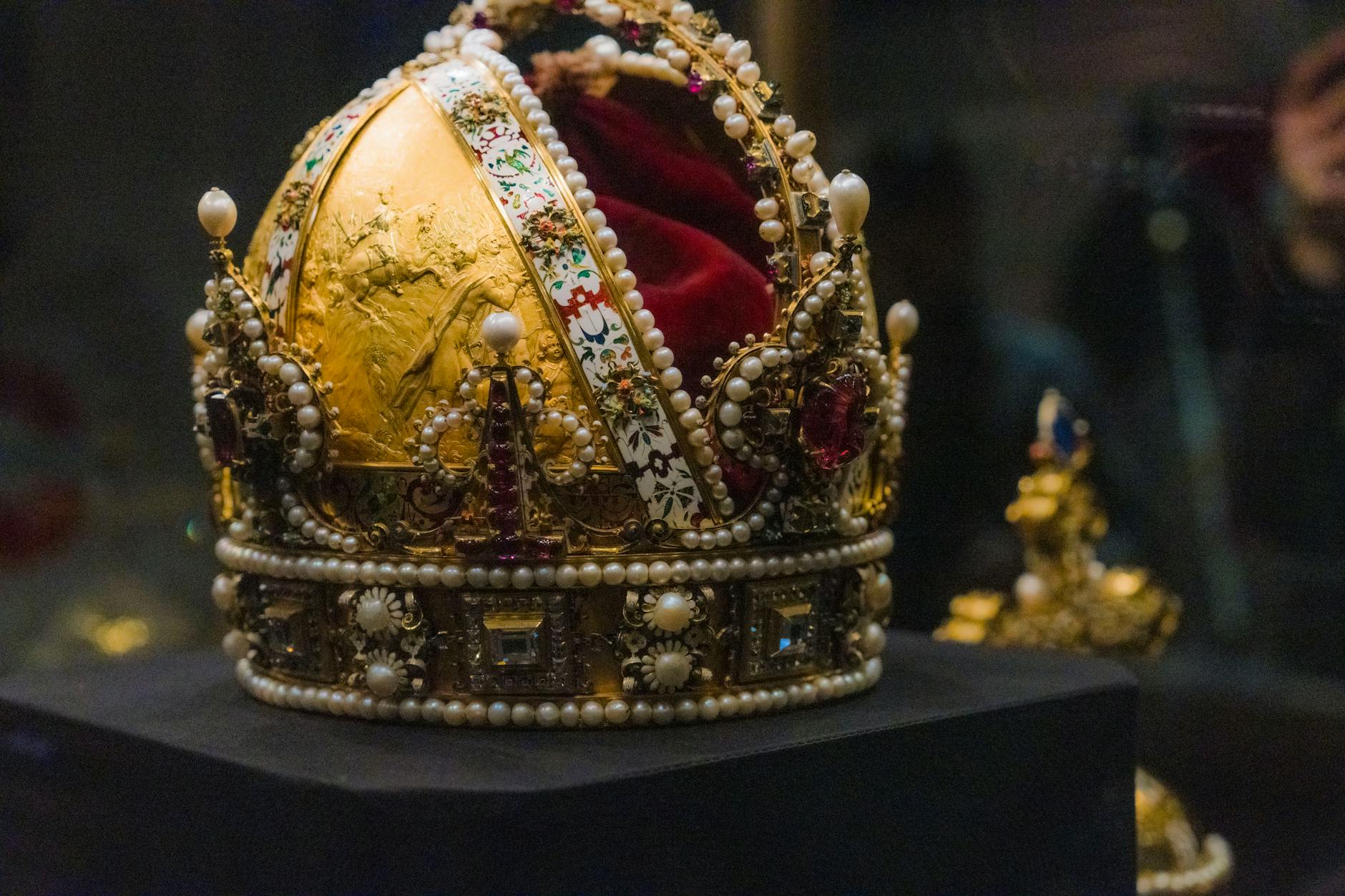
Photo by Jing Zhan
- Tickets, Prices and the New Timed Entry
- Where It Is, and What It Is Not
- What Is Inside
- Why the Regalia Are in Vienna at All
- How to Actually Visit It
- Combining It With the Rest of the Hofburg
- The Two Inalienable Heirlooms
- When to Go and How Busy It Gets
- Our Honest Verdict
- Frequently Asked Questions
- Related Vienna Guides
- Photo Credits
This article contains advertising. Our booking links are routed through a partner that adds commission tracking automatically, so if you book through one we earn a commission from the provider, at no extra cost to you. It never affects what we recommend. Affiliate disclosure
In a dim room in the oldest part of the Hofburg there is an octagonal gold crown, set with uncut sapphires the size of quail eggs and pearls threaded into wire, that was probably made in the tenth century and was placed on the heads of Holy Roman Emperors for roughly eight hundred years. It is not a replica. It is about a metre from your face behind glass, and most days there are perhaps four other people in the room. The Imperial Treasury Vienna — the Kaiserliche Schatzkammer — holds the regalia of two empires, a narwhal tusk the Habsburgs believed was a unicorn horn, and a bowl that was seriously thought to be the Holy Grail, and it costs €16 if you book online.
This guide covers 2026 prices and the timed-entry rule in force since April 2026, what is in each half of the collection, the ten objects to make sure you see, the Vienna City Card pricing trap, how it fits with the rest of the Hofburg, and our honest verdict. Prices and hours were checked on the Treasury’s own site in September 2026.
Tickets, Prices and the New Timed Entry
| Ticket | Online | On site |
|---|---|---|
| Adult | €16 | €18 |
| Reduced (students under 25, pensioners aged 65 or over, Ö1 Club, special needs, conscripts, unemployed) | €12 | €14 |
| Vienna City Card | — | €17 |
| Children and young people under 19 | Free | Free |
| Audio guide | €5 (Take 2 €7; family €8; groups 10+ €3pp) | |
From 1 April 2026, admission is only available in reserved time slots. This is the single most important line on this page. A timed ticket is required, and you choose your slot when you buy it, online in advance on the Treasury’s own site or at the museum cash desk, subject to availability. Booking ahead is the way to get the time you want.
The Vienna City Card trap
Look at that table again. The City Card rate is €17. The standard online rate is €16.
The card saves you a euro against the €18 walk-up price and costs you a euro against simply booking online like everyone else. It is presumably an artefact of how the discount was negotiated rather than anything deliberate, but the practical effect is that flashing your City Card here makes you worse off than not having one. Book online at €16 and keep the card for the transport, which is what it is actually good for — the full analysis is in our City Card vs Vienna Pass guide.
Combination tickets
- Treasures of the Habsburgs — €32. Imperial Treasury plus the Kunsthistorisches Museum. Both are run by the same museum group and the pairing makes sense thematically: the Treasury is the regalia, the KHM is the art the same family bought with the same money.
- Empress Elisabeth — €25. Imperial Treasury plus the Imperial Carriage Museum out at Schönbrunn, where the state coaches and Sisi’s funeral carriage live.
Neither bundle saves a fortune, and both are only worth it if you were going to do the second half anyway. The usual rule applies: work out what you would pay separately before you buy a combination.
Opening hours
Open daily except Tuesday, 09:00 to 17:30, with last entry thirty minutes before closing. The Tuesday closure is shared with the Naturhistorisches Museum and the Leopold, so a Tuesday in Vienna needs planning — the alternatives are in our best museums guide.
Where It Is, and What It Is Not
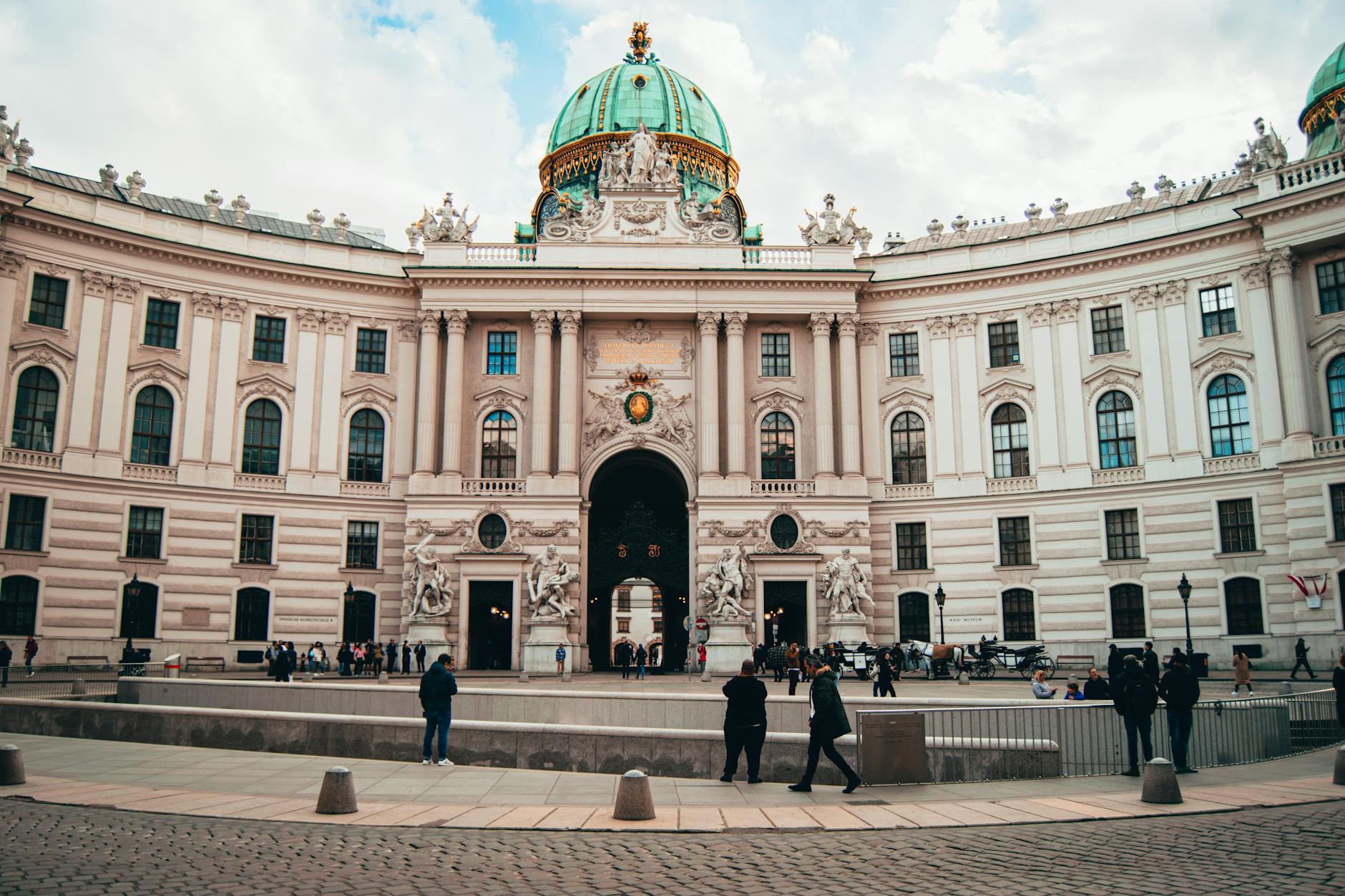
The Treasury is in the Schweizerhof, the oldest surviving part of the Hofburg, reached through the Renaissance Swiss Gate, built in 1552–1553. From Michaelerplatz you walk in under the dome, across In der Burg, and through the archway on the far side; the entrance is up a flight of stairs in the corner of the courtyard and it is signposted, but modestly.
It is not included with the Sisi Museum ticket, or the Imperial Apartments ticket, or the National Library, or the Spanish Riding School, all of which are in the same building complex and all of which are ticketed separately. This confuses a large proportion of visitors, and our Hofburg guide exists largely to sort it out. If you have already done the Sisi Museum and Imperial Apartments, you still need a separate ticket here.
What Is Inside
Around twenty rooms, divided into two collections: the Secular Treasury (Weltliche Schatzkammer), which holds the regalia and the dynastic objects, and the Ecclesiastical Treasury (Geistliche Schatzkammer), which holds the reliquaries, vestments and devotional material of a family that took its Catholicism extremely seriously.
Most visitors go for the first and are ambushed by the second.
The ten things to find
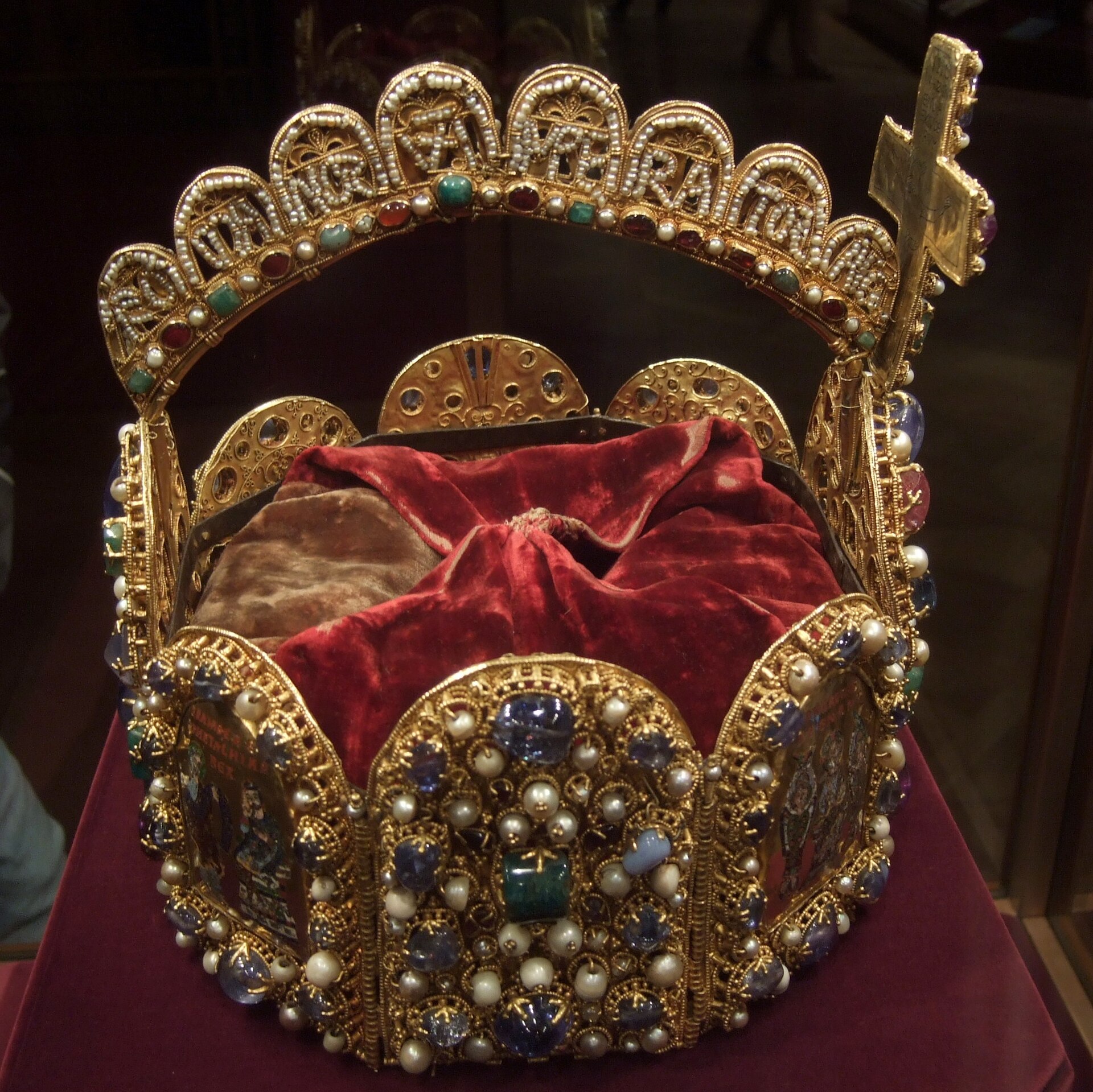
- The Imperial Crown of the Holy Roman Empire. Probably made in the late tenth century, octagonal, eight hinged plates of gold, four with enamel scenes and four with unfaceted stones, and an arch added a generation later bearing the name of Conrad II. It is a medieval crown that has survived intact, and it is the reason to come.
- The Holy Lance. An eighth-century spearhead with an iron nail bound into the blade, held since the early Middle Ages to be from the Crucifixion, and carried by emperors as the most potent object in the imperial armoury. Its twentieth-century history is not decorative: the regalia were taken to Nuremberg in 1938 and returned to Vienna by the Americans after the war.
- The Imperial Cross and the Imperial Sword, which travelled with the crown and the lance as a set.
- The Coronation Gospels, a ninth-century manuscript on which emperors swore their oath.
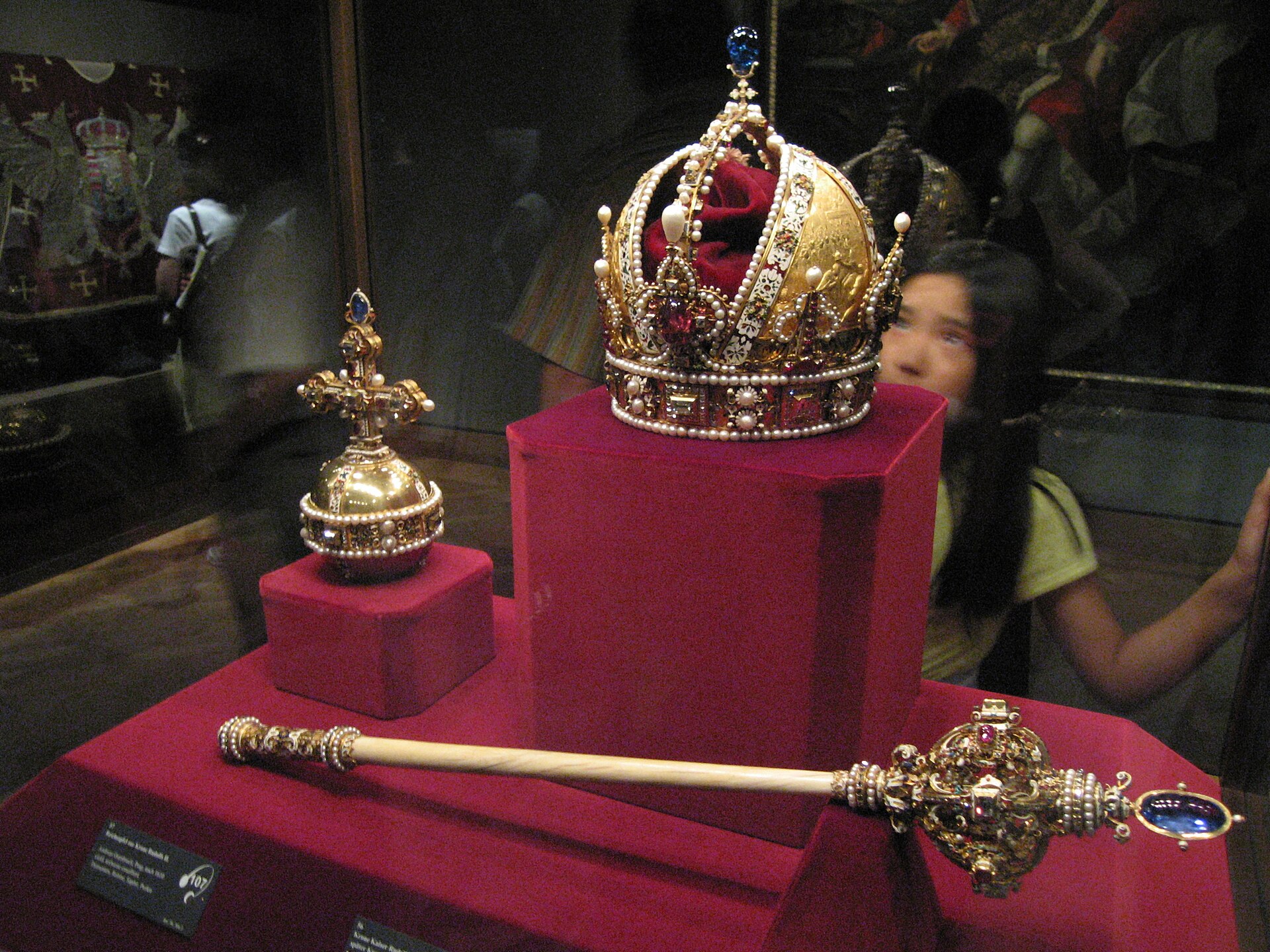
- The Austrian Imperial Crown, Rudolf II’s personal crown, promoted in 1804 to the crown of the new Austrian Empire when Napoleon’s rise made the old Holy Roman title untenable.
- The Ainkhürn — a narwhal tusk which the Habsburgs believed to be a unicorn’s horn and declared an inalienable heirloom of the dynasty, never to be sold or divided.
- The Agate Bowl — a single enormous late-antique bowl carved from one piece of agate, the other inalienable heirloom, and long believed to be the Holy Grail, partly because the natural veining appeared to spell out a word.
- The Mantle of Roger II — a coronation cloak made in Palermo in the 1130s, red silk with gold embroidery, lions attacking camels, and an Arabic inscription around the hem. It came to the Habsburgs through inheritance and it is one of the most extraordinary textiles in Europe.
- The treasure of the Order of the Golden Fleece, inherited from Burgundy: vestments, the collar, and the ceremonial apparatus of the most exclusive chivalric order in Christendom.
- The cradle of the King of Rome — a silver-gilt cradle given by the city of Paris to Napoleon’s infant son, who was also the grandson of the Austrian Emperor, and who ended his short life in Vienna as the Duke of Reichstadt.
The Ecclesiastical Treasury
The second half, and the one nobody expects. Reliquaries in gold and rock crystal, altar sets, monstrances, vestments and a great deal of extremely specific devotional material — fragments, relics, objects made to hold other objects.

Whether you find this moving, grotesque or merely baffling depends entirely on what you bring to it, but it is not filler. The Habsburgs’ Catholicism was not a private matter; it was the justification for the whole enterprise, and the Pietas Austriaca — the family’s cultivated reputation for piety — was a political instrument. These rooms are where that becomes visible.
Why the Regalia Are in Vienna at All
They were not always. For centuries the imperial regalia were kept in Nuremberg, brought out for coronations and returned. In 1800, with French armies moving through southern Germany, they were evacuated east to Vienna for safekeeping — and then the Holy Roman Empire was abolished in 1806, there was no longer an emperor to return them to, and they stayed.
Nuremberg has wanted them back ever since, with more urgency at some points than others. They went there once more, in 1938, when the Nazi regime moved them as a piece of political theatre about German continuity; the Americans found them hidden in 1945 and returned them to Vienna the following year. They have not left since.
That story — a thousand years of use, a hurried evacuation, a fascist appropriation, a restitution — is sitting in the room with the objects, and the Treasury does not shy away from it. The longer arc is in our Habsburg dynasty guide and our short history of Vienna.
How to Actually Visit It
Take the audio guide. This is not a general recommendation, it is specific to this museum. The Treasury’s objects are dense, unfamiliar and frequently meaningless without their story — a bowl is a bowl until someone tells you people thought it was the Grail. The wall text is adequate; the audio guide at €5 is what turns twenty rooms of glinting metal into a coherent argument. It runs in eight languages.
Practical notes:
- Allow ninety minutes. Two hours with the audio guide followed properly. An hour is enough only if you are skipping the ecclesiastical half, which would be a waste.
- The lighting is low, for conservation reasons, and the rooms are quiet. It is a completely different atmosphere from the rest of the Hofburg.
- Entry is by timed ticket. Pick your slot when you buy, and arrive at the start of it so you have the full visit ahead of you.
- Photography rules are posted at the entrance; low light makes flashless photography difficult in any case.
- Under-19s are free, which is generous and rather undersold, though the collection asks a lot of a child — it is objects behind glass, with no interactives at all.
Combining It With the Rest of the Hofburg
A full Hofburg day, in the order that works:
| Time | What | Ticket |
|---|---|---|
| 09:00 | Imperial Treasury | €16 online, timed slot from April 2026 |
| 10:45 | Coffee on Michaelerplatz or Kohlmarkt | — |
| 11:30 | Imperial Apartments (the Sisi Museum area reopens on 19 November) | €15 until 18 November, separate ticket |
| 13:30 | Lunch | — |
| 15:00 | National Library State Hall or the Spanish Riding School stables | Separate tickets |
| 16:30 | Heldenplatz, the Burggarten and the Volksgarten | Free |
That is a lot of Habsburg for one day and a lot of separate tickets. If you want to do less, our recommendation is the Treasury in the morning and the gardens in the afternoon, skipping the apartments entirely — which is an unfashionable view and, we think, the right one.
The Two Inalienable Heirlooms
Of everything in these rooms, the two objects the Habsburgs themselves considered most important are not the crowns. In 1564 the family formally designated two items as unveräusserliche Erbstücke — inalienable heirlooms, which could never be sold, divided or removed from the dynasty’s possession, and which passed intact to whoever headed the house.
The first is the Agate Bowl: a late-antique dish carved from a single piece of banded agate. It came west during the Fourth Crusade and reached the Habsburgs through the Burgundian inheritance. The reason for its status is the veining: at a certain angle, in the right light, the natural pattern in the stone was read as spelling out the name of Christ. The bowl came to be regarded as the Holy Grail.
The second is the Ainkhürn: two and a half metres of spiralled ivory, presented to the family in the 16th century and understood without much doubt to be the horn of a unicorn. Unicorn horn was believed to detect and neutralise poison, which for a dynasty with the Habsburgs’ enemies was not a trivial property. It is a narwhal tusk. Nobody in Vienna knew that for a very long time, and by the time they did, the object’s status as an heirloom had long since stopped depending on what it actually was.
Both are still here, in cases, a few metres apart. They are a better window into how the sixteenth century thought than anything written down, and they are the reason this collection is more interesting than a room of expensive objects.
When to Go and How Busy It Gets
The Treasury is often calmer than the Hofburg’s better-known attractions, and the crown of the Holy Roman Empire is not usually surrounded by crowds.
The timed-entry system in place since April 2026 changes the texture of this rather than the volume. Slots smooth the flow, which means fewer surges and fewer empty stretches. In practice:
- The first slot of the day remains the best, as it does everywhere.
- Late afternoon is the second-quietest window, and the low winter light through the Schweizerhof on the way in is a small bonus.
- Book at least a few days ahead in summer and over Christmas; the collection is small and the slots are correspondingly limited.
- Wednesdays to Mondays only — the Tuesday closure catches people who have already been caught by it at the Leopold two days earlier.
One practical consequence of timed entry worth planning around: you cannot now decide on the spot to add the Treasury to a Hofburg morning that is running ahead of schedule. It has to be in the plan before you leave the hotel.
Our Honest Verdict
The Imperial Treasury is one of the best things in the city. Behind its modest entrance are the Imperial Crown, the Holy Lance, and a narwhal tusk that a ruling dynasty formally declared an inalienable heirloom, never to be sold, because it was a unicorn’s horn.
At €16 booked online, it is good value; allow ninety minutes to two hours. It is also completely free for anyone under nineteen, which almost nobody knows.
Two warnings. First: choose your slot, because entry has been by timed ticket since April 2026, bought online in advance or at the museum cash desk, subject to availability. Second: do not use your Vienna City Card here — at €17 it is worse than the €16 online rate, which is a small absurdity but a real one.
And the honest caveat: if objects-behind-glass is not your thing, no amount of provenance will rescue this for you. There is nothing interactive, nothing to touch, no view, and the lighting is deliberately dim. What there is, is the actual stuff. Whether that thrills you is something you already know about yourself.
Frequently Asked Questions
How much does the Imperial Treasury Vienna cost?
€16 booked online or €18 on site for adults, €12 online or €14 on site reduced, and free for everyone under 19. The Vienna City Card rate is €17, which is worse than the online price. An audio guide is €5 and worth taking.
Do I need to book a time slot?
Yes. Since 1 April 2026 entry is by timed ticket, which you can buy on the Treasury’s own website in advance or at the museum cash desk, subject to availability. Booking online is cheaper regardless.
When is the Imperial Treasury open?
Daily except Tuesday, 09:00 to 17:30, with last admission thirty minutes before closing.
Is the Imperial Treasury included with the Sisi Museum ticket?
No. They are in the same palace complex but are separately ticketed and separately run. The Imperial Apartments have their own ticket (€15 for adults until 18 November 2026, while the Sisi Museum area is closed for its redesign until 19 November), the Silver Collection is closed until further notice, and the Treasury is another ticket again. So are the National Library State Hall and the Spanish Riding School.
What is the most important object in the Imperial Treasury?
The Imperial Crown of the Holy Roman Empire, probably made in the late tenth century and used for coronations for around eight hundred years. Alongside it are the Holy Lance, the Imperial Cross, the Imperial Sword and the Coronation Gospels.
How long do you need at the Imperial Treasury?
Ninety minutes as a minimum, two hours if you follow the audio guide through both the secular and ecclesiastical halves. Skipping the ecclesiastical rooms to save time is a false economy.
Is it suitable for children?
Under-19s get in free, but the collection is entirely objects behind glass in low light, with no interactive element. Older children who already like history will do well; younger ones will find it hard going.
Why are the Holy Roman Empire regalia in Vienna and not Germany?
They were kept in Nuremberg for centuries and evacuated to Vienna in 1800 to keep them from Napoleon’s armies. The Holy Roman Empire was abolished in 1806, so there was no one to return them to. They were taken back to Nuremberg by the Nazi regime in 1938 and returned to Vienna after the war.
Is there a combination ticket?
Two. “Treasures of the Habsburgs” combines the Treasury with the Kunsthistorisches Museum for €32, and “Empress Elisabeth” combines it with the Imperial Carriage Museum at Schönbrunn for €25.
Related Vienna Guides
- Hofburg Palace: The Complete Visitor Guide
- Sisi Museum and Imperial Apartments
- The Habsburg Dynasty in Vienna
- Kunsthistorisches Museum: The Complete Guide
- The Spanish Riding School
- A Short History of Vienna
- The Best Museums in Vienna
- Vienna City Card vs Vienna Pass
- Innere Stadt: Vienna’s First District
- Vienna Attractions: The Complete List
Photo Credits
The Imperial Crown of the Holy Roman Empire: Reichskrone 1 by Aiwok, CC BY-SA 3.0, via Wikimedia Commons.
The Austrian imperial crown, orb and sceptre: Austrian Imperial Crown Jewels by Florian Prischl, CC BY-SA 3.0, via Wikimedia Commons.