Vienna Christmas Markets: Complete Ranked Guide (2026-2027)
Vienna Christmas markets ranked for 2026-2027. Schoenbrunn, Rathausplatz, Spittelberg, and more. Which markets locals visit vs tourist traps.

Photo by Stefan Ellerich
- Vienna Christmas markets: the essential rankings
- Schoenbrunn Palace Christmas Market
- Rathausplatz Christkindlmarkt
- Spittelberg Christmas Market
- Karlsplatz Art Advent
- Maria-Theresien-Platz Christmas Market
- Belvedere Christmas Market
- Freyung Old Viennese Christmas Market
- Am Hof Christmas Market
- Other notable Vienna Christmas markets
- What to eat at Vienna Christmas markets
- Glühwein and mug deposit system
- What to buy at Vienna Christmas markets
- Timing your Christmas market visits
- Christmas market practical tips
- Day visit vs evening visit
- Sample Vienna Christmas market itinerary
- Christmas market opening calendar 2026
- Christmas market mugs as souvenirs
- Best photography spots at Vienna Christmas markets
- Vienna Christmas markets walking route
- Christmas market gift ideas
- Christmas markets photography session planning
- Christmas markets for budget travelers
- Christmas market FAQ
- Closing Christmas markets summary
- Related Vienna Guides
This article contains advertising. Our booking links are routed through a partner that adds commission tracking automatically, so if you book through one we earn a commission from the provider, at no extra cost to you. It never affects what we recommend. Affiliate disclosure
Vienna’s Christmas markets are among the world’s most famous and most attended. The tradition dates to 1296 (yes, that’s the 13th century), making Vienna home to the oldest documented Christmas market culture in Europe. Today the city hosts over 20 official markets running from mid-November through Christmas Eve, ranging from the massive 100-stall Rathausplatz Christkindlmarkt to intimate Biedermeier-era markets in cobblestone alleys. This 2026-2027 guide ranks every major Vienna Christmas market, tells you which ones locals actually visit, and identifies which markets are tourist traps to skip.
Vienna Christmas markets: the essential rankings
The best Vienna Christmas markets for 2026-2027, ranked by overall experience:
1. Schoenbrunn Palace Christmas Market. The Viennese favorite. Imperial palace backdrop, refined atmosphere, excellent food and crafts.
2. Spittelberg Christmas Market. Cobblestone Biedermeier alleys, hand-made crafts, local atmosphere.
3. Rathausplatz Christkindlmarkt. Vienna’s biggest. Stunning lights and ice rink, but crowded and increasingly tourist-oriented.
4. Maria-Theresien-Platz Christmas Market. Between the two museums, with the museum facades as backdrop.
5. Karlsplatz Art Advent. Curated artisan market focused on quality crafts.
6. Belvedere Christmas Market. Smaller market with palace setting.
7. Am Hof Christmas Market. Compact and traditional in the historic Innere Stadt.
8. Freyung Old Viennese Christmas Market. The oldest market location, traditional crafts and atmosphere.
9. Stephansplatz Christmas Market. Convenient location, decent food, lacks character.
Schoenbrunn Palace Christmas Market
Dates 2026: November 6 – December 26, 2026.
Hours: Monday-Friday 10:00 – 21:00, Saturday-Sunday 10:00 – 22:00.
Location: In front of Schoenbrunn Palace. U4 Schoenbrunn station.
Schoenbrunn ranks consistently as the Viennese favorite, beating even Rathausplatz in local polls. The market combines the imperial palace backdrop with a refined “Christmas village” of about 80 stalls offering hand-crafted Christmas decorations, traditional Austrian crafts, and exceptional food.
What makes Schoenbrunn special:
Setting: The imperial palace facade lit up at night is one of Europe’s most photogenic Christmas scenes.
Quality crafts: Schoenbrunn’s stall selection emphasizes traditional Austrian crafts over mass-produced trinkets.
Family atmosphere: Ice skating, ice stock game, children’s activities. Less alcohol-focused than other markets.
Manageable crowds: Even at peak times, the wide spaces handle crowds better than Rathausplatz.
Glühwein quality: The mulled wine at Schoenbrunn is consistently rated highest in blind tests by Vienna food publications.
For a deep dive on this market, see our dedicated Schoenbrunn Christmas market guide.
Rathausplatz Christkindlmarkt
Dates 2026: November 14 – December 26, 2026.
Hours: Sunday-Thursday 10:00 – 21:30, Friday-Saturday 10:00 – 22:00.
Location: In front of the City Hall (Rathaus). U2 Rathaus station.
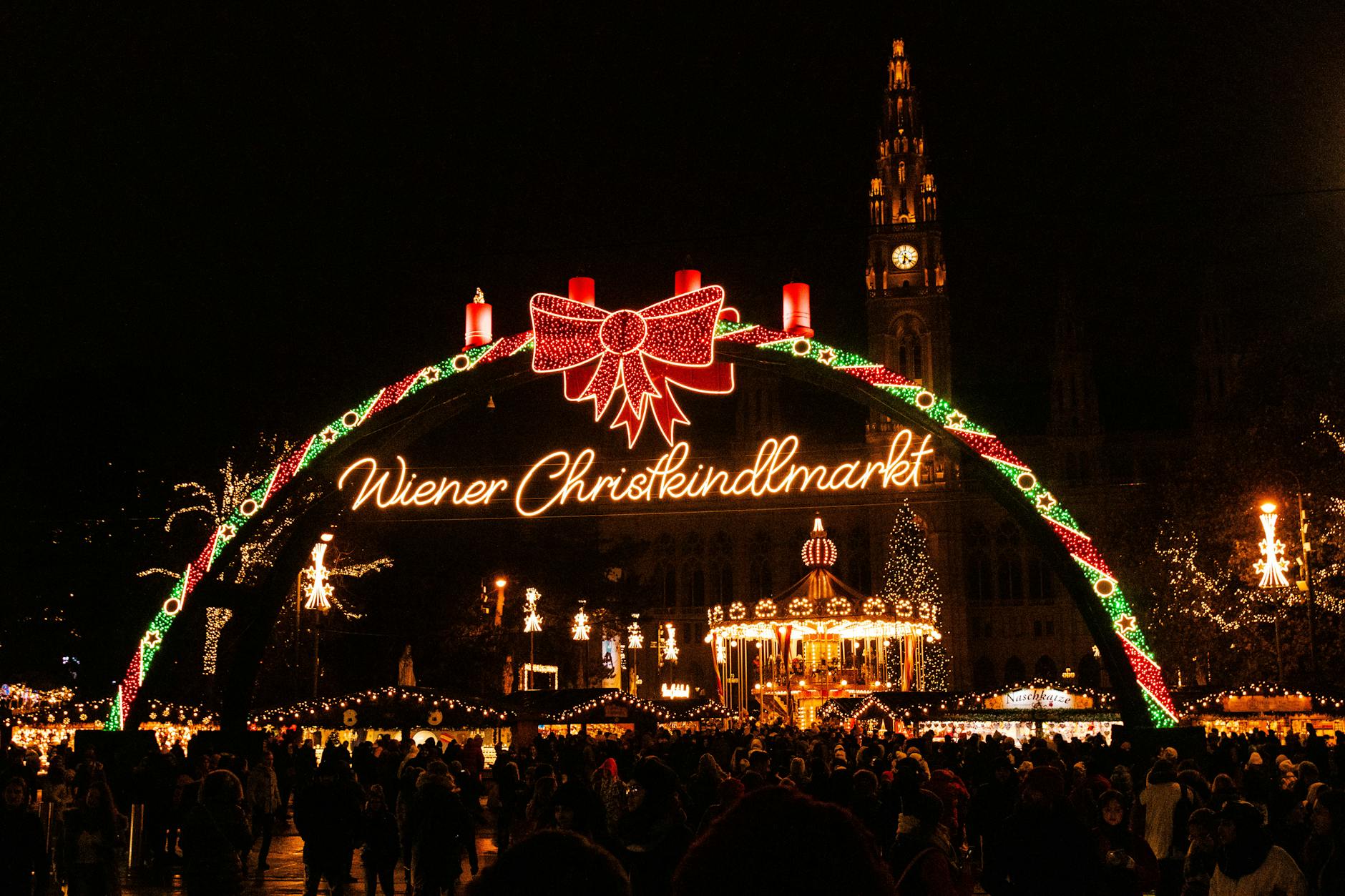
The Rathausplatz market is Vienna’s biggest with over 100 stalls and is listed alongside Cologne and Nuremberg among Europe’s largest Christmas markets. The setting is theatrical: thousands of Christmas lights, the illuminated Gothic-revival City Hall, an ice skating rink, a Ferris wheel, and a children’s Christmas train.
What makes Rathausplatz worth visiting:
Scale: Bigger than any other Vienna market by stall count.
Light spectacle: The “Heart Tree” with light installations changes annually and is iconic.
Ice skating rink: One of two Vienna Christmas markets to feature skating (Schoenbrunn is the other). 8-12 euros for skating including skate rental.
Children’s activities: Carousel, train, child-focused programming.
Drawbacks:
Crowds: Especially in evenings and on weekends, the market becomes nearly impassable.
Touristy stalls: Many vendors sell mass-produced ornaments rather than traditional crafts.
Lower-quality food: Most food is geared toward tourist tastes rather than traditional Austrian Christmas cuisine.
For a deep dive on this market, see our dedicated Rathausplatz Christmas market guide.
Spittelberg Christmas Market
Dates 2026: November 17 – December 23, 2026.
Hours: Monday-Thursday 14:00 – 21:30, Friday 14:00 – 22:00, Saturday-Sunday 10:00 – 21:30.
Location: Spittelberg cobblestone alleys (7th district). U3 Volkstheater or U2 Museumsquartier station.
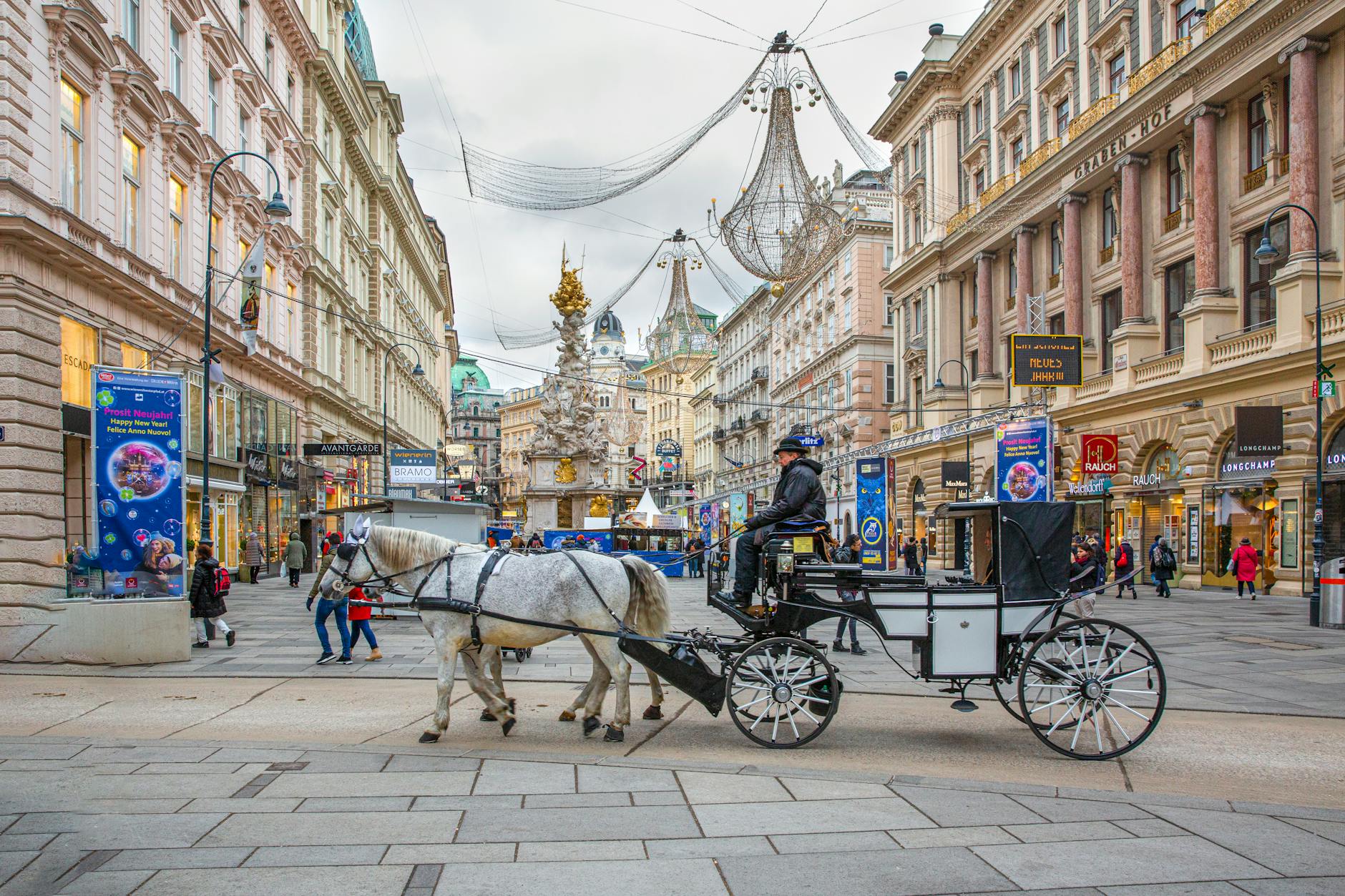
Spittelberg has long been the secret choice of Viennese locals who want a genuine Christmas market experience without the tourist crush. The market winds through cobblestone alleys of the historic Biedermeier-era 7th district, with stalls set among 18th-century townhouses, small galleries, and craft workshops.
What makes Spittelberg special:
Architecture: The 18th-century townhouses and narrow alleys are themselves part of the experience.
Quality crafts: Strong artisan focus with hand-made items not found at larger markets.
Local atmosphere: The market caters more to neighborhood Viennese than to tourist groups.
Mulled wine variety: Multiple producers offer different Glühwein recipes including local specialties.
Live music: Small bands and choirs perform in the alleys.
Spittelberg is typically the Vienna Christmas market we recommend first to repeat visitors who have seen Rathausplatz on a previous trip.
Karlsplatz Art Advent
Dates 2026: November 21 – December 23, 2026.
Hours: Daily 12:00 – 20:00.
Location: Karlsplatz in front of the Karlskirche. U1, U2, U4 to Karlsplatz.
The Karlsplatz Art Advent is a curated artisan market focused on serious crafts: handmade jewelry, ceramics, textiles, woodwork, and traditional Austrian folk art. The setting in front of the baroque Karlskirche is spectacular.
What makes Karlsplatz Art Advent worth visiting:
Curated quality: Vendors are selected for artisan quality rather than commercial appeal.
Compact size: About 70 stalls in a manageable area.
Setting: Karlskirche’s dome and the Resselpark surroundings.
Children’s area: Dedicated kids’ programming on weekends.
Less alcohol-driven: Family-friendly atmosphere.
Maria-Theresien-Platz Christmas Market
Dates 2026: November 17 – December 26, 2026.
Hours: Daily 11:00 – 21:00, Friday-Saturday until 22:00.
Location: Maria-Theresien-Platz between the Kunsthistorisches and Naturhistorisches Museums.
This market occupies the magnificent square between Vienna’s two great museums, with the Maria Theresa monument as centerpiece. About 70 stalls combine traditional crafts with quality food and drink.
The market is convenient for visitors combining Vienna attractions visits with Christmas market browsing. The setting is also one of Vienna’s most architecturally impressive.
Belvedere Christmas Market
Dates 2026: November 14 – December 23, 2026.
Hours: Monday-Thursday 11:00 – 21:00, Friday 11:00 – 21:30, Saturday-Sunday 10:00 – 21:00.
Location: Belvedere Palace courtyard (3rd district).
Smaller than Schoenbrunn but with the same palace-backdrop appeal. Less crowded than Schoenbrunn, more intimate, with about 40 stalls focused on quality crafts and gourmet food.
Freyung Old Viennese Christmas Market
Dates 2026: November 21 – December 23, 2026.
Hours: Sunday-Thursday 10:00 – 20:00, Friday-Saturday 10:00 – 21:00.
Location: Freyung Square (1st district).
The Freyung market claims to be the oldest Vienna Christmas market location, dating to 1772 (though documents suggest market activity here as early as 1296). The market emphasizes traditional crafts, glassware, ceramics, and folk art. Smaller in scale than Rathausplatz but more authentic in feel.
Am Hof Christmas Market
Dates 2026: November 14 – December 23, 2026.
Hours: Daily 11:00 – 21:00.
Location: Am Hof square (1st district).
The Am Hof market is a compact traditional market on one of Vienna’s most historic squares. About 50 stalls with focus on regional Austrian crafts and food. Good choice for visitors staying in the Innere Stadt.
Other notable Vienna Christmas markets
Stephansplatz Christmas Market: Convenient location next to the cathedral. About 40 stalls. Tourist-oriented.
Servitenviertel Christmas Market (Servitenkirche): Local 9th district market with low tourist count.
Wittgenstein Christmas Market (Kundmanngasse): Smaller and quirkier with arts-focused programming.
Heiligenstädter Hof Christmas Market: Small wine-village atmosphere in the 19th district.
Yppenplatz Christmas Market: Local 16th district market with Brunnenmarkt-style atmosphere.
Donauinselfest Eis (Danube Island Ice): Winter event with ice sculptures and skating.
What to eat at Vienna Christmas markets
Christmas market food is part of the experience. Standard offerings:
Glühwein (mulled wine): Hot spiced wine, 3.50-5 euros. Look for “Selbstgemacht” (homemade) signs.
Punsch: Hot punch with rum or fruit base, 4-6 euros.
Bratwurst: Grilled sausages with bread and mustard, 4-6 euros.
Käsekrainer: Cheese-filled sausage, distinctly Austrian, 5-7 euros.
Maroni: Roasted chestnuts in paper bags, 5-7 euros for a small bag.
Langos: Hungarian-style fried flatbread with garlic and cheese, 6-10 euros.
Kartoffelpuffer: Potato pancakes with apple sauce, 4-6 euros.
Lebkuchen: Spiced gingerbread in various forms, 2-8 euros.
Apfelstrudel: Hot apple strudel with vanilla sauce, 5-7 euros.
Glühwein and mug deposit system
Most Vienna Christmas markets charge a deposit (Pfand) on Glühwein mugs, typically 3-5 euros. You can:
Return the mug after drinking to get your deposit back.
Keep the mug as a souvenir (most markets have distinctive annual mug designs).
Many regular visitors keep their first mug of the season as a memento. The Rathausplatz, Schoenbrunn, and Belvedere mugs are particularly collectible.
What to buy at Vienna Christmas markets
Quality finds among the tourist trinkets:
Hand-blown glass ornaments: Particularly at Spittelberg and Karlsplatz Art Advent.
Hand-carved wooden ornaments: Traditional Austrian and German-style.
Beeswax candles: Local Austrian producers.
Hand-knitted woolens: Hats, mittens, scarves.
Traditional ceramics: Austrian and Bohemian designs.
Lebkuchen for home: Quality gingerbread to take home.
Schnaps and liqueurs: Austrian fruit brandies in small bottles.
Avoid: mass-produced “I love Vienna” trinkets, plastic souvenirs, and identical items found at every market (likely not handmade despite labels).
Timing your Christmas market visits
Late November to early December: Markets just opened, less crowded, full inventory.
Mid December: Peak crowds, busy weekends, more atmosphere.
Days before Christmas: Crowded but festive, last-minute shopping rush.
Best times of day: Weekday afternoons (less crowded than evenings). Weekends after 3 p.m. for the lit atmosphere with manageable crowds.
Worst times: Friday and Saturday evenings 6-10 p.m. Wall-to-wall people.
Christmas market practical tips
Bring cash: Smaller stalls may not accept cards. ATMs are limited around markets.
Dress warmly: Vienna in December averages 0-5 degrees C. Multiple layers, good gloves, hat.
Bring snow boots or waterproof shoes: Snow and slush is common.
Plan for walking: Most markets are 5-10 minutes between key locations.
Public restrooms: Most markets have them, often 0.50-1 euro.
Stroller-friendly: Rathausplatz, Schoenbrunn, and Maria-Theresien-Platz handle strollers well. Spittelberg’s cobblestones are difficult.
Day visit vs evening visit
Daytime visit: Fewer crowds, easier to browse stalls. Less atmospheric (lights not as impactful).
Evening visit: Magical lit atmosphere. More crowds. Best photography after 5 p.m. when dark.
For a complete day, visit 2-3 markets during daytime browsing, then return to the most atmospheric (Schoenbrunn, Rathausplatz, or Belvedere) after dark.
Sample Vienna Christmas market itinerary
Day 1: Big markets day. Morning Rathausplatz visit. Lunch nearby. Afternoon at Maria-Theresien-Platz and the museums. Evening return to Rathausplatz for lit-up photos.
Day 2: Quality markets day. Morning at Spittelberg for crafts. Lunch in the 7th district. Afternoon at Karlsplatz Art Advent. Evening at Schoenbrunn (book U-Bahn for return).
Day 3: Local markets day. Freyung old market and Am Hof in the morning. Lunch in 1st district. Belvedere market afternoon. Evening Glühwein at any neighborhood market.
Christmas market opening calendar 2026
Most Vienna Christmas markets open in November:
November 6: Schoenbrunn opens earliest.
November 14: Rathausplatz, Belvedere, Stephansplatz.
November 17: Spittelberg, Maria-Theresien-Platz, Am Hof.
November 21: Karlsplatz Art Advent, Freyung.
Most close December 23-26. Schoenbrunn has a post-Christmas New Year segment through January 6.
Christmas market mugs as souvenirs
Each Vienna Christmas market issues distinctive annual mugs for Gluhwein. Mugs are collectible:
Schoenbrunn mugs feature the palace silhouette.
Rathausplatz mugs feature the City Hall.
Spittelberg mugs are simpler, often artisan-made.
Karlsplatz Art Advent often releases artist-designed mugs.
Many Vienna regulars keep their first Gluhwein mug each year as a souvenir. The 4-5 euro deposit becomes the keepsake price.
Best photography spots at Vienna Christmas markets
Schoenbrunn: Center walkway with palace facade as backdrop at twilight.
Rathausplatz: The Heart Tree with the lit City Hall behind. Best at blue hour.
Spittelberg: Looking down narrow cobblestone alleys with hanging Christmas lights.
Karlskirche Art Advent: Karlskirche dome as backdrop.
Maria-Theresien-Platz: The Maria Theresa monument with twin museums framing the scene.
Vienna Christmas markets walking route
For maximum market exposure in one day, a walking route:
Morning: Start at Stephansplatz market (10 a.m.). Walk to Am Hof (15 min). Continue to Freyung (10 min).
Lunch: At one of the markets or in the Innere Stadt.
Afternoon: Walk to Spittelberg via the 7th district (15 min). Browse Spittelberg.
Late afternoon: U2 to Rathausplatz for the big market. Coffee or Gluhwein.
Evening: U-Bahn to Schoenbrunn for the imperial market at peak atmospheric hour.
This route covers 5-6 markets in one day. Plan U-Bahn connections to minimize walking distance.
Christmas market gift ideas
For shoppers wanting Christmas gifts:
Hand-knitted woolens for family and friends (35-80 euros).
Schnaps in attractive bottles (15-40 euros).
Beeswax candles in distinctive shapes.
Hand-painted Christmas tree ornaments (15-50 euros).
Lebkuchen and gingerbread to ship home.
Vienna-specific souvenirs: opera house figurines, Mozart memorabilia, Klimt-themed items.
Christmas markets photography session planning
For photographers wanting to capture multiple markets:
Morning: Schoenbrunn (palace facade with morning light).
Afternoon: Spittelberg (cobblestone alleys at golden hour).
Evening: Rathausplatz at blue hour (4:30-5:30 p.m. mid-December).
Late evening: Final Schoenbrunn or Belvedere for night atmosphere.
Christmas markets for budget travelers
Save money at Christmas markets by:
Eating one big meal before arriving (avoid impulse food purchases).
Sharing Gluhwein mugs to halve the deposit cost.
Visiting smaller neighborhood markets for lower prices.
Returning empty mugs for the deposit instead of keeping them.
Buying souvenirs at the Brunnenmarkt or Naschmarkt instead of tourist-focused Christmas market stalls.
Christmas market FAQ
When do Vienna Christmas markets open? Mid-to-late November. Schoenbrunn opens earliest in early November; most others by November 14-21.
When do they close? Most close by Christmas Eve (December 24). Schoenbrunn and Rathausplatz remain open through December 26.
Are markets open on Christmas Day? Most are closed on December 25 except Schoenbrunn (limited hours) and Rathausplatz.
How many markets should I visit? 3-5 is typical for first-time visitors. More is fine if you have time.
Is Vienna safe at Christmas markets? Yes. Standard pickpocket precautions apply in crowds.
Are the markets free to enter? Yes, all official Vienna Christmas markets are free to enter; you only pay for food, drinks, and goods.
Can I take kids? Yes, especially Schoenbrunn, Rathausplatz, and Karlsplatz which have kids’ programming.
Is the food good? Varies. Schoenbrunn and Spittelberg have the best food; Rathausplatz is more tourist-grade.
Vienna’s Christmas markets are a genuine highlight of any winter visit, blending tradition, food, drink, and atmosphere unlike any other capital. Whether you focus on the famous Rathausplatz spectacle, the imperial elegance of Schoenbrunn, the artisan quality of Spittelberg, or smaller neighborhood markets, you’ll find experiences that justify a December Vienna trip. Combine with our complete Vienna Christmas markets guide for full seasonal planning.
Closing Christmas markets summary
Vienna’s Christmas markets are among Europe’s most authentic and atmospheric. Whether you prioritize the imperial spectacle of Schönbrunn, the cobblestone charm of Spittelberg, or the massive scale of Rathausplatz, Vienna delivers one of the world’s premier holiday market experiences. Plan multiple market visits for the most complete experience.
One timing point is worth more than any ranking on this page: the markets are fully open from around 21 November, three weeks before the December crush arrives. Our guide to Vienna in November sets out exactly which market opens on which date, and why late November is the best fortnight all year to see them.
Knowing which market to visit is only half of it; knowing which day is the other half. Our guide to Vienna in December sets out the closure calendar around the 8th, the 24th and the 25th, and maps how the crowds build from a manageable first week to the shoulder-to-shoulder crush of the 12th to the 23rd.