Vienna Airport Terminals Explained: T1, T1A, T2 & T3
Which check-in hall your airline uses, what the gate letters B, C, D, F and G actually mean, where the Schengen line falls, and why Terminal 2 still appears on maps.

Photo by Anton Uniqueton
- The Structure in One Table
- Terminal 1 and Terminal 1A
- Terminal 3
- What Happened to Terminal 2?
- Gates, Piers and the Schengen Line
- Security, and How Long to Allow
- Arrivals: What Happens in Reverse
- Connecting Between Terminals
- The 2027 Rebuild
- What Is Where: Food, Shops and Facilities by Terminal
- Practical Orientation
- A Short History of the Numbering
- If You Are at the Wrong Terminal
- What to Check Before You Travel
- The Honest Verdict
- Frequently Asked Questions
- Related Vienna Guides
- Photo Credits
This article contains advertising. Our booking links are routed through a partner that adds commission tracking automatically, so if you book through one we earn a commission from the provider, at no extra cost to you. It never affects what we recommend. Affiliate disclosure
The most useful thing anybody can tell you about Vienna airport terminals is that the terminal number on your boarding pass and the gate letter on the departure board are two completely separate systems, and neither predicts the other. Schwechat is not four separate buildings the way Heathrow or Charles de Gaulle are. It is one connected structure with several check-in halls at one end and five gate concourses at the other, and once you are through security the terminal you checked in at stops mattering entirely.
That single fact resolves about ninety per cent of the confusion visitors have here. This guide sets out which check-in areas are in use, which airlines use which, what the gate letters mean and where the Schengen boundary falls, why Terminal 2 appears on old maps and nothing else, and what the construction work currently under way will change in 2027. Details were checked in September 2026 against the airport’s own information.
The Structure in One Table
| Check-in area | In use? | Who uses it |
|---|---|---|
| Terminal 1 | Yes | Low-cost and charter — Eurowings, Ryanair and others |
| Terminal 1A | Yes | Extension of Terminal 1, same carriers |
| Terminal 2 | No | Not in passenger check-in use |
| Terminal 3 | Yes | Austrian Airlines, Star Alliance, most full-service carriers |
| Gate concourse | Zone | Pier |
|---|---|---|
| Gates B | Schengen | Pier West |
| Gates C | Schengen | Pier West |
| Gates D | Non-Schengen | Pier East |
| Gates F | Schengen | Pier North, lower level |
| Gates G | Non-Schengen | Pier North, upper level |
Read those two tables as separate things, because they are. You check in at a numbered terminal and you depart from a lettered gate, and the mapping between them depends on your destination, not on your airline.
Terminal 1 and Terminal 1A
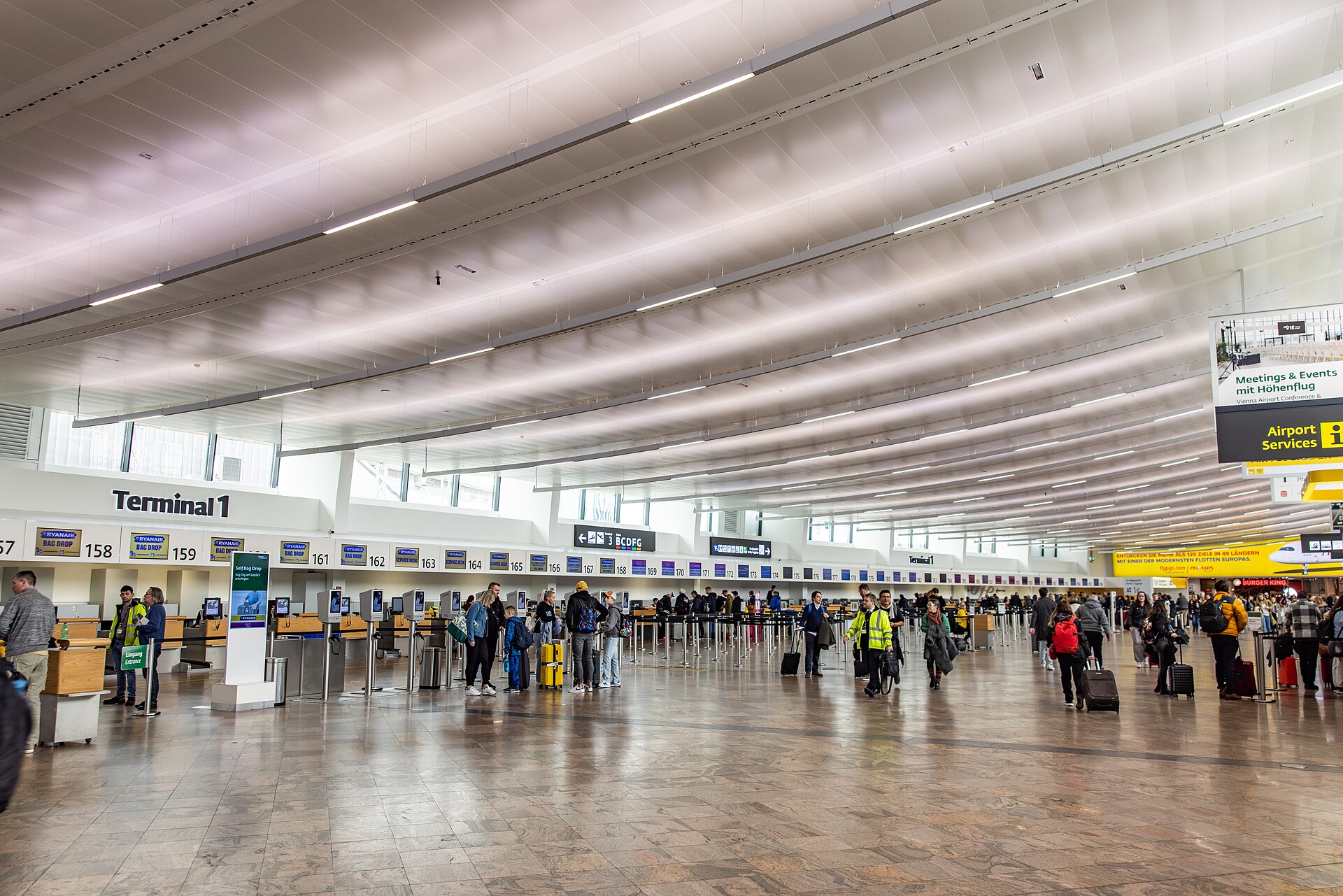
Terminal 1 is the low-cost and charter end of the building. Eurowings and Ryanair check in here, as did Wizz Air until it closed its Vienna base in March 2026 — a change covered in our guide to cheap flights to Vienna, and one that has visibly thinned the desks.
Terminal 1A is not a separate terminal in any meaningful sense; it is an extension of Terminal 1 serving the same sort of traffic. If your boarding pass says 1A, you are going to the same part of the building as everyone else with a 1 on theirs, just a little further along.
The character of this end is plainer than Terminal 3: fewer sit-down restaurants, more self-service kiosks and bag drops, a busier and more chaotic feel at the peak morning wave. The VIENNA Lounge is the Terminal 1 lounge and admits paying passengers, which is worth knowing if you have a long wait at this end.
Terminal 3
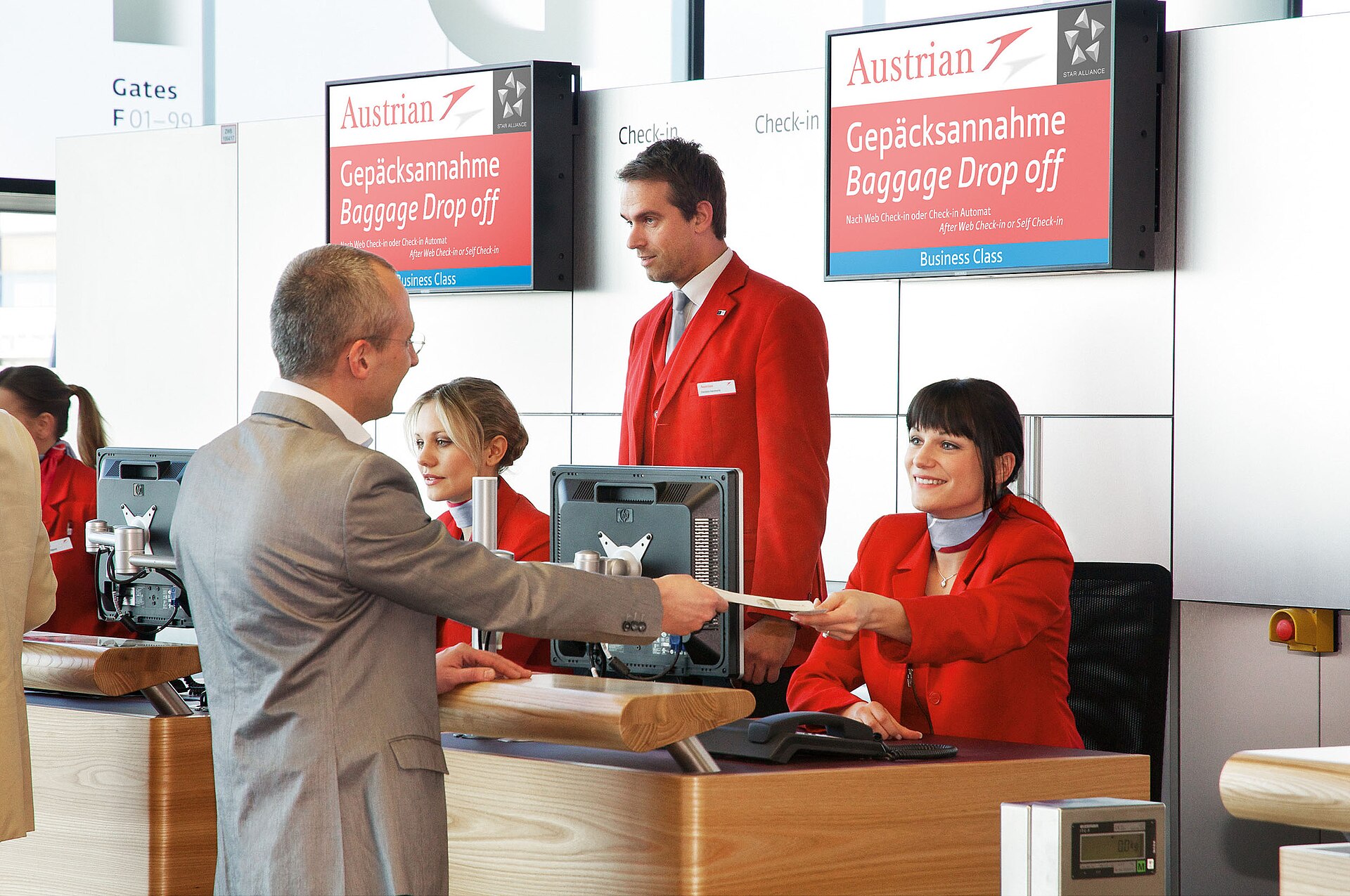
The main terminal, and the newest of the check-in halls. Austrian Airlines and most of its Star Alliance partners check in here, along with the long-haul carriers that serve Vienna from outside the alliance — Emirates, Qatar Airways, Korean Air, El Al and Royal Jordanian among them.
It is a lighter, calmer building than Terminal 1, with a curved upper gallery, a decent spread of food and shopping landside, and the SKY Lounge airside. If you have a choice about where to spend a wait — and landside you generally do, because the halls connect — Terminal 3 is the more pleasant end.
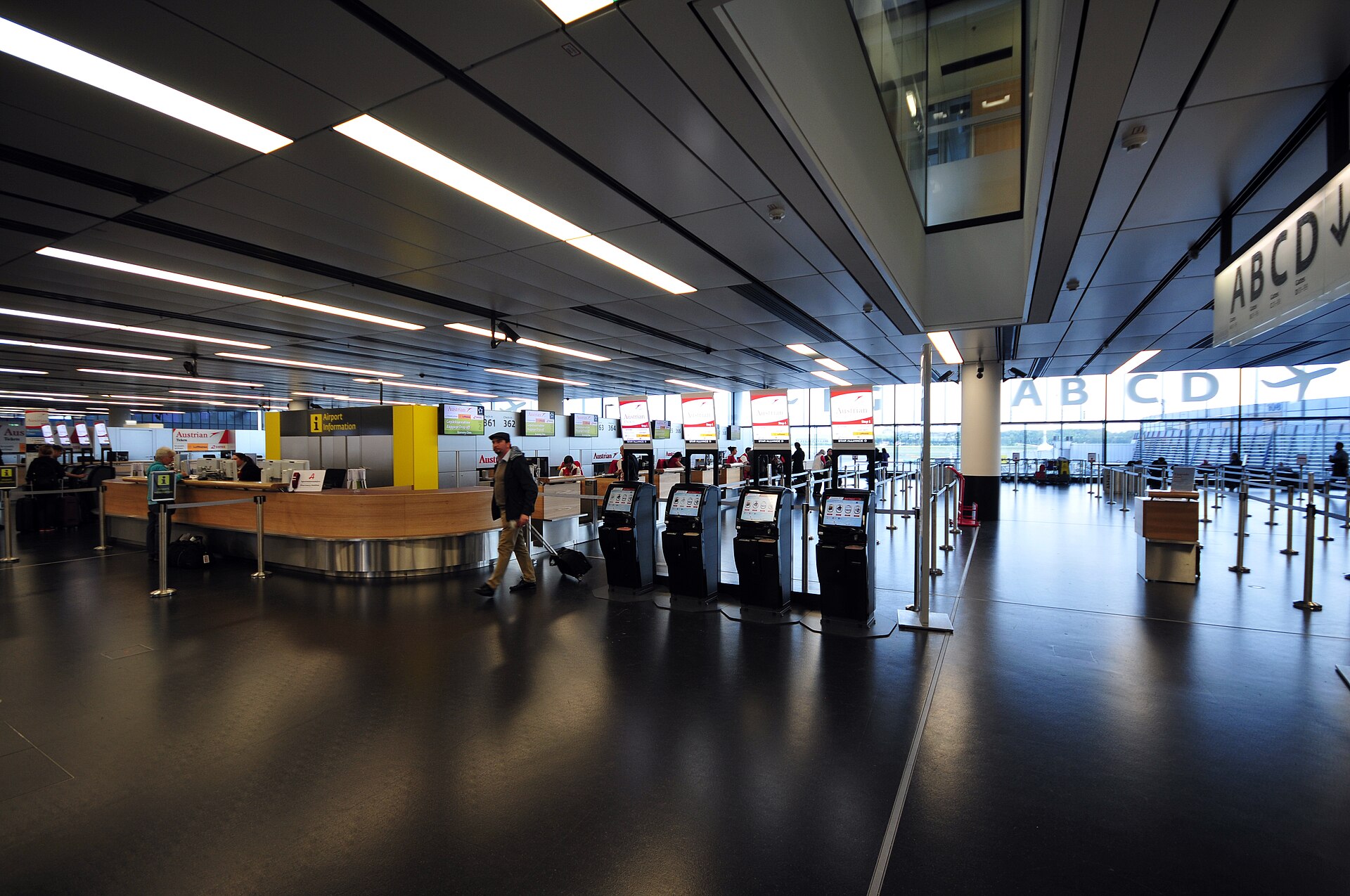
Desk numbering is the quickest way to orient yourself: Terminal 1’s counters run in the low hundreds and Terminal 3’s in the three hundreds. If your bag drop is 362, you are looking for Terminal 3, whatever the signage above your head currently says.
What Happened to Terminal 2?
Terminal 2 exists as a structure and is not in passenger check-in use. It appears on older terminal maps, in older guidebooks, and occasionally on legacy signage inside the building, which causes a steady trickle of confused passengers looking for a check-in hall that has not handled them for years.
If a booking confirmation, a taxi driver or an old blog post directs you to Terminal 2, ignore it and go to Terminal 1 or Terminal 3 as your boarding pass says. There is nothing at Terminal 2 for you.
Gates, Piers and the Schengen Line
This is the part that actually determines your walk, and it has nothing to do with your check-in terminal.
Vienna has five gate concourses: B, C, D, F and G. Concourses B, C and F are in the Schengen zone — B and C on Pier West, F on the lower level of Pier North. Concourses D and G are non-Schengen — D on Pier East, G on the upper level of Pier North. The long northern pier is split horizontally, which is why an F gate and a G gate can sit almost on top of each other and still be a passport check apart.
So the rule is simple, once you know it:
- Flying to another Schengen country? Your gate will be a B, C or F. No passport control on departure.
- Flying outside Schengen — the UK, the US, Turkey, the Gulf, Asia? Your gate will be a D or a G, and you pass passport control to reach it.
Note that this is about Schengen, not the EU. A flight to Dublin is an EU flight and a non-Schengen one; Ireland is not in the Schengen area, and you will clear passport control. A flight to Zurich is the reverse: Switzerland is not in the EU but is in Schengen, and there is no passport check.
How long is the walk?
Longer than the compact terminal maps suggest, particularly to the far end of Pier North. Allow twenty minutes from security to a G gate at a walking pace, and more if you are not moving quickly or have children with you. The airport’s screens give walking times and they are honest; use them rather than eyeballing the map.
Bus gates are the other thing to watch for. Vienna uses remote stands, and a bus gate means an additional ten to fifteen minutes between leaving the gate lounge and boarding the aircraft. The gate number will tell you, and the boarding time on your pass already accounts for it — but the walk to the gate does not.
Security, and How Long to Allow
Vienna runs its security checkpoints at the entrance to the airside area rather than per-gate, and the queue is the single most variable part of a departure here. Two patterns are worth knowing.
The morning wave, roughly 05:30 to 08:00, is when the short-haul departures cluster and the Terminal 1 checkpoint in particular can back up badly. If you are on an early Ryanair or Eurowings departure, the two hours the airline recommends is not padding, and ninety minutes is genuinely tight. The late-afternoon long-haul wave produces a second, gentler peak at Terminal 3.
FastTrack is sold by the airport and included with some premium tickets and lounge memberships. It buys you a separate lane at the checkpoint and nothing else. On a quiet Tuesday it is money wasted; at 06:30 in August it can be the difference between a relaxed coffee and a run to the gate.
Standard EU liquid rules apply for now — 100 ml containers in a single transparent bag — and will continue to until the CT scanners arrive with the new centralised checkpoint. Do not assume the newer rules you may have met at another European airport apply here yet.
Passport control on the way out
If you are flying non-Schengen you pass passport control after security, on the way to the D or G gates. EU, EEA and Swiss passports use the automated eGates where eligible; everyone else queues for a booth. Third-country nationals should also expect biometric registration under the EU’s entry-exit system, which adds time on a first crossing and less thereafter.
Practically, that means a UK, US, Australian or Canadian passenger flying home from Vienna should treat the non-Schengen departure as needing meaningfully more time than a Schengen one. Two hours, not ninety minutes.
Arrivals: What Happens in Reverse
Arriving is simpler than departing and follows the same logic backwards. A Schengen arrival walks off the aircraft, down through the pier, and straight to baggage reclaim with no checks at all — you can be outside the building fifteen minutes after the doors open if you have hand baggage only. A non-Schengen arrival clears passport control first, which at the busiest times means a queue of half an hour or more.
Baggage reclaim is a single area serving the whole airport rather than one per terminal, which is why your reclaim belt bears no relationship to the terminal you departed from at the other end. Check the screens.
Customs is the usual green and red channel arrangement. Austria applies the standard EU allowances, and the thing most likely to catch a visitor out is not alcohol or tobacco but food — meat and dairy products from outside the EU are prohibited, and this is enforced.
Connecting Between Terminals
The good news for anyone with a tight connection: the terminals are connected, and a transfer at Vienna does not involve leaving the building or taking a shuttle.
What can involve a longer walk is a change of Schengen status. A connection from a Schengen arrival to a non-Schengen departure — or the reverse — means passing through passport control between the two zones, and that is where connection time goes. A Schengen-to-Schengen or non-Schengen-to-non-Schengen connection is usually straightforward.
If your onward flight is with a different airline on a separate ticket, none of the above helps you: you will collect your bag, come landside, and check in again from scratch. Budget three hours for that, not one, and see our guide to the Vienna airport layover for the full arithmetic.
The 2027 Rebuild
A substantial terminal annex has been under construction since February 2024, with completion expected in early 2027. It adds:
- 18 new bus gates, which should reduce the remote-stand shuffling that currently affects a lot of short-haul departures.
- A new centralised security checkpoint with CT scanner technology — the kind that lets you leave liquids and laptops in your bag.
- Direct airside walking connections between the F, G, C and D gate areas, which is the significant one. At present the Schengen and non-Schengen sides are more separate than they need to be, and joining them will shorten a lot of connections.
Until then, expect hoardings, diverted walkways and occasional signage that contradicts itself. This is a live building site inside a working airport, and the practical advice is to allow more time than you would at an airport of Vienna’s size normally requires.
What Is Where: Food, Shops and Facilities by Terminal
The two ends of the building are not equivalent, and if you have a choice about where to wait, it is worth knowing which is better provisioned.
Landside
Terminal 3’s landside area has the better spread — a proper supermarket, several cafés, a bank of seating with daylight, and the airport information desk. Terminal 1 landside is functional: bakery counters, a fast-food unit or two, and rather less room to sit. Because the halls connect on foot, there is nothing stopping you checking in at Terminal 1 and then walking to Terminal 3 to wait, and on a long wait that is what we would do.
The other landside point worth knowing: the shops at the station level beneath the terminals include a supermarket with ordinary city prices rather than airport ones. If you want water, snacks or a sandwich at a sane price before a flight, buy them down there on your way up.
Airside
- Duty-free is concentrated in the main airside plaza that all the piers lead off, so you pass it regardless of which gate you are heading for. Austrian wine and spirits are genuinely competitively priced if you are leaving the EU; the Sachertorte in a box costs noticeably more here than in the city.
- Food airside ranges from bakery chains selling a Kaisersemmel and a coffee at a fair price to sit-down restaurants at airport rates. The bakery counters are the better value by a wide margin.
- Lounges: the SKY Lounge serves Terminal 3, the VIENNA Lounge serves Terminal 1, and both sell entry to economy passengers.
- Wifi is free and works throughout the building.
- Showers are available in the lounges rather than as a standalone facility, which is the main practical reason to buy lounge access on a long connection.
- Prayer rooms, baby-changing and family areas exist airside; the signage for them is better than at many European airports.
What Vienna does not have is a proper quiet zone or rest area, which is the airport’s most obvious gap and the reason our layover guide pushes anyone with an overnight gap towards a lounge or a bed rather than a bench.
Practical Orientation
Arriving by road
The forecourt is signed by terminal number, and drop-off at the wrong end means a walk with luggage along the front of the building — not a disaster, but five to ten minutes you did not plan. Know your terminal before you get in the car. Our guide to Vienna airport parking covers which car park serves which terminal, and note that Car Park 3 serves Terminal 1 and 1A while Car Park 4 serves Terminal 3.

Arriving by rail
The station sits directly beneath the terminal complex and you come up into the middle of it, from where both check-in ends are signed and walkable. This is the least error-prone way to arrive, since there is no wrong side to be dropped at. The transfer guide covers what is running while the inner-city S-Bahn works continue.
Arrivals and meeting people
Arrivals halls are separate from departures and the baggage reclaim you emerge into depends on where your aircraft parked rather than on which terminal your airline uses. If you are meeting somebody, agree a landside meeting point in advance — the information desk, or a named café — rather than “arrivals”, which is not one place.
A Short History of the Numbering
The reason Vienna’s terminal numbers do not run 1, 2, 3 in any sensible order is that they were never planned as a set. The airport grew by accretion around a 1950s core, with new halls added and old ones repurposed as traffic outgrew them, and the numbers were assigned as each opened rather than as part of any scheme.
Terminal 3 — the newest and largest of the check-in halls — opened in 2012 after a long and famously troubled construction. That is why it feels like a different generation of building from Terminal 1, and why the two ends of the airport have such different characters despite being the same airport.
Terminal 2 belonged to an earlier era of the airport’s growth and was superseded rather than replaced, which is how it comes to exist as a structure that no longer checks anybody in. Its persistence on maps and in old signage is simply institutional inertia; nobody has had a strong reason to renumber everything, and renumbering would confuse a great many more people than the current arrangement does.
The 2027 annex will not change the numbering either. It adds capacity and connections rather than a new numbered terminal, so a traveller returning to Vienna in 2028 will find the same 1, 1A and 3 they left, joined up rather better behind security.
If You Are at the Wrong Terminal
It happens, and at Vienna it is among the least serious versions of this mistake you can make anywhere.
Because the halls are part of one building and connect landside on foot, walking from Terminal 1 to Terminal 3 takes a few minutes along a signed internal route — no shuttle, no exiting into the weather, no transfer bus schedule to catch. Compare that with the twenty-minute inter-terminal train ride some airports impose and the scale of the error becomes clear.
What is worth avoiding is being dropped at the wrong end by car or taxi, since the forecourt is long and the walk outside with luggage is less pleasant than the walk inside. Tell the driver the terminal number, not the airline.
And if you have already gone through security at the wrong end — which is rare, since one checkpoint serves the airside area — the answer is the same as everywhere: talk to staff rather than trying to solve it yourself.
What to Check Before You Travel
- Your terminal, from your boarding pass or the airline’s app, not from a general guide. Airlines do move between check-in areas.
- Your desk number, which tells you the terminal even when the terminal is not stated: 100s and 200s are Terminal 1, 300s are Terminal 3.
- Whether your destination is in Schengen, which tells you whether to expect passport control and roughly which pier you are heading for.
- The walking time to your gate, from the screens after security rather than from the map.
- Whether it is a bus gate, which adds ten to fifteen minutes at the far end.
The Honest Verdict
Vienna is an easy airport once you stop thinking of it as several airports. There is one building. You check in at one end of it, you clear one security queue, and you walk to a lettered gate whose letter is determined by whether your destination is inside the Schengen area. Terminal 2 is a ghost on old maps and Terminal 1A is a corridor with a name.
The two things worth actually planning around are the walk to Pier North, which is longer than it looks, and the construction, which will improve the place considerably in 2027 and makes it slightly more awkward until then. Everything else is signage you can follow when you get there. For the rest of what the airport offers — lounges, food, left luggage, transfers — our complete Vienna Airport guide covers it.
Frequently Asked Questions
How many terminals does Vienna Airport have?
Three check-in areas are in use: Terminal 1, Terminal 1A and Terminal 3. Terminal 2 exists as a structure but is not in passenger check-in use. They are all part of one connected building, so moving between them does not require a shuttle.
Which terminal does Austrian Airlines use at Vienna?
Terminal 3, along with most Star Alliance partners and the other full-service long-haul carriers serving Vienna, including Emirates, Qatar Airways, Korean Air, El Al and Royal Jordanian.
Which terminal does Ryanair use at Vienna?
Terminal 1, together with Eurowings and the other low-cost and charter operators. Terminal 1A is an extension of the same hall serving the same carriers.
What do the gate letters mean at Vienna Airport?
Gates B, C and F are in the Schengen zone: B and C on Pier West, F on the lower level of Pier North. Gates D and G are non-Schengen: D on Pier East, G on the upper level of Pier North. Your gate letter is decided by your destination, not by the terminal you checked in at.
Is Terminal 2 at Vienna Airport still open?
Not for passenger check-in. It appears on older maps and some legacy signage, which confuses arriving passengers. If a booking or a taxi driver directs you there, go to Terminal 1 or Terminal 3 as your boarding pass specifies.
Are Vienna Airport terminals connected?
Yes. It is a single building and you can walk between the check-in areas landside. Connections airside are also on foot, though a change between the Schengen and non-Schengen zones means passing through passport control, which is where connection time is spent.
How long is the walk to the gate at Vienna Airport?
Up to about twenty minutes from security to the far end of Pier North (Gates F and G). Gates B, C and D are generally closer. Use the walking times on the airport screens rather than estimating from a map, and add ten to fifteen minutes for a bus gate.
What is being built at Vienna Airport?
A terminal annex begun in February 2024 and due for completion in early 2027, adding 18 bus gates, a centralised security checkpoint with CT scanners, and direct airside walking connections between the F, G, C and D gate areas. Expect diversions and extra walking until it opens.
The gate split also decides which lounges you can use. The two lounges that take Priority Pass and walk-in guests are both on the Schengen side before passport control, so a passenger heading for a D or G gate has to leave them in good time to cross. Our guide to Vienna airport lounges works through the options gate by gate.
Related Vienna Guides
- Vienna Airport: The Complete Guide
- Vienna Airport Layover: 3, 6 or 10 Hours
- Vienna Airport Parking
- Vienna Airport to the City Centre
- Cheap Flights to Vienna
- Hotels Near Vienna Airport
- Getting Around Vienna
- First-Time Vienna Tips
Photo Credits
Terminal 3 check-in hall with gate signage: 13-05-24-wien-RalfR-275 by Ralf Roletschek, CC BY 3.0, via Wikimedia Commons.
Austrian Airlines baggage drop-off at Terminal 3: Check-In Terminal 3 – 9523667724 by Austrian Airlines, CC BY-SA 2.0, via Wikimedia Commons.